
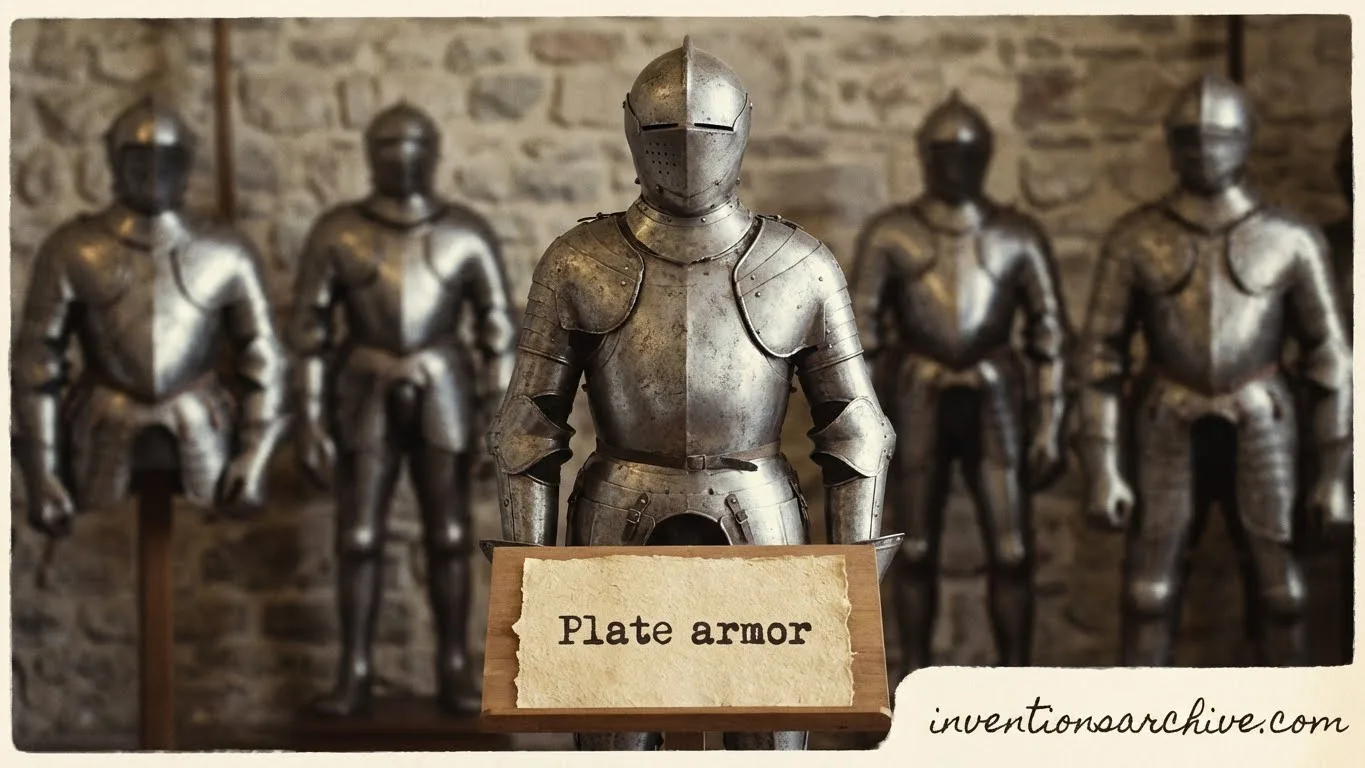
| Invention Name | Plate Armor (Plate Armour) |
|---|---|
| Short Definition | Articulated metal plates forming a close-fitting protective shell |
| Approximate Date / Period | Late 13th–17th c.; peak 15th–16th Approximate |
| Geography | Western Europe; later wider adoption in adapted forms |
| Inventor / Source Culture | Anonymous / collective; specialist armourers’ workshops |
| Category | Materials; Protective Equipment; Wearable Engineering |
| Importance |
|
| Need / Driver | More coverage than mail, without losing movement |
| How It Works | Rigid plates + overlapping lames + rivets/straps |
| Material / Technology Base | Forged iron/steel; heat control; riveting; leather/textile supports |
| Early Use Context | Elite protective wear; tournaments; formal and ceremonial display |
| Spread Route | Italian and German centers → wider European markets |
| Derived Developments | Precision metalworking; modular wearable systems; fitted shells |
| Impact Areas | Craft; art; materials science; museum conservation |
| Debates / Different Views | Exact “first full harness” varies by region Approximate |
| Precursors + Successors | Mail → coat-of-plates → full harness → partial plate + mixed defenses |
| Key Centers | Milan; Innsbruck; Augsburg; Nuremberg |
| Influential Variants | Gothic; Milanese; Maximilian; three-quarter; half-armor |
Plate armor is a landmark in wearable protection: a system of shaped metal plates that cover the body while still allowing complex movement. It is not a single object but a modular suite—many parts, each designed to meet a specific curve of the human frame, and each connected so the whole set moves like one. When people say “a suit of armor,” they often picture the mature form of full plate, built as a fitted shell rather than a loose layer.
Contents
What Plate Armor Is
In practical terms, plate armor is a collection of shaped plates that sit over the torso, limbs, and joints, forming a layered shell. The best-known form is the full harness, where many parts work together: a cuirass for the torso, articulated defenses for the arms and legs, and a system of smaller plates at the joints.
A key idea is fit. Plate armor is not “one size fits all.” Each plate follows anatomy—ribcage, hips, shoulder line, and knee bend—so the set acts like a structured garment. When the shaping is right, the wearer feels supported, not trapped.
Core Idea
Rigid plates protect broad areas, while articulation preserves movement at the shoulders, elbows, hips, knees, and ankles.
Core Method
Overlaps, rivets, straps, and sliding connections let plates shift slightly while still keeping continuous coverage.
Core Result
A wearable shell that balances protection, mobility, and the body’s natural range of motion.
Early Evidence and Timeline
Plate armor did not appear overnight. It grew from reinforcement: adding plates to earlier defenses, testing different shapes, and refining how plates could be attached without turning the body into a rigid statue. In European material culture, the fourteenth century is often described as an experimental phase in which mail was reinforced by plates and other materials, a path that led toward complete plate suits later on.Details
By the early fifteenth century, the mature concept was clear: full plate could enclose almost the entire body using steel plates connected by rivets and straps. One scholarly summary notes that by about 1420 the development of full plate armor as an articulated system was complete, after which styles and regional preferences became increasingly visible in the surfaces and outlines.Details
Timeline Markers
- Late 1200s–1300s: plates appear as reinforcements in mixed systems; coverage expands in steps.
- 1400s: fully articulated harnesses become standardized in elite contexts; regional styles become clearer.
- 1500s: plate armor evolves into many specialized sets, from field-ready to ceremonial.
- 1600s and later: partial plate and mixed systems continue; full coverage becomes less common outside specific traditions.
How Plate Armor Works
The engineering logic of plate armor is simple and powerful: shape and structure do most of the work. A curved plate is stronger than a flat one. A ridge or flute stiffens a surface without adding much weight. Overlaps keep gaps from opening when the body bends.
Plate armor also behaves like a system, not a stack. The torso pieces carry a large share of the load, while limb defenses are designed to “hang” and move in controlled arcs. This is why many suits rely on overlapping plates held together by sliding rivets—a method that preserves coverage while allowing motion across the joints.Details
Deflection
Angles and curves encourage impacts to glance rather than concentrate. The plate’s geometry is a silent tool.
Distribution
Rigid shells spread force over a wider area, reducing peak stress on any single point.
Articulation
Hinges, lames, and rivets create planned mobility where the body must bend, while keeping edges overlapped.
Why Overlaps Matter
- Coverage stays continuous as the body bends and twists.
- Edges are less likely to catch, because plates slide over one another.
- The suit can be tuned: rivet placement and strap routing shape how it moves.
Materials and Technology Base
Most classic plate armor is made from iron or steel. The choice of metal, and the way it is treated, changes the final behavior of the plate—how it resists dents, how it springs back, and how it responds at edges and joints. Even without modern instruments, historical workshops understood practical metallurgy through experience and repeatable methods.
Related articles: Pocket Watch [Renaissance Inventions Series], Chainmail [Ancient Inventions Series]
Modern research adds clarity without harming the objects. Museum conservators use non-destructive study to examine composition and internal structure, including metallography and neutron diffraction to understand steel phases and manufacturing choices.Details That work helps separate original surfaces from later repairs and supports more responsible preservation.
| Element | What It Contributes | What You Often See |
|---|---|---|
| Steel Plate | Strength with formable shape | Curves, ridges, rolled edges |
| Rivets | Controlled movement at joins | Rows of rivet heads, sometimes decorative |
| Leather Straps | Flexible connections and closure | Buckles, internal suspension points |
| Textile Layers | Comfort, spacing, support | Arming garments, padding under plates |
| Surface Finishes | Protection and appearance | Polish, blackened finishes, gilding details |
Parts and Coverage Map
A full harness can look overwhelming, yet it breaks down into repeatable parts. Each area of the body gets a plate solution shaped for that region’s motion. The naming can vary by language and workshop tradition, but the functional map stays fairly consistent.
| Body Area | Common Plate Elements | Movement Challenge |
|---|---|---|
| Torso | Cuirass (breastplate + backplate), fauld, tassets | Breathing, bending at the waist |
| Neck and Shoulders | Gorget, pauldron, besagew (in some sets) | Arm lift and head turn |
| Arms | Rerebrace, couter, vambrace, gauntlet | Elbow articulation and wrist flex |
| Legs | Cuisses, poleyns, greaves | Knee bend and stride length |
| Feet | Sabatons (often segmented) | Toe flex while walking |
| Head | Helmets of many forms; visors on some designs | Vision, ventilation, balance |
Plate Armor as a Wearable System
- Plates do not float alone; they rely on internal support and suspension.
- Edges are often shaped and turned to reduce snagging and add stiffness.
- Joint areas use smaller plates because big plates would restrict range.
Types and Variations
“Plate armor” covers many designs. Some are nearly complete shells. Others mix plates with textile structures. The differences often come down to coverage, intended activity, and local workshop style—not a single linear “upgrade” path.
By Coverage
- Full Harness: near-total coverage; many articulated parts.
- Three-Quarter: strong torso and arms; less coverage below the knee.
- Half-Armor: emphasizes torso and key limb areas; modular approach.
- Cuirass-Only: breastplate and backplate as a focused protective core.
By Construction
- Large Plate Systems: fewer, bigger plates with shaped curves.
- Laminate Systems: rows of smaller lames for controlled flex.
- Plate-Within-Textile: plates fixed between layers; the metal is hidden but functional.
- Mixed Defenses: plate combined with mail or hardened materials in specific zones.
European workshop styles also shaped the silhouette. Some favored clean, rounded surfaces; others used bold ridges and dense fluting. A museum view of Renaissance armor emphasizes that plates must be closely fitted so they act like a human exoskeleton, and that this technical demand pushes armor into a space where sculpture and engineering meet.Details
Style Names You May See
- Gothic: sharper lines, strong vertical emphasis, crisp edges.
- Milanese: smoother, rounder volumes; a solid look.
- Maximilian: dense fluting and ridges that add stiffness and visual rhythm.
Outside Europe, “plate” ideas appear in many forms: lamellar constructions, mirror-plate torsos, and segmented defenses that pursue the same goal—coverage with mobility. The details differ, yet the shared theme is clear: shaped plates and smart joins create wearable structure.
Craft and Decoration and Identity
Plate armor is often remembered for its shine, but its deeper signature is craft. A plate can be raised, sunk, ridged, fluted, etched, or gilded. These processes are not mere surface play. They can add stiffness, protect edges, and define how light moves across the form.
Decoration also carried meaning. A harness could signal rank, workshop identity, or ceremonial purpose. Even when richly embellished, the design still had to respect movement. That tension—between beauty and function—explains why the most admired suits feel both artistic and engineered.
Surface Techniques
- Fluting: parallel grooves that add rigidity and strong visual rhythm.
- Etching: controlled patterns on the surface; often paired with darkened backgrounds.
- Gilding: bright highlights used with restraint to avoid overwhelming the plate.
- Rolled Edges: a functional detail that also reads as a clean finish.
Design Priorities
- Joint clearance: space for bends without exposing key lines.
- Weight balance: torso carries load; limbs stay responsive.
- Modularity: pieces can be swapped, upgraded, or tuned for specific contexts.
- Maintenance access: straps and internal points designed for repair over time.
Conservation and Modern Research
Today, plate armor lives largely in museums, private collections, and careful study spaces. Conservation focuses on stability: controlling corrosion, preserving original surfaces, and documenting every change. The goal is not to make armor look “new,” but to keep it authentic and readable.
Scientific methods can reveal what the eye cannot. Non-destructive techniques allow experts to study internal structure, identify different steels, and recognize later restorations. When that knowledge is paired with curatorial records, plate armor becomes a high-resolution archive of materials choices and workshop practice.
What Researchers Often Look For
- Tool marks that show how a plate was shaped and finished.
- Rivet patterns that reveal articulation choices and later repairs.
- Edge treatments that signal both strength and workshop habits.
- Microstructure evidence that suggests heat control and steel selection.
FAQ
Is plate armor the same as a “full suit of armor”?
Plate armor is the broader category. A “full suit” usually means a full harness with extensive articulated coverage, built from many plates working as a system.
Why does plate armor use so many small plates at joints?
Joints need controlled flex. Smaller plates and lames can overlap while bending, keeping coverage without locking the limb.
What is a cuirass in plate armor terms?
A cuirass is the torso core: breastplate and backplate. It anchors the system and often supports attached waist and hip defenses.
How can museums study plate armor without damaging it?
Many studies use non-destructive approaches, including imaging and material analysis that can reveal structure and composition while keeping surfaces intact.
Why do some plate armors have flutes and ridges?
Flutes can add stiffness and help manage shape across large surfaces. They also create a distinct visual language tied to workshop style.