
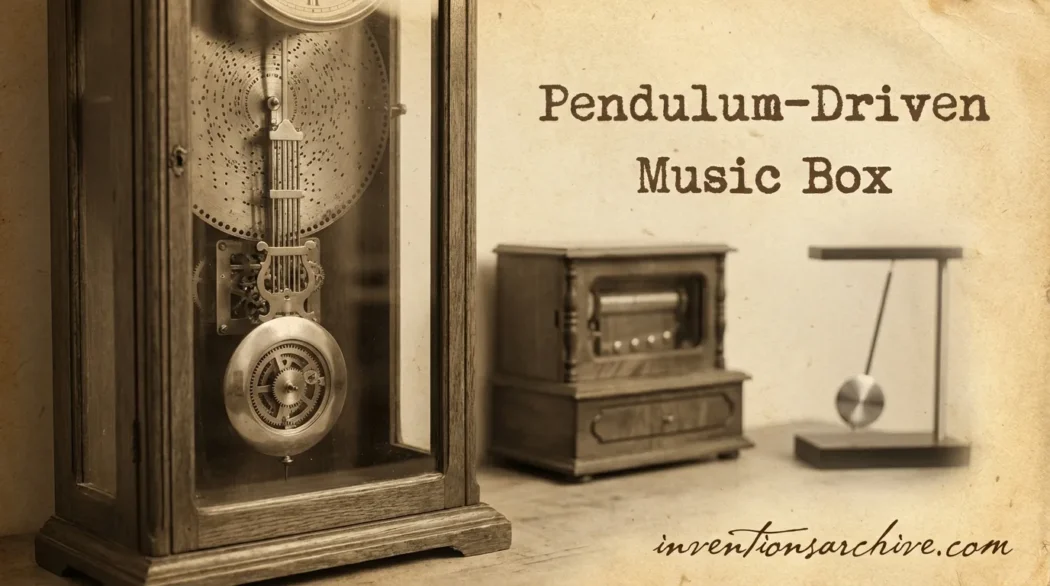
| Invention Name | Pendulum-Driven Music Box (Clock-Integrated Musical Box) |
|---|---|
| Short Definition | Programmable mechanical music played from a clockwork train regulated by a pendulum |
| Approximate Date / Era | c. 1796–early 19th century (Approximate) |
| Geography | Geneva; Swiss Jura; Central and Western Europe |
| Inventor / Source Culture | Anonymous / collective clockmakers; early comb-and-cylinder tradition linked to Antoine Favre (Approximate) |
| Category | Mechanical music; horology; domestic entertainment |
| Importance |
|
| Need / Reason It Emerged | Reliable home music without musicians; timed musical signaling |
| How It Works (Simple) | Pins or slots trigger a tuned metal comb; clockwork meters motion; pendulum regulates release |
| Material / Technology Basis | Hardened steel comb; pinned cylinder or stamped disc; gear train; governor; escapement |
| Early Use Context | Clocks, watches, snuff boxes, sewing boxes; later stand-alone cases |
| Spread Route | Swiss workshops → European luxury trades → middle-class domestic interiors |
| Derived Developments | Disc music boxes; automaton music boxes; standardized musical movements in objects |
| Impact Areas | Craft; education; domestic life; collecting; museum conservation |
| Debates / Different Views | “Pendulum-driven” often means “pendulum-regulated” rather than powered by the pendulum |
| Precursors + Successors | Musical clocks with bells → comb-and-cylinder movements → disc systems → recorded sound devices |
| Key Cultures / Workshops | Swiss watchmaking centers; Geneva-area makers; later German makers |
| Variants Influenced | Musical mantel clocks; longcase musical clocks; automaton boxes; novelty pendulum melody clocks |
A pendulum-driven music box lives where timekeeping meets programmed sound. It is not only a music mechanism placed beside a clock; in the classic form, the clock’s regulated motion becomes the “pace-setter” for the musical train, so the melody arrives with the same calm regularity as the hands on the dial. The charm is practical, too: repeatable mechanical performance, measured in gears, not guesswork.
Table Of Contents
Use these jump links to move through the main topics.
What It Is
The phrase pendulum-driven is used in collecting and describing musical clocks, yet the meaning is usually pendulum-regulated. In many historic mechanisms, the pendulum does not supply the stored energy. It controls the timing of release, so the gears move in steady steps and the music stays even. That steady pulse is the heart of mechanical reliability.
The Core Idea In One Sentence
A pendulum-driven music box is a programmed melody mechanism whose motion is governed by the same kind of regulated train that makes a pendulum clock keep time, so music can be triggered and paced with clock-like steadiness and a clear, repeatable tempo without electronic control.
What Makes It A Music Box
- Sound source: a tuned metal comb (a line of “teeth”)
- Program: pins on a rotating cylinder or features on a disc
- Actuation: each pin lifts and releases a tooth to make a note
What Makes The Pendulum Relevant
- Metered motion through an escapement
- Stable pacing across a full play cycle
- Timed triggering (hourly, on demand, or by a switching train)
Origins And Early Use
The technology that makes a pendulum-driven music box possible did not appear all at once. It grew out of fine clockmaking, where small tolerances and predictable motion were already a discipline. Early comb-based mechanisms were often housed inside familiar objects, including clocks, before many became stand-alone instruments in their own cases.
| Period | What Changed | Why It Matters For Pendulum-Driven Designs |
|---|---|---|
| 1796 | Antoine Favre registered an early “carillon without hammers and bells” concept associated with the start of the musical box tradition (Details-1) | Clockmakers already understood regulated trains, so musical mechanisms could be paired with pendulum-controlled motion |
| Late 18th–Early 19th Century | Comb-and-cylinder mechanisms appeared in objects such as clocks and watches before becoming widely recognized as separate instruments | “Music with time” became a design language: a melody could be scheduled, repeated, and paced with care |
| 19th Century | Movements scaled up in volume and complexity, sometimes adding extra sound sources (bells, small drums, reeds) | Pendulum regulation helped keep longer performances steady, even as mechanisms became more ambitious |
Why Clocks Show Up So Early
Museum Wilhelmsbau notes that the metal comb as a sound source was invented circa 1796 and that the first movements with metal comb were used in clocks (Details-2).
How It Makes Music
At the center is a program and a translator. The program is physical: pins on a cylinder, bumps on a disc, or folds in a paper “book” system. The translator is the tuned comb. Each note happens when a pin lifts a tooth and lets it snap back, creating a bright, stable pitch. The case and basework add body to that sound.
| Component | Role In The Sound | Why Pendulum Timing Helps |
|---|---|---|
| Comb (Tuned Teeth) | Produces pitches; each tooth is one note | Even pacing avoids rushed notes and uneven phrasing |
| Pinned Cylinder / Disc | Stores the melody as a sequence of triggers | Stable rotation keeps note spacing consistent |
| Governor (Fly) | Prevents runaway speed in many music trains | Pendulum-regulated trains can reduce drift and help predictable tempo |
| Stop/Start Work | Ends a tune at the right point; selects a tune | Clock logic can trigger a play cycle cleanly (for example on the hour) |
A concrete museum record shows how specific these movements can be: a small cylinder music box documented by the National Museum of American History lists two tunes and a one-piece comb with 50 teeth, driven by a key-wound spring in a compact format (Details-3).
How The Pendulum Connects
Think of the pendulum as the metronome of the machine, not the battery. In classical pendulum clocks, stored energy (a weight or a spring) wants to unwind continuously. The escapement prevents a free spin and releases motion in steps, while also giving the pendulum tiny impulses so it keeps swinging. That stepping action is exactly the kind of controlled motion that musical trains can borrow, share, or synchronize with without turning music into a blur of gears.
A Museum-Grade View Of The Escapement Moment
Museo Galileo describes a pendulum-clock model where a pallet releases the escapement wheel, then the wheel meets another pallet and provides the impulse needed to keep the pendulum moving; release and impulse happen at the end of each oscillation in rapid succession as a repeating cycle (Details-4).
Three Common Ways Music Meets The Pendulum Train
- Shared regulation: the musical mechanism is paced by a pendulum-controlled release, so the tune stays steady.
- Timed triggering: the clockwork switches the music on at set moments, then stops it cleanly at the end of a program.
- Coupled gearing: the time train and music train stay aligned through carefully chosen gear ratios and levers.
This is why “pendulum-driven” can be a helpful label and a misleading one at the same time. The most accurate reading is pendulum-governed playback: the pendulum makes the machine patient, while the stored energy does the heavy lifting behind the scenes inside the plates.
Types And Variations
Once you look closely, “pendulum-driven music box” turns into a family. The differences are not only about size. They are about what gets programmed, when the music is triggered, and how the sound is projected into a room without amplification.
Musical Pendulum Clocks With Bells
These are “music box cousins” rather than comb boxes. The tune is programmed, yet it is played on bells or chimes. The pendulum train provides timed release, the melody is expressed through struck sound, and the design often centers on scheduled performance.
Clocks With Comb-And-Cylinder Movements
This is the most direct match to the phrase. A clock houses a comb-based movement, and the clockwork helps govern its pace. The experience is intimate: bright steel notes, a gentle mechanical whir, and a tune that arrives like a ritual at predictable times.
Disc Systems And Larger Repertoires
Disc music boxes change the “program carrier” from a cylinder to a stamped disc. That shift makes repertoire management easier because discs can be swapped. The core musical logic stays familiar: mechanical triggers address tuned teeth, and regulation keeps the rotation musical rather than chaotic to the ear.
Automaton Music Boxes And Animated Scenes
Some objects add moving figures to music. The mechanism becomes a small theatre: the music train drives motion as well as sound. The Victoria and Albert Museum highlights clockwork automata boxes as machines that follow pre-determined instructions, combining decoration and mechanism into a single performance in use as a delight object (Details-5).
Hybrid “Musical Movement” Objects
Factories also produced self-contained musical movements meant to be installed into other items. Some were modest; others were surprisingly refined. In pendulum-associated contexts, the key question becomes how the host object controls the start and stop: by a lever, a switching cam, or a time-based trigger. The best examples feel inevitable when they play, as if the tune always belonged to that clock in that case.
Materials And Craft
The sound is born in steel, yet the craft is broader. A convincing pendulum-driven music box depends on material choices, surface finish, and how well every moving part respects friction. Even the case matters, because it shapes how the comb’s vibration is heard in the room as tone.
Sound-Making Parts
- Comb: hardened steel teeth, each tuned to pitch
- Cylinder/Disc: brass or steel carrier that stores the note pattern
- Mounting block: transfers vibration into the case
Time-Control Parts
- Train: gears that carry stored energy forward
- Escapement: step-by-step release for stable motion
- Pendulum: the oscillator that governs the rhythm of release
When the comb is well made, you hear clean attack and a long, even decay. When it is not, notes can sound thin or short. Makers historically improved tuning by minute adjustments to tooth mass and stiffness, a process that demanded trained judgment and repeatable measuring habits over time.
Where You Find Them Today
Today, pendulum-driven music box designs are easiest to meet in museum collections, private collections, and carefully conserved interiors. They are studied as objects of engineering and culture: how sound was “stored” before recording, how families marked time at home, and how precision craft turned motion into music without electricity for generations.
How Museums Describe Their Value
- Evidence of precision craft: small parts, reliable timing, repeatable playback
- Sound history: programmed melody as a physical artifact
- Design history: cases, ornament, and mechanical aesthetics in one object
In modern life, the pendulum is often used as a visual symbol of calm timing. Mechanical pendulum-driven music boxes keep that symbolism honest: the rhythm you see is the rhythm the machine obeys. That is why the best examples feel alive but never frantic, precise but not cold in sound.
FAQ
Is the pendulum the power source in a pendulum-driven music box?
Usually, no. The pendulum is best understood as a regulator. Stored energy (weight or spring) supplies motion, and the pendulum-and-escapement system meters that motion in controlled steps. The result is steady pacing that keeps the melody coherent from start to finish.
How is it different from a musical clock?
A musical clock may play on bells or chimes, while a music box classically plays with a tuned metal comb. Many pendulum-associated designs blend the two traditions. The most useful distinction is the sound source: struck bells versus plucked comb teeth in a programmed sequence.
What determines the length of a tune?
In cylinder systems, the tune length is constrained by the cylinder’s usable surface and the density of pins. Disc systems allow different pieces by swapping discs, yet each disc still has a finite circumference. In all cases, the mechanism is a physical memory, not an infinite library like digital storage today.
Why do some designs sound louder than others?
Volume depends on comb strength, tooth geometry, how firmly the comb is mounted, and how the case projects vibration. A well-coupled case can make the sound feel present even at low mechanical energy, while a poorly coupled one can feel thin and short-lived.
What parts tend to be the most sensitive over time?
Small bearing points, delicate teeth, and the interfaces where pins lift teeth are all precision areas. In pendulum-associated designs, the escapement and suspension components also matter because they govern the system’s timing. The whole object rewards gentle handling, because tiny alignments shape both tempo and tone at once.