
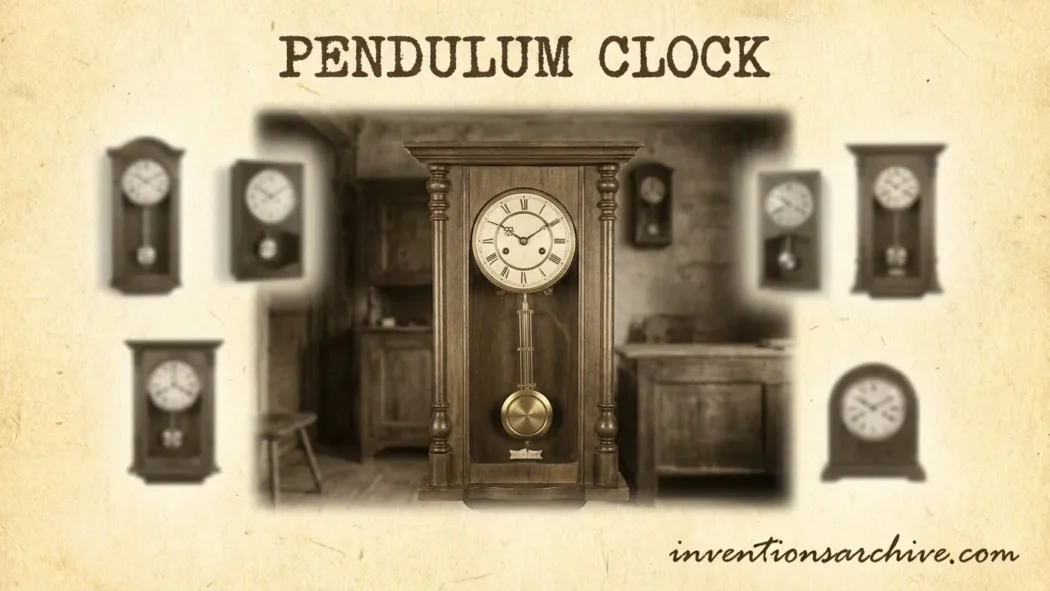
| Invention Name | Pendulum Clock |
|---|---|
| Short Definition | Mechanical clock regulated by a swinging pendulum. |
| Approximate Date / Period | 1656–1657 Certain |
| Geography | Dutch Republic (Netherlands); later across Europe |
| Inventor / Source Culture | Christiaan Huygens (concept); early makers include Salomon Coster |
| Category | Timekeeping; scientific instruments; mechanical engineering |
| Importance |
|
| Need / Reason It Emerged | More stable time for astronomy, navigation planning, and coordinated work |
| How It Works | Pendulum sets the tick rate; escapement meters gear motion |
| Material / Technology Basis | Gears; escapement; pendulum rod & bob; weight or spring drive |
| First Main Uses | Domestic clocks; observatories; workshops; public time displays |
| Spread Route | Netherlands → England & France → wider Europe |
| Derived Developments | Regulator clocks; refined escapements; compensation pendulums |
| Impact Areas | Science; education; industry; commerce; navigation planning |
| Debates / Different Views | Concept roots linked to Galileo; “first” builds vary by maker and date |
| Precursors + Successors | Verge-and-foliot clocks → pendulum clocks → quartz and atomic standards |
| Key People / Centers | Huygens; Clement; Graham; Harrison; major clockmaking hubs in Europe |
| Notable Variants Influenced | Longcase clocks; wall regulators; mantel clocks; precision observatory clocks |
Pendulum clocks turned time from a rough estimate into something measurable, repeatable, and shared. A steady swing became the heart of a mechanical rhythm, and that rhythm shaped everything from home life to laboratory work. Even today, the pendulum clock remains a clear lesson in how careful design can make motion behave.
Table of Contents
What A Pendulum Clock Is
A pendulum clock is a mechanical clock whose timekeeping comes from the regular swing of a pendulum. That swing does not “push” the hands directly. Instead, it controls an internal gate called an escapement. The escapement allows the gears to advance in small, even steps, so the clock moves forward at a stable pace.
The big change was predictability. Earlier mechanical clocks could drift because their regulating parts were sensitive to friction and changes in driving force. A well-made pendulum system makes the beat more consistent, so minutes and seconds stop behaving like guesswork and start behaving like measurement.
What “Pendulum” Really Means Here
- Regulator: the pendulum sets the tempo of the clock’s motion.
- Metering: the escapement releases gear teeth in timed steps.
- Energy flow: weights or springs provide power, but the pendulum controls when that power is delivered.
Early Evidence and Timeline
The pendulum clock is strongly tied to 1656–1657, when Christiaan Huygens produced the first practical design. Early performance was already striking: error could be under one minute per day, later refined to under ten seconds per day in improved versions. A key step was the anchor escapement, which reduced interference with the pendulum’s motion, and later work added temperature compensation for even steadier timing.Details
| Period | What Changed | Why It Mattered |
|---|---|---|
| Late 1500s–Early 1600s | Pendulum motion studied as a repeating swing | Foundation for a stable time regulator |
| 1656–1657 | First practical pendulum clock design | Precision jump for mechanical clocks |
| 1670s | Long pendulums and improved escapements spread | Better seconds display and steadier beat |
| Early 1700s | Compensation ideas for temperature effects | Reduced drift as environments changed |
People and Credit in Plain Terms
In the story of the pendulum clock, two ideas travel together: the concept of regulating a clock with a pendulum, and the successful build that works day after day. Huygens is closely linked to the practical breakthrough, and surviving scholarly records also highlight how he relied on accurate time for scientific work while developing pendulum-based timekeeping.Details
The Cycloid Detour That Improved Accuracy
A pendulum is nearly isochronous, yet its timing can shift when the swing becomes wide. Huygens explored a clever fix: guiding the pendulum so its bob follows a cycloidal path, which can make the period less sensitive to swing size. This is a classic example of geometry serving precision in clockmaking.Details
How A Pendulum Clock Works
One steady swing sets the beat. The escapement releases the gear train in measured steps. Power comes from a weight or a spring, yet the pendulum decides the pace, creating that familiar tick-tock.
Escapement and The Beat
The escapement is the clock’s gatekeeper. Each swing lets the escape wheel move a small amount, then locks again. That lock-and-release pattern is why the hands advance smoothly in steps, not in a blur. A longer pendulum often yields a calmer, more stable motion, which is one reason longcase designs became closely tied to reliable seconds and improved escapements.Details
Power Sources
Weight-Driven
- Gravity provides steady pull.
- Often paired with longcase clocks.
- Smooth torque supports stable timing.
Spring-Driven
- Mainspring stores energy compactly.
- Common in wall and mantel clocks.
- Extra gearing manages changing spring force.
Main Parts and Materials
A pendulum clock looks calm on the outside, yet inside it is a disciplined system of materials chosen for strength, low wear, and predictable motion. The best designs treat friction and expansion as real forces, not afterthoughts. That mindset is why precision clocks often feel engineered, not merely decorated.
Related articles: Pendulum-Driven Music Box [Renaissance Inventions Series], Pendulum Regulator [Renaissance Inventions Series]
Regulating System
- Pendulum rod (wood, steel, or low-expansion alloys)
- Bob (often dense metal for stable inertia)
- Suspension spring or flexure supporting the swing
Motion and Display
- Escapement (anchor, deadbeat, and more)
- Gear train (going train, sometimes striking train)
- Hands and dial work translating internal steps into readable time
Accuracy and What Affects It
The accuracy of a pendulum clock is not a single trick. It is the sum of many small choices that keep the pendulum’s swing regular. When those choices align, the clock becomes a dependable instrument. When they drift, the clock still works, yet it loses its role as a reference.
Temperature, Air, and Friction
- Temperature can lengthen or shorten the pendulum rod, shifting the beat.
- Air density and drag can slightly change swing behavior.
- Friction at pivots and escapement surfaces can add irregularity.
Seconds Pendulum
A famous target is the seconds-beating pendulum, where the clock advances once per second in a steady rhythm. In many classic longcase designs, that meant a long pendulum paired with an escapement optimized for small, controlled swings. The result is not only better timekeeping, but also a clear and readable seconds display on the dial.
Types and Variations
“Pendulum clock” is a family name. The core idea stays the same, yet cases, pendulum lengths, and escapements shift to fit different spaces and goals. Some designs focus on home use, others on precision, and some on sheer mechanical elegance. All remain grounded in the same timing principle.
| Type | Typical Pendulum | Common Strength | Where Seen |
|---|---|---|---|
| Longcase (Grandfather) | Long; often seconds-beating | Stable beat | Homes; halls; historic interiors |
| Wall Clock | Medium | Space-efficient | Homes; schools; offices |
| Mantel Clock | Short | Compact form | Shelves; mantels |
| Regulator | Optimized for precision | Reference time | Workshops; observatory-style settings |
| Turret / Tower | Varies; robust | Visibility | Public buildings |
Escapement Families
The escapement is the clock’s character. Some emphasize durability, others prioritize low interference with the pendulum. One especially admired route is low friction designs. A noted example is the grasshopper escapement seen in Harrison-related longcase work, often paired with a temperature-compensated gridiron pendulum in precision-focused builds.Details
Pendulum Designs
- Simple pendulum: straightforward rod and bob, common in domestic clocks.
- Seconds pendulum: long swing tuned for clear seconds measurement.
- Compensated pendulum: structure designed to resist temperature-driven length change.
- Refined bobs: shapes chosen to reduce air effects while maintaining stable inertia.
Where It Shaped Daily Life
Once the pendulum clock became reliable, time stopped being only personal. It became shared. That shift sounds subtle, yet it changed how people coordinated work, kept records, and built trust in schedules. A clock that holds its beat becomes a quiet form of infrastructure.
Homes and Communities
- Routine built around dependable hours.
- Public time became easier to coordinate.
- Craft pride turned clocks into valued objects.
Science and Measurement
- Repeatable timing supported careful observation.
- Seconds became practical to record and compare.
- Precision culture grew around stable instruments.
Work and Coordination
- Scheduling became more consistent across places.
- Records gained more precise timestamps.
- Quality control improved when timing was stable.
Frequently Asked Questions
Who invented the pendulum clock?
The first practical pendulum clock is closely associated with Christiaan Huygens in the mid-1650s, with early successful builds appearing soon after.
Why did pendulum clocks improve accuracy so much?
A pendulum provides a regular oscillation that can control the gear train through an escapement. That separation between “power” and “timing” made mechanical clocks far more stable.
What is a seconds-beating pendulum?
It is a pendulum chosen so the clock’s beat tracks seconds in a clear rhythm, often paired with a long pendulum and an escapement designed for controlled swings.
What makes a pendulum clock drift?
Common causes include temperature changing the pendulum’s effective length, friction in the movement, and small changes in the way the escapement interacts with the pendulum.
Are pendulum clocks still used for precision today?
For everyday reference, modern electronic standards dominate. Yet well-made pendulum regulators remain valued as precision mechanical instruments and as clear demonstrations of classic timekeeping physics.