
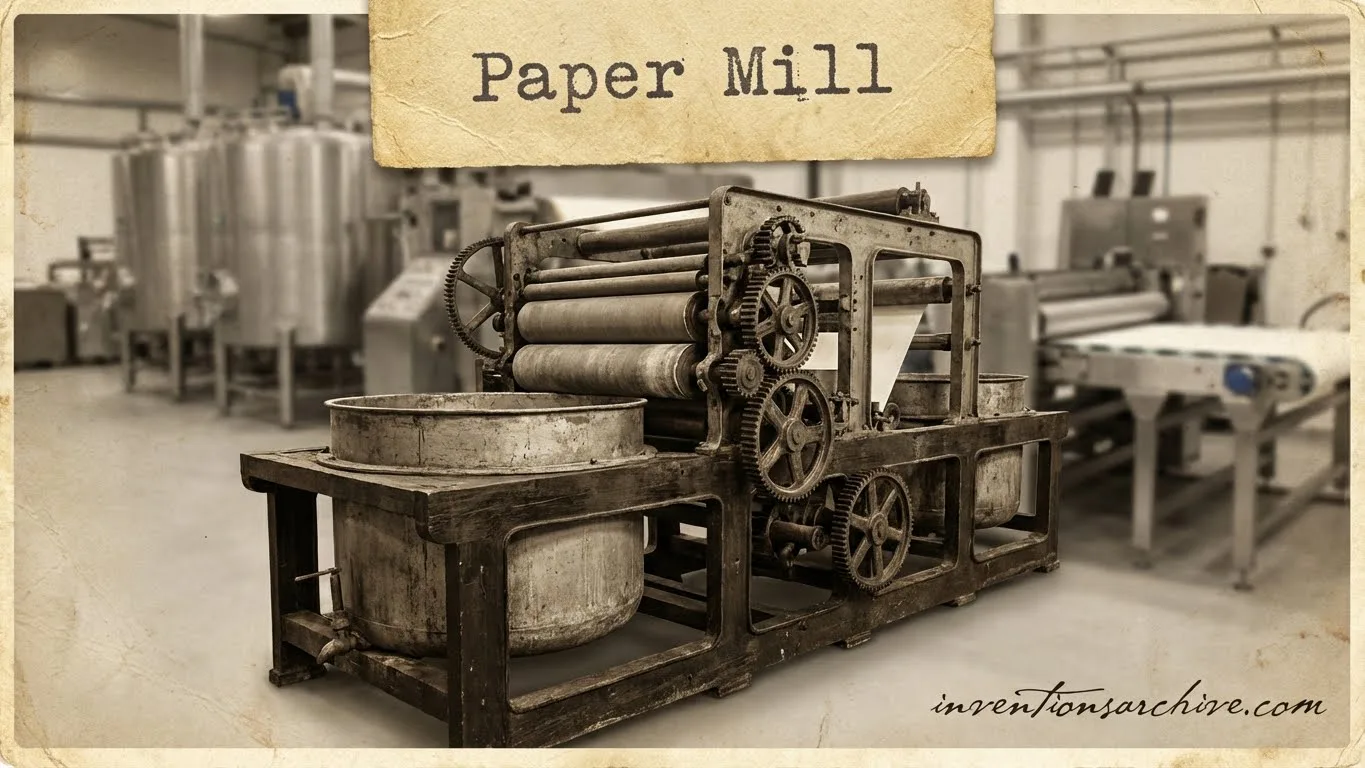
| Invention Name | Paper Mill (Europe) |
| Short Definition | Water-powered (later mechanized) site for turning fiber into paper sheets |
| Approximate Date / Period | 12th–19th centuries Approximate |
| Geography | Iberian Peninsula → Italy → wider Europe |
| Inventor / Source Culture | Anonymous / collective craft networks; adapted mill technology |
| Category | Manufacturing, communication materials |
| Importance |
|
| Need / Driver | Affordable records, books, trade paperwork |
| How It Works | Water drives stampers/beaters → pulp → mould → press → dry |
| Material / Tech Basis | Rags, clean water, wooden/metal mould, gelatin sizing, waterpower |
| First Common Uses | Manuscripts, ledgers, letters, early printing |
| Spread Route | Iberia → Italy → France/Germany → Low Countries/England |
| Derived Developments | Watermarks, rag engines, continuous-sheet machines |
| Impact Areas | Education, arts, science, commerce |
| Debates / Different Views | “First” sites and dates vary by records |
| Precursors + Successors | Parchment/papyrus → rag paper → machine-made rolls |
| Key Regions / Centers | Xàtiva, Fabriano, Low Countries, Britain |
| Influenced Variants | Laid papers, mould-made papers, Fourdrinier papers |
Paper mills changed how Europe stored knowledge, shared ideas, and kept reliable records. A mill did more than “make paper.” It linked water power, skilled hands, and careful finishing into a repeatable system that could supply towns, schools, workshops, and printers with sheets that looked consistent and behaved well with ink.
Table Of Contents
What A Paper Mill Is
A paper mill is a purpose-built workplace where fiber becomes paper through a controlled chain of steps: pulp preparation, sheet forming, pressing, drying, and finishing. In much of Europe, early mills used waterwheels to power heavy machinery that reduced rags to pulp. This let papermakers scale output while keeping texture and thickness predictable.
Useful distinction: “Papermaking” can happen anywhere a vat and mould exist. A mill adds power, infrastructure, and repeatable routines that support steady production.
Why Mills Mattered In Europe
Before paper became common, many European documents relied on parchment, which was durable but costly. Paper mills made a different promise: more sheets, faster, with surfaces that could take ink cleanly. That steady supply helped expand book culture, everyday accounting, and workshop knowledge that needed written reference.
- Supply reliability: mills standardized batches and routines.
- Material efficiency: rags could be gathered, sorted, and reused as fiber.
- Workflow gains: water power handled punishing labor that was hard to scale by hand.
Early European Evidence
Records are uneven, and “first” claims depend on what survives. Still, sources often point to the Iberian Peninsula and central Italy as early anchors for European papermilling. A commonly cited milestone is the introduction of a water-powered stamping mill for pulping fiber in Spain in 1151 ApproximateDetails.
A Simple Timeline
- 12th century: early documented milling activity in Iberia; water power becomes central for pulping.
- 13th century: Italian centers refine mill practice and paper quality; trade spreads techniques.
- 14th–15th centuries: mills appear across more regions; papers diversify by purpose and finish.
- 17th–18th centuries: new beating machines accelerate pulp prep in many mills.
- 19th century: continuous-sheet machines shift production toward industrial scale.
How A Traditional Mill Worked
Think of a classic European paper mill as two connected systems: a power line and a paper line. The power line converted moving water into motion. The paper line turned cleaned fiber into sheets, then finished those sheets so they accepted ink and aged well.
Power System
- Millrace or channel to guide water.
- Waterwheel to turn steady flow into rotation.
- Gears and cams to lift and drop stampers, or drive later beaters.
Paper Rooms
- Rag room: sorting and cutting fiber sources.
- Beating area: rags reduced to pulp.
- Vat room: sheets formed on moulds.
- Press and drying loft: water removed and sheets dried.
From Rag To Sheet
- Sorting: linen, hemp, or cotton rags separated by grade and color.
- Cutting: rags reduced to smaller pieces for even processing.
- Softening: soaking (and in some places fermentation) prepared fibers for beating.
- Pulping: stampers or beaters turned fiber into a workable slurry.
- Forming: a mould and deckle lifted a thin layer of pulp from the vat.
- Couching: the wet sheet transferred to felts in a stack.
- Pressing: pressure removed water and tightened the sheet structure.
- Drying: sheets dried in lofts with steady airflow.
- Finishing: sizing and smoothing created a stable writing surface.
Key Technologies and Materials
European paper mills were material-smart. They relied on what was available in bulk, and they tuned each step so the sheet handled ink well. Clean water mattered, but so did fiber selection, beating style, and finishing chemistry. In the Fabriano tradition, sources highlight improvements such as water-powered multi-headed stampers, gelatin sizing, and watermarks that helped identify makersDetails.
Fibers
Linen and hemp rags were valued because they formed strong sheets with good longevity. Cotton could also appear, depending on region and trade. The goal stayed the same: a fiber network that dried into a cohesive web.
Sizing and Surface
Sizing reduced absorbency so ink lines stayed crisp. Gelatin sizing, often linked to Italian high-quality papers, gave a smoother feel and improved resistance to feathering, helping sheets behave predictably for writing and print.
Small Glossary
- Mould: the screened frame that shapes a wet sheet.
- Deckle: the top frame that defines sheet edges.
- Couching: transferring a wet sheet from mould to felt.
- Watermark: a design formed in the sheet during making, visible in transmitted light.
Types and Variations
“Paper mill” covers more than one design. Across Europe, mills varied by power source, pulp technology, and what kind of paper they aimed to sell. Two major approaches to pulp preparation stand out: stamper systems and the later Hollander style beating systems.
Stamper Mills
Stamper setups used repeated vertical blows to open and fibrillate fibers. The action was slow but could yield a robust pulp that formed strong sheets. In many regions, stampers stayed in use for long periods because mills were built around them and craft preferences favored the paper they produced.
Hollander Beater Mills
The Hollander beater was introduced in the 17th century Approximate and, over time, replaced stamper beating in many European mills—often cited as becoming common in the mid-18th centuryDetails. It sped up pulp preparation and reduced dependence on certain older routines, which influenced both mill economics and the feel of many papers.
| Variation | Main Drive | Pulp Prep | Typical Output | Common Era |
|---|---|---|---|---|
| Stamper mill | Waterwheel | Stampers | Handmade sheets | 12th–18th c. |
| Hollander-based mill | Water or other power | Beater raceway | Handmade sheets | 17th–19th c. |
| Hybrid craft mill | Waterwheel | Mixed systems | Specialty papers | 18th–19th c. |
| Early mechanized mill | Power trains | Continuous systems | Rolls and cut sheets | 19th c. |
Continuous Machine Shift
By the early 19th century, a major change arrived: machines designed to form an unbroken sheet. A well-known milestone is the Fourdrinier-linked work at Frogmore Mill in 1803 Certain, where an improved machine based on earlier designs was installedDetails. Instead of lifting one sheet at a time, the machine drained pulp on a moving wire and carried it through pressing toward rolling.
What Changed
- Forming moved from a handheld mould to a moving wire.
- Output shifted toward continuous rolls.
- Mill organization changed: more machine tending, less single-sheet handling.
Mill Buildings and Sites
Paper mills were shaped by their landscape. Many needed steady flow, space for drying lofts, and rooms that kept pulp work separate from finishing. Museums preserve this physical logic. In Fabriano, the Museo della Carta e della Filigrana describes a rebuilt medieval gualchiera for handmade paper production and presents centuries of local traditionDetails.
Why This Invention Stays Relevant
Paper mills created a bridge between craft and large-scale supply. Their legacy shows up in the survival of archives, the tools used by artists, and the way modern paper production still follows the same basic logic: prepare fibers, form a web, remove water, then stabilize the surface.
Even when machines replaced vats, the old mill questions stayed: which fibers make the best sheet, how much beating is enough, and what finishing makes ink sit cleanly without bleeding. Those choices remain central to quality papers, from conservation-grade sheets to fine art stock with deliberate texture and character.
FAQ
Were the first European paper mills definitely in Spain?
Many histories cite early milling activity in the Iberian Peninsula, including water-powered pulping dated to the 12th century. The strongest claims depend on what documents survive, so wording like “earliest recorded” is usually the safest.
What made a “mill” different from small papermaking?
A mill tied papermaking to power and infrastructure. With water-driven machinery, mills could prepare pulp more consistently and support steadier output than small, fully manual setups.
Why are watermarks so common in older European papers?
Watermarks were formed during sheet making and acted as a maker marker. They can also help researchers compare batches and trace paper circulation across regions, especially when paired with format and fiber clues.
Did the Hollander beater immediately replace stampers?
No. Even when beaters existed, many mills continued with stampers for a long time due to cost, habit, and preferences about sheet feel. Adoption varied by region and by what customers expected from local paper.
What was the biggest change brought by continuous paper machines?
The key shift was continuity: paper could be formed as an unbroken web on a moving wire, then pressed and carried forward toward rolling. That changed scale, labor patterns, and the kinds of products mills could offer at volume.