
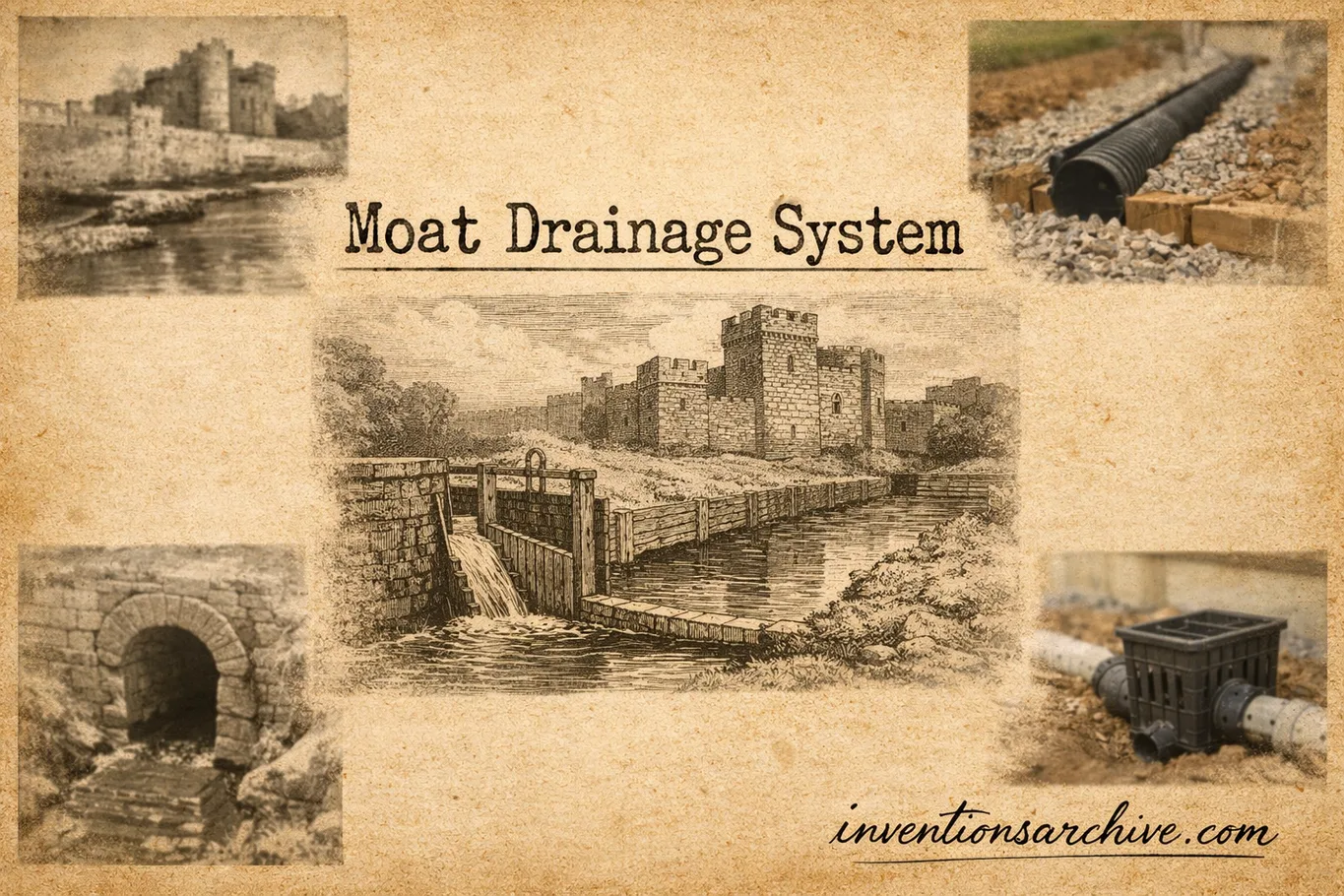
| Invention Name | Moat Drainage System |
|---|---|
| Short Definition | Water-level control for a moat using managed inflow and outflow. |
| Approximate Date / Period | c. 1250–1350 (peak use in many medieval moated sites) Approximate |
| Geography | Widespread; strong medieval evidence across England and Europe |
| Inventor / Source Culture | Anonymous / collective (builders, masons, water engineers) |
| Category | Hydraulic engineering, architecture, landscape design |
| Importance |
|
| Need / Reason It Emerged | Seasonal rain, springs, and runoff needed controlled routing |
| How It Works | Inlet + outlet + flow control (sluice/culvert) + overflow path |
| Material / Technology Base | Earthworks, masonry/brick, timber gates, clay lining, stone culverts |
| First Use Context | Moated residences, manors, religious sites, strongholds |
| Spread / Transfer | Local watercraft traditions; adaptable to rivers, springs, and flatlands |
| Derived Developments | Sluice management, controlled ponds, wetland landscaping, site hydrology |
| Impact Areas | Heritage conservation, archaeology, ecology, landscape history |
| Predecessors + Successors | Ditches + berms → managed moats → modern heritage water-control works |
| Key Civilizations / Traditions | Medieval European building practice; regional hydraulic crafts |
| Variants Influenced | Wet moat, dry moat, spring-fed moat, river-fed moat, tidal moat, double moat |
Moat drainage is the quiet craft behind a moat’s calm surface. A moat looks simple, yet it behaves like a small engineered water body: it takes water in, holds it, and releases it with control. When the balance is right, the water stays steady, the edges stay sound, and the surrounding ground stays predictable.
Table of Contents
What It Is
A moat drainage system is a set of routes and controls that keeps moat water within a planned range. It combines inlets, outlets, and flow control so the moat can respond to rain, springs, and seasonal changes without turning into a floodplain or a dry trench.
Many moats were tied to residential prestige and careful land planning. In England, around 6,000 moated sites are known, and the peak building period is often placed between about 1250 and 1350.Details The drainage system is what makes that water feature liveable and stable.
Why It Matters
Water Level Stability
A moat with no controlled exit can swing between extremes after rain or dry spells. A drainage plan keeps the level predictable, which protects edges, paths, and nearby structures.
Inflow and Outflow Balance
At Oxburgh Estate, the moat is supplied from a nearby river via a channel and culvert, and a sluice gate adjusts how much water drains out before it returns to the same river.Details That pattern—feed, hold, release—is the core logic of moat drainage.
Drainage also shapes the moat’s water quality. Where water moves slowly, fine material settles and organic layers build up. Over time, the moat can shift toward shallower, more plant-filled conditions, especially when inflow is irregular. Research on medieval moat deposits shows how strongly moat conditions track freshwater supply and sedimentation patterns.Details
Core Components
A well-planned moat drainage system relies on a few repeatable parts. The exact shape changes by landscape, yet the roles stay familiar: bring water in, guide it, let it out.
- Feeder route (channel, spring line, or diverted stream): delivers water at a controlled point.
- Inlet structure (stone or timber throat, protected opening): reduces erosion at entry.
- Culvert (pipe-like passage under a bank or path): moves water out of sight without breaking the moat edge.
- Sluice or gate: adjusts outflow so the level remains steady.
- Outfall (ditch, brook, or return channel): carries water away safely.
- Overflow path (weir-like lip or designed low point): releases excess during heavy rain without tearing banks.
- Silt-trap zones (quiet corners, widened bays): allow sediment to settle where it is easier to manage.
| Component | Main Role | What It Protects | Typical Clue on Historic Sites |
|---|---|---|---|
| Inlet | Supply water | Moat level and continuity | Small channel meeting moat at a single corner |
| Culvert | Move water under banks | Paths, walls, stable edges | Stone-lined opening or arched passage at waterline |
| Sluice | Fine control | Foundations, gardens, banks | Slot, gate frame, or boxed structure near outlet |
| Outfall | Release water | Downstream ground stability | Ditch line leaving moat toward a brook or low ground |
| Overflow | Emergency release | Edges during heavy rain | Lowest lip or spillway-like notch |
Water Paths and Control
Moat drainage is easiest to understand as a loop: water enters, circulates slowly, then exits through a controlled point. The system works best when water has a clear path and the outlet is not left to chance.
A Common Pattern: Gentle Through-Flow
Some designs aim for a slow, continuous movement of water rather than stillness. A heritage appraisal for a recreated moat describes using two stone culverts to permit a gentle flow through the moat—simple, durable, and easy to observe.Details
Control Points That Make a Difference
- Single outlet control keeps the whole moat easier to manage than many random exits.
- Protected openings reduce scouring at entry and exit points.
- Defined overflow protects banks during sudden high water.
- Quiet corners act as natural settling zones, concentrating fine material away from main crossings.
Types and Variations
Moat drainage changes with climate, soils, and nearby water sources. The same goal—stable water behavior—can appear in several forms. Each variant uses the landscape itself as part of the system.
Wet Moat Systems
- River-fed: inlet from a nearby stream, outlet returns downstream.
- Spring-fed: steadier input; outlet prevents overfilling in wet seasons.
- Through-flow: slow movement via culverts or channels to avoid long stagnation.
- Tidal-influenced (where local geography allows): level shifts managed by timing and gates.
Dry Moat Systems
- Drainage ditch focus: shaped to carry runoff away from the enclosure.
- Soakaway behavior: relies on ground absorption; overflow routes still matter.
- Seasonal wetting: holds water briefly, then returns to a dry profile.
- Double ditches: inner and outer lines with separate flow paths.
Linked Features
Drainage rarely stops at the moat edge. Moats often sit within a larger water landscape of ponds, channels, and ditches. These links can turn the moat into a node within a broader system, shaping water availability and ground moisture across the site.
Field Evidence and Dating
Moat drainage leaves traces that can persist for centuries. Even when water is gone, the routes it once followed may remain visible as subtle dips, embankments, or stone-lined openings. In wet moats, layered deposits can preserve delicate evidence that rarely survives on dry ground.
Clues Commonly Linked to Drainage
- Feeder line: a shallow channel that approaches the moat at a single, deliberate angle.
- Outlet throat: a narrowed exit zone where flow was easier to control.
- Culvert mouth: stonework or brickwork near the waterline, often symmetrical.
- Widened bay: a quiet pocket where fine material settles over time.
- Organic layers: waterlogged deposits that can preserve plant remains and microfossils.
Scientific work on moat deposits shows how channels, depth differences, and sediment build-up shape the internal character of a moat over time. Those patterns help reconstruct how water moved through the system and how the surrounding landscape changed alongside it.
Modern Research Value
Moats are more than visible earthworks. They can function as time capsules, storing layers that reflect past water conditions, local vegetation, and human activity around the site. Because many moats collect fine organic material, they can preserve quiet evidence that is rare elsewhere.
Why Researchers Care
- Environmental history captured in waterlogged layers
- Landscape change visible in sediment shifts
- Site planning reflected in channels and control points
- Material survival improved in wet conditions
What Drainage Adds
- Water routing that can be traced across a site
- Level control visible in sluice locations and outlet design
- Flow zones that explain why deposits differ corner to corner
- System logic connecting moat, channels, and nearby ground
FAQ
Is a moat drainage system always visible above ground?
Not always. Many key elements—such as culverts and controlled outlets—can be hidden within banks, under paths, or behind masonry. The visible moat can look unchanged while the working parts sit out of sight.
Did all moats have moving water?
No. Some were designed for slow through-flow, while others behaved more like a still basin. Even still moats often needed a defined outlet and an overflow path to keep water levels stable across seasons.
What is the difference between a culvert and a sluice?
A culvert is a passage that carries water under a bank or route. A sluice is a control point—often a gate—that adjusts how much water can pass, shaping the moat’s level and flow.
Why do some moats become marshy over time?
As fine material settles and organic layers build up, the moat can become shallower. If water supply becomes irregular, plant growth can increase and the moat may shift toward marsh-like conditions in some areas.
Are dry moats still “drainage systems”?
Yes, in a broader sense. A dry moat still manages runoff, directs water away from key ground, and often includes channels or low points that guide flow during wet periods.