
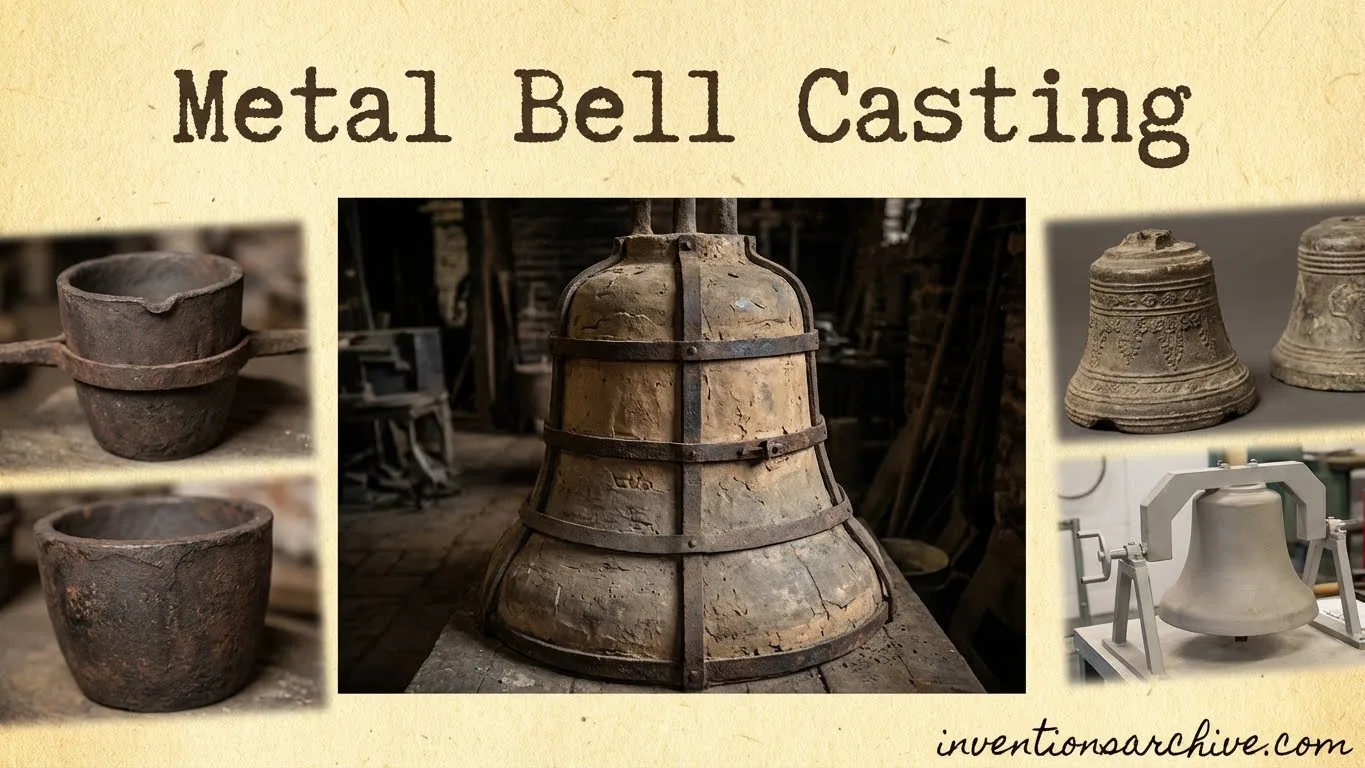
| Invention Name | Metal Bell Casting |
|---|---|
| Short Definition | Shaping a bell by pouring molten metal into a bell-form mold and finishing it for sound. |
| Approximate Date / Period | At least 1600 BCE–present (earliest excavated evidence)Details |
| Date Certainty | Approximate (earliest evidence) / Certain (continuous practice) |
| Geography | East Asia; later widespread across many regions |
| Inventor / Source Culture | Anonymous / collective (multiple traditions) |
| Category | Metallurgy; music; signaling; timekeeping |
| Importance |
|
| Need / Reason It Emerged | Durable signal; repeatable tone; ceremonial sound |
| How It Works | Molten alloy fills a bell-shaped cavity; cooling forms a resonant shell |
| Materials / Technology Base | Bronze; clay/loam molds; high heat furnaces |
| Early Uses | Ritual sound; court music; status objects; signaling |
| Spread Route | Regional craft networks; religious and civic building programs |
| Derived Developments | Carillons; tower clocks; acoustic tuning practices |
| Impact Areas | Music; education; craft heritage; public communication |
| Debates / Different Views | “First bell” claims vary by find and definition |
| Precursors + Successors | Bronze casting → bell casting → precision tuning and standardized bell sets |
| Key Cultures and Places | Early Chinese bronze centers; later bellfoundries in many regions |
| Influenced Variations | Tower bells; handbells; chime bells; carillon bells; ritual bells |
Metal bell casting is a quiet triumph of materials science and sound design. A cast bell looks simple, yet its voice depends on details that the eye barely notices: thickness, curve, alloy, and cooling. Across centuries, bellfounders refined the craft until a single strike could carry time, ceremony, and music through open air with remarkable clarity.
Table of Contents
What Metal Bell Casting Is
A cast bell is a hollow resonator designed to ring with a controlled blend of tones. The casting step matters because it fixes the bell’s geometry in one piece: crown, shoulder, waist, and rim become a single continuous shell. That one-piece form is a big reason bells can stay usable for a very long time, while still keeping a recognizable voice.
Where Cast Bells Show Up
- Tower and church bells designed for distance
- Carillon bells tuned as a keyboard instrument
- Handbells sized for ensemble playing
- Ritual bells and decorative bells in cultural settings
- Signal bells for schools, ships, and public buildings
The invention is not a single moment. It is a repeatable method: build a mold, cast a durable metal shell, and shape the sound through proportion. Over time, that method became a reliable way to produce bells in sets, not just as one-off objects.
Origins and Early Evidence
Archaeology shows metal bells early in Chinese bronze culture, with evidence reaching at least 1600 BCE. Over many centuries, designs expanded from small clapper bells to large, graduated sets built for courtly music. One famous landmark is the tomb of the Marquis Yi of Zeng, dated to around 433 BCE, where a large set of bronze bells was buried as a complete musical world.
| Period | What It Shows | Why It Matters |
|---|---|---|
| 3rd millennium BCE ApproximateDetails | Lost-wax casting established as a durable method | Complex hollow forms became practical |
| At least 1600 BCE Approximate | Early bronze bells appear in excavations | Bells enter metalworking history as a distinct form |
| c. 433 BCE Approximate | Large tuned bell sets documented in elite burials | Bell casting becomes systematic for music |
| 1765 CertainDetails | Detailed technical plates illustrate molds and furnaces | Bellfounding becomes recorded as a mature craft |
Some ancient Chinese bells were engineered to produce two distinct tones from one body. Their cross-section could be lens-shaped rather than perfectly round, and the strike point changed the pitch. It is a vivid reminder that bell casting is not only metallurgy; it is acoustics made solid.
Bell Metal and Other Alloys
Many of the most resonant cast bells are made from a high-tin bronze often called bell metal. A common description places the tin level around 22–24% by weight, with the remainder largely copperDetails. In plain terms, more tin tends to make the metal stiffer, which supports a clear ring, yet it also demands careful control because extreme brittleness is not a friend of long service.
What the Alloy Must Deliver
- Elastic response so the shell rings instead of thudding
- Stable casting so thin and thick zones form cleanly
- Durable surface that ages gracefully with a protective patina
Other Metals You May See
- Brass for smaller bells and bright, quick tones
- Steel in some modern signal bells where toughness is prized
- Cast iron for utilitarian bells that prioritize strength over musical richness
Alloys also shape how a bell cools. Cooling rate influences microstructure, and that can affect the balance between ring and long-term reliability. This is one reason historic bellfounding remained a specialized craft: the ear listened, the eye measured, and the furnace demanded respect.
How A Bell Is Cast
Metal bell casting starts with a profile, the bell’s outline in cross-section. That profile sets the distribution of thickness, which later shapes the sound. Foundries typically build a mold around that profile using materials such as clay, loam, or other refractory mixtures. A cavity is formed between an inner core and an outer case, and molten metal fills that space to become a single, continuous shell.
Key Parts of a Traditional Bell Mold
- Core: shapes the inside surface
- Case (outer mold): shapes the outside surface
- Gates and vents: guide metal flow and let gases escape
- Support features: keep alignment stable during the pour
The lost-wax method is another route to a hollow form. A wax model is invested in a heat-resistant mold, then the wax melts away, leaving a cavity for metal. This method is described as widespread across continents and traced to the 3rd millennium BCEDetails. In bell history, variations of wax modeling and clay molding helped makers reach complex shapes and fine surface detail.
After cooling, a bell is released from its mold and finished. Marks from casting are cleaned, inscriptions may be refined, and the bell’s interior can be shaped to guide its final voice. In modern practice, small adjustments are often made with controlled material removal so the bell fits a musical plan without losing its strength.
Sound and Tuning
A bell does not produce only one note. It produces a family of partials that the ear blends into a perceived strike pitch. Thickness, curvature, and alloy stiffness influence how those partials line up. When the alignment is good, the sound feels clean, even when the bell is very loud.
| Term | Plain Meaning | Why It Matters |
|---|---|---|
| Strike Pitch | The main note people perceive | Guides matching in sets |
| Partials | Multiple tones created by vibration modes | Shape “brightness” and “warmth” |
| Soundbow | Thicker zone near the rim | Handles impact and drives projection |
| Two-Tone Design | One bell giving two pitches by strike point | Shows deliberate acoustic engineering |
Bell Geometry That Shapes Tone
- Wall thickness distribution from crown to rim
- Rim diameter and overall height
- Shoulder curve that controls stiffness
- Clapper interaction in clappered bells
Why Casting Quality Matters
- Even metal flow reduces weak zones
- Clean cooling helps stability over time
- Sound consistency improves matching in ensembles
In a tuned set, the goal is not “louder.” The goal is agreement: bells should relate in pitch while keeping their own character. That balance is the signature of mature bellfounding.
Related articles: Blast Furnace [Medieval Inventions Series], Bronze Casting [Ancient Inventions Series]
Bell Types and Variations
“Bell” covers many families. The casting idea stays the same, yet shape, mounting, and intended sound create distinct types. Below are common variations, each tied to a specific acoustic role and cultural use.
By Setting and Function
- Tower Bells: large, projecting, designed for open-air reach
- Carillon Bells: a tuned series for keyboard performance, where pitch matching is central
- Chime Bells: smaller tuned groups, often used for melodies and signals
- Handbells: handled instruments, often tuned in sets for ensemble music
- Ritual Bells: forms shaped by tradition, sometimes with symbolic handles or profiles
There are also variations defined by how the bell is struck. Some are clappered, where an internal striker swings. Others are struck externally with a mallet. That choice affects the required strength of the soundbow and the bell’s long-term wear patterns.
| Type | Typical Mounting | Sound Character | Design Notes |
|---|---|---|---|
| Clappered Bell | Suspended, mouth down | Full-bodied ring | Impact zone reinforced at the rim |
| Struck Bell | Fixed, struck from outside | Clear attack | Often used in ensembles and signals |
| Two-Tone Bell | Varies by tradition | Two pitches from one body | Strike point changes vibration pattern |
Even within one category, profiles vary. A slightly different shoulder curve can change how partials line up. That is why historic bells can sound distinct even when they share the same general size. A bell is never only a dimension; it is a relationship of curves.
Legacy and Preservation
Metal bells often develop a surface patina that many people associate with age and authenticity. Conservation work tends to focus on keeping the bell structurally sound and acoustically stable, rather than chasing a “like-new” look. The result is a form of heritage that stays audible, not just visible.
What Collectors and Curators Note
- Inscriptions and maker marks
- Profile and casting seams that reveal mold practice
- Wear patterns near the strike zone
- Pitch relations if the bell belongs to a set
Why the Craft Still Matters
- Shared sound that reaches many people at once
- Continuity between ancient casting and modern acoustics
- Precision that turns metal into music
From early bronze bells to modern tuned sets, metal bell casting stands as a human-scale invention: fire, earth, metal, and a listening ear. That blend keeps the subject evergreen, because every bell is a compact record of its era’s technology and taste.
FAQ
Why do many high-quality bells use bronze rather than pure copper?
Bronze can be stiffer and more resilient than pure copper, which helps a bell hold a clearer ring. The alloy balance also supports consistent casting and long-term stability.
What does “bell metal” mean?
It usually refers to a high-tin bronze selected for strong resonance. The exact ratio can vary by tradition and foundry practice.
How can one bell produce two tones?
Some bells are designed so the shape and vibration patterns change with strike location. When the geometry supports it, different strike points emphasize different modes, creating two distinct perceived pitches.
Is lost-wax casting used for bells?
Lost-wax is a long-established casting approach for hollow metal forms. In bell history, wax modeling and clay molding both appear in different contexts, alongside other mold-building traditions.
What makes a bell “tuned”?
A tuned bell is shaped so its main partials align in a planned way, helping the strike pitch sit correctly within a set. This often involves careful control of thickness and profile.
Are all cast bells meant to be musical instruments?
No. Many are built mainly for signaling and clarity. Musical bells prioritize pitch relations and overtone balance, while signal bells may focus on durability and audibility.