
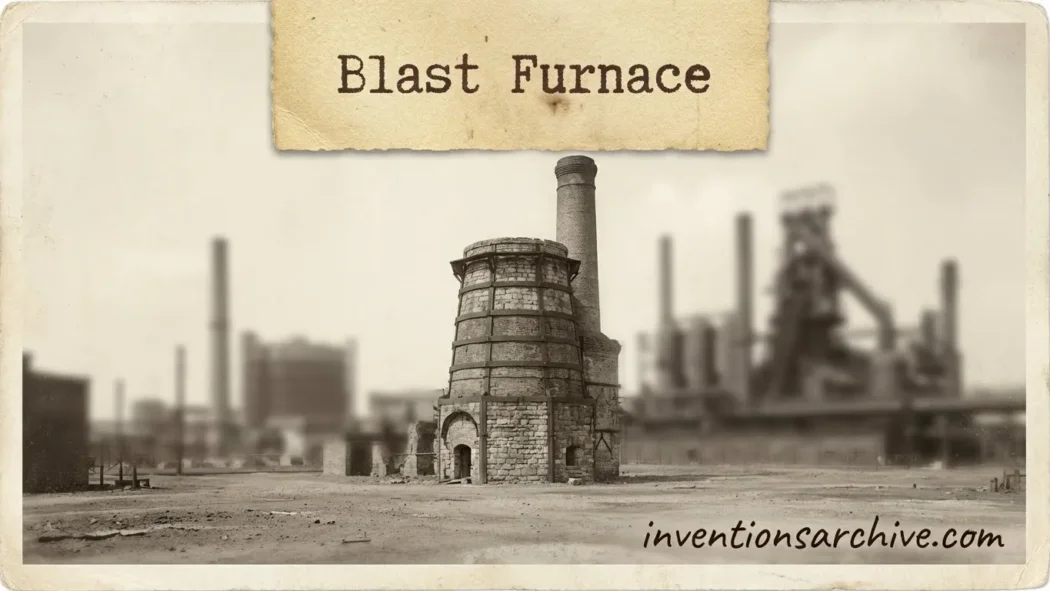
| Invention Name | Blast Furnace |
|---|---|
| Short Definition | A tall shaft furnace that uses a forced air blast to reduce iron ore and produce molten high-carbon iron. |
| Approximate Date or Period | By the mid-first millennium BCE in China Approximate |
| Date Certainty | Based on surviving evidence; the first use may be older than the earliest finds. |
| Geography | Early evidence in China; later medieval development in Europe, including Sweden. |
| Inventor or Source Culture | Anonymous / collective; developed through generations of ironworkers rather than one recorded inventor. |
| Category | Manufacturing; materials; energy; metallurgy. |
| Main Problem Solved | Producing larger and more regular quantities of molten iron from ore. |
| Why It Matters |
|
| How It Works | Ore, carbon fuel, and flux descend while hot reducing gases rise; molten iron and slag collect below. |
| Technical Principle | Counter-current heat exchange, chemical reduction, melting, carburization, and slag separation. |
| Main Materials | Iron ore or prepared ore burden; charcoal or coke; limestone or another suitable flux; refractory lining; forced air. |
| Early Uses | Cast tools, vessels, fittings, and pig iron for secondary refining. |
| Predecessors | Bloomery furnaces; shaft furnaces; bellows; charcoal smelting. |
| Development Path | Bloomery → early blast furnace → water-powered blast → coke-fired furnace → hot blast → modern integrated ironmaking. |
| Major Later Improvements | Coke fuel; preheated blast; regenerative hot-blast stoves; improved charging; gas cleaning; process control. |
| Main Variations | Charcoal-fired; coke-fired; cold-blast; hot-blast; modern integrated; smaller regional or mini blast furnaces. |
| Surviving Evidence | Cast-iron objects, slag, furnace ruins, refractory remains, written records, industrial sites, drawings, and patents. |
| Evidence Status | Attribution varies; early Chinese and medieval European histories rest on different bodies of evidence. |
| Related Inventions | Bloomery; bellows; waterwheel; coke oven; hot-blast stove; finery forge; basic oxygen furnace. |
| Modern Descendants | Blast furnace–basic oxygen furnace steelmaking, advanced hot-blast systems, top-gas recovery, and monitored high-capacity furnaces. |
| Fields Affected | Manufacturing; construction; transport; agriculture; machinery; tools; infrastructure; steel production. |
What the Blast Furnace Is
A blast furnace is a continuously operated shaft furnace built to turn iron-bearing ore into molten iron. The word blast refers to the forced stream of air entering near the lower part of the furnace through openings called tuyeres.
The furnace is not simply a hot container. Its tall shape creates several reaction zones. Solid material moves downward under gravity. Hot gases move upward. This opposing movement lets the rising gas heat and chemically reduce the descending ore before the material reaches the hottest lower zone.
The main liquid product is usually called hot metal or pig iron. It contains more carbon than finished steel. A separate liquid layer, slag, carries much of the unwanted mineral matter removed from the ore.
How the Origin Is Traced
Early Chinese Ironmaking
China followed an early ironmaking path in which cast iron became established long before it did in Europe. Furnaces capable of producing liquid, carbon-rich iron depended on strong air delivery, heat-resistant furnace walls, control of the burden, and skill in casting or refining the product.
Early cast iron did not replace every other form of iron at once. Bloomery iron, cast iron, decarburized iron, and steel could exist within the same broad technological tradition. A found object may reveal the material used, yet it does not always identify the exact furnace design that produced it.
Later Chinese furnaces show that the technology continued to change through stronger air delivery, different fuels, altered furnace shapes, and larger production systems. The record describes a long technical tradition rather than a single isolated discovery.
Medieval European Furnaces
In Europe, the older bloomery remained common for centuries. Medieval blast-furnace sites mark a change from producing a solid, spongy bloom to producing liquid pig iron that could be cast or refined in another hearth.
At Lapphyttan in Sweden, archaeological work identified a blast-furnace site with activity reaching back to the late twelfth century. Jernkontoret notes that the technology was in Swedish use by that period and that the excavated site preserved evidence of earlier furnaces beneath the later remains. [b]
Whether European blast furnaces developed through local experimentation, long-distance transfer, or several routes is not settled by one artifact. Similar furnace functions do not by themselves prove a direct line of transmission.
The Problem It Answered
Bloomery furnaces could make workable iron, but they usually produced a solid mass called a bloom. The bloom contained trapped slag and needed repeated hammering, reheating, and sorting. Batch size and output were limited by furnace size, air supply, fuel, and the difficulty of handling the product.
The blast furnace answered a different production need: how to keep ore, fuel, flux, heat, and air moving through a tall furnace long enough to make liquid iron in a sustained process.
That shift created several practical changes:
- Molten iron could be tapped and cast into repeatable forms.
- Furnaces could run for long campaigns instead of one short smelt.
- Pig iron could be sent to fineries, forges, foundries, and later steelworks.
- Iron production could support larger networks of miners, charcoal burners or coke makers, carriers, molders, refiners, and merchants.
Before and After the Blast Furnace
| Before the Blast Furnace | What Changed After It |
|---|---|
| Iron was commonly recovered as a solid bloom mixed with slag. | Iron could be produced as a molten, carbon-rich metal and tapped from the hearth. |
| Each smelt was a more limited batch operation. | Long furnace campaigns supported repeated charging and tapping. |
| Much refining began with hammering a hot bloom. | Pig iron could be cast directly or refined in a separate process. |
| Output was closely limited by small furnace volume and manual air supply. | Taller furnaces and stronger blasts supported greater throughput. |
| Product form varied with each bloom and refining sequence. | Foundries and fineries received a more regular flow of pig iron. |
| Local workshops served narrower production networks. | Ironworks could supply tools, cast goods, machinery, transport systems, and later steel plants. |
How the Furnace Works
The process is best understood as a counter-current system. Solid burden descends while hot gases rise. Modern teaching material describes iron ore, coke or pulverized coal, and lime or limestone as the main inputs, with hot metal as the intended iron product. [c]
Charging and Preheating
Iron-bearing material, carbon fuel, and flux enter at the top. In historical furnaces these materials could be ore, charcoal, and a local flux stone. A documented seventeenth-century example at Saugus used bog ore, charcoal, and gabbro flux, and ran for months during a furnace campaign. [d]
As the burden moves downward, rising gas removes moisture and raises its temperature. The furnace shape and the size of the charged pieces affect how evenly gas can pass through the bed.
Reduction and Melting
Near the lower furnace, carbon fuel reacts with the incoming air. The reaction releases heat and forms gases that move upward. Carbon monoxide removes oxygen from iron oxides through a series of reduction reactions.
The reduced iron descends into hotter zones, melts, and absorbs carbon. This carbon lowers the melting range compared with nearly pure iron, helping the metal remain liquid in the hearth. The product is not finished steel; it is high-carbon hot metal that normally needs later refining.
Slag Formation
Flux combines with unwanted minerals from the ore and ash from the fuel. The resulting slag melts and separates from the denser iron. Because slag and iron have different densities and properties, they can be tapped through separate openings or at different stages of the cast.
Gas Flow and Heat Recovery
Gas leaving the top still contains heat and combustible components. Later furnace systems cleaned and reused part of this gas, including as fuel for hot-blast stoves. Technical records describe these stoves as heat-transfer systems whose operation is measured and controlled to meet blast-air requirements. [e]
Materials and Main Parts
The Burden
- Iron-bearing material: lump ore, sinter, pellets, or another prepared ore feed.
- Carbon source: charcoal in many older furnaces; coke in most later large furnaces; some modern plants also inject finely prepared coal.
- Flux: commonly limestone or lime in modern practice, chosen to help form a fluid slag with the unwanted mineral matter.
The Furnace Body
- Top and charging system: admit the burden while controlling gas escape and material distribution.
- Stack: the tall upper shaft where solids are heated and much of the ore reduction begins.
- Belly and bosh: widening and narrowing zones where the burden softens, reactions speed up, and melting develops.
- Tuyeres: water-cooled air inlets near the lower furnace.
- Hearth: the lower chamber where molten iron and slag collect.
- Tap holes and runners: controlled outlets and channels for moving liquid products to later handling systems.
Refractory and Cooling
The inner lining must resist heat, chemical attack, abrasion, and movement of the burden. Historical furnaces used local stone, clay, and brick systems. Modern furnaces use selected refractory materials and cooling arrangements suited to different zones.
The furnace shell is only one part of the invention. Reliable ironmaking also depends on air supply, charging, burden preparation, casting arrangements, gas handling, and the refining process that receives the hot metal.
Early Use in Work and Trade
Blast-furnace iron entered daily life through two main paths. Some liquid iron went into molds to make cast objects. Some was cast into manageable pigs and then refined to lower its carbon content.
Related articles: Hydraulic Forge Bellows [Medieval Inventions Series], Water-Powered Forge Hammer [Medieval Inventions Series]
Depending on place and period, the output supported:
- Agricultural implements and replaceable iron parts.
- Cooking vessels, cauldrons, stoves, and household fittings.
- Weights, molds, architectural fittings, and workshop equipment.
- Water-management, mining, and milling equipment.
- Machine parts, pipes, rails, bridges, ships, and structural products in later industrial systems.
- Steelmaking after the hot metal passed through a refining stage.
Cast iron offered fluidity and moldability, but it could also be brittle. Refiners and founders chose the next process according to the object required. A cast pot, a forgeable bar, and a steel rail did not need the same material properties.
How the Furnace Changed Over Time
| Stage | Form | What Changed |
|---|---|---|
| Earlier Tool | Bloomery and small shaft furnace | Produced a solid bloom; required strong secondary hammering and slag removal. |
| Early Blast Furnace | Charcoal-fired tall furnace with forced air | Reached conditions for liquid high-carbon iron and repeated tapping. |
| Powered Blast | Water-driven bellows | Provided steadier air and supported larger, longer-running furnaces. |
| Fuel Change | Coke-fired blast furnace | Reduced dependence on charcoal and supported expansion near coalfields. |
| Air Change | Hot-blast furnace | Preheated incoming air, lowered fuel demand, and raised output. |
| Heat Recovery | Regenerative hot-blast stoves | Used furnace gas to heat large checker-brick chambers before switching airflow. |
| Modern Form | Integrated blast furnace with prepared burden and automated control | Combined high-capacity ironmaking with gas cleaning, monitoring, cooling, and downstream steelmaking. |
| Related Modern Routes | Direct reduction and electric furnace steelmaking | Use different reduction or melting paths rather than copying the blast-furnace process. |
Coke at Coalbrookdale
Charcoal worked well as a blast-furnace fuel, but large iron districts required extensive woodland, labor, and transport. Coal was abundant in some regions, yet raw coal could introduce problems in the furnace. Coke, made by heating suitable coal with limited oxygen, offered a stronger mineral fuel.
In 1709, Abraham Darby I developed coke-smelting practice at Coalbrookdale. UNESCO identifies the surviving Coalbrookdale furnace with this change from charcoal to coke. [f]
Darby’s result did not replace charcoal everywhere at once. Ore chemistry, coke quality, furnace shape, local skills, transport, and the intended iron product all affected adoption. The change spread through working iron districts rather than appearing as one instant conversion.
The Hot Blast
Early furnaces used air near the surrounding temperature. The hot-blast method warmed the air before it entered the tuyeres. This saved part of the fuel that would otherwise be used to heat cold incoming air inside the furnace.
James Beaumont Neilson is conventionally linked with the 1828 hot-blast patent, yet the history is more layered. Research in Historical Metallurgy notes an earlier 1828 patent by Thomas Botfield and argues that several people and ironworks contributed to the early development. [g]
Later regenerative stoves stored heat in firebrick and transferred it to the next air cycle. The principle linked furnace operation, waste-gas use, and heat recovery in one plant system.
Modern Control and Scale
Modern furnaces use prepared ore burden, controlled charging, measured air and fuel delivery, cooling systems, gas cleaning, sensors, and computer-based process control. Some large units have internal heights measured in tens of metres and produce thousands of tonnes of hot metal in a day.
Scale alone does not define a good furnace. Stable gas flow, burden strength, refractory life, product chemistry, energy use, and safe tapping all matter to plant performance.
Main Types and Variations
| Variation | Main Feature | Historical or Technical Context |
|---|---|---|
| Early Chinese Furnace | Forced-air shaft furnace producing cast iron | Part of an early cast-iron tradition with regional differences in furnace form and refining. |
| Charcoal Blast Furnace | Charcoal serves as fuel and reducing material | Common in pre-industrial iron districts with access to managed woodland. |
| Coke Blast Furnace | Coke carries burden weight and supplies carbon and heat | Became central to large industrial ironmaking after eighteenth-century development. |
| Cold-Blast Furnace | Air enters without purposeful preheating | Earlier arrangement used before hot-blast equipment became common. |
| Hot-Blast Furnace | Incoming air is preheated | Uses less fuel for heating the blast and supports higher furnace output. |
| Modern Integrated Furnace | Prepared burden, coke, hot blast, gas recovery, and automated control | Feeds hot metal to a basic oxygen furnace or another steel-refining unit. |
| Mini Blast Furnace | Smaller industrial unit | Used in some regional ironmaking systems where plant scale and raw materials differ from large integrated works. |
What Changed Because of It
Iron Became a Flowing Intermediate Material
The blast furnace changed the physical form in which iron left the smelting stage. Instead of removing only a solid bloom, ironworkers could tap molten metal. That made casting practical on a wider scale and created a steady intermediate product for refining.
Ironworks Became Linked Systems
A blast furnace rarely stood alone. It drew on mines, forests or coalfields, roads, waterways, bellows or blowing engines, foundries, fineries, repair shops, and markets. Its operation encouraged specialized work and tighter coordination between raw materials and finished goods.
Later Steelmaking Depended on Hot Metal
Many later steel processes began with blast-furnace hot metal. The refining step changed across time—from finery hearths and puddling to converters and basic oxygen furnaces—but the furnace remained the iron-producing first stage.
The modern integrated route combines a blast furnace with a basic oxygen furnace and uses iron ore, carbon-bearing fuel, flux, and selected recycled material. Other routes, such as direct reduction and electric arc furnaces, follow different material and energy paths.
Materials Reached More Fields
More regular iron supply supported foundries, machine building, rail transport, water systems, construction, agricultural equipment, shipbuilding, and public infrastructure. The effect came through both cast iron and the wrought iron or steel made after further refining.
Common Misunderstandings
“Abraham Darby Invented the Blast Furnace”
Darby is tied to the successful use of coke at Coalbrookdale in 1709. Blast furnaces existed in China and medieval Europe long before his work.
“The Oldest Surviving Evidence Proves the First Use”
An excavated furnace or dated cast-iron object establishes a known point in the record. Earlier experiments may have left no trace or may not yet have been found.
“A Blast Furnace Produces Finished Steel”
The normal product is carbon-rich hot metal or pig iron. Steel requires a later refining stage that lowers carbon and adjusts other elements.
“It Is Only a Larger Bloomery”
A bloomery usually makes a solid bloom. A blast furnace is arranged to make liquid high-carbon iron and to operate as a continuing downward burden and upward gas process.
“Coke Was Always the Standard Fuel”
Charcoal powered many blast furnaces for centuries. Coke became dominant in large industrial systems only after fuel quality, furnace practice, and supporting equipment improved.
Related Inventions
- Bloomery: the earlier direct iron-smelting furnace that usually produced a solid bloom.
- Bellows: the air-delivery device behind the furnace’s forced blast.
- Waterwheel: a power source used to drive larger and steadier bellows.
- Coke Oven: equipment that converts suitable coal into coke for ironmaking.
- Hot-Blast Stove: a heat-storage system that preheats the furnace air.
- Finery Forge: a refining hearth used to turn pig iron into lower-carbon iron.
- Puddling Furnace: a later method for refining pig iron without direct contact with solid fuel.
- Basic Oxygen Furnace: a modern steelmaking vessel that refines blast-furnace hot metal.
Frequently Asked Questions
Who invented the blast furnace?
No single inventor is known. The furnace developed through collective metallurgical work. Early evidence is associated with Chinese cast-iron production, while medieval European furnaces appear much later in a separate and partly debated history.
What did Abraham Darby change in 1709?
Darby developed successful blast-furnace smelting with coke at Coalbrookdale. He improved the fuel system of an older furnace technology rather than inventing the blast furnace itself.
Why is it called a blast furnace?
The name comes from the forced blast of air sent through tuyeres near the bottom. The air supports combustion, heat generation, and the reducing gas needed to remove oxygen from iron ore.
What comes out of a blast furnace?
The main outputs are molten hot metal or pig iron, molten slag, and furnace gas. Dust and other captured materials also arise in the gas-cleaning system.
Does a blast furnace make steel directly?
Usually no. It makes high-carbon hot metal. A later process removes carbon and unwanted elements, then adjusts the metal to meet the required steel grade.
Are blast furnaces still used?
Yes. They remain part of integrated iron and steel plants. Direct-reduction and electric-furnace routes are also used, and the balance between these routes depends on raw materials, energy systems, plant design, and production needs.
Sources and Verification
- [a] Metals (Chapter 16) – Archaeological Science — Used to verify the early emergence of blast-furnace and cast-iron production in China. (Reliable because it is an academic chapter published by Cambridge University Press.)
- [b] The Blast Furnace in Earlier Times — Used to verify the Lapphyttan evidence, medieval Swedish use, and the basic charcoal-furnace process. (Reliable because it is a topic-specific historical page from Jernkontoret, the Swedish steel industry organization.)
- [c] Blast Furnace — Used to verify modern raw materials, furnace purpose, scale, and hot-metal production. (Reliable because steelUniversity is an industry education platform developed for iron and steel training.)
- [d] Blast Furnace — Used to verify the recorded materials and operating context of the 1646 Saugus furnace. (Reliable because it is an official U.S. National Park Service site page.)
- [e] Hot Blast Stove Process Model and Model-Based Controller — Used to verify the purpose, heat-transfer role, and controlled operation of modern hot-blast stoves. (Reliable because it is a U.S. Department of Energy technical report preserved by the University of North Texas Digital Library.)
- [f] Ironbridge Gorge — Used to verify Abraham Darby I’s 1709 coke-smelting development at Coalbrookdale. (Reliable because it is the official UNESCO World Heritage Centre record.)
- [g] Hot Blast Iron Smelting in the Early 19th Century: A Re-Appraisal — Used to verify the 1828 hot-blast attribution and the evidence for earlier or shared development. (Reliable because it is a research article in the Historical Metallurgy Society’s journal.)

