
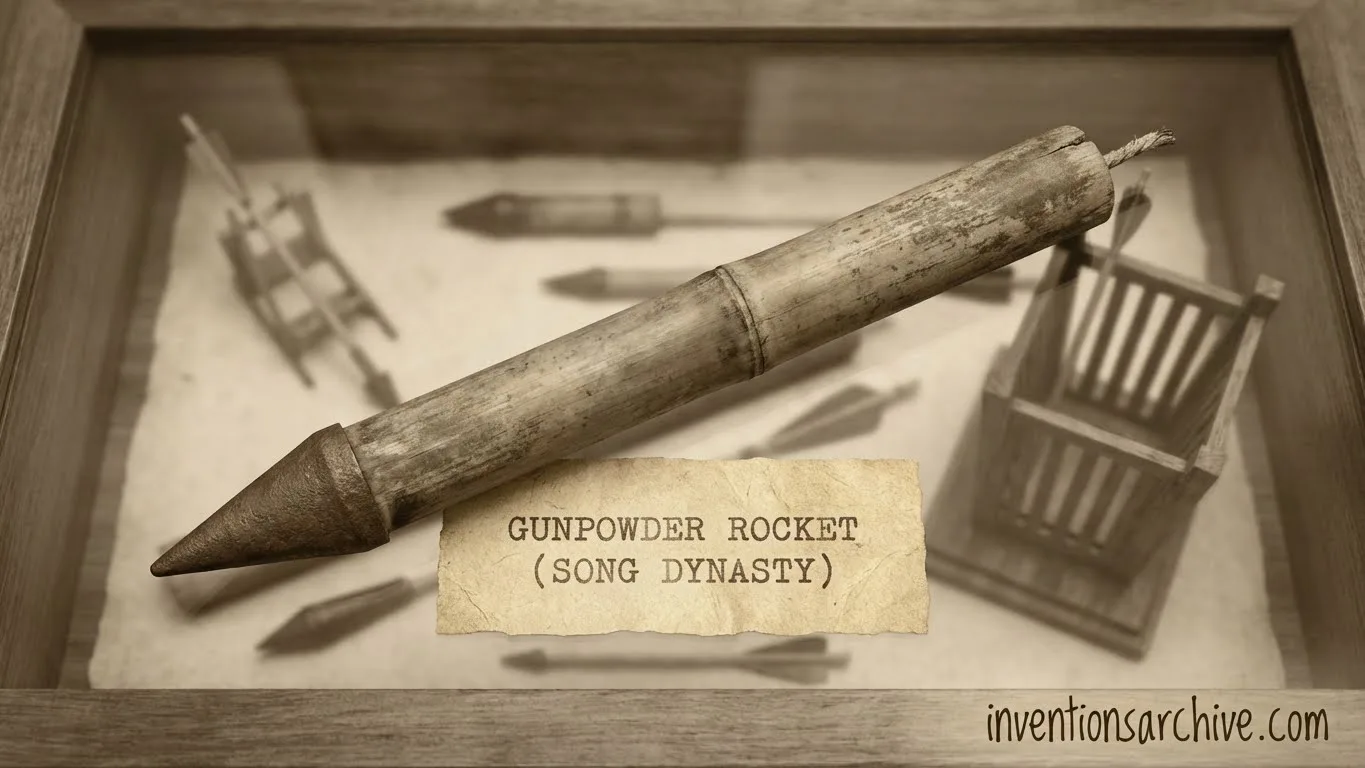
Invention Profile
| Invention Name | Gunpowder Rocket (Song Dynasty) |
| Short Definition | A self-propelled fire-arrow device powered by gunpowder thrust. |
| Approximate Date / Period | 1044 (documented gunpowder formula); early 12th c. (maturing rocket forms) Approximate |
| Geography | Song China (North China and South China) |
| Inventor / Source Culture | Anonymous / collective; Song-era engineers and workshops |
| Category | Propulsion; pyrotechnics; early rocketry |
| Importance |
|
| Need / Driver | Reliable flame and smoke effects; stronger range than simple incendiaries |
| How It Works | Burning black powder makes fast gas; gas exits one end to create thrust |
| Material / Technology Base | Bamboo or paper tube; fuse; gunpowder; stick or arrow shaft |
| First Known Documentation | Wujing Zongyao (1044 CE) for large-scale formula recording |
| Typical Form Factor | Tube motor + guidance stick; often described under “fire arrow” terms |
| Impact Areas | Materials science; engineering practice; communication effects; celebratory pyrotechnics |
| Key Terms | Huo jian (“fire arrow”); solid propellant; reaction propulsion |
Gunpowder rockets in Song Dynasty China are best understood as a practical step in reaction propulsion: a small tube burns gunpowder, the exhaust rushes out, and the device moves the other way. The language of the period often grouped several ideas under “fire arrow,” so careful reading matters when separating incendiary arrows from true self-propelled rockets.
Table of Contents
What It Is
A gunpowder rocket is a device that carries both the material that burns and the oxygen source needed for that burn, so it does not depend on outside air the way many other propulsion systems do. In historical Song-era contexts, the core idea appears as a compact solid-propellant motor built from a simple tube and a controlled outlet. Details
The phrase fire arrow can be tricky. Sometimes it points to a regular arrow carrying a burning payload. Other times it refers to a self-propelled device where thrust provides motion. That overlap is not a flaw in the history; it is a reminder that labels evolve as technology changes.
Why This Counts as Rocketry
- Thrust comes from exhaust leaving a single outlet
- Propellant is carried inside the device
- Motion follows direct reaction, not external pushing
Early Evidence and Timeline
The Song era sits at an important point: gunpowder shifts from experimental mixtures to documented formulas and organized production. A key written reference is the Wujing Zongyao (1044 CE), which records a “true” gunpowder formula and describes scaled preparation. Details
- 1044 CE: A major Song military manual records a usable gunpowder formula and discusses large-scale handling.
- 11th–12th centuries: Devices described as fire arrows diversify, including forms that look increasingly like rocket motors.
- Later copies and illustrations: Surviving editions help modern readers visualize how early systems may have been assembled and carried.
Physical examples are rare because early motors often relied on organic parts like bamboo, paper, and bindings. That makes texts, careful translation, and the archaeology of related pyrotechnic materials especially valuable. Gaps in surviving artifacts are expected, not suspicious.
How It Works
In simple terms, black powder burns fast and creates hot gas. If that gas can only escape in one main direction, the device experiences thrust in the opposite direction. The tube acts as a pressure container, while the open end behaves like a basic nozzle. This is the same foundational idea that appears throughout later solid rocket designs, even when materials become far more advanced.
Inside the Motor
- Tube: bamboo or paper-based casing
- Propellant: compacted black powder
- Fuse: timed ignition pathway
- Outlet: the exhaust exit
What Makes It Stable
- A stick or arrow shaft adds directional stability
- Mass distribution matters; uneven loads can cause wobble
- Consistent burn improves predictability
Materials and Technology Base
Song-era rocketry depends on two linked advances: better control of gunpowder and better control of containment. Black powder combines a fuel fraction and an oxidizing fraction; the balance affects whether it behaves more like a slow-burning composition or a more forceful propellant. Historical texts often describe function rather than modern chemical ratios, which is why cross-checking language is essential.
The casing is not a small detail. A simple tube must survive long enough to channel expanding gas toward a single exit. Bamboo offers natural stiffness; paper-based structures are light and easy to shape; bindings control seams. Add a fuse, and timing becomes repeatable enough for organized use in both signals and public displays.
Types and Variations
In many sources, the term huojian (“fire arrow”) can indicate either an incendiary arrow or a true rocket, so the distinction often comes from context. One reference-work summary highlights that early “fire arrows” could be bow-launched incendiaries, while later developments relied on higher-nitrate solid compositions and fuses that support more reliable rocket-like thrust. Details
| Form | Core Idea | Motion Source | Common Label in Texts |
|---|---|---|---|
| Incendiary Fire Arrow | Arrow carries burning payload | Bow or crossbow launch | Fire arrow (broad usage) |
| Rocket-Propelled Fire Arrow | Tube motor provides thrust | Direct reaction | Fire arrow (narrower usage) |
| Directional Firework Devices | Small motors that move or spin | Thrust + lightweight body | Regional names; festive contexts |
Under the Song, “variation” often meant changes in tube size, binding, fuse behavior, and how the motor was attached to a shaft. These tweaks look modest, yet they directly shape range, steadiness, and reliability. That is why early rocketry history reads like a story of materials testing as much as a story of ideas.
Legacy and Influence
By the time rockets become clearly visible in multiple sources, they already sit on a broader pyrotechnic base. A record-style summary notes early examples such as ti lao shu (“ground rats”) and highlights how the term “fire arrows” can blur earlier incendiaries with later rocket devices. Details
The long-term impact is easy to recognize even without modern comparisons. The Song-period gunpowder rocket made three durable contributions: a compact solid motor concept, practical fuse timing, and stable guidance using a shaft or stick. Those building blocks show up again and again in later pyrotechnics and in the vocabulary that engineers still use when they talk about thrust and exhaust flow.
Where the Evidence Is Strongest
- Written records that describe formulas and devices
- Terminology tracking: fire arrow vs rocket
- Engineering logic: tubes, outlets, and stability methods that match thrust behavior
FAQ
Did Song sources describe rockets clearly, or only “fire arrows”?
Many texts use fire arrow language broadly. Clarity usually comes from whether the description implies self-propelled thrust or a conventional launch carrying a burning payload.
What makes a gunpowder rocket different from a simple firework?
A rocket is a moving device driven by exhaust flow. Fireworks can be stationary effects. Some Song-linked devices sit between these categories, especially when they are directional and produce motion.
Why are original Song rockets rarely found today?
Early motors often relied on bamboo, paper, and bindings, which degrade quickly. That leaves documents and later depictions as primary evidence for many design details.
Was the Song gunpowder rocket already a “modern rocket”?
It shares the essential idea—reaction propulsion—but materials and control methods were simpler. Modern rockets extend the same logic with stronger casings, engineered nozzles, and tightly controlled propellants.
Is there one exact “first date” for the gunpowder rocket?
Sources vary because terms overlap and evidence types differ. Many researchers treat early dates as approximate, focusing on the transition from carried fire effects to consistent self-propelled motion.