
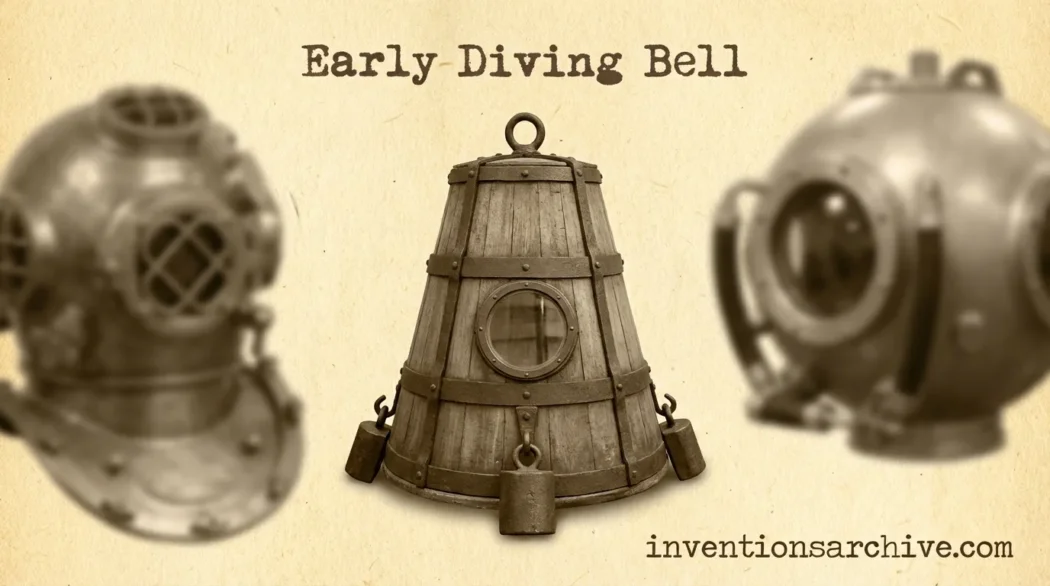
| Invention Name | Early Diving Bell |
| Short Definition | Inverted chamber that traps air so people can pause, breathe, and work below the surface. |
| Approximate Date / Period | 4th c. BCE Debated; 1535 CE Approximate; late 1700s Approximate |
| Geography | Mediterranean; Renaissance Italy; Britain; Europe-wide adoption |
| Inventor / Source Culture | Anonymous / collective; later documented: Guglielmo de Lorena; Edmond Halley; John Smeaton |
| Category | Underwater engineering; salvage; maritime infrastructure |
| Importance | • Extended underwater work time • Opened practical routes to inspection, salvage, and construction |
| Need / Origin | Longer bottom time than breath-hold diving allows |
| How It Works | Trapped air resists incoming water; pressure sets the waterline inside |
| Materials / Tech Basis | Wood or metal shell; ballast; ropes/hoist; later air valves, hoses, pumps |
| Early Use Contexts | Harbor work; wreck inspection; retrieval and repair tasks |
| Spread Route | Mediterranean ideas → Italian experiments → Northern Europe → industrial engineering |
| Derived Developments | Air-replenished bells; diving helmets; caissons; modern wet and closed bells |
| Impact Areas | Engineering; trade ports; science; major infrastructure |
| Debates / Different Views | Ancient texts: diving bell vs snorkel interpretation |
| Precursors + Successors | Breath-hold diving → trapped-air chambers → pumps/valves → pressure-rated transfer bells |
| Influenced Variants | Open (wet) bell; closed (dry) bell; rescue bell; pneumatic caisson |
The early diving bell is one of the simplest ideas in underwater technology, and that is its power. An upside-down chamber holds a pocket of air, creating a small, usable space below the waterline. In practice, this became a bridge between breath-hold diving and the later world of surface-supplied diving systems. At its core is trapped air—reliable, predictable, and surprisingly capable when paired with careful engineering.
Table Of Contents
Diving Bell Overview
A classic diving bell is an inverted container lowered into water, open at the bottom, with an air pocket trapped inside. That air pocket becomes a small “dry” zone where heads can rise out of the water. It sounds almost too simple, yet simple geometry plus pressure balance can create a stable working space. The key behavior to remember is the moving boundary between air and water inside the bell, sometimes called the internal waterline.
- Open bottom lets water enter partway, but not all the way.
- Ballast keeps the bell upright and prevents it from floating away.
- A hoist line controls depth and recovery from the surface.
Early Evidence and Timeline
Long before standardized diving gear, writers described ways to carry air underwater. A Smithsonian Ocean timeline preserves a well-known ancient passage about lowering a cauldron that holds air, and it also lists later milestones such as a documented 1535 bell used for wreck exploration near Rome and a 1707-era lockout bell associated with Edmond Halley (Details-1).
What “Early” Usually Means
In diving-bell history, early often spans three layers: written descriptions, experimental devices, and reliable working systems. The first layer can be interpretive. A text might describe a bell-like effect without proving routine use. That ambiguity is part of the story, and it explains why “first” claims should be handled with care.
A Compact Timeline
- 4th c. BCE: texts describe air retained under an inverted container.
- 1500s: documented experiments connect bells to salvage and inspection.
- 1600s–1700s: improvements focus on air replenishment and longer stays.
- Late 1700s: pumping fresh air becomes a practical turning point.
Interpretation note: Some ancient references are read as a diving bell; others as a different breathing aid. The practical engineering record becomes clearer once designs include repeatable lifting methods and a way to manage air quality.
How Diving Bells Work
A diving bell works because air and water find a balance. Lower the bell and the surrounding water pressure rises. The trapped air compresses, so the water level inside climbs. Raise the bell and pressure drops, the air expands, and the internal waterline falls. This is pressure equilibrium in action, and it explains why the bell’s air space changes with depth without needing complex machinery. The bell becomes a stable pocket of breathable space as long as fresh air is maintained.
Inside The Bell
- Air pocket sits above the internal waterline.
- CO₂ build-up becomes the limiting factor before oxygen runs out in many cases.
- Visibility depends on windows, light, and water clarity.
At The Surface
- Hoisting gear sets depth and keeps the bell steady.
- Air management can be passive (short stays) or active (supplied air).
- Signals and lines keep coordination clear.
Air Supply and Key Improvements
The earliest bells could trap air, yet the air did not stay usable for long. The leap forward came from ideas that kept the bell’s air refreshed. In a Royal Society publication, Edmond Halley describes methods for providing air at depth and staying underwater longer (Details-2).
A Model That Captures The Idea
A Science Museum Group collection record describes a model of Halley’s diving bell, noting its tinplate construction and the broader point that a simple bell, without refreshed air, could only support brief periods (Details-3). That detail matters because it frames the real engineering problem: not getting down, but staying useful.
- Valves and stopcocks help control incoming air and exhaust.
- Weighted air containers (or later hoses) support longer operations.
- Stable ballast keeps the chamber upright under changing buoyancy.
By the end of the 18th century, John Smeaton’s use of an air pump is often highlighted as a point where the diving bell became far more workable for sustained tasks (Details-4). The story shifts from a clever container to a managed air system, and the bell starts to look like a true tool of underwater engineering.
Materials and Practical Limits
Early bells appeared in wood, iron, and later more refined metalwork. Material choice shaped everything: weight, durability, and how easily a bell could carry fittings like windows or valves. Even when air could be replenished, there were stubborn limits. Depth increases squeeze the air space, and any leak becomes more demanding. A bell also has to remain steady, because a tilted bell changes the internal waterline fast. Designers learned that stability is not a detail; it is the whole point. Comfort mattered too, in a quiet way: a bell that jolts, swings, or clouds with silt stops being usable even if the air stays breathable.
Related articles: Submarine (Cornelis Drebbel) [Renaissance Inventions Series]
- Ballast: counters buoyancy and resists wave-driven motion.
- Open-bottom geometry: affects how calmly the waterline settles.
- Windows: trade visibility for structural complexity.
Types and Variations
“Diving bell” can mean more than one design. The earliest idea is the open (wet) bell, where water occupies the lower portion and air occupies the upper portion. Later systems expand the concept into sealed transfer chambers. The names vary, but the distinction is consistent: whether the bell is open to the surrounding water at the bottom, or pressure-rated as a closed vessel. Across all of them, air management is the defining feature.
| Type | Core Idea | Typical Use |
| Open (Wet) Bell | Air pocket above internal waterline | Short-to-moderate work at depth |
| Closed (Dry) Bell | Sealed chamber with controlled pressure | Transfer to a worksite with stable conditions |
| Rescue Bell | Specialized recovery and transfer capsule | Emergency access and safe transport |
| Bell-Like Habitat | Larger “room” using the same trapped-air interface | Extended underwater presence |
Common Historical Uses
Early diving bells were built for work, not spectacle. They supported tasks where time underwater mattered and a brief “air break” changed what was possible. In ports and rivers, the bell served as a small staging space. In clearer water, it could even support inspection and documentation. When infrastructure projects demanded dry working conditions below water, the trapped-air idea also influenced pressurized construction methods.
- Wreck inspection and selective recovery of cargo or fittings
- Harbor maintenance and underwater repairs
- Foundation work where controlled air spaces improved access
Diving Bell and Pneumatic Caisson
The diving bell’s logic scales up: if an air pocket can keep a small chamber usable, a larger air-filled box can keep a work zone drier for construction below the waterline. A National Archives page describing Brooklyn Bridge foundations notes that pneumatic caissons used air pressure to keep the work site dry while bridge foundations were built (Details-5). The connection is conceptual: air against water, shaped into a tool.
Design Details That Mattered
Many early descriptions focus on the “bell” as a single object, yet the working system is larger. The chamber needs a lifting arrangement, stable lines, and a way to manage air. Small choices often decided whether the bell was merely interesting or truly productive. A wider opening can feel inviting, then become unstable in moving water. More ballast can steady the bell, then become hard to handle. Designers gradually converged on a balanced approach: controlled descent, predictable stability, and air renewal matched to depth.
Core Parts
- Shell: the main chamber, shaped for stability.
- Ballast: weight low on the bell to prevent rolling.
- Rigging: lines for lowering, raising, and guiding.
Working Features
- Air control: valves, hoses, or replenishment methods.
- Communication: signals and procedures for coordination.
- Visibility: windows or viewing ports where practical.
FAQ
Why Does Water Not Fill a Diving Bell Completely?
The trapped air pushes back. As outside pressure increases with depth, the air compresses until the internal air pressure matches the surrounding water pressure at the opening. That balance fixes the waterline inside the bell.
Was Aristotle Describing a True Diving Bell?
Some readers treat the ancient “cauldron” passage as the first written description of the diving bell effect. Others read it as a different breathing aid. The key point is that the trapped-air principle was known early, even if routine engineering use came later.
What Limited Early Diving Bells Most: Depth or Time?
Both mattered, yet time often failed first because air quality degrades in a closed space. Once designs included reliable air replenishment, bells became far more useful at consistent working depths.
What Did Later Improvements Add to the Basic Bell?
Better stability, more reliable lifting control, and above all, air management. Valves, pumps, and replenishment methods turned a clever container into a dependable tool for repeated work.
How Is a Pneumatic Caisson Related to a Diving Bell?
They share the same core logic: air pressure can hold back water and create a usable space below the waterline. A caisson scales that logic into a larger working chamber for construction.
What Is the Difference Between an Open Bell and a Closed Bell?
An open (wet) bell is open to the water at the bottom and holds an air pocket above the internal waterline. A closed (dry) bell is a sealed chamber designed to manage internal pressure and support controlled transfer.