
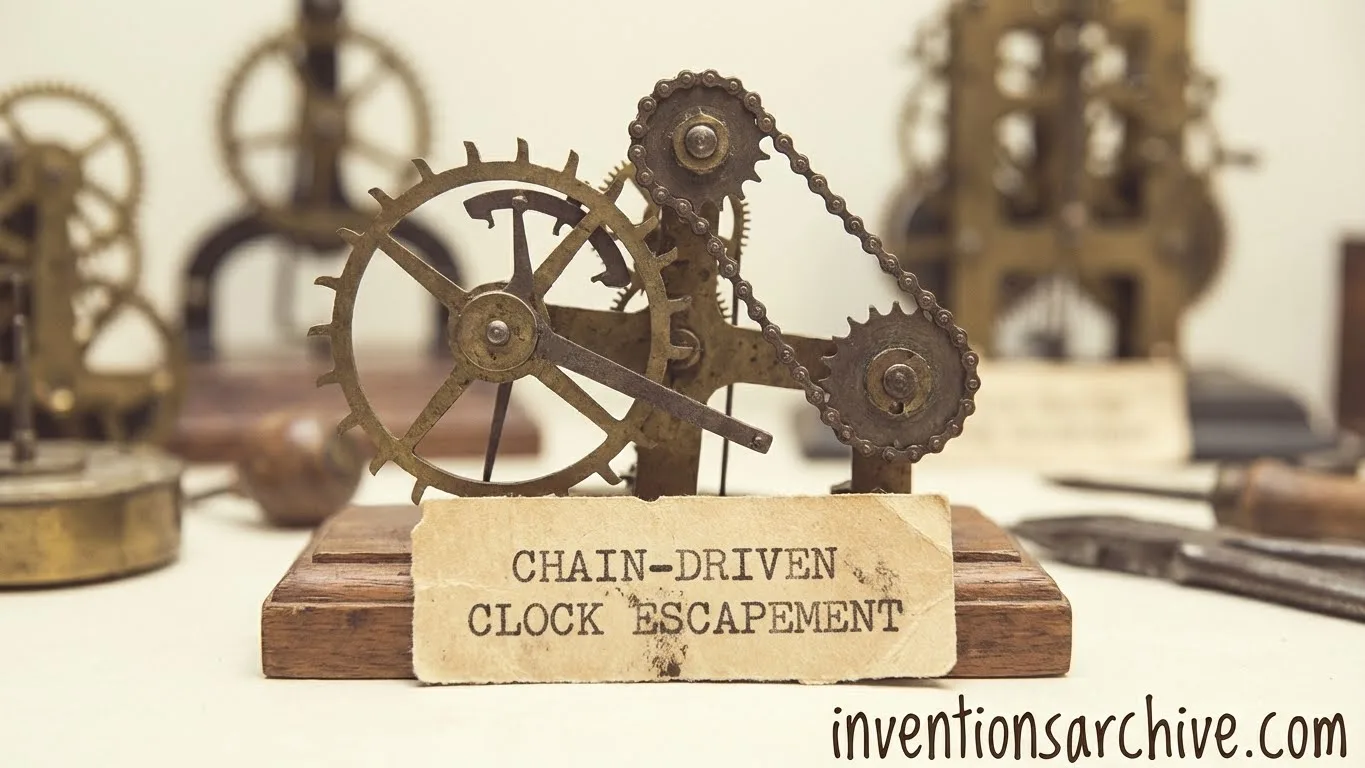
| Invention Name | Chain-Driven Clock Escapement |
|---|---|
| Short Definition | Escapement-regulated clockwork paired with a chain transmission for controlled, long-distance power transfer |
| Approximate Date / Period | Late 11th century (c. 1086–1092) Approximate |
| Geography | Kaifeng, Northern Song China |
| Inventor / Source Culture | Su Song; Northern Song engineering team |
| Category | Timekeeping; mechanical engineering; astronomical instruments |
| Why It Matters | Controlled periodic motion; reliable vertical power transmission; automated display coordination |
| Need / Problem | Stable time signal for complex displays; coordinated motion across multiple tower levels |
| How It Works | Power source → escapement regulator → gear train → chain transmission → driven displays |
| Materials / Technical Basis | Water power; gears; chain-and-sprocket style transmission; mechanical linkages |
| First Known Use Context | Astronomical observation; calendar time; public time display |
| Spread Route | Documented in technical treatise; later studied via reconstructions and models |
| Derived Developments | Escapement-centered clock design; multi-stage power distribution; later chain-transmission clockwork |
| Impact Areas | Science; education; craftsmanship; public time culture |
| Debates / Different Views | Exact internal geometry varies across reconstructions Discussed |
| Precursors + Successors | Clepsydra-based regulators → escapement clocks → advanced mechanical regulators |
| Key People / Dynasties | Northern Song; Su Song |
| Notable Variants It Inspired | Endless chain transmission for tower displays; chain-assisted winding/drive in later clockmaking |
Chain-driven clock escapement refers to a timekeeping architecture where an escapement creates a regular stop-and-release rhythm, while a chain transmission carries that controlled motion to parts of a clock that may sit far from the power source. One celebrated historical example is Su Song’s Northern Song clock tower, described as adding a chain-driven mechanism to a water-powered system.Details
Table Of Contents
What It Is
Escapement
An escapement is the clock’s time gate. It repeatedly locks and releases a moving wheel so rotation becomes a measured sequence, not a runaway spin. In Su Song’s tower, a water-driven escapement concept is described as part of the mechanism in the late 11th century.Details
Chain Transmission
The chain is the clock’s motion carrier. Instead of relying only on short gear trains near the power source, a linked chain can move torque upward or across a tower with steady engagement. That makes multi-level displays easier to coordinate without forcing the main drive to sit close to every dial.
Why The Chain Matters
A chain-driven layout shines when a clock must deliver one regulated rhythm to several outputs spread over distance. In tower-scale systems, the chain can act like a vertical backbone, keeping the drive compact at the base while still turning higher mechanisms.
- Reach: carries motion across height without demanding a single long, fragile shaft.
- Grip: engages reliably with toothed wheels, reducing slip compared to smooth belts.
- Modularity: supports separate sub-systems (display, striking, astronomical motion) that still share one regulator.
Early Evidence And Timeline
| Time Window | What Is Documented | Why It Matters |
|---|---|---|
| c. 1086 Approximate | Design stage for a large astronomical clock tower | Shows the project was planned as an integrated time + sky system, not a single dial |
| 1088 Approximate | Construction described for a tall tower with water drive and controlled motion | Links power to a regulated cycle suitable for time display |
| 1092 Approximate | Technical writing on the design and operation is referenced in museum-level commentary | Preserves a route for later reconstruction and study |
A concise institutional summary notes the clock was first designed in 1086, built as a tall wooden tower (about 40 ft), and powered by a water-driven large gear wheel that started and stopped at fixed intervals.Details
How It Works
The Power Path
- Power source provides continuous force (often described as water-driven in tower systems).
- Escapement converts that force into a stepped rhythm.
- Gear train shapes speed and torque for each task.
- Chain transmission carries motion to distant outputs with repeatable engagement.
The Time Gate In Plain Terms
In a chain-driven escapement system, the escapement is the key to regularity. It holds a wheel, then releases it in controlled steps, so each step can be counted. A museum curator’s overview describes the internal mechanism as similar to the escapement used in modern clocks, with the design and operation recorded in a dedicated technical work.Details
What The Chain Adds
The chain is not there to “make time.” It helps deliver the regulated motion to where it is needed. In tall clockwork, that can mean transferring torque upward so a top-mounted display can rotate while the regulator stays near the main drive. The result is a cleaner architecture: one steady rhythm, many coordinated motions.
Types And Variations
“Chain-driven clock escapement” can describe a family of layouts. The shared idea is a regulated step paired with a linked drive that carries motion beyond a compact gear cluster. The differences often sit in the power source and the purpose of the chain.
Tower-Scale Chain Transmission
- Use: move regulated motion to upper displays.
- Typical outputs: rotating astronomical instruments; visual time indicators.
- Signature: one regulator feeding multiple, separated mechanisms.
Drive-And-Regulate Separation
- Goal: keep the escapement in a stable zone while relocating the drive path.
- Benefit: simpler routing of torque around architectural constraints.
- Common theme: chain as a dependable connector, not the timekeeper.
Reconstruction-Focused Variants
Because many early tower mechanisms survive mainly through technical descriptions and later scholarship, modern understanding often comes from reconstruction work. A detailed engineering chapter surveys feasible reconstructions of Su Song’s escapement regulator and compares designs against the technological limits of the time.Details
Core Parts And Roles
| Part | Role In The System | What To Look For In Descriptions |
|---|---|---|
| Regulator / Escapement | Creates countable steps | Language like “stops and starts,” “fixed intervals,” “release,” “lock” |
| Primary drive | Supplies force to keep motion going | Often described as water-driven in tower designs |
| Gear train | Scales speed and torque for different tasks | Mention of “wheels,” “pinions,” “ratios,” “stages” |
| Chain transmission | Moves torque across distance | “Chain-driven mechanism,” “power-transmitting system,” “vertical transfer” |
| Outputs | Show or signal time and cycles | Dials, figures, striking elements, rotating globes or spheres |
FAQ
Is a chain-driven clock escapement a single “part” or a system?
It is best understood as a system: an escapement regulates time in steps, and a chain transmission helps carry that regulated motion to distant outputs.
What does the chain contribute that gears alone may not?
A chain can transfer torque across larger distances and around spatial constraints while maintaining reliable engagement with toothed wheels. In tower layouts, it supports clean vertical power transfer.
Why are Su Song’s designs often discussed with this topic?
Institutional summaries describe a Northern Song tower that combined a regulated cycle with a power-transmitting system, including a chain-driven mechanism for coordinated motion across the structure.
Does the escapement “create” accuracy by itself?
The escapement enforces a repeatable rhythm, which is essential for timekeeping. Overall performance still depends on the broader design: power stability, friction, and how motion is distributed through the mechanism.
Why do reconstructions sometimes differ in details?
Early complex mechanisms are often known through technical descriptions and partial evidence. Modern reconstructions test what is mechanically feasible while staying consistent with period materials and methods.