
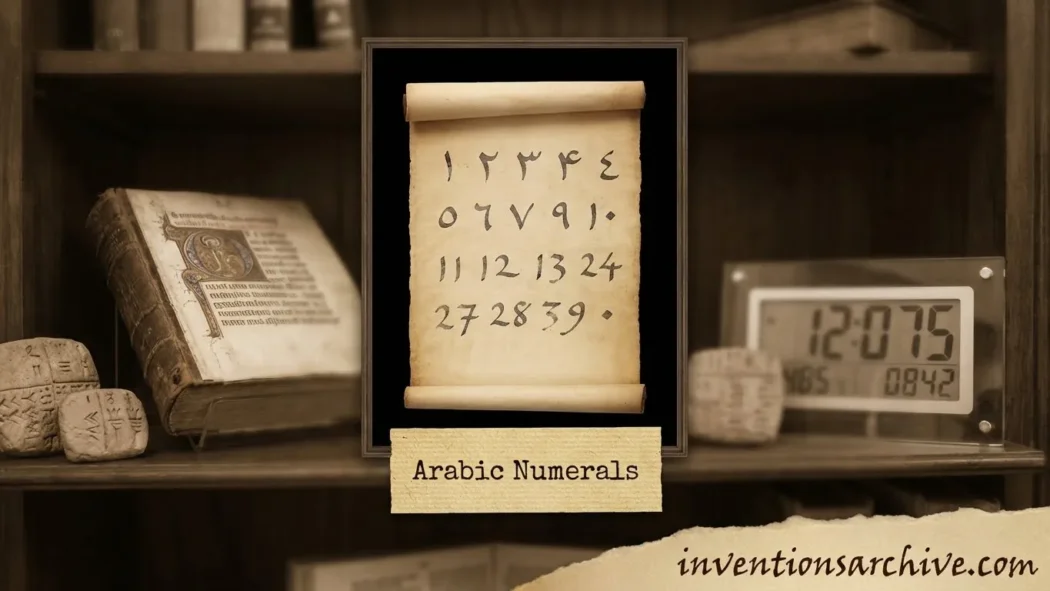
| Invention Name | Arabic Numerals (also known as Hindu-Arabic numerals) |
| Short Definition | A decimal numeral system using ten digits and place value to write any number. |
| Approximate Date / Era | Core ideas in ancient India; transmission and expansion in 8th–12th centuries Approximate |
| Geography | India; West & Central Asia; Mediterranean Europe |
| Inventor / Source Culture | Collective; Indian mathematicians; later Arabic-language scholars (transmission) |
| Category | Mathematics; notation; communication |
| Importance |
Place value + zero Fast written calculation; record-keeping scale |
| Need / Motivation | Reliable counting; trade records; astronomy; education |
| How It Works | Base-10; digit position sets value; 0 marks empty places |
| Material / Tech Basis | Writing; symbols; positional notation rules |
| Early Use Context | Mathematical texts; computation methods; scholarly exchange |
| Spread Route | India → Arabic-language learning → Latin Europe |
| Derived Developments | Algorithmic arithmetic; bookkeeping methods; standardized numeracy |
| Impact Areas | Education; science; commerce; engineering; computing |
| Predecessors + Successors | Non-positional numerals → positional decimal digits → global digit standards |
| Influenced Variants | Western digit shapes; Arabic-Indic digits; Eastern Arabic-Indic digits; Indian script digits |
| Notes on Naming | “Arabic” often names the route of spread not the first invention |
Arabic numerals are the 0–9 symbols many people use every day, yet the real invention is bigger than the shapes. It is a place-value system that lets small marks carry large meaning. With zero holding empty places and position setting value, this system turned written calculation into a practical tool for science, trade, and later the digital world.
Contents
What Arabic Numerals Are
In strict terms, a numeral is a written symbol for a number, while a number is the abstract idea. Arabic numerals usually means the familiar 0–9 shapes. In many academic contexts, the broader phrase Hindu-Arabic numeral system is used to highlight the two key layers: Indian origin of the core method and Arabic-language transmission that carried it widely.
The system matters because it compresses meaning. A single digit can stand for ones, tens, or thousands depending on where it sits. That simple rule is the engine behind fast arithmetic, clear accounting, and the compact notation used across science and engineering.
Two Pieces That Travel Together
- Method: positional decimal notation with place value
- Glyphs: the written digit shapes used in different regions
Origins and Early Spread
Historians generally describe the story like this: the decimal idea and early digit forms grew in India, then traveled west through Arabic-language scholarship and translation, eventually reaching Latin Europe. That path is the reason many books call the system Hindu-Arabic.Details
One reason the system spread so well is its practical feel. Merchants needed dependable records, astronomers needed clean computation, and educators needed a teachable pattern. The same compact logic served all of them.
Timeline and Cultural Movement
| Phase | What Changes | Why It Matters |
|---|---|---|
| Early Indian Development | Decimal thinking; evolving digit symbols | Creates a flexible base for place value |
| Arabic-Language Scholarship | Teaching texts; systematic calculation methods | Turns numerals into portable knowledge |
| Latin Europe | Translation; commercial arithmetic manuals | Builds a shared numeral language for trade |
| Print Era Standardization | More uniform digit shapes | Makes written numbers easy to read across borders |
Zero and Place Value
Zero is both humble and powerful. In everyday writing, 0 often works as a placeholder, marking an empty spot so other digits keep their meaning. In 505, the middle 0 says “no tens,” while still preserving hundreds and ones.
There is also a deeper shift: zero becomes a number in its own right, something that can be added, subtracted, and used to express ideas cleanly. That step supports consistent arithmetic rules and makes larger systems—from measurement to finance—feel stable and predictable.
A famous manuscript linked to early zero notation is the Bakhshali manuscript, associated with a dot-like placeholder form. Scientific testing reported that parts of the manuscript material date to the 3rd–4th century, while other leaves come from later centuries, showing the object is a multi-period collection rather than a single-page snapshot.Details
Place Value in One Glance
| Number | Thousands | Hundreds | Tens | Ones |
|---|---|---|---|---|
| 5,047 | 5 | 0 | 4 | 7 |
The 0 does not “add value” by itself here. It protects the meaning of every other digit.
How the System Works
The system is built on a few rules that stay consistent across languages and scripts. Those rules are why the method is evergreen: the same logic fits a classroom worksheet, a lab notebook, or a spreadsheet.
- Base ten: each step to the left is 10× the value of the step to the right.
- Ten digits: 0 through 9 repeat as needed to build larger numbers.
- Position creates meaning: the same digit can mean 2, 20, or 200.
- Zero keeps structure: it marks empty positions so the number stays unambiguous.
Why Written Calculation Becomes Fast
With place value, many operations reduce to repeated patterns. Carrying and borrowing are simple moves because each column has a fixed meaning.
Related articles: Zero [Ancient Inventions Series], Decimal System (India) [Ancient Inventions Series]
Why Records Become Clear
On a ledger page, digits align into columns. That alignment makes totals, differences, and comparisons readable at a glance.
Digit Forms and Variants
One common surprise: the idea is shared, yet the shapes vary. Many Arabic-script contexts use Arabic-Indic digits (٠١٢٣٤٥٦٧٨٩), while Persian and some neighboring contexts often use Eastern Arabic-Indic digits (۰۱۲۳۴۵۶۷۸۹). The global “Western” shapes remain 0123456789. Unicode encodes these digit families as standard characters so modern text stays consistent across devices.Details
| Common Name | Digit Set | Typical Use |
|---|---|---|
| Western Arabic Digits | 0123456789 | International print; science; global interfaces |
| Arabic-Indic Digits | ٠١٢٣٤٥٦٧٨٩ | Arabic-script publishing and regional usage |
| Eastern Arabic-Indic Digits | ۰۱۲۳۴۵۶۷۸۹ | Persian and some nearby contexts |
This is why the name Arabic numerals can mean two things in everyday conversation: the global 0–9 shapes or the Arabic-Indic shapes. The underlying place-value logic stays the same.
Related Writing-System Variations
- Indian scripts have their own digit forms while sharing the same decimal structure.
- Typography changes styling (serif, sans, lining, oldstyle), but preserves meaning.
- Digital design supports localized digits without changing the number itself.
Adoption in Europe
In medieval Europe, Roman numerals remained familiar for a long time. The shift accelerated as practical arithmetic texts gained readers. A landmark is Liber abaci (1202) by Leonardo of Pisa, widely known as Fibonacci, which introduced the “Hindu-Arabic” numeral system and calculation approaches to a Western audience.Details
Adoption was not a single event. It was a gradual change in habits: merchants, teachers, and administrators learned that place value and zero made records easier to maintain and calculations quicker to check. Over time, the new symbols became the default for written numbers.
Modern Impact
Arabic numerals are now a shared global tool. They appear in textbooks, contracts, medicine labels, maps, laboratory results, and on-screen keyboards. That reach comes from the system’s clean separation between meaning (place value) and style (digit shapes).
Where You Meet Them Daily
- Time and dates on devices and calendars
- Money in prices, invoices, and banking apps
- Measurement in cooking, travel, and construction
- Science in graphs, formulas, and data tables
What They Enable
- Compact notation for very large and very small values
- Reliable calculation with standard written methods
- Shared formatting in international documents and software
- Digit localization without changing numeric meaning
Closely Related Innovations
- Positional notation as a general idea (used beyond base ten as well)
- Written algorithms for arithmetic (repeatable steps, easy to teach)
- Standard digit encoding so modern systems display numbers consistently
FAQ
Why are they called “Arabic” numerals?
The name often reflects the route of transmission into Europe through Arabic-language scholarship. The core place-value method is commonly described as having Indian origins.
Are Arabic numerals the same as Arabic-Indic digits?
They are related but not identical. “Arabic numerals” often means 0123456789 globally, while Arabic-Indic digits are ٠١٢٣٤٥٦٧٨٩. Both express the same decimal place-value system.
What does zero do in this system?
0 can mark an empty position so other digits keep their meaning, and it also functions as a number with its own arithmetic role. That dual role supports clean, scalable notation.
Can the same digit mean different values?
Yes. In a place-value system, a digit’s position sets its value: 2, 20, and 200 use the same symbol but different places. This is why the system stays compact.
Why did these numerals spread so widely?
The system is easy to scale, easy to teach, and efficient for written calculation. Once communities share the same notation, records and learning move faster with less confusion.