
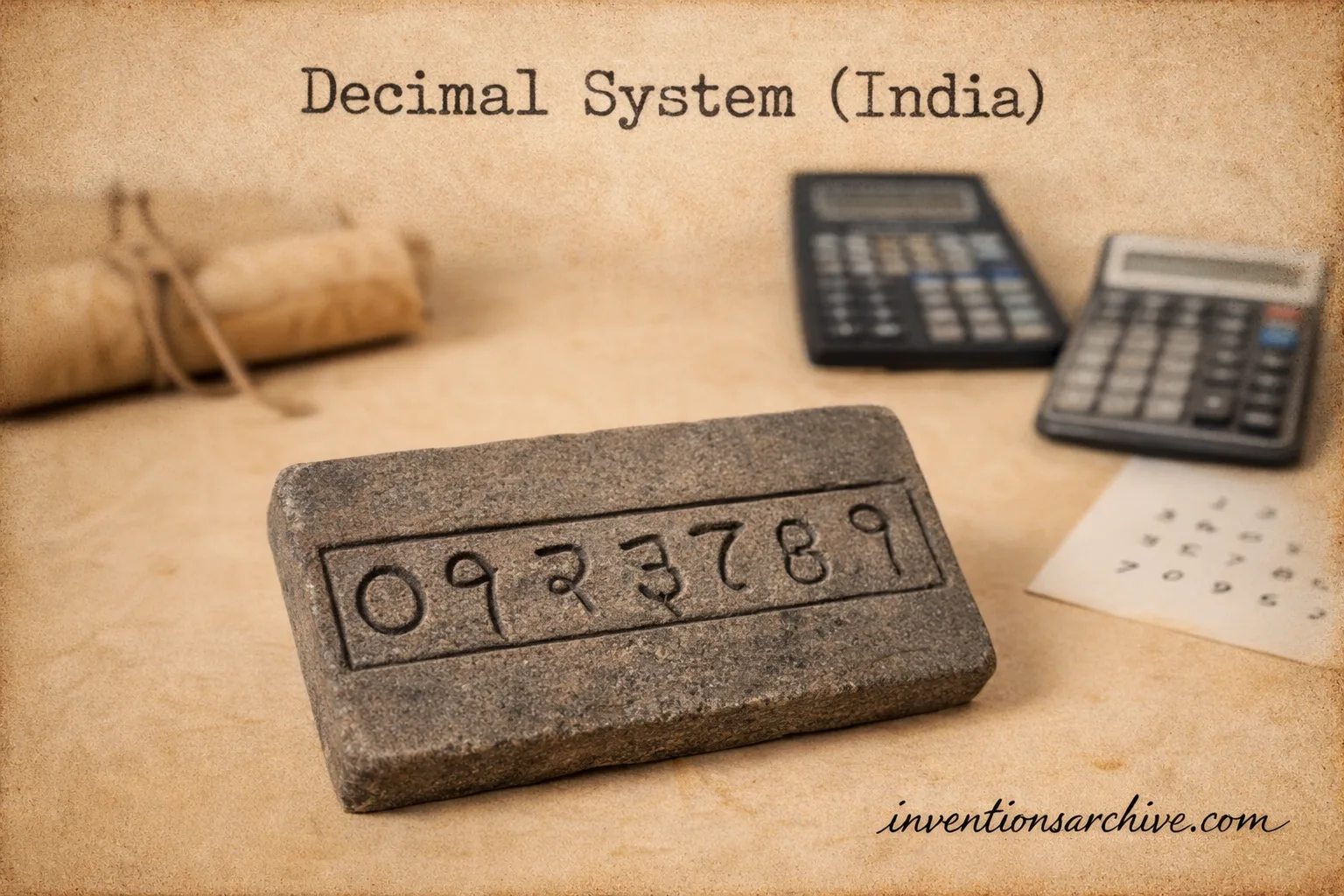
| Invention Name | Decimal Place-Value Numeral System in the Indian mathematical tradition |
|---|---|
| Short Definition | A numeral system in which a digit’s value depends on its position, using powers of ten and a zero marker for empty places. |
| Approximate Date / Period | Developed over several centuries; clear Indian place-value evidence by the late 6th century, with zero as a number established by about the 7th century. Approximate |
| Geography | Indian subcontinent; later transmitted through Arabic mathematical writing and then into Europe. |
| Inventor / Source Culture | Anonymous and collective; shaped by Indian mathematical, astronomical, commercial, and scholarly traditions. |
| Category | Mathematics, measurement, education, administration, science, commerce. |
| Main Problem Solved | Writing large numbers compactly and making calculation easier without a separate symbol for every value. |
| How It Works | Each digit stands in a place: ones, tens, hundreds, thousands, and so on; zero marks an empty place. |
| Evidence Status | Based on mathematical texts, inscriptions, manuscript evidence, and later historical transmission. Based on surviving evidence |
| Important Associated Figure | Brahmagupta, who wrote formal rules involving zero and negative numbers in the 7th century. |
| Surviving Evidence | Indian mathematical writings, the Gwalior inscription, and manuscript material such as the Bakhshālī manuscript. |
| Development Path | Number names and earlier numerals → Indian decimal place value → zero notation → Hindu-Arabic numerals → modern written arithmetic. |
| Related Inventions | Zero, abacus, counting boards, Hindu-Arabic numerals, written arithmetic algorithms, algebraic notation. |
| Modern Descendants | School arithmetic, accounting, scientific notation, calculators, spreadsheets, programming, digital computation. |
The decimal system associated with India is one of the most useful inventions in the history of calculation. Its strength is simple: the same ten symbols can express small numbers, large numbers, and empty places by position. A 5 can mean five, fifty, five hundred, or five thousand depending on where it stands. That idea made written arithmetic more compact, more teachable, and more reliable than many older numeral systems.
Today this may feel obvious. It was not obvious when numbers were written with repeated marks, additive signs, counting tokens, or letter-based symbols. The Indian decimal place-value system joined three ideas that work together: ten-based grouping, positional value, and a mark for an empty place. When these ideas were used together, arithmetic could be written and taught in a cleaner form.
What the Decimal System Is
The decimal system is a base-ten system. It groups numbers by powers of ten: ones, tens, hundreds, thousands, ten-thousands, and so on. In a place-value system, the position of a digit changes its value.
For example, the digit 2 has different values in these numbers:
- 2 means two ones.
- 20 means two tens.
- 200 means two hundreds.
- 2,000 means two thousands.
The symbol 0 makes this system practical. It shows that a place is empty. Without zero, it is harder to distinguish 205 from 25 or 2,005 from 205. In the Indian tradition, zero became more than a blank space. It became a concept that could be handled in arithmetic, discussed by mathematicians, and carried into later number systems.
The system is often called the Hindu-Arabic numeral system because the numerals developed in Indian mathematical culture and were later transmitted, studied, and adapted through Arabic scholarship before reaching medieval Europe.
How Its Origin Is Traced
The origin of the decimal system in India is traced through several kinds of evidence rather than through one surviving “first” document. Historians look at written numerals, mathematical treatises, inscriptions, manuscript traditions, and later translations.
MacTutor’s history of Indian numerals notes that the Indian system became a place-value system and that our modern place-value notation is a direct descendant of it. The same source also warns that Indians were not the first people in history to develop any kind of place-value system, which helps keep the claim accurate rather than exaggerated. [b]
This distinction is important. Earlier cultures, including Mesopotamian mathematical traditions, had positional ideas. What made the Indian decimal system especially powerful was the combination of base ten, written digits, and zero in a form that could travel across languages and teaching traditions.
Why a Single Inventor Is Hard to Name
No reliable evidence points to one named inventor of the decimal system in India. The better explanation is collective development. Merchants, scribes, astronomers, teachers, and mathematicians all had reasons to prefer a system that made numbers easier to write and calculate.
Named mathematicians enter the story later because they left texts. Brahmagupta is especially important, but he should not be described as the inventor of the decimal system. His role was closer to formal explanation and mathematical development, especially around zero and rules of arithmetic.
The Problem It Answered
Before place-value notation, many number systems needed different symbols for different ranks or repeated signs to build larger numbers. That could work for recording totals, but it made written calculation slower and less flexible.
The decimal place-value system answered several practical needs:
- Large numbers could be written with fewer symbols.
- Calculations could be arranged step by step on a page, board, or dust surface.
- Students could learn general rules instead of memorizing many separate symbols.
- Astronomers and mathematicians could handle long numerical tables more efficiently.
- Administrative and commercial records became easier to copy and compare.
The system did not remove all difficulty from mathematics. It made number writing more economical. That economy gave later arithmetic, accounting, astronomy, engineering, and education a cleaner written base.
How It Worked in Simple Terms
The decimal system works because every place is ten times the place to its right. The rightmost whole-number place is ones. Moving left gives tens, hundreds, thousands, and larger powers of ten.
In the number 4,708:
- 4 means four thousands.
- 7 means seven hundreds.
- 0 means no tens.
- 8 means eight ones.
The zero is not decorative. It keeps the 8 in the ones place. Without it, the written number would collapse into a different value. This is why zero as an empty-place marker was such a useful step in written arithmetic.
Earlier Ideas Before the Indian Decimal System
The decimal system did not appear from nowhere. It grew from older counting habits, number words, written marks, and administrative needs. Many societies counted in tens because human hands made ten a natural grouping. The deeper change was to make the written position of a digit carry the rank of the number.
Before the mature decimal place-value system, people used different ways to count and record numbers:
- Tally marks for simple counting.
- Counting boards and movable counters for calculation.
- Numeral signs derived from earlier scripts, including Brahmi numerals.
- Word-based number systems for naming large powers of ten.
- Astronomical and administrative tables that required repeated numerical work.
The Indian decimal system made these earlier practices easier to write in a stable form. It did not replace mental calculation, counting devices, or teaching aids overnight. It gave them a more compact written language.
Before and After the Decimal System
| Before the Invention | What Changed After It |
|---|---|
| Large numbers often needed many marks, special signs, or word-heavy expressions. | Large numbers could be written with a small set of symbols arranged by place. |
| Calculations depended heavily on counting devices, tables, or repeated procedures that were harder to record. | Written arithmetic became easier to arrange, copy, teach, and check. |
| An empty position in a number could create ambiguity. | Zero could mark an empty place, helping distinguish values such as 205 and 25. |
| Numeral systems often worked well locally but could be difficult to adapt across languages. | Place-value digits could travel through translation, trade, astronomy, and education. |
| Advanced numerical work required more cumbersome notation. | Astronomy, accounting, algebra, and later scientific calculation gained a clearer written tool. |
The Development Path
The development path is best understood as a sequence, not a sudden switch. There were earlier number names and written signs. Then place value became more visible. Then zero gained a stronger role. Later, the system moved through Arabic mathematical culture and into Europe.
| Stage | Form | What Changed |
|---|---|---|
| Earlier Tool | Counting marks, counters, number words, and early numeral signs. | Numbers could be counted and recorded, but large values were less compact. |
| Early Indian Numerals | Brahmi-derived numeral forms and decimal number names. | Written number signs and base-ten thinking became more developed. |
| Decimal Place Value | Digits gained value from position in a base-ten structure. | A small number of signs could express many values. |
| Zero Notation | A mark for an empty place, later treated as a mathematical number. | Numbers with internal empty places became clearer; arithmetic rules expanded. |
| Later Form | Hindu-Arabic numerals in Arabic mathematical writing. | The system entered wider scholarly and commercial circulation. |
| Modern Descendant | Global decimal numerals used in education, science, finance, and computing. | Place-value arithmetic became a shared numerical language across much of the world. |
Main Forms and Variations
The decimal system is sometimes discussed as if it were only the modern symbols 0, 1, 2, 3, 4, 5, 6, 7, 8, and 9. That is too narrow. The deeper invention is the notation principle. The symbols changed across regions and scripts, while the place-value logic stayed recognizable.
| Form or Variation | What It Means |
|---|---|
| Decimal number names | Names for powers of ten helped support base-ten thinking and large-number expression. |
| Brahmi-derived numerals | Earlier Indian numeral shapes that contributed to later digit forms. |
| Place-value notation | A digit’s value changes according to its position in the written number. |
| Zero marking an empty place | A sign marks an empty place so the written number keeps its correct value. |
| Zero as a number | Zero becomes part of arithmetic rules, not merely a blank marker. |
| Hindu-Arabic numerals | The later family of numerals transmitted through Arabic scholarship and adapted into Europe. |
| Modern decimal notation | The global school and scientific notation used in everyday arithmetic, finance, science, and technology. |
Brahmagupta and Zero
Brahmagupta, active in the 7th century, is one of the most important named figures in this story. He did not invent the whole decimal system. His importance lies in the written mathematical treatment of zero, negative numbers, and arithmetic rules within Indian mathematics.
MacTutor records that Brahmagupta wrote the Brāhmasphuṭasiddhānta in 628 and worked in the mathematical-astronomical tradition connected with Ujjain. [c]
That matters because astronomy needed careful numerical tables. Mathematical astronomy pushed scholars to handle large quantities, repeated computations, and abstract rules. A strong numeral system was not just a classroom convenience. It was a practical tool for scholarly calculation.
Related articles: Early Algebra (India) [Ancient Inventions Series]
The Gwalior Inscription and Surviving Evidence
One of the best-known pieces of surviving evidence for written zero is the Gwalior inscription, often dated to 876 CE. It includes numerals such as 270, where the final symbol functions as a zero in a decimal place-value number. The Mathematical Association of America discusses this inscription as an early appearance of zero in India and explains the land-measure context in which the number appears. [d]
The Gwalior example is valuable because it is epigraphic evidence: the number appears in an inscription rather than only in a later copied text. Even so, it should not be described as “the first use of zero” in every possible sense. It is better described as an important surviving and dated example of zero in written positional notation.
The Bakhshālī Manuscript and Dating Caution
The Bakhshālī manuscript is often mentioned in discussions of Indian mathematics and zero. It contains mathematical material and has been studied closely because of its zero-like dot notation. Recent discussion must be handled carefully because radiocarbon work and manuscript interpretation are not the same thing.
An Oxford University Research Archive record published in 2024 presents radiocarbon determinations for several Bakhshālī folios. This is useful for evidence history, but a radiocarbon date for manuscript material does not automatically settle the date of every mathematical idea represented in the text. [e]
For a general reader, the safe lesson is this: the Bakhshālī manuscript supports the importance of Indian mathematical manuscript traditions, but claims about “the first zero” should be worded with care.
How the System Spread
The decimal place-value system did not remain limited to one region. It moved through scholarship, translation, teaching, trade, and calculation. Arabic mathematicians studied and transmitted Indian numerical methods, and later Latin texts helped carry these methods into Europe.
MacTutor’s history of Arabic numerals explains that a Latin translation associated with al-Khwarizmi describes the Indian place-value system using the numerals 1 through 9 and 0. It also notes that the original Arabic text is lost and that the surviving transmission has complications, so the history should not be oversimplified. [f]
This route helps explain the name “Hindu-Arabic numerals.” The name does not mean the system had only one cultural home. It recognizes a chain of development and transmission: Indian mathematical notation, Arabic scholarly adaptation, and later European adoption.
Real Uses in Daily and Scholarly Life
The decimal system mattered because it was useful in ordinary and advanced work. It helped people write numbers, teach arithmetic, calculate debts, record quantities, and manage tables.
Education
A small set of digits made arithmetic easier to teach. Students could learn place value, addition, subtraction, multiplication, and division through repeatable procedures rather than through a large collection of special signs.
Commerce and Administration
Records involving money, land, goods, taxes, and quantities benefit from compact number writing. The system did not create commerce, but it made many numerical records easier to prepare and compare.
Astronomy and Mathematics
Indian mathematical astronomy required repeated calculation. Tables, cycles, measurements, and rules were easier to handle with place-value notation. This is one reason the system was not just a writing habit; it belonged to a larger culture of calculation.
Later Science and Technology
Modern science, engineering, finance, and computing all depend on decimal notation or its descendants. Even when computers operate internally in binary, people still enter, read, and teach numbers mainly through decimal place-value notation.
What Changed Because of It
The decimal system changed the written handling of numbers. Its influence is easy to underestimate because the system is now ordinary. Yet its practical effects were large.
- Arithmetic became more portable: written procedures could be copied across schools and languages.
- Large numbers became less bulky: a small set of digits could express a huge range of values.
- Zero gained a stable role: empty positions could be shown clearly, and later zero could be treated as a number.
- Mathematical teaching became more systematic: place value allowed repeated rules for calculation.
- Later notation became possible: algebra, decimal fractions, scientific notation, and digital interfaces all benefited from positional thinking.
The invention’s deepest effect was not that it made people “better at math” instantly. It gave calculation a more efficient written structure.
Common Misunderstandings
“One Person Invented the Decimal System”
This is too simple. The decimal system in India developed through a wider mathematical culture. Named figures such as Brahmagupta are important, but the system itself was collective.
“Zero and the Decimal System Are the Same Invention”
They are connected, but not identical. A decimal place-value system can be discussed as a notation structure. Zero can mark an empty place and later function as a number in arithmetic.
“The First Surviving Evidence Proves the First Use”
Surviving evidence shows what has lasted and been studied. It does not always show the true beginning of an idea. This is especially important for manuscripts and inscriptions.
“Arabic Numerals Mean the System Started Only in Arabia”
The name reflects transmission as well as origin. The numerals developed from Indian traditions, were studied and spread through Arabic scholarship, and then entered Europe.
“The Modern Digit Shapes Were Always the Same”
Digit shapes changed across scripts and regions. The lasting invention was not one fixed set of shapes, but the place-value method behind them.
Related Inventions
The decimal system sits inside a wider history of counting, writing, and calculation. These related inventions and ideas help place it in context:
- Zero: closely linked to empty places and later arithmetic rules.
- Brahmi numerals: earlier Indian numeral forms connected to later digit shapes.
- Counting boards: practical tools used for calculation before and alongside written algorithms.
- Abacus: a calculation device that shows the broader history of place-based counting.
- Hindu-Arabic numerals: the later transmitted numeral family used across many regions.
- Algebraic notation: later symbolic mathematics that benefited from stable number writing.
- Decimal fractions: later extensions of place value to parts smaller than one.
- Scientific notation: a modern descendant of powers-of-ten thinking.
Frequently Asked Questions
Was the decimal system invented in India?
The decimal place-value system used in modern arithmetic is widely traced to Indian mathematical traditions, though it developed over time rather than appearing as one single event. Earlier cultures had other positional or counting systems, but the Indian decimal system with zero became the ancestor of modern decimal notation.
Who invented the decimal system in India?
No single inventor is known. The system is better understood as a collective development within Indian mathematical culture. Brahmagupta is an important named figure because he wrote influential rules involving zero in the 7th century, but he was not the sole inventor of the whole decimal system.
Why was zero important to the decimal system?
Zero made place-value notation clearer because it could mark an empty place. This helps separate numbers such as 205, 25, and 2,005. Later, zero also became a number used in arithmetic rules, which made the system more powerful.
Is the Gwalior inscription the first zero?
It is one of the most important surviving dated examples of zero in an Indian inscription, often dated to 876 CE. It should be described as major surviving evidence, not as absolute proof of the first-ever use of zero.
Why are the numerals called Hindu-Arabic?
The name reflects both origin and transmission. The numeral system developed from Indian mathematical traditions and was later studied, adapted, and spread through Arabic scholarship before becoming common in Europe.
Sources and Verification
- [a] Decimal System in India | SpringerLink — Used to verify the broader scholarly framing of the decimal system in India as a major mathematical and practical innovation. (Reliable because it is an academic reference entry published by Springer.)
- [b] Indian numerals – MacTutor History of Mathematics — Used to verify the development of Indian place-value numerals, the caution that Indians were not the first to create any positional system, and the later transmission of Indian numerals. (Reliable because it is a university-hosted history of mathematics resource.)
- [c] Brahmagupta – MacTutor History of Mathematics — Used to verify Brahmagupta’s dates, his 628 work, and his role in Indian mathematics and astronomy. (Reliable because it is a university-hosted mathematical biography resource.)
- [d] Mathematical Treasure: Indian Zeros | Mathematical Association of America — Used to verify the Gwalior inscription context, including the numeral 270 and its place in the evidence history of zero. (Reliable because it is published by a long-standing mathematical association.)
- [e] Radiocarbon dating of the Bakhshālī manuscript – ORA – Oxford University Research Archive — Used to verify the 2024 Oxford record for radiocarbon determinations on Bakhshālī manuscript folios. (Reliable because it is an Oxford University Research Archive record.)
- [f] Arabic numerals – MacTutor History of Mathematics — Used to verify the transmission of Indian place-value numerals through Arabic mathematical writing and the caution around al-Khwarizmi’s lost original text. (Reliable because it is a university-hosted history of mathematics resource.)