
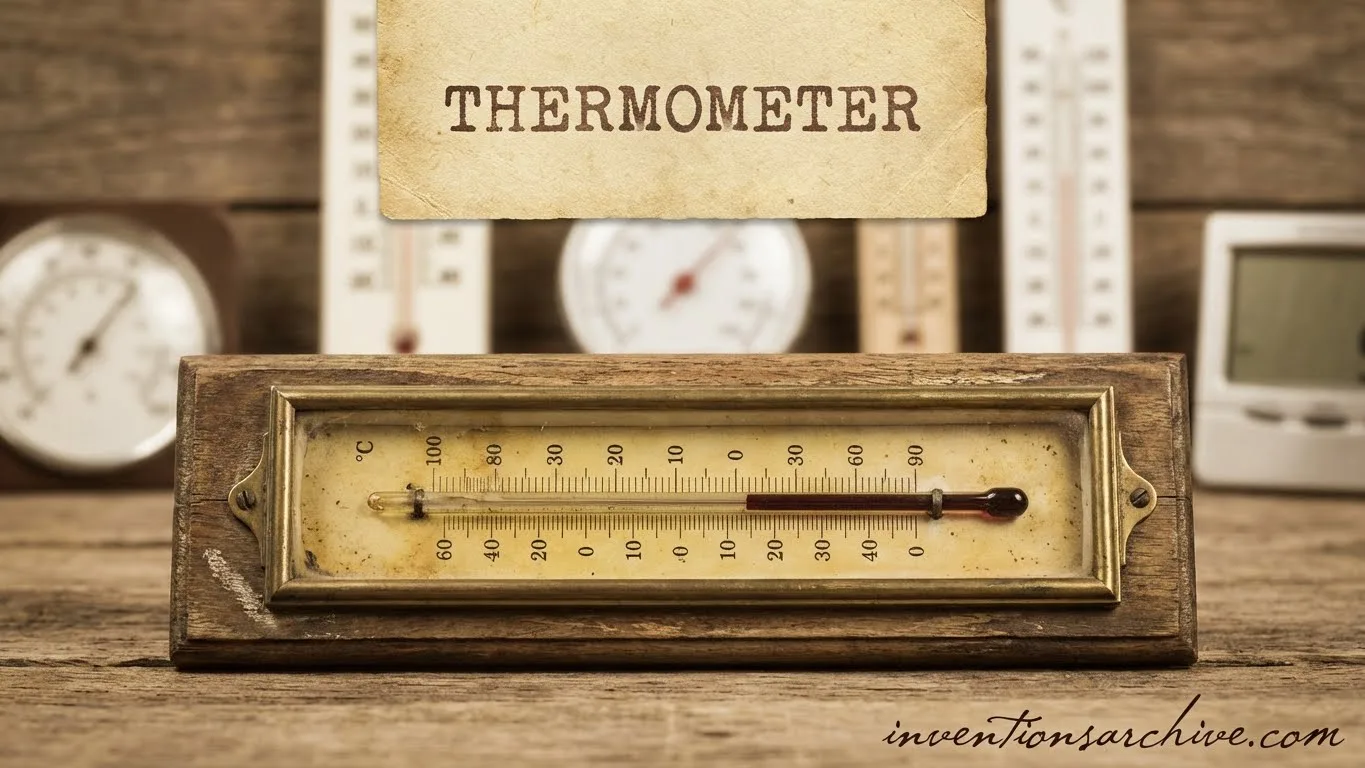
| Invention Name | Thermometer |
|---|---|
| Short Definition | Calibrated instrument that indicates temperature through a measurable physical change. |
| Approximate Date / Period | Late 16th–18th c. Certainty: Disputed |
| Geography | Europe (Italy, Netherlands, Sweden); later global adoption |
| Inventor / Source Culture | Early work: collective instrument makers; thermoscope linked to Galileo |
| Category | Measurement, science, medicine, industry |
| Importance | Standardizes temperature; enables safer processes; supports modern science |
| Need / Origin Driver | Comparable readings for weather, health, and experiments |
| How It Works | Maps a repeatable change (volume, resistance, voltage, radiation) to a scale |
| Materials / Technology Basis | Glass + liquid; metals; semiconductors; optics; electronics |
| Early Use Context | Natural philosophy; medicine; laboratories; meteorology |
| Spread Route | Workshops → academies → hospitals → industry → households |
| Derived Developments | Reliable scales; calibration methods; digital sensing; non-contact measurement |
| Impact Areas | Science; education; healthcare; food safety; manufacturing; environment |
| Debates / Different Views | “First thermometer” definition varies (thermoscope vs calibrated scale) |
| Precursors + Successors | Precursors: thermoscopes • Successors: RTDs, thermocouples, IR sensors |
| Key People / Cultures | Galileo-linked circle; Celsius; Fahrenheit; metrology institutions |
| Varieties Influenced | Liquid-in-glass; bimetal; digital probe; infrared; lab reference thermometers |
Thermometers look simple, yet they sit at the heart of trustworthy measurement. A thermometer turns an invisible idea—temperature—into a number that can be compared across rooms, days, labs, and devices. The key is not the display. It is the calibration: a carefully built link between a physical response and a standard scale.
Table Of Contents
What A Thermometer Is
A thermometer is a temperature indicator with a defined mapping to a numeric scale. It differs from a simple heat indicator because it is calibrated. That calibration makes readings comparable across instruments, places, and time.
Core Idea
Temperature is inferred from a stable physical response. The response is chosen because it changes predictably as thermal energy shifts.
Core Parts
Sensor (the element that changes) + readout (scale marks or electronics) + a method to reduce errors like drift.
Contact vs Non-Contact
Most thermometers touch the object. Infrared models read emitted radiation and need emissivity awareness.
Early Evidence and Milestones
The thermometer’s story is really a story of standardization. Early devices could show “warmer” or “cooler.” Later designs anchored that change to reference points and a repeatable scale.
- 1597 (often cited): a thermoscope design associated with Galileo is described in later accounts; it showed temperature-driven air changes rather than a numbered scale.Details
- 1742: Anders Celsius develops a scale defined by the freezing and boiling points of water at normal air pressure, split into 100 degrees.Details
- 19th–20th c.: electrical methods grow—thermocouples, resistance thermometers, and later compact digital sensors—pushing thermometry into industry and everyday life.
- Modern metrology: global standards tie temperature to fundamental constants, strengthening long-term consistency.
Why “First Thermometer” Is Debated
A thermoscope reacts to heat. A thermometer adds calibration and a scale. Different historians emphasize different thresholds, so dates can be disputed.
How Thermometers Measure Temperature
Every thermometer relies on the same principle: a material property changes with temperature. The instrument turns that change into a readable number. The property might be volume, electrical resistance, a tiny voltage, or emitted infrared energy.
Four Common Sensing Paths
Thermal Expansion
Liquids rise in a capillary as they expand. Metals bend in a bimetal strip. Simple, visual, robust.
Resistance Change
A thermistor or RTD shifts resistance with temperature. Electronics convert that into a digital reading.
Thermoelectric Voltage
A thermocouple produces a small voltage at junctions of two metals. It shines in wide ranges and harsh settings.
Infrared Emission
Non-contact models estimate temperature from IR radiation. Surface finish and emissivity influence accuracy.
What Makes A Reading Reliable
- Thermal contact: better contact usually reduces lag and improves repeatability.
- Response time: sensors take time to settle toward a stable value; fast does not always mean accurate.
- Placement: measuring the “right spot” matters, especially when temperature varies across a surface.
- Environment: airflow, sunlight, and nearby heat sources can bias results.
Types and Variations
The word “thermometer” covers a family of designs. Each type chooses a sensing method that fits its needs: speed, range, durability, or precision. Some are optimized for people, others for furnaces, labs, or weather stations.
| Type | Sensing Element | Strength | Typical Context |
|---|---|---|---|
| Liquid-In-Glass | Liquid expansion in capillary | Simple, stable, no power | Lab, education, legacy use |
| Bimetal Dial | Coiled bimetal strip | Rugged, easy to read | Ovens, HVAC, appliances |
| Thermistor Digital | Semiconductor resistance | Fast, compact | Home, clinical devices, probes |
| RTD | Platinum resistance | High accuracy, low drift | Calibration, industry, labs |
| Thermocouple | Thermoelectric voltage | Wide range, durable | Engines, kilns, process control |
| Infrared | Detected IR radiation | Non-contact, very quick | Moving targets, hot surfaces |
| Liquid Crystal Strip | Color shift with temperature | Visual, low cost | Rough screening, education |
Liquid-In-Glass Subtypes
- Mercury-in-glass: sharp meniscus and good stability; many settings now prefer alternatives because spilled mercury can be hazardous.
- Alcohol (spirit) thermometers: safer fluids; helpful at very low temperatures where mercury would freeze; often dyed for visibility.
- Maximum-minimum designs: record temperature extremes over time, valuable for weather and storage monitoring.
- Galileo-style decorative thermometers: floating bulbs respond to density changes; visually engaging, generally not used for precision.
Digital and Industrial Variations
In modern settings, the sensor often lives at the tip of a probe while electronics handle conversion, filtering, and display. That separation enables long cables, data logging, alarms, and integration into control systems. It also makes calibration workflows more consistent.
RTDs
Often platinum-based. Favored when low drift and accuracy matter more than extreme range.
Thermocouples
Excellent for high temperatures and tough environments. They trade some precision for resilience.
Related articles: Hot air engine (Amontons) [Renaissance Inventions Series], Early Thermometer Scale (Fahrenheit) [Renaissance Inventions Series]
Infrared
Great for hot, moving, or inaccessible targets. Surface properties can shift readings, so context matters.
Scales and Units
A thermometer’s scale is a language for temperature. In daily life, Celsius and Fahrenheit dominate. In science and engineering, Kelvin anchors thermodynamic temperature. The practical goal is the same: consistent communication.
Celsius, Fahrenheit, Kelvin
| Scale | What It Fits | Anchor Idea |
|---|---|---|
| Celsius (°C) | Everyday and scientific reporting | Convenient reference to water points |
| Fahrenheit (°F) | Common in parts of daily life | Fine-grained everyday increments |
| Kelvin (K) | Physics, chemistry, engineering | Absolute thermodynamic scale |
The modern definition of the kelvin fixes the numerical value of the Boltzmann constant at 1.380 649 × 10−23 J·K−1, tying temperature to a fundamental constant rather than a single material artifact.Details
Simple Conversions
°C to °F
°F = (°C × 9/5) + 32
°F to °C
°C = (°F − 32) × 5/9
°C to K
K = °C + 273.15
Accuracy and Calibration
When thermometers are compared, three ideas appear again and again: accuracy (closeness to the true value), precision (repeatability), and resolution (smallest readable step). A crisp display can look impressive while still hiding bias. Calibration keeps those risks visible.
Why Calibration Exists
- Sensor drift: materials change over time, especially after heat cycles.
- Assembly effects: probes, housings, and bonding can shift a response curve.
- Environment: pressure, airflow, and surface conditions can bias readings.
- Traceability: calibration links a reading to recognized standards, with a stated uncertainty.
National metrology labs maintain temperature standards and support calibration across wide ranges. NIST describes its thermometry standards work over 0.65 K to 2011 K (and broader support for practical services), illustrating how far modern temperature measurement reaches.Details
A Small Word That Matters: Uncertainty
A temperature value can be reported with an accompanying uncertainty. That number communicates the likely spread around the true temperature and supports honest comparisons.
Where Thermometers Matter
Thermometers influence daily comfort, product quality, and scientific discovery. The instrument is often invisible in the background, yet it quietly protects consistency and supports better decisions. The same core idea—mapping a physical response to a scale—shows up in very different environments.
Health and Care
- Clinical screening with fast digital sensors
- Incubators and controlled environments
- Cold-chain monitoring for supplies
Food and Labs
- Refrigeration and storage stability
- Reaction control and incubation
- Instrument verification with reference thermometers
Industry and Energy
- Process control with thermocouples
- HVAC balancing and efficiency
- Quality checks in manufacturing
A Note On Safe Measurement
Many older thermometers used mercury because it behaves predictably inside glass. If a mercury thermometer breaks, the spill requires careful handling. That is one reason many environments now prefer alcohol-filled designs, sealed electronic probes, or infrared tools.
FAQ
What is the difference between a thermoscope and a thermometer?
A thermoscope shows temperature-related change without a numbered scale. A thermometer is calibrated, so its reading maps to a defined unit such as °C or K.
Why can two thermometers show different values in the same room?
Differences often come from response time, placement, airflow, and small calibration offsets. In uneven conditions, the “same room” can have multiple microclimates, especially near windows, vents, or warm equipment.
Why do infrared thermometers sometimes read low or high?
Infrared models estimate temperature from emitted radiation. Surface finish, reflectivity, and emissivity affect the signal, so the reading can shift when the surface material changes.
What makes a laboratory thermometer “reference grade”?
Reference-grade instruments emphasize stability, documented calibration, and low drift. The value is not only the sensor, but the traceable link between the instrument and recognized temperature standards.
Why does Kelvin not use the degree symbol?
Kelvin is the SI base unit of thermodynamic temperature. It is written as K without a degree symbol because it is an absolute unit, not a relative scale mark.