
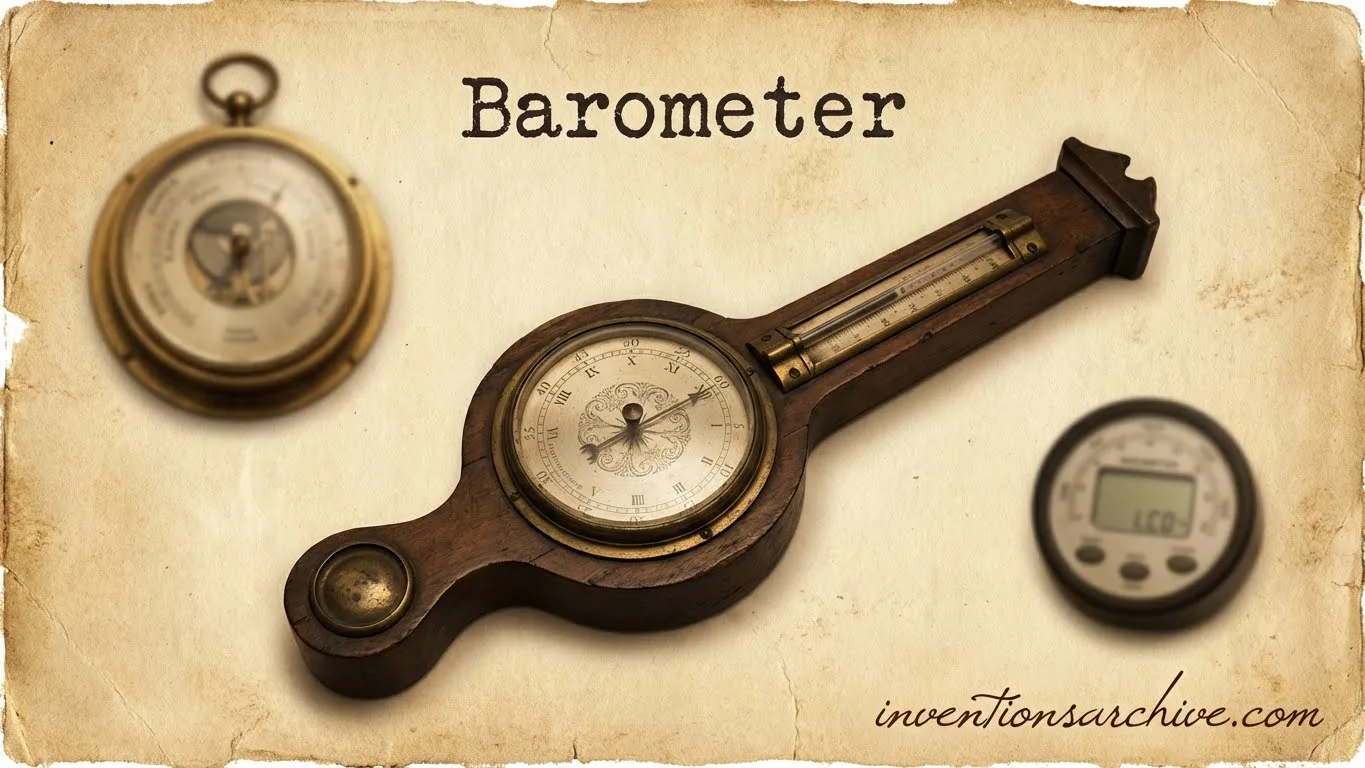
| Invention Name | Barometer |
|---|---|
| Short Definition | Atmospheric pressure measuring instrument |
| Approximate Date / Period | 1643–1644 (Disputed)Details |
| Geography | Italy (Florence), early modern Europe |
| Inventor / Source Culture | Evangelista Torricelli |
| Category | Meteorology, measurement, scientific instruments |
| Importance |
|
| Need It Solved | Understanding the “weight” of air and pressure changes |
| How It Works | Pressure balances a column (liquid) or flexes a sealed capsule (aneroid) |
| Material / Tech Basis | Vacuum principle, fluid column, elastic metal capsule, sensors |
| First Use Context | Scientific experiments; later routine weather observation |
| Derived Developments | Aneroid barometer, recording barometer, altimeter, digital pressure sensors |
| Impact Areas | Science, aviation, navigation, outdoor planning, climate research |
| Debates / Different Views | Exact “first” year varies across records |
| Precursors + Successors | Vacuum studies + pump limits → barometer → barograph + electronic barometers |
| Key Figures | Torricelli; Blaise Pascal; Robert Hooke; Nicolas Fortin; Lucien Vidie |
| Notable Variations It Influenced | Mercury designs, portable aneroid models, calibration standards |
Table of Contents
What a Barometer Measures
The core target is atmospheric pressure, also called barometric pressure. Pressure is force spread over area. In the atmosphere, it reflects how much air is stacked above a place at a given moment. When the air mass changes, the pressure changes too.
A barometer does not “predict” weather by magic. It detects pressure trends: slow rises, steady periods, and sharp drops. Those patterns often line up with the movement of large air systems. The value matters, yet the direction of change is usually what makes the reading feel meaningful.
Why Pressure Feels Like “Weather”
Pressure influences cloud formation and the vertical motion of air. A lower surface pressure often means air is more likely to rise, cool, and form clouds. A higher pressure pattern often supports steadier air. These are broad tendencies, not guarantees, and they work best when combined with other observations.
Origins and Early Evidence
The classic starting point is Torricelli’s mercury-tube experiment. A glass tube filled with mercury is inverted into a mercury basin. The column falls, then stabilizes at a height that reflects air pressure. Torricelli identified the atmosphere as the cause, and the empty space above the mercury became famous as the Torricellian vacuum.
Early observations showed that the mercury height changes with altitude. That gave the barometer a second role: not only a weather instrument, but a way to compare pressure between places. It also encouraged better designs: easier reading, steadier movement, and practical portability.
By the 1800s, the barometer was widely recognized as a public-facing scientific tool. Homes, offices, and institutions displayed it as a sign of measured knowledge. Around the mid-19th century, the aneroid format helped make the instrument smaller and easier to carry.
How a Barometer Works
Liquid Column Principle
In a mercury design, atmospheric pressure pushes on the mercury in the basin and supports a column inside the tube. The column height rises or falls as pressure changes. In many educational descriptions, the column sits near 30 inches at sea level conditions.Details
- Higher pressure tends to lift the column
- Lower pressure tends to lower the column
- The top space remains a very low-pressure region
Aneroid Capsule Principle
An aneroid barometer uses a sealed metal capsule with a partial vacuum. As outside pressure changes, the capsule flexes slightly. A mechanical linkage amplifies that tiny motion and moves a pointer. It avoids liquid while keeping the same goal: pressure to readable signal.
Digital models replace linkages with sensors. Many modern devices use compact pressure elements and convert the change into a stable value, often shown as hPa or Pa. The feeling is modern, yet the physics stays familiar.
Types and Variations
The word barometer covers a family of designs. Some aim for top precision, some for portability, some for continuous records. The most recognizable branches are mercury, aneroid, and electronic, yet the historical catalog is richer.
Mercury Barometer Families
- Basin (Cistern) Barometer: direct tube-over-basin style; simple reading of column height.
- Siphon Barometer: U-shaped tube; changes show as level shifts in two arms.
- Wheel Barometer: a pointer and dial translate level changes through floats and pulleys, linked to early modern instrument craft.
- Fortin Barometer: a portable cistern design with careful adjustment for reference alignment, built for precision reading.
- Folded Barometer: bent tube to reduce height; more compact, typically less exact than full-length mercury setups.
Aneroid and Recording Types
Aneroid instruments became the everyday standard for portability. Some versions add a recording mechanism. A recording design is often called a barograph: it tracks pressure over time as a continuous curve. That curve can reveal subtle patterns that a single glance at a dial might miss.
Digital and Sensor Barometers
Modern sensor-based barometers show up in weather stations, aircraft systems, research tools, and personal devices. Many combine pressure with temperature for compensation. Some are built into altitude estimation systems; in that context the same pressure reading supports an altimeter calculation.
Related articles: Air Pump [Renaissance Inventions Series]
| Type | Signal Source | Strength | Typical Setting |
|---|---|---|---|
| Mercury | Liquid column height | High stability in controlled conditions | Laboratories, reference contexts |
| Aneroid | Flexing metal capsule | Portable, no liquid | Homes, field use, instruments |
| Digital | Electronic pressure sensor | Compact, easy logging | Weather stations, devices, research |
| Barograph | Recorded trend line | Trend visibility | Monitoring and archives |
Units and Reading
Barometer scales often show more than one unit. That is practical, not decorative. Scientific work commonly uses Pa (pascal) or hPa (hectopascal). Many weather reports also use mbar as a familiar match to hPa. Traditional instruments may show mmHg or inHg.
One historical reference point is the standard atmosphere, defined as 101,325 N/m² (101,325 Pa).Details It is a fixed definition used for consistency, even though real sea-level pressure varies from day to day.
What Makes Readings Look Different
- Altitude: higher elevation usually means lower station pressure.
- Temperature: materials and air density shift slightly; precision instruments account for it.
- Calibration: reference alignment matters for consistent comparisons.
- Trend window: the same pressure can feel different if it is rising fast or falling fast.
A Simple Way to Think About Trends
Pressure trend is a story. A steady line can suggest a stable air mass. A sharp change can signal a shift in the larger pattern. That is why a barometer has always been more than a number; it is a measured mood of the atmosphere.
Where Barometers Matter
The barometer remains a foundation tool because pressure touches many systems. In meteorology, it supports weather maps and local interpretation. In aviation, pressure measurement supports altitude-related calculations. In research, long pressure records help track seasonal patterns and rare events without drama or speculation.
For everyday curiosity, a barometer helps explain why the same temperature can feel different on different days. Air mass, moisture, and wind patterns connect to pressure in quiet ways. The instrument gives that quiet change a clear scale.
Care and Safety Notes
Many historic designs use mercury, a material handled with care in professional settings. Museums and laboratories treat these instruments as valuable heritage objects and manage them with appropriate safety practices. Aneroid and digital barometers avoid liquid while still measuring barometric pressure effectively.