
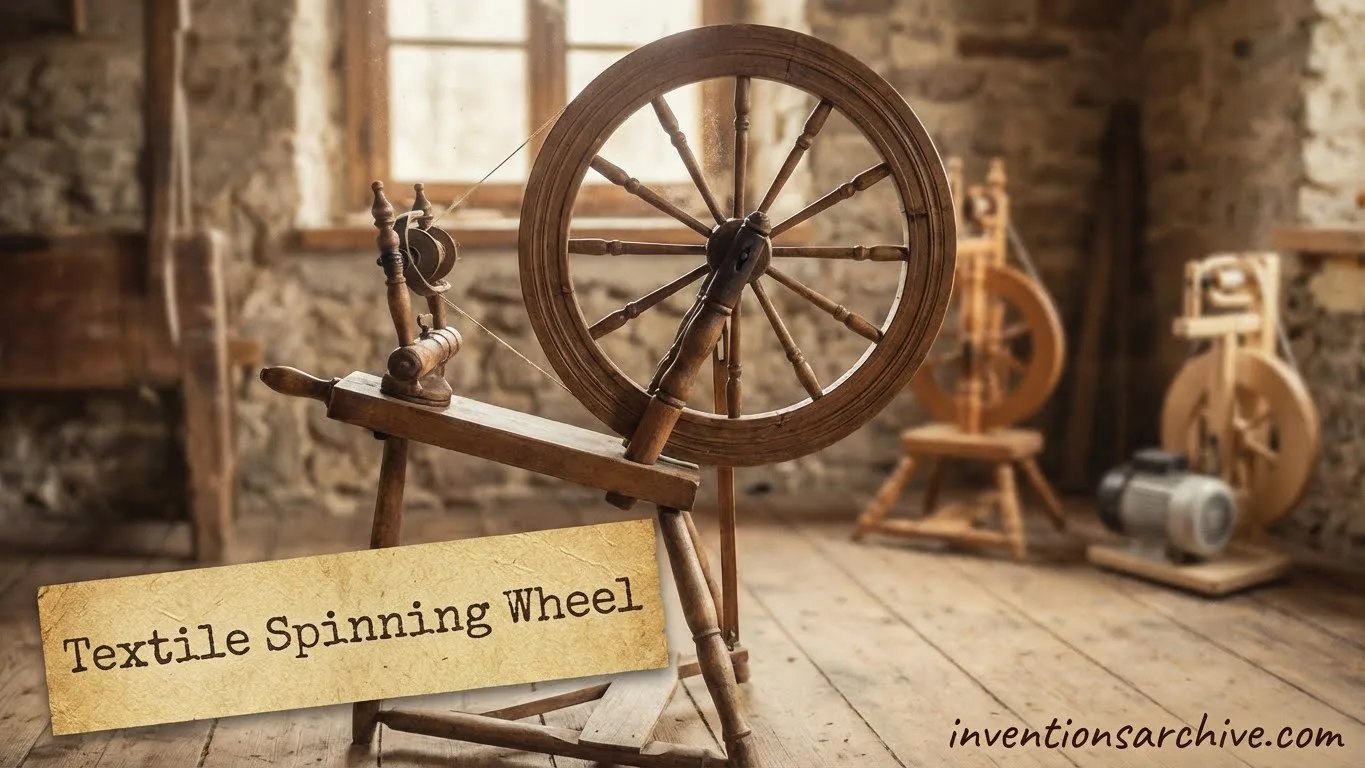
| Invention Name | Textile Spinning Wheel |
|---|---|
| Short Definition | Hand-powered tool that turns fiber into yarn |
| Approximate Date / Period | Origins: unclear Debated · Wider spread: c. 1200s Approx. |
| Geography | South Asia · Middle East · Europe · later worldwide |
| Inventor / Source Culture | Anonymous / collective |
| Category | Textiles · Fiber processing · Household technology |
| Importance |
|
| Need / Reason It Emerged | More yarn for looms · steadier thread |
| How It Works | Rotation adds twist · take-up winds yarn |
| Materials / Tech Basis | Wood frame · spindle or flyer · drive band |
| First Common Use | Household yarn for cloth and thread |
| Spread Route | South Asia → Middle East → Europe Approx. |
| Derived Developments | Flyer-and-bobbin wheels · treadle drive · later mechanized spinning |
| Impact Areas | Craft · trade · education · textile industry · home production |
| Debates / Different Views | “First” place and date not settled |
| Precursors + Successors | Drop spindle → spinning wheel → spinning frames |
| Key Cultures / Periods | Medieval + early modern textile centers · rural households |
| Varieties Influenced | Great wheel · Saxony wheel · castle wheel · charkha |
A textile spinning wheel is a hand-powered machine that turns loose fiber into continuous yarn. It sits between the simple drop spindle and later factory machines, giving spinners a steady rhythm and a way to build thread that can be woven into cloth.Details
Why it matters: when a community can spin more yarn with steadier thickness, weaving becomes easier to plan, cloth becomes more consistent, and textile skills spread faster through households, workshops, and markets.
Contents
What the Spinning Wheel Is
The core idea is simple. A rotating part adds twist to a thinning strand of fiber, turning it into yarn. Early wheels mechanized rotation so the spinner did not rely only on the fingers to keep the spindle turning. That steady rotation is what separates a wheel from pure hand spinning.
Spindle Spinning vs Wheel Spinning
- Drop spindle: twist comes from a hanging spindle’s spin; portable and ancient.
- Spinning wheel: twist comes from a wheel-driven rotation; faster output and more uniform rhythm.
- Shared point: both depend on controlled twist to keep fibers locked together.
Early Evidence and Timeline
The exact origin is not pinned to one place or year. Many accounts link the early spinning wheel to South Asia, then describe its movement into Europe through the Middle East in the medieval period.
One U.S. National Park Service museum note frames the wider development and spread as happening about 800 years ago, and stresses that wheel forms varied by fiber and region.Details
A major later step was the flyer-driven spindle. A museum of textile machinery describes this shift as appearing around 1480, enabling twisting and winding onto a bobbin in the same continuous motion.Details
A Simple Way to Read the Timeline
- Earlier phase: spindle-focused wheels that speed rotation.
- Medieval spread: wider adoption across regions Approx..
- Flyer-and-bobbin phase: continuous wind-on becomes common in many European designs.
- Industrial follow-on: wheel ideas feed into powered spinning machines.
How the Spinning Wheel Works
A spinning wheel’s job is to balance two actions: twist and take-up. Twist binds fibers into a strong strand. Take-up moves that finished strand onto a storage point, often a bobbin, so spinning can continue without stopping every few moments.
In spindle-only designs, the yarn forms at the spindle tip and is then placed onto the spindle in sections. In flyer-and-bobbin designs, the yarn passes through an opening and along hooks on a U-shaped flyer, then winds onto the bobbin with a controlled speed difference. The details vary, yet the goal stays the same: even twist with smooth wind-on.
Parts and Materials
Core Parts
- Drive wheel: the large wheel that provides rotation.
- Drive band: cord or band that transfers motion.
- Spindle or flyer: the rotating element that adds twist.
- Whorl (often grooved): sets a speed ratio.
- Support frame: keeps alignment stable.
Common Add-Ons
- Bobbin: stores finished yarn on flyer wheels.
- Hooks on the flyer: guide yarn across the bobbin.
- Distaff: holds prepared fiber, especially long fibers like flax.
- Treadle: foot-powered drive on many later wheels.
- Tension adjuster: controls take-up feel.
Many surviving wheels are built from hardwoods with simple bearings and carefully aligned supports. A detailed museum record of a “walking” style wheel notes construction choices like a grooved rim for the drive cord and a screw-based adjustment for cord tension, showing how practical engineering shaped everyday textile tools.Details
Wheel Types and Variations
Spinning wheels are not one fixed design. They split into families based on where twist happens, how yarn is stored, and how the spinner powers the motion. The most visible difference is whether the wheel uses a simple spindle or a flyer-and-bobbin system.
| Type | Core Mechanism | Typical Strength | Common Notes |
|---|---|---|---|
| Great Wheel (walking wheel) | Spindle-focused twist; wind-on in sections | High twist speed | Large footprint; often used for wool |
| Saxony Wheel | Flyer + bobbin; treadle common | Continuous spinning | Classic “horizontal” home wheel shape |
| Castle Wheel | Flyer + bobbin in upright layout | Compact form | Smaller footprint; vertical geometry |
| Charkha | Hand-driven wheel; spindle-based | Portable | Often used for fine, short fibers like cotton |
| Flyer-Driven Spindle | Speed difference twists and winds onto bobbin | Efficient wind-on | Documented as a key step toward modern textile machinery |
Why So Many Designs Exist
- Fiber length matters: long fibers and short fibers behave differently under twist.
- Space matters: some homes favored compact frames.
- Take-up control matters: some wheels prioritize gentle winding, others faster pull.
- Maintenance matters: simpler mechanisms were easier to keep running.
Twist and Direction
Twist direction is often described as s or z, based on the slant of the fibers in the yarn. A university PDF used in teaching notes that spin (the first wrap) is labeled with lowercase s or z, while twist made by plying strands together is labeled with uppercase S or Z.Details
This naming system helps museum staff, textile historians, and makers describe yarn structure with clear shorthand. It also explains why two yarns can look similar in thickness yet behave differently in weaving: direction and ply can change how a thread balances.
Where It Spread and Why
Once looms became more productive, yarn supply became a bottleneck. The spinning wheel answered that pressure with repeatable motion and steadier output. In many regions it became a household tool, then a workshop tool, and later a reference point for mechanized spinning ideas.
Its spread followed practical logic. Regions with strong weaving traditions gained a tool that could keep looms fed. Regions with access to spinnable fibers adapted wheel forms to local materials and preferred yarn styles. That is why the wheel’s “family tree” looks wide, not narrow.
What It Changed
The spinning wheel changed textiles by making thread production more predictable. Predictability is quiet power. It supports planning: how much yarn a weaver can expect, what thickness can be repeated, and how quickly cloth can be produced for daily life and trade.
Long-Run Effects
- Skill transmission: spinning knowledge became easier to scale through steady tools.
- Quality control: more consistent yarn supported finer cloth and reliable sewing thread.
- Design evolution: flyer-and-bobbin systems tightened the link between twist and storage.
- Industrial stepping stone: wheel logic informed later powered spinning systems.
FAQ
Is a spinning wheel the same as a spindle?
A spindle is a simple rotating tool that twists fiber as it spins. A spinning wheel is a system that drives rotation with a wheel, making twist easier to maintain for longer stretches of yarn.
What made flyer-and-bobbin wheels a big change?
The key change is continuous winding. Twist is added while yarn is guided onto a bobbin, so spinning can flow with fewer pauses and more even build-up.
Why are there different wheel styles?
Wheels reflect fiber needs, available space, and local preferences. Some prioritize portability, some prioritize output, and some prioritize compact storage.
What do “S” and “Z” mean in yarn?
They describe the slant of twist in the yarn. Lowercase letters are often used for the first spinning direction, and uppercase letters for the direction created when strands are plied together.
Did spinning wheels replace hand spindles everywhere?
No. Spindles stayed valuable because they are portable, simple, and effective. In many places, both tools remained useful in different settings.