
| Field | Value |
|---|---|
| Invention Name | Telescope |
| Short Definition | Instrument that gathers light (or other waves) to form a magnified, analyzable image |
| Approximate Date / Period | 1608 Contested |
| Geography | Dutch Republic (Netherlands) |
| Inventor / Source Culture | Hans Lipperhey; early Dutch lens-making circles (credit debated) |
| Category | Optics, Observation, Navigation, Science |
| Importance |
|
| Need / Trigger | Long-distance viewing for navigation, surveying, and discovery |
| How It Works | Collects waves, focuses them, then magnifies or records the focused signal |
| Materials / Tech Basis | Glass lenses; polished mirrors; later electronics and detectors |
| Early Use | Terrestrial viewing; early astronomical observation |
| Spread Route | Netherlands → Italy → broader Europe → global scientific practice |
| Derived Developments | Precision optics; observatories; space telescopes; radio arrays |
| Impact Areas | Science, Education, Navigation, Technology |
| Debates / Different Views | “First inventor” and priority claims among early Dutch lens makers |
| Precursors + Successors | Magnifying lenses → early refractors → reflectors → multiwavelength telescopes |
| Key People / Institutions | Early Dutch lens makers; Galileo; Newton; modern space and ground observatories |
| Major Variations Influenced | Refractors, Reflectors, Catadioptrics, Radio Telescopes, Space Telescopes, Interferometric Arrays |
Table Of Contents
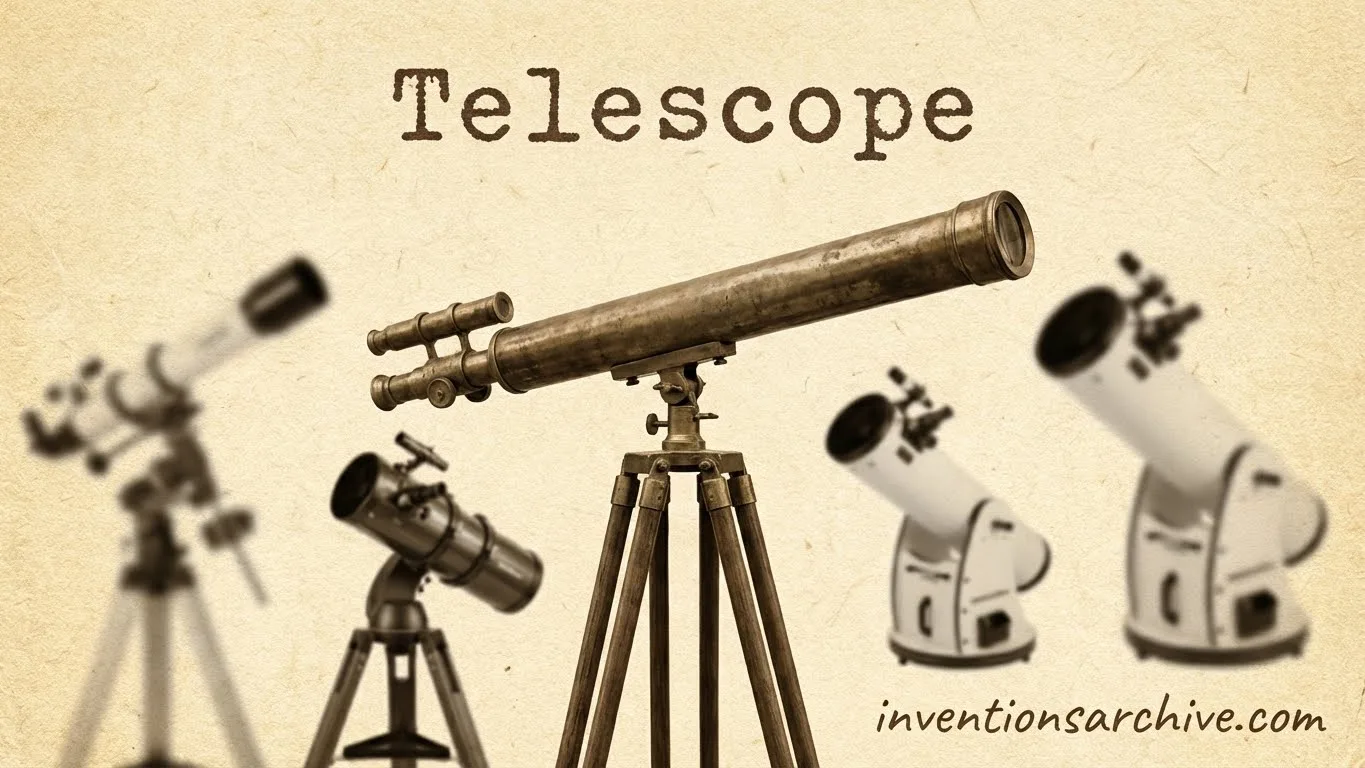
A telescope is a quiet kind of power: it turns distant light into usable detail. It began as a tool for seeing farther across land and sea, then became a foundation for modern astronomy and careful measurement. Whether it uses a lens, a mirror, or an antenna, the idea stays simple: collect more of a faint signal, focus it, and make it readable.
What Makes A Telescope “Powerful”
- Aperture (main lens or mirror size) sets how much light is collected and how faint an object can be detected Details
- Resolution is about fine detail; it depends on optics and conditions, not just “zoom”
- Stability and precise alignment keep images crisp over long observations
What The Telescope Is
At its core, a telescope is a signal collector. For visible light, it gathers rays with a primary lens or primary mirror and brings them to a focus. From there, the focused image can be magnified for viewing or recorded by a detector. The same logic extends beyond visible light: a radio telescope gathers long radio waves with an antenna and concentrates the signal for measurement.
A Telescope Does Three Jobs
- Collects faint light or waves
- Focuses them into a usable form
- Delivers that focused signal to eyes or instruments
Why It Changed History
- Distance became measurable
- Faint objects became visible
- Precision observation became routine
Early Evidence and Timeline
The telescope appears in the historical record in the early 1600s, with priority and credit still discussed among Dutch lens makers. A key documented moment is the 1608 patent application linked to Hans Lipperhey in the Netherlands Details. Soon after, telescope designs spread quickly across Europe, and the instrument shifted from a distance-viewing device into a scientific tool.
| Period | Milestone | Why It Matters |
|---|---|---|
| 1608 | Patent application for a distance-viewing instrument (credit debated) | Documented entry of the telescope into public record |
| 1609 | Rapid refinements and early astronomical use | Observation expands from Earth to sky |
| 1610s | Design variations mature (different lens layouts) | Sharper images and wider uses |
| 1668 | First working reflecting telescope by Isaac Newton | Mirrors reduce lens-related color problems Details |
| 1700s–1800s | Larger observatory instruments and improved optics | Scale and precision grow together |
| 1900s | New detectors and non-optical telescopes | Multiwavelength astronomy emerges |
| Late 1900s–Today | Space telescopes and giant ground-based observatories | Cleaner views, deeper surveys, better instruments |
How Telescopes Work
Optical telescopes rely on a clean chain: collect, focus, then deliver. The objective (lens or mirror) gathers a wide bundle of rays. The optics bring those rays to a focal plane, where an eyepiece can magnify the image for the eye, or a detector can capture it as data. With better optics and stable tracking, a telescope turns dim light into measurable structure.
Inside The Optical Path
- Primary element: lens (refractor) or mirror (reflector)
- Focus: a point or plane where the image forms
- Eyepiece or sensor: magnifies or records
What Limits Sharpness
- Atmosphere: turbulence blurs fine detail
- Diffraction: physics sets a natural limit for a given aperture
- Alignment: small errors soften the image
Major Telescope Types
Telescopes come in families. Each family is built around the same question: which primary element shapes the incoming signal most effectively? Refractors use lenses, reflectors use mirrors, and catadioptrics blend both. Outside the optical world, radio telescopes use reflective dishes and sensitive receivers. The result is a broad set of instruments, each tuned for a different kind of clarity.
Refracting Telescopes
A refractor bends light through a primary lens. Early telescopes were refractors, and many small instruments still are Details. A lens-based design can give a high-contrast image when well made. The challenge is that very large lenses become heavy, and lens systems can show color fringing unless carefully corrected.
Reflecting Telescopes
A reflector uses a primary mirror to focus light. Newton pursued this route after studying lens-related color effects, producing the first working reflecting telescope in 1668 Details. Mirrors can be made large without the same weight penalties as big lenses, which is why many research-grade telescopes lean on reflector designs.
Catadioptric Telescopes
Catadioptric designs combine mirrors and lenses to fold a long optical path into a compact tube. Well-known examples include Schmidt-Cassegrain and Maksutov-style layouts. The appeal is practical: a short, portable instrument can still deliver long focal length behavior, and the optics can be tuned for versatility.
| Type | Main Optics | Strengths | Typical Limits | Common Uses |
|---|---|---|---|---|
| Refractor | Lens | Clean contrast; sealed tube | Large lenses get heavy; color correction needed | Moon/planets; education; precision viewing |
| Reflector | Mirror | Large apertures possible; less lens color issues | Needs alignment; open tube can require care | Deep-sky observation; research instruments |
| Catadioptric | Mirror + lens | Compact; flexible focal designs | More surfaces; can reduce brightness slightly | General-purpose observing; imaging setups |
| Radio Telescope | Antenna / dish + receiver | Sees through dust; studies cold and distant processes | Long wavelengths need large collectors | Galaxies, gas clouds, pulsars, cosmic radio sources |
Key Design Elements
Most telescope talk circles back to a few core terms. Aperture describes the size of the main lens or mirror, and it strongly affects light-gathering power Details. Focal length shapes image scale, while focal ratio hints at how the light cone behaves inside the system. These pieces interact with mounts, detectors, and optics quality to create a final view that feels steady and sharp.
| Term | Plain Meaning | What It Shapes |
|---|---|---|
| Aperture | Main lens or mirror diameter | Faint-object reach; detail potential |
| Focal Length | Distance to focus (simplified) | Image scale; field size |
| Focal Ratio | Focal length divided by aperture | Light cone geometry; exposure behavior in imaging |
| Magnification | How large the image appears | Comfort and detail only when optics/conditions allow |
| Mount | Tracking structure | Stability; ability to hold objects in view |
| Detector | Sensor at the focal plane | Recorded data quality; sensitivity |
Aperture, In One Line
Aperture is the most direct way to say how much faint light a telescope can collect, which is why it matters so much for objects that are dim or distant by nature.
Related articles: Magnetometer (Early Form) [Renaissance Inventions Series], Optical Glass Lens Production [Renaissance Inventions Series]
Beyond Visible Light
“Telescope” does not mean “visible light only.” It means focused observation. Radio telescopes, for example, observe the longest wavelengths of light, from about 1 millimeter to over 10 meters Details. Other instruments work in infrared, ultraviolet, X-ray, and gamma-ray bands. Each band reveals different physics: dust can hide stars in visible light yet look transparent in radio or infrared, while high-energy events may stand out in X-rays.
That multiwavelength view also explains why some telescopes go to space. Earth’s atmosphere is friendly for life, yet it can block or distort certain wavelengths. So a space telescope is often about access: reaching bands that do not arrive cleanly at the ground, and holding an unbroken view for long observations. The same simple goal stays in place: collect a faint signal and turn it into reliable information.
Radio Telescopes, In Plain Words
A radio telescope gathers weak radio waves, brings them to a focus, amplifies the signal, and hands it to instruments for analysis. The dish shape is often parabolic, concentrating incoming waves into a receiver that can measure them with high sensitivity at scale.
Modern Breakthroughs and Variations
Modern telescopes keep stretching the same old idea in new directions. Segmented mirrors let very large apertures be built as precise panels. Interferometry combines signals from separated instruments to act like a much wider collector. Adaptive optics can reshape a mirror’s surface in real time to counteract atmospheric blur, producing a view that feels tighter and more stable.
- Segmented optics: giant collectors assembled from many controlled pieces
- Interferometric arrays: multiple telescopes acting together for finer detail
- Advanced detectors: higher sensitivity, faster readout, broader wavelength reach
- Precision control: tracking and alignment measured in tiny fractions of a degree
Frequently Asked Questions
Who Invented The Telescope?
The first documented telescope appears in the early 1600s in the Dutch Republic. Credit is often linked to Hans Lipperhey, yet discussions include other Dutch lens makers, so the “first inventor” is contested rather than perfectly settled.
Why Did Newton Switch From Lenses To Mirrors?
Newton studied the color problems caused by lenses and concluded that a mirror-based design could avoid that kind of chromatic aberration. He built a working reflecting telescope in 1668, showing that a mirror could focus light effectively.
Is Magnification The Main Measure Of A Telescope?
Magnification matters, yet it is not the core limiter. A telescope’s aperture sets how much faint light it can collect and how much detail it can potentially resolve, while the atmosphere and optical precision decide how much of that potential becomes real clarity.
What Is The Difference Between Refractors And Reflectors?
A refractor uses a primary lens to bend light to a focus. A reflector uses a primary mirror to reflect light to a focus. Mirrors can scale to very large sizes more easily than lenses, which is why many modern research instruments favor reflectors.
What Makes A Radio Telescope A “Telescope”?
It follows the same logic as optical instruments: collect a faint signal, focus it, then amplify and analyze it. Radio telescopes observe very long wavelengths—roughly 1 mm to over 10 m—so they often use large dishes or arrays to reach useful resolution.
Why Are Some Telescopes Placed In Space?
Space telescopes avoid much of Earth’s atmospheric distortion and gain cleaner access to wavelength bands that are blocked or weakened at the ground. The goal is steady, sensitive observation that turns faint signals into consistent, high-quality data.