
| Detail | Value |
|---|---|
| Invention Name | Steam Turbine Prototype (Branca Steam-Jet Wheel) |
| Short Definition | A focused steam jet strikes paddle-like blades to create rotary motion. |
| Approximate Date / Period | 1629 (printed record) |
| Date Confidence | Certain (publication documented) |
| Geography | Italy (Rome publication; Loreto/Loretto association appears in later records) |
| Inventor / Source Culture | Giovanni Branca (Italian engineer/architect; also described as a chemist in museum catalog text) |
| Category | Power Conversion / Early Turbomachinery / Mechanical Transmission |
| Need / Motivation | Workshop rotary power Targeted at small mechanized tasks (e.g., stamping or mortar work) |
| How It Works |
Boiler → pipe/nozzle → steam jet → bladed wheel → shaft/gears → driven tool Impulse-style momentum transfer |
| First Intended Use | Stamp mill / pestles (as described in institutional summaries of the concept) |
| Primary Evidence | Le machine (1629), a woodcut-illustrated treatise; records note 77 plates and identify a figure associated with a steam impulse turbine concept (Details-2) |
| Surviving Object Record | Smithsonian holds a demonstration model of the Branca turbine idea (not a verified 1629 build); catalog text describes a jet from a nozzle striking a wheel and driving a stamp mill (Details-1) |
| Model Dimensions (Museum Record) | 6 in × 7 3/8 in × 10 7/8 in (catalog measurements) |
| Spread Route | Not firmly documented (later mentions appear in engineering history summaries) |
| Derived Developments | Impulse turbines, nozzle-driven blading, staged turbine architecture (later centuries) |
| Areas of Impact | Mechanical engineering; power generation; manufacturing mechanization; education/museum interpretation |
| Debates / Different Views | Labeling varies: “first steam turbine” is often framed as an early concept rather than a proven working machine (Details-5) |
| Timeline Mentions | Engineering history timelines list a Branca steam turbine entry around 1629 (Details-4) |
| Technical Framing (Later Survey) | A university-hosted historical survey describes Branca’s device as an impulse turbine concept used to power a stamping mill, and calls it possibly among the earliest steam turbines (Details-3) |
| Precursors + Successors |
Precursors: reaction-style steam toys and hot-air “chimney” devices (concept lineage) Successors: De Laval impulse turbines; Parsons reaction turbines (industrial era) |
| Invention Variants It Connects To | Impulse vs reaction turbines; axial vs radial flow; single-stage vs multi-stage; condensing vs back-pressure designs |
A steam turbine is easy to picture today: blades, stages, a generator hall, steady output. Branca’s 1629 “prototype” is the opposite—compact, drawn like a workshop contraption, and powered by something as ordinary as hot water turning into vapor. Still, the idea is sharp: use a fast jet to spin a wheel, then pass that rotation through gears to do practical work. That one move—turning steam speed into shaft rotation—is why this sketch keeps resurfacing in turbine histories.
On This Page
What It Was and What It Was Not
Branca’s “steam turbine” sits in an awkward but interesting spot. It looks like a waterwheel, yet its driving fluid is steam. It behaves like an impulse machine (a jet hits blades), yet it lacks the staged blading and tight flow control that make later turbines efficient. That mismatch is the whole story.
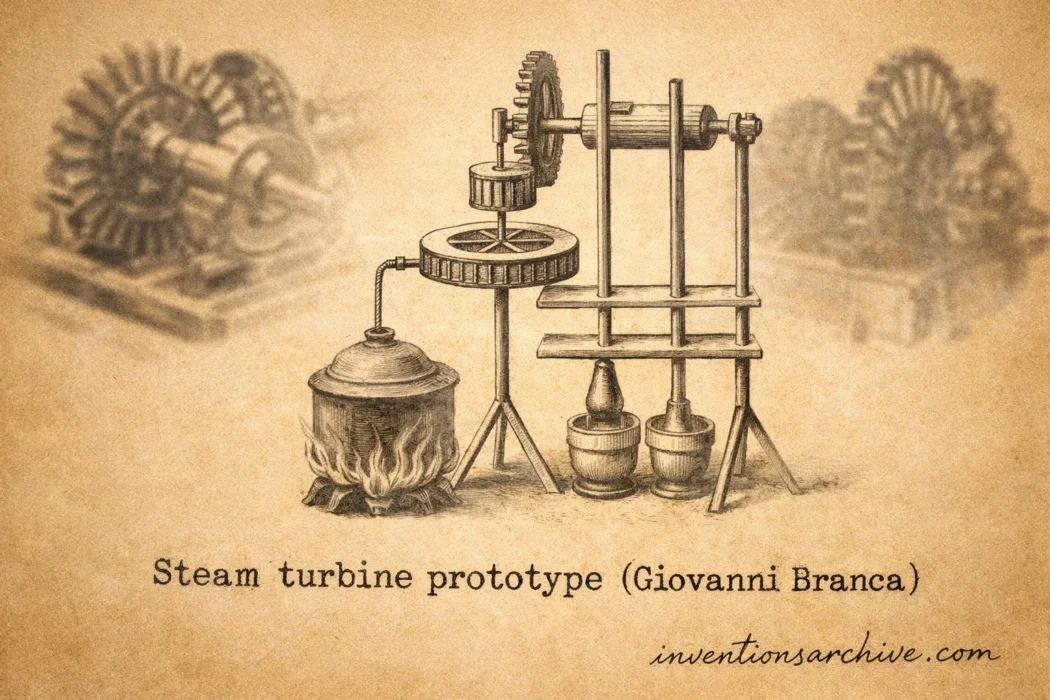
What The Drawing Clearly Shows
- Nozzle-driven jet aimed at a bladed wheel
- Rotary motion carried through a shaft
- Mechanical transmission to a tool train (gears, linkages)
- A purpose that feels very “shop floor,” not theoretical
In other words, it treats steam like a moving fluid with force, not merely a hot cloud.
What It Is Often Mistaken For
- Not a piston steam engine
- Not a closed-cycle plant with a condenser
- Not a multi-stage turbine with guide vanes and tight clearances
- Not proof of a 1629 industrial installation
That last point matters. Many later retellings treat it as a concept-first artifact—useful, memorable, and easy to redraw.
Why People Still Call It a Turbine
Because the essential move is there: pressure becomes velocity, and velocity becomes rotation. Even if the hardware is rudimentary, the energy pathway reads like a turbine—jet momentum pushing blades around a rim.
Where It Appeared in 1629
Branca published his machine ideas in Le machine, a work presented through woodcut plates and brief explanations. The steam-jet wheel is one plate among many, and that context changes how the image reads. It is not framed as a single “breakthrough machine.” It is one more practical mechanism—filed alongside lifting devices, water machinery, and other workshop-ready concepts.
Oddly enough, that mundane placement is part of its appeal. A reader does not need advanced theory to follow it. A boiler, a pipe, a wheel, a gear train. Simple pieces. A bold claim.
- The design is presented visually, so the flow path is “seen” more than “derived.”
- The output task is concrete, not abstract: mechanized stamping rather than a lab demo.
- Its language of parts (wheel, blades, gearing) sits close to water-powered craft.
How The Device Worked
Think of the everyday clue: a kettle spout. When steam escapes through a narrow opening, it forms a fast jet. Branca’s drawing borrows that behavior and points it at blades.
Heat source → boiler
              ↓
        pressurized steam
              ↓
           nozzle (jet)
              ↓
   bladed wheel (rotation)
              ↓
     shaft + gears (torque)
              ↓
   tool output (stamp / pestles)
Mechanically, it is clean: a jet hits the wheel’s vanes; the wheel turns; gears convert speed to useful force at the tool. Nothing mystical. The hard part is everything the drawing leaves unsaid—seals, friction, steam quality, and pressure control.
Energy Path, In Plain Terms
- Thermal energy in hot water becomes pressurized vapor
- The nozzle turns pressure into jet speed
- Blades convert jet momentum into shaft rotation
- Gears trade speed for usable torque at the tool
What Makes It “Prototype-Like”
It behaves like a prototype because it isolates one idea—jet-on-blade rotation—and connects it to a believable task. It does not document a tested build, measured output, or a repeatable installation. That gap is why institutions often present it as an early proposal, then show it through later models.
Design Choices That Limited Power
Branca’s concept is strong on clarity and weak on controllability. Early turbines thrive on managed flow: tight clearances, well-shaped nozzles, blade angles tuned to the jet, and staging that captures energy step by step. The Branca wheel, as typically reproduced, is much closer to an exposed jet striking paddles in open air.
- Steam containment: early boilers and joints struggled with leakage and stable pressure.
- Flow focus: a jet that spreads loses bite; blades only “feel” part of the momentum.
- Friction: gear trains and stamp mechanisms can eat a lot of power, fast.
- Thermal losses: hot steam dumping to the environment wastes energy the moment it leaves the nozzle.
- Materials: blade durability, shaft straightness, and bearing quality set a hard ceiling.
Short version? The drawing sells the concept. The engineering details decide the outcome. And those details were tough in the early 1600s.
Turbine Types and Variations
“Steam turbine” is a family name, not a single machine. Branca’s concept aligns most closely with impulse behavior (a fast jet does the pushing). Later designs split into branches that solve problems Branca’s drawing doesn’t address.
| Family | How Energy Reaches The Rotor | What The Hardware Emphasizes |
|---|---|---|
| Impulse | Nozzle jet hits blades; momentum transfer dominates | Well-shaped nozzles; blade buckets; often multi-stage for better capture |
| Reaction | Pressure drop happens across rotor as well; blades act like airfoils | Tight clearances; staging; blade rows with careful sealing |
| Single-Stage | One main energy “bite” | Simplicity; limited efficiency at large pressure ratios |
| Multi-Stage | Energy taken in steps across many rows | Lower loss per step; smoother torque; higher total extraction |
| Condensing | Exhaust goes to low pressure (condenser) | Higher expansion; lower exhaust pressure; better energy use |
| Back-Pressure | Exhaust is kept above atmospheric for process steam use | Useful heat delivery; less expansion than condensing setups |
Branca’s plate hints at the first row in that table—impulse—without the later refinements that make turbines practical at scale.
Related Ideas Before and After
No invention arrives alone. Branca’s steam-jet wheel makes more sense when placed between earlier “steam motion” curiosities and later industrial machines.
Earlier Threads
- Reaction devices that spin as steam escapes (the “toy” lineage)
- Hot-air rotors used to turn spits and fans
- Waterwheels and gearing traditions that made rotary power feel normal
These predecessors teach one lesson: fluids can push, and rotation can be harvested.
Later Developments
- Higher-pressure boilers that sustain flow without collapsing into a weak puff
- Better bearings and machining that cut friction down to sane levels
- Staging strategies that spread the work across many blade rows
- Electrical generation that rewards smooth, continuous rotation
Once those pieces exist, the turbine stops being a clever picture and starts being a dependable machine.
Why It Still Shows Up in Invention Histories
Rarely does a single plate earn so much afterlife. Branca’s turbine prototype is remembered because it is visually unambiguous: steam is not just heating something; it is being used as a motive jet. That’s a clean conceptual break, even if the device itself stayed closer to idea than installation.
- It provides an early printed picture of steam-driven rotation, not just pumping.
- It frames turbomachinery in familiar workshop language—wheels, gears, tools.
- It helps explain why later turbines look the way they do: control the jet, shape the blades, reduce losses.
There is also a quieter value. Engineering history needs anchor images—pictures that let a reader remember a concept without memorizing equations. Branca’s drawing does that job well. Really well.
FAQ
Was Branca’s steam turbine a working machine or a concept?
Most references treat it as a documented concept shown in a printed plate, with later models used to demonstrate the idea. Clear evidence of a 1629 full-scale installation is not commonly documented in the same way modern machines are.
Why is it called an impulse turbine?
Because the wheel is driven by the impact of a fast jet on blades. That is impulse behavior: momentum transfer from a directed stream produces torque on a rotor.
How is Branca’s design different from modern steam turbines?
Modern turbines rely on tight flow control, precise blade profiles, and usually multiple stages. Branca’s concept, as typically shown, is more like a jet-on-paddle wheel plus gearing—clear in principle, light on the refinements that make turbines efficient and durable.
What practical task did the concept aim to power?
Institutional descriptions often connect it to a stamp mill or pestle-driven work—mechanical motion applied to repetitive crushing or stamping tasks.
Does this invention connect to turbine “types” used today?
Yes, mainly through the impulse idea: a nozzle turns pressure into speed, and a rotor takes that speed as torque. Later impulse and reaction turbines refine the same energy pathway with better materials, sealing, staging, and thermodynamic control.