
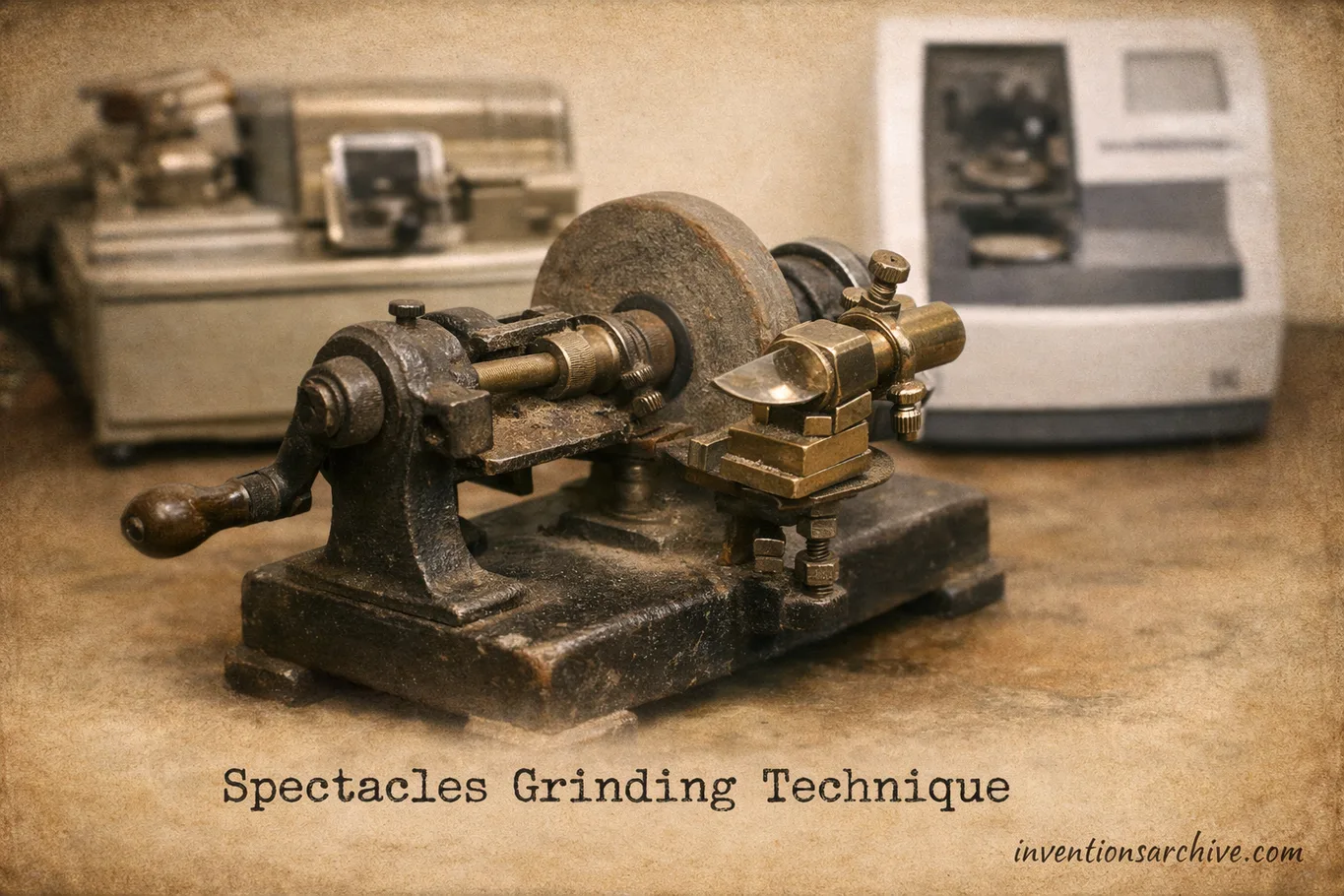
| Invention Name | Spectacle Lens Grinding Technique |
|---|---|
| Short Definition | Shaping and polishing lenses to a specified optical power |
| Approximate Date / Period | Late 13th century Approximate; major refinements in the 17th century Approximate |
| Geography | Northern Italy; later Europe-wide; now global |
| Inventor / Source Culture | Anonymous / collective workshop practice |
| Category | Optics; materials processing; health technology |
| Significance | Reliable vision correction; repeatable optical surfaces |
| Need / Driver | Reading clarity; aging vision; precision optics demand |
| How It Works | Abrasive lapping on shaped tools; final polishing on compliant laps |
| Material / Tech Basis | Glass blanks; abrasives (emery/oxides); pitch or pads; later diamond tooling |
| First Use Context | Reading aids; clerical and scholarly work |
| Diffusion Route | Italy → European craft centers → industrial optical supply chains |
| Derived Developments | Prescription standardization; lens inspection tools; freeform surfacing |
| Impact Areas | Education; medicine; science; daily life |
| Debates / Views | Exact “first spectacles” date Debated |
| Precursors + Successors | Reading stones → rivet spectacles → multifocals → freeform lenses |
| Key People / Civilizations | Italian opticians; European glassworkers; instrument makers |
The spectacle lens grinding technique is the craft-and-industry method that turns a plain blank into a lens with predictable optical power, clean transparency, and stable geometry. In simple terms, it is controlled surface shaping: abrasives remove tiny amounts of material, then polishing refines the surface until light passes through with minimal scatter and the intended focus is reached.
Contents
What Spectacle Lens Grinding Is
Spectacle lens grinding is a controlled way to create the lens surfaces that deliver a chosen focal effect. A finished lens must do two things at once: it must be optically accurate and also wearable inside a frame without unwanted distortion.
At its core, the technique balances three targets:
- Power: the lens bends light as intended for clearer focus without surprises.
- Surface quality: polishing reduces micro-roughness so the view stays clean and comfortable.
- Geometry: thickness, centering, and edge shape stay consistent for stable fit and visual alignment.
Eyeglass lenses work because they bend light so it focuses correctly on the retina; different lens designs address different refractive errors.Details That big idea is old. The precise, repeatable way to deliver it—through measured grinding and verified polishing—is what made spectacles a dependable tool for everyday life.
Key Words That Matter
- Blank: a starting piece of lens material before final surfacing.
- Curve: the surface shape that sets optical power; small changes can have big visual effects.
- Lap: a tool surface (rigid or compliant) used to grind or polish.
- Figure: how closely the surface matches the intended shape, beyond just being smooth.
- Centering: aligning the optical axis with the lens’ mechanical edge for balanced viewing.
Early Evidence and Timeline
The story of spectacle lens grinding sits inside a wider history: people first needed lenses, then workshops learned how to make them more consistent, then demand pushed production toward scale.
The earliest commonly accepted spectacles are associated with Northern Italy in the 13th century, and early designs used two lenses joined together with minimal support on the face.Details Those first lenses were typically convex, supporting near work for aging eyes—a practical need that helped the craft spread.
A Clear Line of Change
- 13th century: simple rivet-style spectacles; near-vision support becomes visible in daily life.
- 16th century: designs become easier to hold and more common; lenses increasingly serve both near and distance needs.
- 18th century: temple-style arms improve stability, encouraging longer wear times.
- 19th century: new forms like pince-nez appear, showing how frames and lenses evolved together.
Lens making became even more important as telescopes and microscopes rose in prominence, since optical performance demanded better surfaces and tighter control. One documented traditional approach describes shaping a glass disk against a metal bowl with damp emery as an abrasive, then finishing with finer powders; it also highlights how hand work stayed dominant for high-quality optics for a long time.Details
Core Tools and Materials
Across centuries, the technique relies on a stable trio: a lens blank, a tool surface shaped to guide curvature, and an abrasive that removes material in a controlled way. Details changed—hand tools to machines, loose grit to engineered media—yet the principle stayed recognizable.
What Removes Material
- Loose abrasives: particles in a slurry; flexible, traditional, widely adaptable.
- Bonded abrasives: fixed grains on a tool; more repeatable in many modern setups.
- Polishing compounds: fine oxides for final refinement and clarity.
What Guides the Shape
- Curved laps: guide spherical curves with strong geometric discipline.
- Compliant layers: materials like pitch or pads that help refine figure and surface finish.
- Blocking materials: compounds that hold lenses securely for batch work.
Modern optics education often describes a structured flow—generation, grinding, polishing, then centering and edging—while noting that grinding is mainly mechanical removal and polishing blends mechanical and chemical effects; pitch polishing remains a classic reference point even as CNC methods and specialized processes appear.Details
How the Technique Works
The technique is best understood as progressive refinement. Early steps aim for the correct overall shape. Later steps reduce texture, improve figure, and bring the lens to a comfortable visual result. Each stage leaves a surface that is better, not perfect, and the next stage is tuned to remove the signature of the previous one.
| Stage | Main Aim | Typical Surface Result | What Improves Next |
|---|---|---|---|
| Generating | Close to target curve and thickness | Visible tool marks | Fine grinding removes damage and regularizes shape |
| Fine Grinding | True geometry with smaller abrasives | Matte, uniform haze | Polishing reduces haze into transparency |
| Polishing | High transparency, low scatter | Clear, reflective surface | Inspection confirms figure and surface quality |
| Centering and Edging | Optical alignment and wearable outline | Correct diameter and bevel | Final fit in the frame, stable viewing |
Why Curvature Control Matters
A spectacle lens is not just “smooth glass.” It is a controlled curve that creates a specific optical effect. Even when the surface looks flawless, a small error in radius, centering, or symmetry can shift how the wearer perceives clarity, comfort, and depth. That is why the technique historically grew alongside measuring tools and verification practices.
A Classic Description of Surfacing
A widely cited manufacturing description explains lens blanks being brought to final form by grinding on a suitably curved tool with progressively finer abrasives, then mounting multiple blanks with pitch so they can be polished as a group; after both sides are polished, the lens is edged to the intended diameter and centered for use.Details The value is not in one material or one machine, but in the steady logic: shape, then refine, then verify.
From Handwork to Industrial Production
Spectacle lens grinding began as a workshop skill and later became a repeatable industrial pipeline. The shift did not erase craft; it reorganized it. Skilled judgment moved from constant hand correction to process design, tooling, quality checks, and reliable duplication of successful surface recipes.
What Changed as Demand Grew
- Batch consistency: groups of lenses could be processed together with tight similarity.
- Repeatable tooling: standard tool geometries reduced variability and improved predictability.
- Inspection culture: defects became measurable categories, not vague impressions.
- More designs: complex prescriptions and multifocals pushed the technique into new surface forms.
Industrial methods also encouraged specialization. Surfacing, polishing, coatings, edging, and final verification could be separated into stages, each optimized for speed and reliability. This staged approach is one reason modern eyewear can be widely available without sacrificing the basic optical expectations users rely on.
Lens Types and Variations
“Spectacles” include many lens families, and the grinding technique adapts to each by changing surface geometry, tooling strategy, and how the lens is checked. The categories below describe common variations without reducing the topic to a single “one-size” method.
By Optical Purpose
- Single-vision lenses: one consistent power across the usable area; valued for simplicity.
- Bifocals and trifocals: distinct zones for near, intermediate, and distance; edges between zones are intentional design elements.
- Progressive lenses: a smooth power change without a visible dividing line; the surface is highly controlled to manage perception and comfort.
- Toric lenses: different curvatures in different meridians to address astigmatism; axis alignment becomes critical.
By Surface Form
- Spherical: the classic form; predictable and widely used.
- Aspherical: reduced distortion and slimmer profiles in many prescriptions; requires more controlled surfacing and verification.
- Freeform: digitally defined surfaces tailored to prescription and frame parameters; relies on precise machine control and thorough quality checks.
By Lens Material
Historically, many lenses were glass, which responds well to established grinding and polishing approaches. Modern eyewear often includes plastics and hybrids, where surface creation may involve different tool choices and finishing steps, yet the goal stays the same: accurate curvature, clear transmission, and dependable performance in daily use.
Quality, Measurement, and Fit
The success of spectacle lens grinding is proven at the end, not at the machine. A finished lens is judged on optical accuracy, surface cleanliness, and how comfortably it performs during long wear. Quality is practical: clear edges, stable power, and trustworthy alignment.
What Is Checked
- Power and axis: the lens matches the intended correction; axis matters especially for toric lenses.
- Prism and centering: optical center placement supports comfortable viewing.
- Surface defects: scratches, digs, and haze that can affect clarity and perceived quality.
Why Fit Is Part of Optics
- Edge geometry: correct edging supports stable mounting and reduces chipping risk.
- Thickness balance: helps lens position feel natural and visually aligned.
- Frame interaction: lens shape and placement support consistent viewing across the usable area.
Over time, the grinding technique also shaped expectations. People came to assume a pair of glasses would be repeatable: two lenses that agree with each other, stable performance across the day, and clarity that feels easy. That social trust is an overlooked achievement of manufacturing discipline, not only optical theory.
FAQ
What does “grinding” mean in spectacle lens making?
It means shaping a lens surface by controlled abrasion so the curve matches an intended optical power. The goal is accuracy first, then refinement through finer steps.
How is polishing different from grinding?
Grinding primarily removes material in a mechanical way. Polishing focuses on surface quality and final figure, reducing scatter so the lens looks clear and performs smoothly.
Why are pitch laps mentioned so often in optics history?
Pitch is a compliant material that helps a polishing tool conform to the optic’s shape while improving smoothness and preserving the intended curve. It became a durable reference point for what high-quality polishing looks like.
Do modern freeform lenses still rely on “grinding”?
Yes, the underlying idea remains controlled material removal and refinement. The difference is that surface definitions and tool paths can be digitally controlled, enabling complex curves with strong repeatability.
What makes a lens feel comfortable to wear?
Comfort usually comes from correct power, stable centering, and a clean surface that minimizes glare and haze. Small geometric choices can affect how natural the view feels, especially in multifocal designs.