
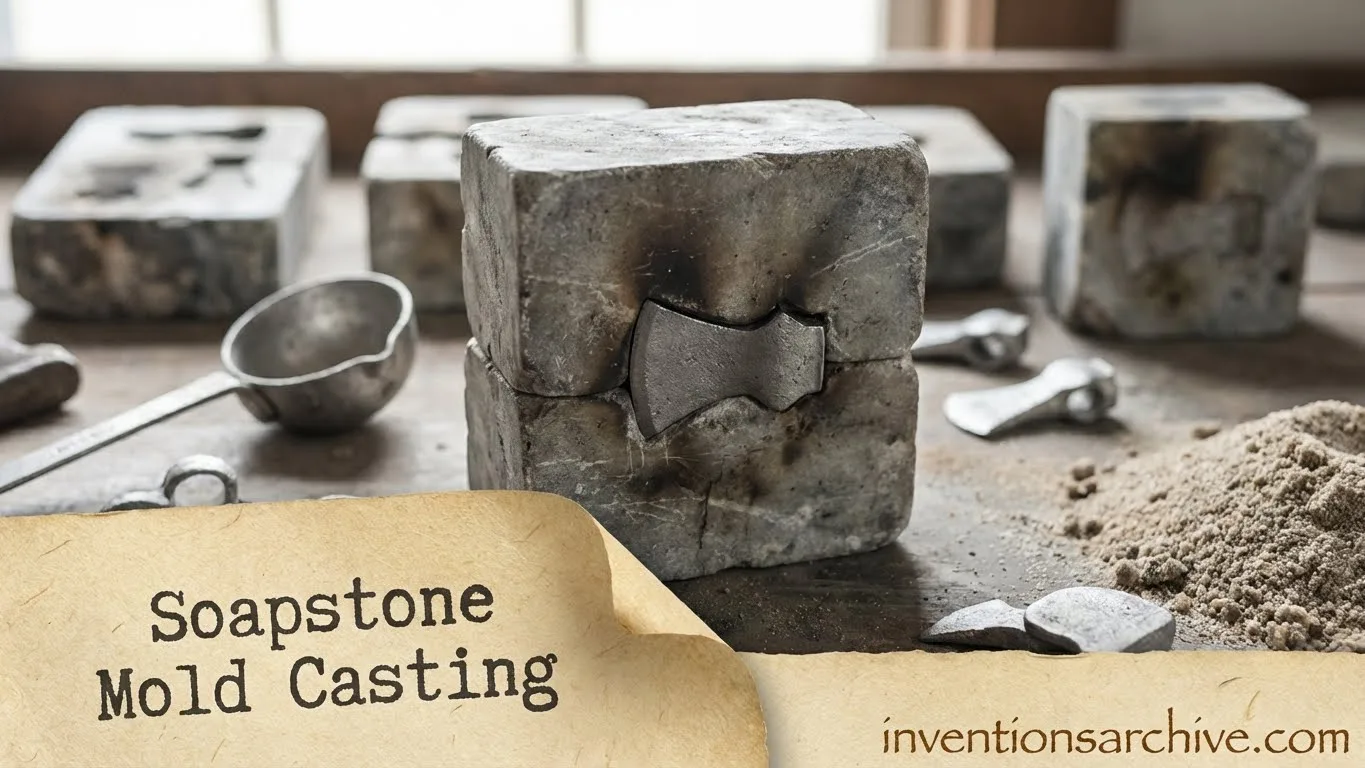
| Invention Name | Soapstone Mold Casting |
|---|---|
| Short Definition | Carved soapstone used as a reusable casting mould for small metal objects |
| Approximate Date / Period | Documented example: 6th c BC–6th c AD Certain; broader use spans multiple eras Approximate |
| Geography | Egypt (documented); North Atlantic & Scandinavia (well attested by archaeology) |
| Inventor / Source Culture | Anonymous / collective craft traditions |
| Category | Materials • Metalworking • Craft Technology |
| Importance |
Reusable moulds for repeatable shapes Fine detail from carved cavities |
| Need / Origin Driver | Consistent small parts; efficient repetition; portable workshop practice |
| How It Works (Simple) | Metal fills a carved cavity; solidifies; the piece is released |
| Material / Tech Basis | Soapstone (steatite); carving tools; simple alignment & clamping |
| First Known Uses | Small-object production (ornaments, fittings, seals or inlay-related forms) |
| Spread / Transfer Pattern | Shared craft knowledge; trade hubs; mobile specialists |
| Derived Developments | More standardized parts; mould libraries; repeatable motifs |
| Impact Areas | Craft • Trade • Education • Cultural Design |
| Predecessors + Successors | Earlier: clay/stone forms; Later: more durable multi-part mould systems |
| Debates / Different Views | “First use” varies by region; many finds reflect local innovation |
| Variations Influenced | Open-face, two-part, multi-cavity, reversible mould layouts |
Soapstone mold casting is a small-scale casting method that uses carved steatite (soapstone) as a reusable mould. It sits at a practical crossroads: easy carving meets repeatable shapes, so workshops could produce consistent pieces without rebuilding a mould every time.
Table of Contents
What Soapstone Mold Casting Is
At its core, soapstone mould casting uses a carved cavity in soft stone to shape molten metal as it cools. The mould can be single-sided or split into parts, and it often includes small carved channels that guide metal into place. The result is a method that favors repeatability and surface detail over large size.
- Reusable cavity for recurring forms and motifs
- Carved detail that translates into crisp cast surfaces
- Compact workflow suited to small-object production
Why Soapstone Works
Soapstone is valued because it is soft and highly workable, which makes carving precise cavities realistic even with simple tools. A widely cited technical description notes it is composed mainly of talc with chlorite, often with some magnetite, and it resists heat and acid while acting as an excellent electrical insulator.Details
- Carvability: fine grooves, letters, and borders are feasible
- Heat tolerance: suitable for brief contact with hot metal
- Chemical calm: less reactive than many porous stones
What the Material Encourages
The material naturally pushes designs toward small, repeatable forms. That fits well with objects where consistent size matters, and where a workshop benefits from a library of moulds rather than a single one-time form.
- Series-making without rebuilding the mould
- Motif consistency across many items
- Portable practice for traveling specialists
Early Evidence and Timeline
Archaeology shows that steatite moulds appear in multiple regions and time periods, often tied to dense networks of craft production. One documented museum record describes a circular mould carved from steatite, associated with Egypt and found at Naukratis, dated broadly from 6th century BC to 6th century AD, with a recorded diameter of 5.60 cm.Details
| What Archaeologists Look For | Why It Matters |
|---|---|
| Heat tint and surface wear | Hints at repeated pouring and handling |
| Gates and fine channels | Shows controlled metal flow, not simple shaping |
| Matched halves or alignment marks | Suggests two-part mould systems and repeatability |
| Motif repetition across finds | Points to shared design language and workshop practice |
How the Molds Work
A soapstone mould is essentially a carved negative space. Metal enters through a gate, fills the cavity, and then solidifies. Many examples include tiny vent lines that help air escape, plus shallow locating features that keep halves aligned when a mould is two-part. The strength of the technique is the way a stable cavity can be reused to create consistent geometry across multiple casts.
Common Mold Features
- Cavity: the shaped negative space
- Gate: entry channel for the metal
- Vents: fine paths for air release
- Registration marks: alignment points for halves
What These Features Control
- Fill quality: fewer voids, cleaner edges
- Surface finish: sharper lines from clean cavities
- Repeatability: stable shapes across runs
- Join lines: where halves meet on two-part moulds
Mold Types and Variations
Soapstone mould traditions include several practical layouts. Each variation is a response to shape complexity, desired output volume, and how easily a cast piece can be released without damage.
Open-Face Molds
- One carved face with a shallow cavity
- Best for flat-backed or low-relief shapes
- Clear viewing of the fill path during use
Two-Part Molds
- Matched halves form a complete cavity
- Supports more rounded, 3D geometry
- Parting line may leave a subtle seam
Multi-Cavity Molds
- Several cavities in one stone block
- Efficient for repeated small items
- Shared gates or separate feeds depending on layout
Reversible Molds
Some moulds are double-sided, effectively offering two working faces. A documented reproduction example notes that reversing a double-sided soapstone mould can switch between designs, reflecting known patterns from the Viking world and its diaspora.Details
- Two designs in one compact object
- Practical for traveling craft contexts
What the Method Made
Soapstone mould casting is strongly associated with small-object metalwork. It supports forms where consistent size and repeatable motifs matter, and where a workshop benefits from keeping moulds ready for future use.
- Ornaments and dress fittings with repeatable patterns
- Small connectors and functional fittings
- Weights and tokens where consistent form is valuable
- Decorative plaques and stamped-like motifs in metal
Limits and Preservation
The method is admired for its clarity, yet it naturally has boundaries. Soapstone is soft, so cavities can gradually change with use, and mould faces can chip if handled roughly. Archaeological finds often show a second life as well: a mould might be recarved, repurposed, or worn down to the point where only parts of a design survive.
| Strength | Natural Tradeoff |
|---|---|
| High detail from carved stone | Soft surfaces can wear over time |
| Reusable for repeated shapes | Mould life depends on design complexity and handling |
| Compact tooling and easy storage | Best suited to small and medium-detail objects |
FAQ
Is soapstone the same as steatite?
In many contexts, steatite is used as a formal name for soapstone, reflecting its talc-rich composition. Terminology can vary by region, but the words commonly point to the same family of soft, workable stone.
Why did workshops choose soapstone for casting molds?
Soapstone combines easy carving with heat resistance, which supports reusable mould cavities and stable shapes. A technical description highlights its talc-based makeup and notes that it resists heat and acid.Those traits align well with repeated small-object casting.
What clues show that a stone object was used as a casting mold?
Researchers look for carved cavities, gates and fine channels, plus wear that suggests repeated use. Context matters too: a mould found alongside metalworking debris can strengthen interpretation, while isolated finds may leave more room for careful debate.
Were soapstone molds used in more than one region?
Yes. Museum records document steatite moulds in ancient contexts, and archaeological research across northern Europe also associates soapstone with craft traditions in Scandinavia and beyond. The material’s workability made it attractive wherever suitable stone was available or could be traded.