
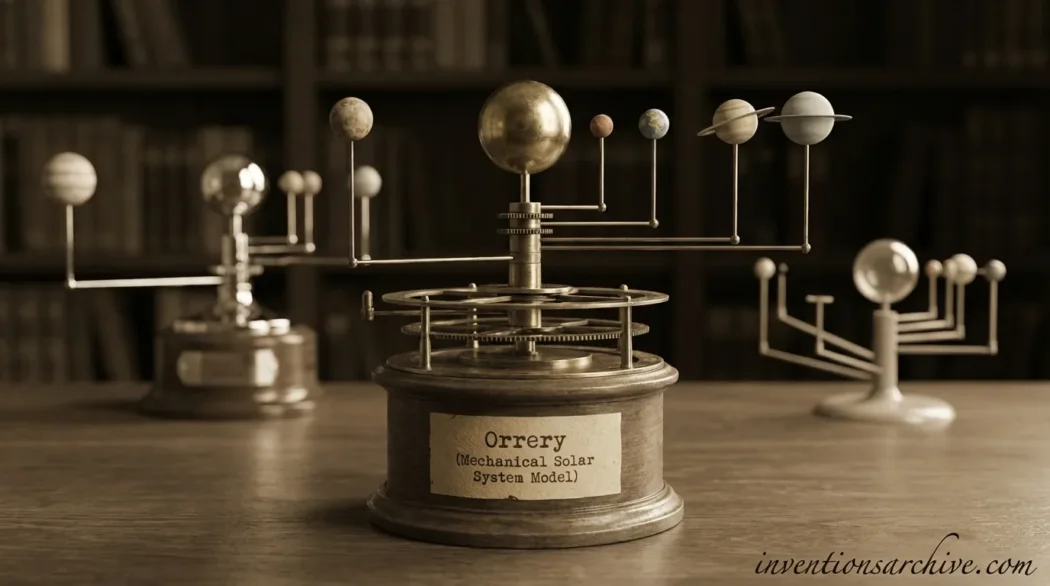
| Invention Name | Orrery |
| Short Definition | Mechanical model showing solar system motions |
| Approximate Date / Period | 1704–1713 Approx. (modern-era orrery) |
| Geography | London (England) → Europe → North America |
| Inventor / Source Culture | Graham & Tompion (early build); Rowley (name link) |
| Category | Astronomy; education; precision mechanics |
| Importance | Visible orbital periods; public science teaching |
| Need / Reason | Explain heliocentric motion in a tactile way |
| How It Works | Gear ratios drive planet arms around a central Sun |
| Materials / Tech Base | Brass gears; clockwork; wood; ivory; glass (varies) |
| Early Use | Lectures; salons; instrument cabinets; schools |
| Spread Route | Instrument makers → museums → classrooms |
| Derived Developments | Tellurian; lunarium; portable models; orrery clocks |
| Impact Areas | Education; horology; scientific visualization |
| Debates / Different Views | Credit and “first” claims Contested |
| Predecessors → Successors | Astronomical clocks → orreries → modern planetariums |
| Notable Makers | George Adams; W. Jones; David Rittenhouse |
| Key Variations | Grand; portable; tellurian; lunarium; clock hybrids |
An orrery is a mechanical solar system model that turns abstract astronomy into something you can watch and understand. It is not a toy, and it is not a scale replica. A good orrery is a precision teaching instrument: it makes the timing of planetary motion feel real, even when the distances and sizes must be simplified.
Contents
What It Is and Why It Matters
An orrery is a moving heliocentric model: the Sun is placed at the center, and the planets travel around it on arms or rings. The point is timing. When you turn the handle (or when a clockwork drive turns it for you), each planet advances at a different speed, guided by geared ratios. That simple idea turns a textbook diagram into a shared, visual experience.
- It explains motion without equations: inner planets rush, outer planets drift.
- It shows relationships: moons around planets, seasons, phases, eclipses (on models built for that).
- It makes the solar system feel like a system, not a set of isolated facts.
Historically, orreries helped audiences grasp the idea that celestial motion could be studied with care, measurement, and repeatable demonstration (Details-2).
Early Evidence and Timeline
Mechanical models of the heavens existed long before the word “orrery” became common. The modern-era orrery, though, is closely tied to early eighteenth-century London clockmaking. One influential build is dated to 1704, and the name became associated with Charles Boyle, the 4th Earl of Orrery (name origin) (Details-1).
A Simple Timeline
- Early 1700s: modern-era orreries appear in elite workshops and collections.
- Mid–late 1700s: “grand” instruments grow larger, meant for group viewing.
- Late 1700s–1800s: portable designs spread astronomy demonstrations more widely.
Why They Spread
- Lecture culture: instruments made public explanations feel credible.
- Instrument making: advances in gearing and finishing made complex motion dependable.
- Education: models let students “see” a year, a month, or a season in minutes.
How It Works
An orrery is a compact gear train. A single input motion drives several outputs, each rotating at a different speed. Planet spheres are mounted on arms that circle the center. It shows a controlled “speed map” of the solar system: relative periods matter more than exact scale (true scale would not fit on a tabletop).
What You Usually See on a Working Orrery
- Central Sun sphere (fixed or slowly rotating, depending on the build).
- Planet arms that orbit at different speeds.
- Optional attachments for specialized motions (Earth–Moon eclipses, seasons).
| Motion Shown | What It Helps Explain | How It Is Represented |
| Planetary revolution | Years and orbital speed differences | Gear ratios controlling arm rotation |
| Earth’s rotation and tilt | Day/night and seasons | Tellurian-style tilted Earth axis |
| Moon around Earth | Phases and eclipses | Lunarium-style Moon motion system |
Some instruments were designed so the owner could swap parts: a “planetarium” arrangement for planetary motion, then a lunarium for eclipses, or a tellurian for seasons (modular teaching) (Details-4).
Design Choices and Limits
Even the finest orrery makes tradeoffs. Real planetary distances and sizes explode beyond what a table-sized instrument can show. Many models choose clarity over literal scale. The most honest description is this: an orrery is a time machine for orbital periods, not a miniature universe.
What Orreries Do Well
- Relative speeds of planets
- Order and rhythm of the system
- Hands-on explanation for groups
What They Simplify
- True scale of size and distance
- Full accuracy of elliptical paths (many are circular)
- Precision prediction over long times
Museum documentation often stresses that most orreries focus on the relative speeds and only rarely capture accurate sizes, distances, or orbital shapes. A few designs introduced ways to suggest elliptical orbits, but that added complexity raises cost and fragility (Details-5).
Types and Variations
“Orrery” is a family name. Makers built versions for different audiences, budgets, and teaching goals. The differences are not cosmetic. A change in size, drive, or attachments changes what the instrument can explain with real clarity.
Grand Orreries
A “grand” orrery is designed for group viewing. It typically features longer arms, stronger frames, and an arrangement suited to multiple observers standing around it. Many of these instruments were used in lectures or demonstrations (several people could observe the same planetary motion at once).
Portable Orreries
Portable designs compress the same logic into a smaller package. A notable thread in the late eighteenth and nineteenth centuries is the push toward compact teaching instruments. These were easier to move, store, and demonstrate, even when they included extra parts like calendars and zodiac scales (historical conventions) built for explanation.
Tellurians and Lunariums
Some instruments separate tasks:
- Tellurian: focuses on Earth’s tilt, rotation, and revolution, making seasons understandable without heavy math.
- Lunarium: focuses on Moon motion and eclipses, showing alignment in a way a flat diagram struggles to match.
- Hybrids exist, and some sets let you swap components for different lessons.
Orrery Clocks and Hybrid Instruments
When an orrery is combined with a clock mechanism, it becomes an orrery clock, where timekeeping and planetary motion operate within the same system. These mechanisms are often carefully constructed and highlight detailed mechanical work. They also reflect the close relationship between astronomy and horology during the period of mechanical clock development (both relied on similar gear principles).
Uses in Teaching and Research
The strongest value of an orrery is not decoration. It is structured explanation. A teacher can point to motion instead of asking an audience to imagine it. A museum guide can connect a visible orbit to a calendar scale. Students remember what they can track with their eyes.
Common Learning Goals
- Relative orbital periods
- Connecting tilt and seasonal change
- Seeing why alignment matters for eclipses
- Comparing inner and outer planet motion without overload
Some historic instruments went further. For example, large, multi-panel orreries could include a “grand” planetary view plus a dedicated Moon system. One famous American example was built in 1770–1771 and includes a lunarium panel alongside the main model (a layered teaching device) (Details-3).
Museums and Notable Examples
You will find orreries in science museums, university collections, and astronomy-focused galleries. They vary from small brass-and-wood teaching tools to large display pieces that invite a crowd to gather around. The most informative displays usually explain three things:
- What is being modeled (which bodies and which motions)
- What is simplified (scale and geometry)
- How the drive works (hand-crank, clockwork, or motor)
| Example Style | Typical Focus | What Makes It Distinct |
| Demonstration orrery | Planet periods | Clear, durable layout for teaching |
| Portable orrery | Compact learning | Smaller footprint; often modular fittings |
| Grand orrery | Public viewing | Larger arms; group readability |
| Hybrid (tellurian/lunarium) | Seasons and eclipses | Specialized motion systems |
Royal Museums Greenwich documents a portable orrery that includes calendar and zodiac scales and even references the planet once called Georgium Sidus (later named Uranus) (a period detail) useful for dating.
Frequently Asked Questions
Is an orrery a planetarium?
Historically, the word planetarium was used for mechanical planetary models. Today, “planetarium” often means a projection theater. An orrery is specifically a mechanical model with moving parts that show planetary motion.
Does an orrery show the solar system to scale?
Almost never. Most models prioritize relative timing over true distance and size. A tabletop instrument can be excellent at showing motion while still being a major simplification of scale.
What is the main thing an orrery teaches?
It teaches the rhythm of orbital periods. Inner planets move quickly, outer planets move slowly. When the model also includes Earth’s tilt or Moon motion, it can teach seasons, phases, and eclipse alignment in a clear way.
What is a tellurian and how is it different?
A tellurian focuses on Earth: rotation, tilt, and revolution around the Sun. It often exists as an attachment or companion to an orrery. The emphasis is Earth-based phenomena like seasons and day/night rather than the full set of planets.
What is a lunarium?
A lunarium focuses on the Moon’s motion around Earth. When designed for it, it can illustrate the geometry behind eclipses. It is a specialized system, sometimes added to larger instruments as a swap-in module.
Why do some orreries include zodiac and calendar scales?
Those scales reflect historical ways of organizing astronomical knowledge. They can help connect the model’s motion to dates and to traditional sky references. On many instruments, they also serve as a reading interface that makes the demonstration easier for groups.