
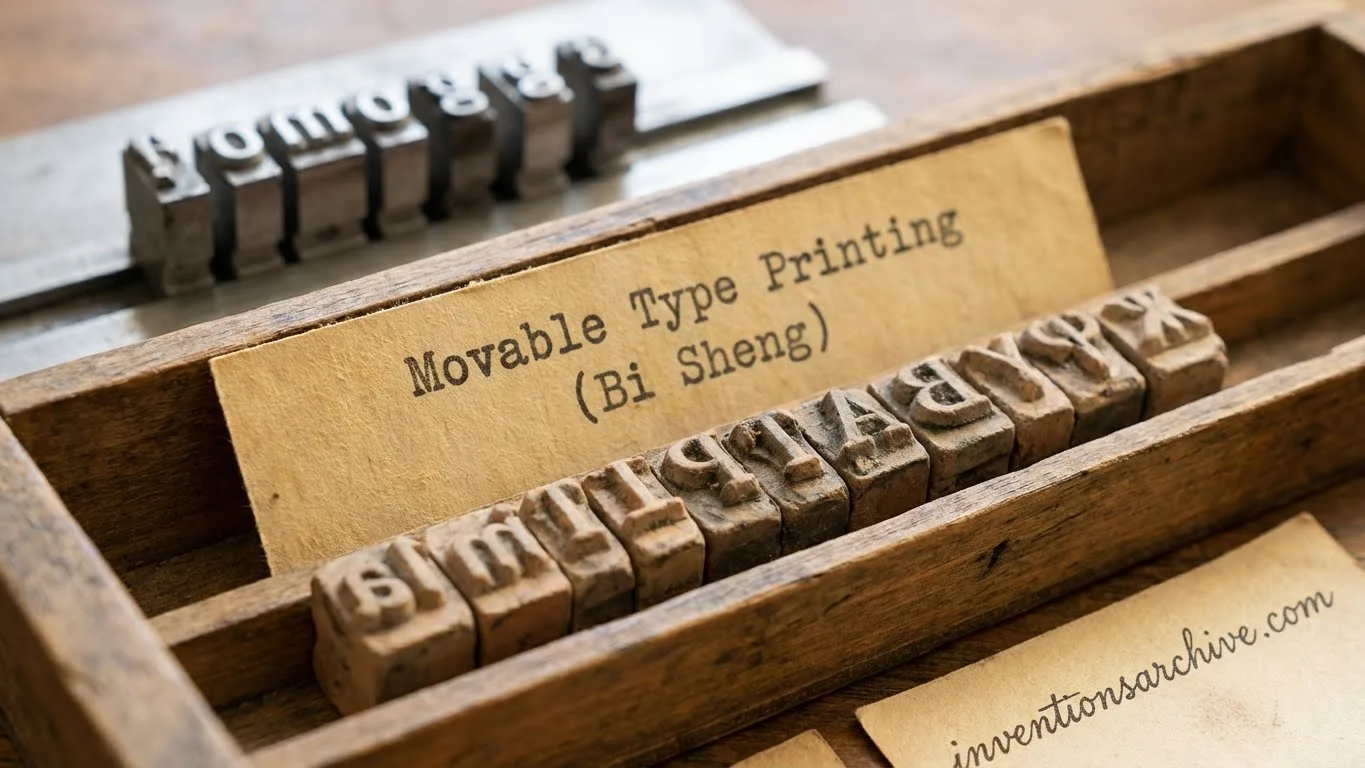
| Field | Value |
|---|---|
| Invention Name | Movable Type Printing (Bi Sheng) |
| Short Definition | A printing method that uses reusable individual characters to form pages. |
| Approximate Date / Period | 1041–1048 CE Approximate Details |
| Date Certainty | Approximate |
| Geography | Northern Song China |
| Inventor / Source Culture | Bi Sheng; Song-era craft tradition |
| Category | Communication; Publishing; Knowledge Preservation |
| Importance | Reusable type; Faster reprinting at scale |
| Need / Driver | Growing book demand; education; records |
| How It Works | Type pieces arranged in a frame; inked; pressed on paper |
| Material / Technology Base | Fired clay type; type frame; printing bed |
| First Known Use Areas | Books; reference texts; workshops |
| Spread Route | East Asia print culture; later regional adaptations |
| Derived Developments | Wooden type; metal type; later mechanized typesetting |
| Impact Areas | Education; administration; libraries; crafts |
| Debates / Different Views | Exact years; extent of early adoption |
| Predecessors + Successors | Woodblock printing → movable type → metal type → modern typography |
| Key People / Cultures | Song China; later East Asian printers |
| Variants Influenced | Ceramic type; wooden type; metal type |
Movable type printing is a simple idea with big reach: instead of carving one full page, printers assemble pages from reusable characters. In Song-era workshops, this meant pages could be rebuilt, corrected, and printed again with less waste. The name most often linked to the first clear description is Bi Sheng, whose approach turned printing into a system of parts.
Table of Contents
What It Is
Movable type breaks a page into small repeatable units. Each unit carries one character, so a printer can build a page, print it, then reuse the same pieces for a different page. That shift sounds modest, yet it changes the economics of printing: the “page” stops being permanent, while the type inventory becomes the long-term asset.
Core Idea
- Reuse the same characters across many pages and titles.
- Arrange pieces in a frame for one page, then redistribute them for the next.
- Correct a page by swapping a few pieces, not recarving a whole block.
- Build a workshop around sorting, storage, and fast composition.
Woodblock Printing
One block per page. Great for stable texts. Changes require new carving. The block is the finished page.
Movable Type Printing
Many pieces per page. Works best when reuse is high. The value sits in type sets and organized cases.
The logic behind movable type fits naturally into the longer story of the book. Even when the tools change, the goal stays steady: consistent pages, repeatable output, and dependable copies.
Where It Began
Historical summaries of Song dynasty technology regularly note that Bi Sheng (990–1051) used baked clay pieces, a choice that made early type fragile. Accounts also explain why the method was not the default for every job: when a writing system uses many characters, the workload shifts from carving pages to managing a very large type library. Details
What Makes This Period Important
- Growing reading demand created pressure for reliable copying.
- Printing became a workshop craft, not a one-off effort.
- New methods competed side by side, from woodblocks to type pieces.
How the Record Survives
A major anchor for Bi Sheng is the written record associated with Shen Kuo’s “Mengxi bitan” (Dream Pool Essays), a work described by the Library of Congress as covering the first known movable-type printing press. The same description notes an early printed edition dated to 1305. Details
How It Worked
The earliest descriptions focus on ceramic type: characters formed as separate pieces, then hardened by heat. A page was built by arranging those pieces into a tight grid, so the printing surface behaved like a single block. What stands out is the systems thinking: repeatable pieces, a stable layout method, and a way to reclaim the same characters for future pages. That reclaim step is the heart of movable type printing.
A Page, Viewed as Parts
- Type pieces represent single characters.
- Pieces are arranged to form a full page.
- The page is inked and pressed to paper.
- Pieces are then sorted and stored for reuse.
Workshop Tools That Matter
- Type cases for fast retrieval and return.
- Frames that keep the page tight and aligned.
- Inks and papers chosen for clean impressions.
- Rules for consistent character size and baseline, supporting legibility.
| Component | Role | Why It Matters |
|---|---|---|
| Type Piece | One character unit | Reusability |
| Frame | Holds layout | Even spacing and alignment |
| Storage Case | Organizes inventory | Speed in composition |
| Ink | Transfers image | Clarity and consistency |
Limits and Strengths
Movable type printing shines when reuse is high. A workshop can keep printing the same set of characters across many projects, and corrections are simpler than recarving a full page. Yet the method also has natural friction: building and maintaining a large inventory of characters takes time, space, and careful sorting. In early forms, ceramic pieces also demanded gentle handling to avoid breakage.
When It Fits Best
- Works that need many copies from the same content.
- Collections with repeated terms and shared characters.
- Environments where editing and correction are frequent.
The most important takeaway is balanced: movable type is not “better” in every case, it is different. It trades carving labor for organization labor. For many printers, that trade was worth it in the right context, especially where speed and revision mattered. Printing became modular.
Types and Later Paths
Once the page is treated as a set of reusable characters, the next question is material. Different type bodies serve different needs: durability, precision, and ease of making. Over time, workshops explored solutions that kept the same logic while changing the physical form.
| Type Family | Typical Material | Strength | Trade-Off |
|---|---|---|---|
| Ceramic Type | Fired clay | Accessible materials | Fragility |
| Wooden Type | Carved wood | More durable than early ceramic | Wear over long runs |
| Metal Type | Cast metal | High durability and crisp edges | Higher production complexity |
A well-known later milestone in metal movable type is the Korean book Jikji, printed in July 1377 using movable metal types, and recognized within UNESCO’s Memory of the World program. Details It shows how the movable type principle stayed relevant as materials improved.
What Stayed the Same
- Composition: building a page from units.
- Consistency: repeating the same character shapes across copies.
- Redistribution: returning type to storage for the next job.
- Standard sizing: keeping characters aligned and printable.
Lasting Influence
The long-term importance of movable type printing is not tied to one workshop or one city. It lies in a concept that keeps resurfacing: standardized symbols assembled into pages on demand. That thinking supports scalable publishing, predictable layouts, and faster correction cycles. Knowledge becomes easier to replicate.
Practical Effects
- Lower marginal cost for reprints once type exists.
- More stable text across copies, supporting reference use.
- Faster updates through piece-level correction.
Cultural Effects
- Broader access to printed materials over time.
- Support for education through repeatable editions.
- Growth of specialized crafts: type making, sorting, layout.
FAQ
Why is Bi Sheng connected to movable type printing?
Because historical writing credits Bi Sheng with early movable type made from fired clay, marking a clear step toward reusable character-based printing.
What is the key difference between woodblocks and movable type?
A woodblock is a single carved page. Movable type is a set of pieces that can be rearranged into many pages, turning printing into modular composition.
Why could early movable type be challenging to use?
It requires a large, well-organized inventory of characters. Sorting, storing, and retrieving pieces must stay consistent, or composition slows down. Fragility also mattered for early ceramic sets.
Did movable type evolve after Bi Sheng?
Yes. Printers explored wooden and metal types to gain durability and sharper impressions, while keeping the same reusable unit concept. Materials changed, the logic stayed.
Why does movable type matter for the history of publishing?
It introduced a durable idea: standard symbols assembled into pages as needed. That supports repeatability, cleaner correction, and scaled reproduction across many kinds of texts, with workshop efficiency at the center.