
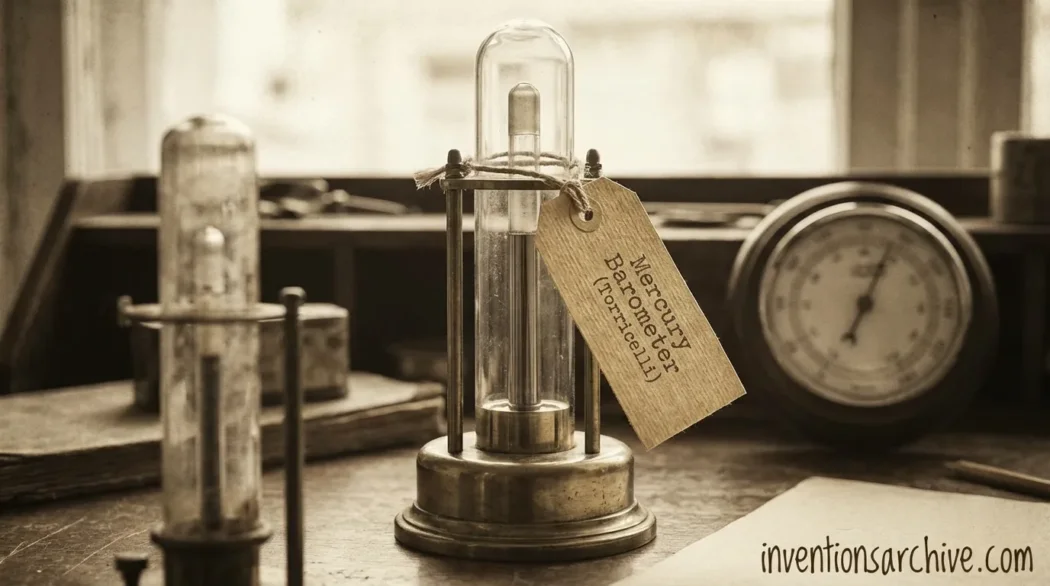
| Invention Name | Mercury Barometer (Torricelli) |
| Short Definition | Atmospheric-pressure instrument using a mercury column |
| Approximate Date / Period | 1644 Certain |
| Geography | Italy (Florence) |
| Inventor / Source Culture | Evangelista Torricelli |
| Category | Measurement; Meteorology; Physics |
| Need / Reason It Emerged | Explaining fluid-column limits; testing air weight |
| How It Works | Air pressure balances mercury-column weight |
| Material / Technology Basis | Glass tube; mercury; sealed vacuum space |
| Signature Observation | Column height about 76 cm above the reservoir (Details-1) |
| First Use Context | Natural philosophy; early laboratory measurement |
| Spread Route | Italy → European scientific networks → wider instrumentation |
| Derived Developments | Weather forecasting; altimetry practice; aneroid designs |
| Impact Areas | Science; navigation/aviation; education; engineering |
| Common Pressure Units Linked To It | atm; Pa; mmHg; inHg; torr (official conversions) (Details-2) |
| Variations It Inspired | Basin; siphon; wheel; cistern; Fortin; folded; aneroid; recording |
| Predecessors + Successors | Fluid-column experiments → mercury barometers → aneroid/barograph systems |
| Why It Matters |
|
A mercury barometer turns an invisible force into a visible height. The idea is simple, yet its reach is enormous: a column of mercury shifts as atmospheric pressure changes, giving a direct physical reading of the air’s weight above a place.
Contents
What The Barometer Is
A barometer measures pressure in the air. In daily language, it is often tied to weather, yet the deeper point is measurement: pressure is the force from the air column above a surface. The mercury version is special because it keeps that force in view as a height that can be compared across time and place.
What It Tells You
- Pressure level at a location
- Pressure change over time (the trend)
- A stable reference for comparison in labs and calibration
Why Mercury Matters
- High density keeps the instrument compact
- Clear, stable column supports fine readings
- Small changes become visible shifts
Torricelli and The First Mercury Barometer
Torricelli’s breakthrough was not a clever scale. It was a new view of nature: air has weight, and that weight can hold up a liquid column. The classic mercury setup shows a striking effect. The column settles and stays near a particular height, leaving an apparently empty space above it. That space became famous as the Torricellian vacuum.
What Made It Revolutionary
- Measurement becomes physical: pressure becomes a height
- Vacuum becomes stable: empty space can persist
- Standards emerge: barometer readings connect to shared units
The later pressure unit torr is named in Torricelli’s honor, and the familiar reference 760 mm of mercury is tied to standard atmospheric pressure. (Details-5)
How It Measures Pressure
A mercury barometer rests on hydrostatic balance. The air pushes on the mercury surface in the reservoir. The mercury inside the tube rises until its weight matches that push. The outcome is a clean relationship: more atmospheric pressure means a slightly taller column, and less pressure means a slightly shorter one. The height is the signal.
Units Without Confusion
Because the reading is a height, old and modern units sometimes mix. The safest way to compare is to treat pascal (Pa) as the common language, and see mercury heights as historical companions. NIST lists standard conversions, including standard atmosphere, mmHg, inHg, and torr. That keeps scientific writing consistent across fields.
Design Types and Variations
The Torricellian idea stayed the same, yet instrument makers explored many forms. Some designs favored clarity, others favored transport, and a few aimed for easy dial reading. Together they show how a single principle can adapt to different needs.
Direct-Reading Mercury Designs
- Basin barometer: closest to the original arrangement
- Siphon barometer: U-shaped tube; visible level change
- Cistern barometer: improved transport and steadier motion
- Fortin barometer: portable refinement with careful calibration features
Amplified And Recording Designs
- Wheel barometer: float and pulley translate mercury motion to a dial
- Folded barometer: compact tube with bends; easier to carry
- Balance barometer: pressure inferred from weight change
- Recording barometer: traces pressure over time (often aneroid-based)
Aneroid As A Close Relative
The aneroid barometer keeps the purpose while changing the method. It replaces mercury with a sealed capsule that flexes with pressure. That shift supports rugged devices and compact instruments, while the mercury barometer remains a benchmark reference in many historical and calibration contexts.
Uses and Long-Term Impact
The mercury barometer’s influence is wider than weather instruments on a wall. It helped turn pressure into a dependable quantity, and that change echoed into science and engineering. When a measurement is repeatable, it becomes a language shared by many fields. Pressure gained that status, and the barometer played a central role.
- Meteorology: pressure patterns and forecasting foundations
- Aviation: pressure-based altitude concepts and settings
- Physics: vacuum studies and gas behavior under pressure
- Metrology: pressure standards and conversions across units
- Education: a clear demonstration of balance and force
Why It Stayed Relevant
Many instruments can estimate pressure. Fewer can serve as a physical reference that is easy to understand. The mercury barometer offers that clarity: a column height tied to weight and gravity, with a direct readout.
Readings, Accuracy and Limits
A mercury barometer reading is precise, yet it is not isolated from the real world. Local conditions shape what the number means. Two terms matter right away: station pressure (what the air truly exerts at your elevation) and sea-level-reduced pressure (a comparison tool). These are related, yet they are not identical measures.
Elevation Changes The Baseline
As elevation increases, there is less air above you, so pressure drops. Weather.gov describes station pressure as the true barometric pressure at a location and notes a common rule of thumb: about 1 inch of mercury per 1,000 feet of elevation gain, with typical mid-elevation values lower than sea level. (Details-3)
Beyond elevation, precision can be shaped by factors such as temperature effects on materials, the cleanliness of the mercury surface, and the fine detail of how the meniscus is read. Those influences do not weaken the invention’s value. They simply remind the reader that measurement has context, and that context can be described with careful terminology and stable units.
Mercury Safety and Stewardship
Mercury barometers are historically important, and many are beautifully made. At the same time, mercury is a toxic substance. That is why modern practice favors sealed systems, controlled environments, and responsible handling. The U.S. EPA summarizes mercury’s hazards and basic context in a public, science-focused format. (Details-4)
Safe, General Takeaways
- Historical instruments are best treated as sealed artifacts
- Spills require expert response, not improvised methods
- Environmental care matters as much as personal safety
FAQ
Who Invented The Mercury Barometer?
Evangelista Torricelli is credited with the mercury barometer, based on his 1644 mercury-column experiment. The key idea is air pressure balancing the mercury’s weight, creating a stable, measurable height.
Why Does The Column Settle Near 76 cm?
The mercury rises until a balance forms between the air’s push on the reservoir and the mercury’s weight in the tube. The classic sea-level reference of 760 mm is a convenient benchmark, and the 76 cm observation is the historical doorway into pressure measurement.
What Is The Torricellian Vacuum?
It is the space above the mercury column where the liquid does not fill the tube. Historically, it showed that a stable vacuum could exist, and that pressure could be read through simple equilibrium rather than guesswork. The result is a clean physical reference.
What Is The Difference Between mmHg And Torr?
In many practical contexts they are treated as equal. Metrology references list both as pressure units linked to mercury-height tradition. The modern key is to map them back to Pa for clarity, and use mmHg or torr as familiar companions where they are standard in a field.
Are Mercury Barometers Still Used Today?
They are less common in routine settings, largely because of mercury safety. Still, the mercury barometer remains historically central and can serve as a reference instrument in controlled environments. Its legacy lives on in units, standards, and the concept of pressure as a measured quantity.