
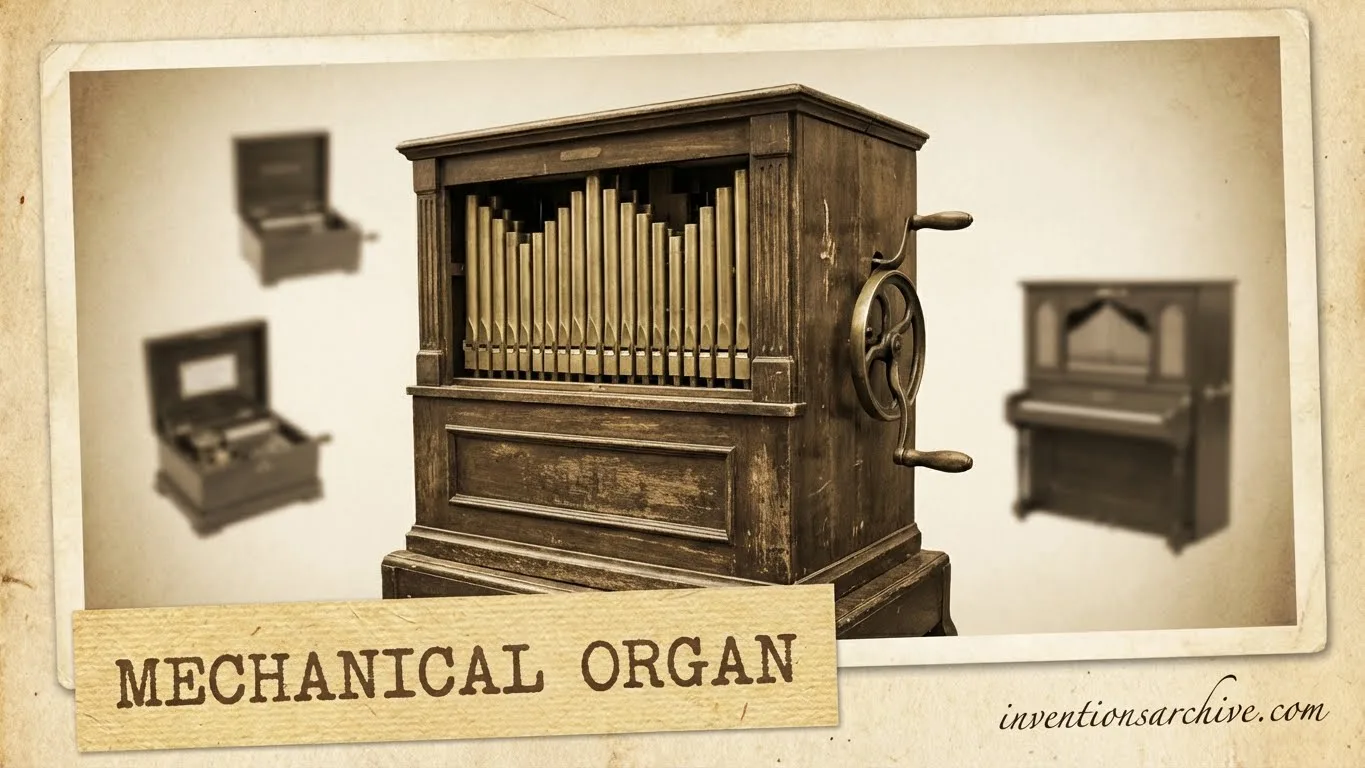
| Invention Name | Mechanical Organ |
|---|---|
| Short Definition (1 sentence) | Self-playing organ that converts a stored music program into wind-driven notes. |
| Approximate Date / Period | 16th–19th centuries (major growth) Approximate |
| Geography | Europe (court, salon, street), later wider adoption |
| Inventor / Source Culture | Anonymous / collective; later specialist builders |
| Category | Music, entertainment, automation |
| Importance (why it matters?) |
|
| Need / Reason It Emerged | Repeatable music, prestige display, portable public entertainment |
| How It Works (simple) | Program triggers valves; valves route wind to pipes/reeds |
| Material / Technology Basis | Bellows, windchest, valves, pipes or reeds; programmed medium |
| First Typical Use Settings | Courts, salons, churches, streets, fairs, dance halls |
| Spread Route | Workshop networks, instrument trade, public venues, collectors |
| Derived Developments | Organ books, perforated rolls, pneumatic player actions, electrified drives |
| Impact Areas | Craft, music culture, engineering, preservation collections |
| Debates / Different Views | Terminology scope (“barrel organ” vs “player organ”) Disputed |
| Predecessors + Successors | Musical clocks + hand organs → book/roll organs → electro-mechanical control |
| Key People / Traditions | European organ builders; fairground organ workshops; roll manufacturers |
| Varieties Influenced | Chamber barrel organs, street organs, fairground organs, dance organs, serinettes, orchestrions |
A mechanical organ is an automatic organ that “reads” a stored music program and turns it into sound. It sits in a fascinating middle ground: it keeps the wind, pipes, and stops of organ building, while adding a repeatable way to perform without a live keyboard player.
Contents
What It Is
A mechanical organ stores music in a physical format, then uses motion to translate that stored pattern into valve openings and wind flow. In a classic barrel organ, the notes are encoded as pins on a rotating cylinder, and a hand crank can both pump bellows and advance the program.Details
The Central Idea
- Program: a barrel, book, roll, or other medium that represents which notes play and when.
- Drive: hand crank, weights, springs, pneumatic assist, or electric motor that supplies motion.
- Translation: levers and valves that convert the program into air-to-pipe decisions.
Core Parts and How It Works
Even when designs differ, the same chain appears again and again: motion powers a wind system, a program selects notes, and a sound source (pipes or reeds) speaks.
Wind System
- Bellows to create air pressure or suction
- Reservoir to steady the flow
- Windchest as the distribution box
Program Reader
- Keys/levers lifted by pins, holes, or folds
- Tracker surfaces that sense perforations
- Shift or indexing to select tunes
Sound Source
- Pipes (flue or reed pipes)
- Free reeds in “reed organs” and compact variants
- Stops to change tone color
| Component | What It Does | Common Mechanical Approaches |
|---|---|---|
| Drive train | Supplies motion and timing | Crank + gears, weights, springs, motor |
| Program | Stores note events | Pinned barrel, organ book, perforated roll |
| Valve action | Opens selected notes | Mechanical linkages, pneumatic pouches, hybrids |
| Wind control | Maintains stable air | Reservoir + regulators, suction systems for reeds |
| Voicing | Shapes timbre | Stops, ranks, reed sets, percussion add-ons (in some large organs) |
Early Evidence and Timeline
Mechanical organs appear in many sizes, from small salon instruments to large public organs. In museum collections focused on mechanical music, barrel organs are described as being present in royal courts and salons in the 16th century, and later becoming more common in private homes and public life.Details
- 16th–17th centuries: prestige instruments; rare workshop production; early “automatic” examples in elite settings.
- 18th century: chamber and parlour barrel organs; refined cabinetry; larger repertoires per instrument.
- 19th century: broader public presence; street and fair contexts expand; more standardized manufacturing.
- Late 19th–early 20th century: growth of perforated media systems and more industrial distribution of programmed music.
- 20th century onward: restoration culture, museums, and digitization projects preserve mechanisms and music media.
A Note on Names
In everyday use, “mechanical organ” can mean a pinned-barrel organ, a book organ, a roll-controlled organ, or a hybrid. The shared feature is programmed playback through a wind-driven sound source.
Programming Media
The character of a mechanical organ is shaped by its program medium. Each format balances portability, variety, and how easily music can be copied or swapped.
Pinned Barrels
A pinned barrel (or cylinder) is a compact, durable storage method. Notes are “hard-set” into the wood as pins and staples. Changing repertoire usually means swapping the barrel. That physical certainty is also a limit: the tunes are fixed until the hardware changes, and long programs can become bulky.
Organ Books
Organ books use folded, perforated cardboard in a zigzag “book” format. Compared with heavy cylinders, the book approach supports larger libraries of music in a more manageable form. It also fits the needs of larger public organs that benefit from fast tune changes and repeatable performance.
Perforated Paper Rolls
Roll systems represent notes as perforations in a long paper strip, read by a tracker mechanism. The Library of Congress even defines a “roll” as paper where the notes are represented by perforations and can be mechanically produced as sound.Details Rolls can be duplicated, archived, and indexed, which reshaped how mechanical music could circulate.
| Medium | Strength | Tradeoff |
|---|---|---|
| Pinned barrel | Robust, self-contained, consistent timing | Limited repertoire per barrel; physical swapping |
| Organ book | Large program capacity; practical for big organs | Bulky libraries; careful handling needed |
| Paper roll | Copyable and catalog-friendly; long pieces possible | Sensitive to wear, humidity, tearing |
| Later digital control | Compact libraries; precise repeatability | Not historically “purely mechanical” Approximate |
Roll Detail and Expression
Perforated rolls can carry different levels of information. A university library guide explains that roll formats evolved with technology and includes distinctions such as arranged rolls and “reproducing” systems that encode more performance detail.Details The same underlying idea—holes as data—made richer automatic playback possible in multiple mechanical-instrument families.
Types and Variations
“Mechanical organ” is an umbrella term. The variations below share a program and a wind-driven voice, while changing scale, portability, and sonic ambition.
Related articles: Railway System [Industrial Age Inventions Series], Hydraulic Pump (Renaissance Engineering) [Renaissance Inventions Series]
- Chamber Barrel Organ: home-sized case, refined cabinetry; often built for parlours and private rooms; typically crank-driven.
- Street Organ: larger case and louder projection; moved on a frame or cart; designed for public squares and promenades.
- Fairground Organ: built for space and impact; broad sound palette; often paired with book or roll systems for frequent tune changes.
- Dance Organ: tuned for rhythm and presence; sized for halls; strong, steady wind and consistent timing.
- Serinette: small pinned-barrel organ built for teaching melodies; compact pipes and a focused, bright tone.
- Orchestrion: extended “one-machine ensemble”; may combine organ pipes with other sound-producing mechanisms.
- Player Reed Organ / Roller Organ: free reeds and suction wind; often paired with roll media in compact furniture-like cases.
- Hybrid “Finger and Barrel” Forms: an automatic mechanism alongside a manual keyboard in a single instrument (seen in some historical designs).
Small-Scale Feel
Chamber organs and serinettes emphasize detail and clarity. Their programs are often tightly curated, and the mechanics are designed for close listening.
Large-Scale Presence
Fairground and dance organs prioritize projection and color. Many use formats that support broad repertoires and quick swaps between programs.
Where It Was Used
Mechanical organs were built for specific social spaces. Their form follows the setting: size, repertoire handling, and even decorative choices align with where the instrument was expected to live.
- Courts and salons: small-to-medium automatic organs as conversation pieces and musical displays.
- Churches and chapels: in some contexts, automatic mechanisms complemented regular organ use, adding repeatable music for set moments.
- Streets and promenades: durable cases, steady timing, and strong projection for outdoor performance.
- Fairs and dance venues: larger sound, extended libraries, and program formats designed for variety.
- Collectors and museums: conservation-focused environments that keep mechanism and program media together for study.
Why It Mattered
The mechanical organ is more than a novelty. It is a clean demonstration of automation before electronics, built with wood, leather, metal, and precision. Each program medium is a practical answer to a single question: how can music be stored so it can be performed again?
Programmable Culture
- Repeatable performance without a live keyboardist
- Catalogable repertoires: tunes become items that can be stored and tracked
- Standardization in parts and mechanisms for reliability
Engineering Value
- Timing and motion control through gears and regulators
- Air management as a stable power system for sound
- Readable media that turns patterns into actions
What Survives Today
Many surviving mechanical organs are valued for two linked artifacts: the instrument and the program library. Barrels, books, and rolls hold repertoire history in a direct, physical way. When those media survive alongside the mechanism, the instrument becomes a working archive of encoded music.
FAQ
What Makes a Mechanical Organ Different From a Pipe Organ?
A pipe organ is played by a person through a keyboard and manual controls. A mechanical organ performs from a stored program, translating that pattern into valve actions and wind flow.
Are Barrel Organs and Mechanical Organs the Same Thing?
A barrel organ is a major type of mechanical organ. “Mechanical organ” can also include book organs, roll-controlled organs, and other self-playing organ variants, depending on context and tradition.
Why Did Program Media Shift From Barrels to Books and Rolls?
Barrels are sturdy but limited in repertoire per cylinder. Book and roll systems made it easier to handle larger libraries and exchange music more efficiently, while keeping the same underlying idea: a readable pattern that controls sound.
Do Mechanical Organs Always Use Pipes?
Not always. Many mechanical organs use pipes, especially larger instruments. Some compact designs use free reeds instead, which can support a furniture-sized form while still using a programmed medium and wind control.
What Is the Most Distinctive “Mechanical” Feature?
The standout feature is the program reader: pins, folds, or perforations that convert a stored pattern into real-time valve openings. That translation layer is the heart of automatic organ performance.