
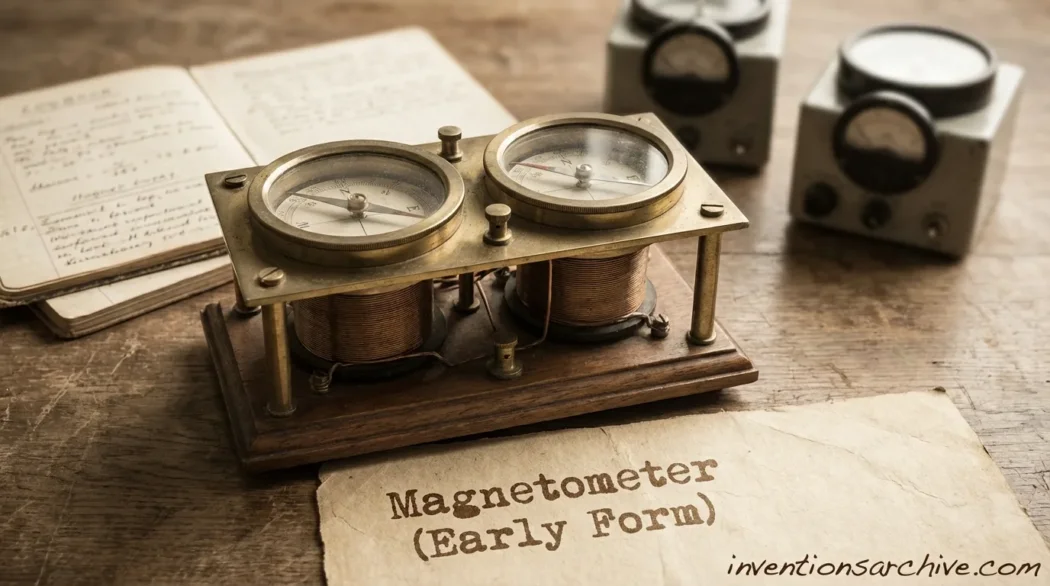
| Invention Name | Magnetometer (Early Form) |
| Short Definition | Instrument for measuring magnetic field direction and strength |
| Approximate Date / Period | 1832–1840 Certain |
| Geography | Göttingen (Germany); later observatory networks |
| Inventor / Source Culture | C. F. Gauss and collaborators; precision-instrument makers |
| Category | Measurement; navigation; geoscience instrumentation |
| Importance | Absolute field measurement; observatory standardization |
| Need / Reason It Emerged | Comparable magnetic data across places and time |
| How It Works | Suspended magnet + optics; oscillation and deflection readings |
| Material / Tech Basis | Permanent magnet; silk or fiber suspension; scales; telescope |
| Early Use | Geomagnetic observation; scientific surveys |
| Spread Route | Instrument workshops → observatories → survey services |
| Derived Developments | Unifilar and bifilar designs; standardized observatory practice |
| Areas Influenced | Science; mapping; education; engineering calibration |
| Debates / Different Views | “First magnetometer” wording varies by definition |
| Precursors + Successors | Magnetic needle → absolute instruments → electronic sensors |
| Key People / Institutions | Gauss; Weber; 19th-century magnetic observatories |
| Notable Variants It Shaped | Unifilar; bifilar; Kew-pattern systems; survey magnetometers |
The early magnetometer turned magnetism into numbers. It moved beyond simply pointing north and began to quantify the Earth’s field in ways that could be checked, repeated, and compared. That shift mattered because measurement culture grows fast once instruments become trustworthy. Even today, many modern sensors still echo the same goal: capture direction and strength without ambiguity.
Table Of Contents
What A Magnetometer Is
A magnetometer is a tool that detects magnetic field properties in a measurable way. In early forms, the “sensor” was often a magnetized bar or needle that could move freely, paired with optics and scales to read tiny changes. The core idea is simple: a magnetic field creates torque on a magnet, and that motion can be observed and translated into numbers. When the design is careful, the result becomes a repeatable measurement, not an impression.
Core Measurements In Plain Terms
- Direction: where the local magnetic field points (often tied to “declination”).
- Strength: how intense the field is at a location (often resolved into components).
- Variation: how those values change across minutes, days, seasons, and years.
- Comparability: whether two readings taken by different people can be meaningfully matched.
Why Early Measurement Mattered
Once magnetism could be measured with discipline, it became possible to build shared records. That unlocked a new kind of science: maps of the invisible. The Earth’s magnetic field is not perfectly stable, and early instruments revealed that it drifts and pulses. Observatories needed methods that resisted small errors and could be repeated for decades. That is why the most influential early designs chased absolute measurement, not just relative movement. The result was a foundation for long-term magnetic archives used in research and practical surveying.
What “Absolute” Changed
- Values could be compared across different sites.
- Results could be tracked across long spans of time.
- Instrument drift became visible, not hidden.
- Standards became part of the workflow.
Why Observatories Cared
- To build a dependable baseline for local field values.
- To detect small variations without guesswork.
- To maintain consistent records across generations.
- Networked data became possible.
Early Timeline And Evidence
Early magnetometers did not appear fully formed. They evolved from magnetic needles and astronomical-style reading techniques into standardized instruments that could travel between laboratories and observatories. A strong documented milestone is the unifilar tradition linked to Göttingen workshops and observatory networks, with instruments produced across 1832–1840, and a reported spread to multiple stations by the late 1830s (Details-1).
Common Milestones In Early Practice
- Magnetic direction becomes a measurable angle (declination).
- Inclination instruments establish the field’s tilt (dip) as an observable quantity.
- Optical reading and steady suspension reduce friction errors.
- Absolute methods link results to shared units rather than local “instrument-only” scales.
A Note On “Firsts”
When a source says “first magnetometer,” it often means “first widely recognized design that measured the Earth’s field with a dedicated instrument and clear method.” One prominent public-history account describes a Gauss-linked 1832 design as an early benchmark, featuring a magnet suspended by a fiber and framed within the idea of absolute and relative styles (Details-2). Different definitions can shift the wording, yet the early 1830s remain a central turning point for standardized measurement.
How Early Magnetometers Worked
Most early instruments rely on one idea: a magnet under the Earth’s field behaves like a carefully balanced pointer. What changes is how that motion is read. The best-known early approaches pair motion (oscillation or deflection) with optical magnification so small angles become readable. This is why telescopes, mirrors, and fine scales appear so often in historical designs. The aim is a stable link between what the magnet does and a number that can be recorded.
Oscillation Method
A suspended magnet swings with a period tied to magnetic conditions. By timing that motion, observers could infer field strength relationships. The strength of this approach is that it converts magnetism into time, which is naturally measurable. Designs often used mirrors or reading optics to reduce uncertainty. The goal is a consistent, repeatable rhythm.
Deflection Method
A known magnet can deflect another magnetic element by a measurable angle. With the right geometry, that angle supports a quantitative comparison between the magnet’s influence and the Earth’s background field. The attraction is clarity: angle becomes data. The challenge is subtle alignment and careful reading, so optics and stable mounts matter. A small deflection can still carry big meaning.
What “Absolute” Meant
“Absolute” in this context points to a measurement that can be anchored to shared units rather than a single instrument’s private scale. That ambition shaped instrument design: it pushed makers toward stable suspensions, repeatable geometry, and consistent reading methods. The practical effect is that two observatories could share a number and trust that it describes the same physical thing. That is a quiet revolution, and it is why early magnetometers sit at the boundary between natural philosophy and modern measurement science. The payoff is comparability across distance.
Types And Variations
“Early magnetometer” is not one single device. It is a family of designs that share a measurement goal while differing in suspension, geometry, and the part of the field they emphasize. The most influential variants focus on making small changes readable while keeping the system stable. In observatory work, designs also needed routine repeatability, not delicate one-off demonstrations. Many later patterns reflect this same discipline, just with more refined mechanics and optics. The family resemblance is the focus on controlled motion.
| Variant | Main Idea | Best At | Typical Setting |
|---|---|---|---|
| Unifilar Magnetometer | Magnet suspended on one fiber | Stable angular readings | Observatories; calibration rooms |
| Bifilar Magnetometer | Magnet supported by two fibers | Sensitive variation tracking | Long-term monitoring |
| Declination Instrument | Needle angle relative to true north | Directional changes | Surveying; observatories |
| Dip Circle / Inclination Tool | Needle tilt in vertical plane | Field inclination (dip) | Geophysical observation |
| Kew-Pattern Systems | Standardized observatory patterns | Consistency across sites | Institutional networks |
Kew-Pattern Design
Kew-pattern magnetometers reflect a drive toward institutional consistency. A university museum description of a Kew-pattern instrument highlights a tripod base with levelling screws, reading microscopes, and an approach that uses oscillation and deflection to resolve the Earth’s field strength while managing the magnet’s own moment (Details-3). That kind of structured design reduced ambiguity and supported reliable record-keeping.
Where It Was Used
Early magnetometers earned their reputation in places that demanded patience: observatories, survey programs, and research rooms built for careful readings. The emphasis was not speed. It was traceable reliability. Over time, those readings formed archives that help later researchers interpret how the Earth’s field changes. Large-scale collections of historical magnetic records also preserve the daily texture of the field, including variation that would otherwise be lost. The long view is built from routine measurement and disciplined documentation, often tied to named observatory sites and multi-decade continuity (Details-4).
Typical Use Contexts
- Geomagnetic observatories: stable rooms, consistent routines, long records.
- Survey work: field measurements that support mapping and reference values.
- Instrument comparison: checking one setup against another to keep results coherent.
- Education and training: controlled demonstrations of measurement principles without shortcuts.
- Calibration culture: verifying that readings mean the same thing over time.
Limits And Accuracy
Early magnetometers were powerful, yet they were not effortless. Their precision depended on stable conditions, careful mechanics, and thoughtful reading methods. Several practical challenges show up repeatedly across historical designs: friction, temperature effects, and slow changes in a magnet’s properties. Instrument makers responded with better suspensions, improved optics, and repeatable setups. Even then, observers needed to treat the instrument as a system, not a single object. That mindset—measure, cross-check, and record context—kept results meaningful. It also made magnetometry feel quietly rigorous rather than dramatic. The best designs aimed for trustworthy consistency more than showy complexity.
Common Sources Of Error
- Mechanical friction and tiny sticking points.
- Temperature drift affecting dimensions and magnet behavior.
- Local magnetic contamination from nearby materials.
- Reading bias when scales are hard to interpret.
- Aging magnets changing slowly over time.
What Good Designs Did Well
- Made small angles readable with optics.
- Kept geometry stable and repeatable.
- Supported consistent routines for long records.
- Allowed checks that reduced one-off noise.
- Protected measurement meaning with standard practice.
FAQ
Is An Early Magnetometer The Same As A Compass?
A compass shows direction, yet it typically does not aim to quantify magnetic strength or support standardized comparisons. Early magnetometers kept the directional idea, then added methods that translate motion into measurable values, often with optical reading and recorded timing. That shift enabled scientific datasets.
What Does “Unifilar” Mean In Historical Magnetometers?
It refers to a magnet suspended by a single fiber. The suspension reduces friction and allows the magnet to rotate cleanly in response to the Earth’s field. This supports precise angular observation and can be paired with deflection or oscillation approaches. The key value is stability.
Why Were Optics So Important?
Magnetic effects often produce very small angles. Mirrors, telescopes, and fine scales magnify those tiny changes into something readable. With good optics, observers could record small variations without forcing the instrument or relying on guesswork. This supports repeatable observation and consistent records.
What Was The Main Scientific Payoff In The 19th Century?
The payoff was shared data. Once instruments supported comparable readings, observatories could build long-term series and compare different sites. That made it possible to treat the Earth’s magnetic field as a dynamic system rather than a static background. The culture of standard measurement is the deeper legacy, with archives that remain valuable.
Did Early Magnetometers Measure The Full Magnetic Field?
Often they measured components or angles rather than a single “complete” value. Many instruments focused on declination (horizontal direction), inclination (tilt), or strength relationships. Over time, designs and routines improved so multiple components could be tracked with greater coherence. The general trend is from single-focus readings toward component-based records with better comparability.
How Do Modern Magnetometers Relate To Early Forms?
Modern sensors may use electronics and different physics, yet many still aim to measure direction and strength with controlled calibration. The continuity is the demand for traceable values and stable procedures. Early magnetometers helped establish that expectation: measurement should be repeatable, interpretable, and recorded in a way others can trust. That mindset is still central.