
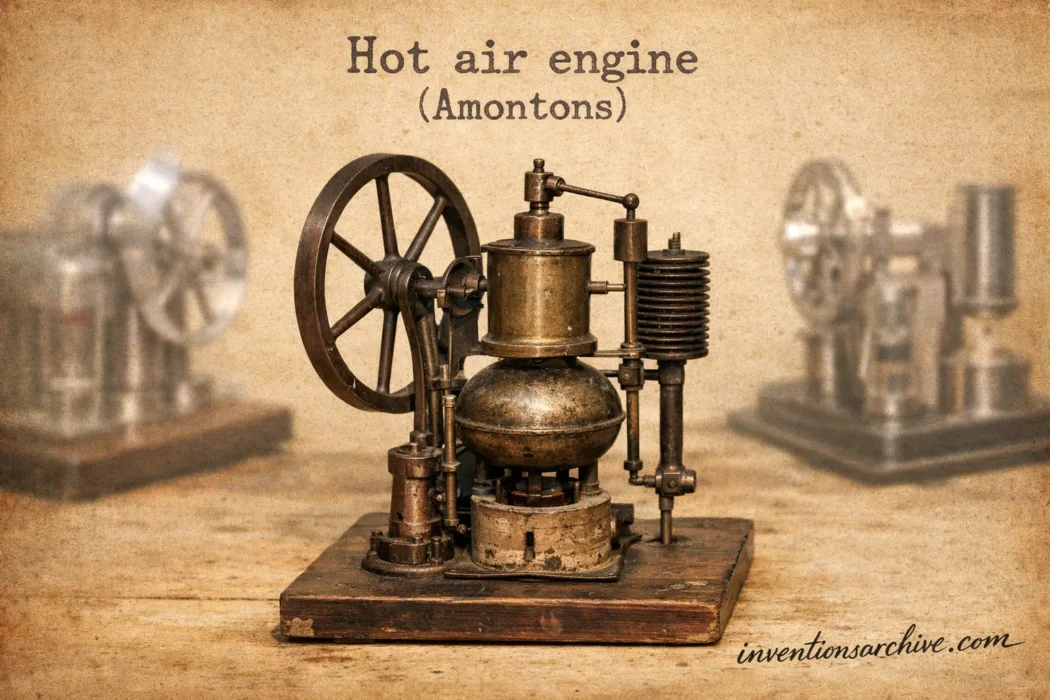
| Aspect | Value |
|---|---|
| Invention Name | Hot Air Engine (Amontons) (moulin à feu) |
| Short Definition | An external-combustion air-power concept that uses heated air to move water and turn a wheel. |
| Approximate Date / Period | June 1699 — Certain |
| Geography | Paris, France (Académie Royale des Sciences) |
| Inventor / Source Culture | Guillaume Amontons (French physicist; scientific instrument inventor) |
| Category | Power; mechanical engineering; heat engine (hot-air / external combustion) |
| Need / Reason For Emergence | Replace human and animal labor for machines; steady mechanical power |
| How It Works | Heated air expands; water shifts between chambers; weight imbalance turns a wheel |
| Material / Technology Base | Air expansion & cooling; metal cells; furnace heat; water as moving mass |
| First Known Use | Académie presentation; proposal and analysis (no verified industrial deployment) |
| Spread Route | Académie records and later engineering histories |
| Derived Developments | Hot-air engines; Stirling-type engines; caloric engines |
| Impact Areas | Thermodynamics; measurement science; machine design; concept of mechanical work |
| Debates / Different Views | Called “hot air engine” or “fire mill”; not a piston engine; cycle labels vary |
| Precursors + Successors | Precursors: pneumatics, early fire-powered pumps; Successors: Stirling (1816), later hot-air engines |
| Related Variants | Open-cycle hot-air engines; closed-cycle regenerative engines; alpha/beta/gamma layouts (later) |
A heat engine does not need steam to be bold. In June 1699, Guillaume Amontons described a moulin à feu—a “fire mill”—built around one plain idea: warm air expands, and that push can be turned into motion. The design reads like careful laboratory thinking brought to the scale of machinery.
On This Page
What It Is
The hot air engine (Amontons) is an early proposal for turning temperature change into mechanical output. It sits in the family of external-combustion machines: the fire stays outside the working chambers, while the working fluid—air—does the moving.
- Working fluid: air (heated, then cooled)
- Moving mass: water shifted by air pressure
- Output motion: rotation (a wheel), not a piston stroke
Calling it a “hot air engine” can mislead a little. Many later hot-air machines use pistons and heat exchangers; Amontons’ design uses water transfer to create torque. Different hardware, same ambition: turn heat into work—plainly, mechanically.
Amontons And Setting
Who Amontons Was
Amontons worked as a physicist and instrument inventor. He contributed to temperature measurement and explored how pressure changes as air warms, a line of thinking that later helped make temperature a more rigorous quantity. Dates matter here: he presented the fire-mill paper across meetings in late June 1699.
Britannica notes his work on air-pressure thermometry and the path it opened toward the idea of absolute zero. (Details-2)
What He Claimed In 1699
According to a later scholarly reconstruction of the Académie record, Amontons treated the project like an engineering argument, not a sketchy thought experiment. He tied it to measurable human and animal effort—then scaled up. No poetry, just numbers.
- Wheel diameter: 30 feet (about 9 m)
- Rotation target: one turn every 9 seconds
- Equivalent output: 39 horses or about 234 men (as he estimated)
Those figures come from an academic paper that traces the June 1699 presentation and summarizes the mechanism in technical terms. (Details-1)
The 1699 Design
Picture a large wheel with chambers around its rim. Some chambers warm near a furnace; others cool in water. As air heats, it expands and drives water through tubes. That water shift changes the wheel’s balance, so gravity provides the turning moment. It is a torque-by-weight trick, powered by heat.
Main Parts
- Air cells (thin metal chambers) that alternately heat and cool
- Furnace zone to raise air temperature on one side of the wheel
- Cooling bath to contract air on the opposite side
- Water channels and tubes that move water between rings
The clever part is the coupling: air pressure acts on water, and the water’s weight creates rotation. In later hot-air engines, a piston takes that role; here, water behaves like a liquid piston without the sealing headaches of sliding parts. Different solution, same physics.
A Small Comparison Table
| Design Feature | Amontons Fire Mill (1699) | Later Hot-Air Engines |
|---|---|---|
| Main Moving Element | Water mass shifted by air pressure | Pistons and/or displacers moving gas |
| Output Motion | Rotation of a wheel | Usually reciprocating motion, then crank rotation |
| Heat Handling | Heat and cooling applied around the wheel | Heat exchangers; often regeneration (heat recovery) |
| Working Gas | Air | Air, helium, hydrogen (varies by design) |
| Typical Label | “moulin à feu” / hot air engine concept | Stirling, caloric, and other hot-air families |
Heat To Motion
A hot-air engine lives on one reliable behavior: when air warms, it pushes harder if it is confined. When it cools, pressure drops. Amontons exploited that swing with expansion and contraction cycling around the wheel. No mystery—just gas behavior and careful geometry.
Where The Work Comes From
- Heat input raises air pressure in heated cells.
- Pressure difference pushes water through tubes into a different ring.
- Water ends up “piled” more on one side, creating a gravity torque.
- The wheel turns; cells move on, and the pattern repeats.
Notice what this avoids: a tight-fitting piston sliding in a cylinder. That choice made sense in 1699. Materials and machining existed, sure, but consistent sealing and low-friction motion at scale were a constant fight. Amontons chose water and let gravity do the heavy lifting.
What The Design Demands
The concept places pressure on three practical limits. First, heat must pass quickly through thin metal so the air cycles fast. Second, the system needs stable valves or flow paths so water moves predictably. Third, the wheel must stay balanced except for the intended water shift—otherwise friction eats the output. Engineering details decide everything. Always.
Measurements And Ideas
The fire mill matters because it forced a serious question: how does one compare a machine’s output to real labor? Amontons approached that by measuring forces and motion in a familiar industrial action—polishing glass—then using those observations to estimate human work rate. Measured effort beat vague analogy. That shift sticks.
Friction Enters The Story
In the June 1699 work, Amontons discussed friction as a machine limit, drawing on direct measurement. That link—heat engine thinking feeding into machine friction—is easy to miss, yet it is there in the historical record. Machines do not move in a vacuum. They rub.
Thermometry And Temperature
Amontons also built tools for measuring temperature via air pressure. This matters for engines because temperature can be treated as a quantity, not just a feeling. Britannica points to his air-pressure thermometer work around 1702 and its role in later thinking about absolute zero. Better measurement enables better machines.
Variants And Descendants
After Amontons, hot-air ideas did not freeze in place. Designers returned to the same resource—heat outside the working chamber—and tried new hardware. The most famous branch is the Stirling engine, often described in terms of layouts: alpha, beta, and gamma. NASA’s Stirling design manual treats these types as standard categories in engineering literature. (Details-3)
Common Hot-Air Families (Plain Descriptions)
- Closed-cycle, regenerative engines (Stirling-type): the working gas stays inside; heat shuttles through exchangers and a regenerator.
- Open-cycle hot-air engines: air moves in and out; combustion stays outside the power cylinder, but the working gas may not be sealed.
- Liquid-piston variants: gas pressure moves a liquid column or mass, echoing Amontons’ water-based choice.
Stirling Layout Names
The labels help describe geometry, not “better” or “worse.” Alpha places power pistons in separate hot and cold cylinders. Beta places a displacer and power piston in one cylinder. Gamma uses a separate power piston cylinder with a displacer cylinder alongside. Same cycle family, different packaging.
Where Amontons Still Feels Modern
- External heat keeps combustion products away from moving parts—cleaner internals by design.
- Heat transfer limits show up immediately; his concept forces attention onto materials and surface area.
- The design treats power as a quantity to estimate, compare, and argue about. That habit became standard engineering.
FAQ
This section uses collapsible items so the page stays readable while still covering the usual questions. Answers stay historical, not instructional. Clean and simple.
Was Amontons’ machine actually built?
Records describe the design and its performance estimates as a presented project. Surviving accounts emphasize the proposal and analysis rather than a documented, full-scale industrial build. It is best treated as a serious concept with detailed reasoning.
Why call it a “hot air engine” if it used water?
The working pressure comes from air that heats and cools. Water serves as the movable weight and pressure-transmission medium. In modern terms, it behaves like a liquid piston. Air provides the push; water provides the torque.
Did it use the Stirling cycle?
Later writers sometimes connect Amontons to the Stirling family because both rely on external heating of a gas. The hardware differs: Amontons used a wheel and water shifting rather than piston-displacer arrangements. Shared principle, different mechanism.
What made the design hard to realize at scale?
Large-scale success depends on fast heat transfer, reliable flow control for water movement, and low losses from friction and leakage. Those constraints are ordinary engineering constraints—nothing dramatic—yet they can decide output. Heat must move quickly, and losses must stay small.
How did this connect to measurement science?
Amontons worked on thermometry using air pressure and discussed machine effects with measured quantities. That combination—measurement plus machine reasoning—helped make heat, pressure, and work discussable with numbers rather than impressions.
What is the cleanest way to summarize its influence?
It shows an early, explicit attempt to turn air expansion into mechanical motion and to compare machine output with labor using measurement. That mindset shaped how later heat engines were argued for, tested, and improved.