
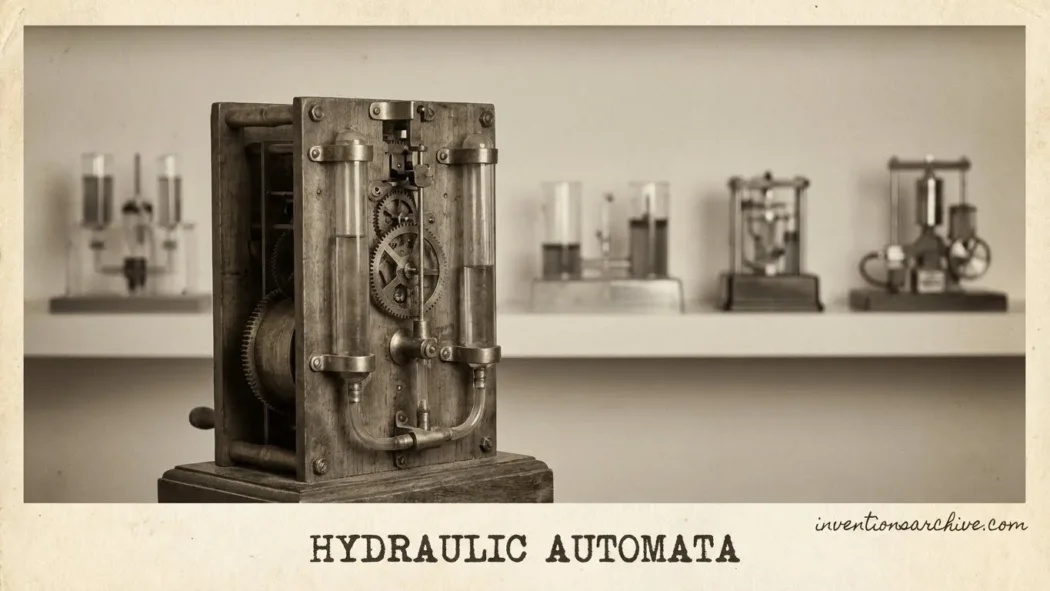
| Invention Name | Hydraulic Automata |
|---|---|
| Short Definition | Self-acting mechanical devices moved, timed, or triggered by water, air pressure, floats, valves, siphons, weights, or related fluid systems. |
| Approximate Date / Period | Hellenistic and Roman Alexandria, later expanded in the medieval Islamic world Approximate |
| Geography | Alexandria; Greek and Roman Mediterranean; Abbasid Baghdad; northern Mesopotamia; Syria and Egypt in manuscript tradition |
| Inventor / Source Culture | Not one inventor; linked to Ctesibius, Philo of Byzantium, Hero of Alexandria, the Banū Mūsā brothers, and al-Jazarī Attribution varies |
| Category | Mechanical engineering; water technology; measurement; entertainment; courtly display; early automation |
| Main Problem Solved | Creating movement, timing, sound, dispensing, or visual surprise without continuous visible human action. |
| How It Worked | Water flow, changing water levels, air displacement, floats, siphons, valves, levers, and weights produced a planned action. |
| Material / Technology Base | Bronze, wood, ceramic vessels, pipes, basins, floats, cords, levers, gears, valves, and water reservoirs. |
| Evidence Status | Mostly written descriptions and illustrated manuscripts; a few related archaeological and museum objects Based on surviving evidence |
| Early Use Areas | Temple effects, theatrical display, fountains, clocks, courtly entertainment, handwashing devices, and teaching demonstrations. |
| Development Path | Water clocks and pneumatic devices → hydraulic automata → programmable display devices → clocks, fountains, mechanical toys, and early robotics concepts. |
| Related Inventions | Water clock, hydraulis, siphon fountain, automatic temple doors, peacock clock, elephant water clock, mechanical clockwork. |
| Modern Descendants | Animated fountain systems, clockwork automata, feedback-controlled mechanisms, theatrical special effects, and educational robotics history. |
| Why It Matters | It shows that automatic action was studied long before electric motors, electronics, or digital control. |
Hydraulic automata were not one machine. They were a family of early automatic devices that used water, air pressure, floats, siphons, valves, levers, and weights to make something happen without a visible hand moving it. Some opened doors. Some moved figures. Some made birds sing, poured water, marked time, or created surprising fountain effects. The idea was simple to watch but difficult to design: a hidden fluid system turned natural forces into controlled motion.
What Hydraulic Automata Means
A hydraulic automaton is a device that performs a planned action by using water or water-related pressure. In many early examples, water did not act alone. It often worked together with trapped air, falling weights, floats, counterweights, cords, levers, or rotating parts.
The word hydraulic can mislead modern readers. Today it often brings to mind pressurized oil, heavy machinery, and industrial cylinders. In ancient and medieval automata, the word is closer to water-driven action: water flowed, filled, drained, pushed air, lifted a float, tilted a vessel, or released a mechanism.
These devices sat between practical engineering and controlled wonder. A water clock measured time. A fountain produced a changing display. A handwashing automaton delivered water in a staged sequence. A temple or theatrical device hid its mechanism so the action looked self-moving.
How the Origin Is Traced
The roots of hydraulic automata lie in the mechanical culture of the Hellenistic Mediterranean, especially Alexandria. Ctesibius is associated with early pneumatic and hydraulic devices, Philo of Byzantium wrote on mechanical and pneumatic subjects, and Hero of Alexandria preserved a remarkable body of writing on machines.
Two Hero-related works matter here. Pneumatica describes devices using air, steam, or water pressure, while De automatis deals with automatic mechanisms and theatrical display. The Perseus Catalog records both as works of Hero of Alexandria in the Teubner edition of Opera quae supersunt omnia, Vol 1, Pneumatica et Automata.[b]
That does not mean every hydraulic automaton was invented by Hero. His writings are better understood as a surviving window into a larger technical tradition. Earlier devices, workshop practices, temple effects, water clocks, and pressure experiments all fed into the same stream of invention.
The Problem It Answered
Before hydraulic automata, many public or private displays depended on visible human action. Someone had to open a door, pour water, move a figure, play a sound, or reset a display. Water clocks could measure time, but turning measured flow into animated action required more control.
Hydraulic automata answered several practical and cultural needs:
- Timing: water flow could mark intervals more steadily than a person watching the sky indoors.
- Repetition: a device could perform the same motion each time a reservoir filled or emptied.
- Hidden operation: a mechanism could be placed inside a vessel, clock, fountain, or architectural frame.
- Display: courts, temples, gardens, and theaters could use motion, sound, and water as controlled spectacle.
- Teaching: devices made abstract ideas about pressure, flow, balance, and motion visible.
The change was not that machines became independent in the modern sense. The real change was that a prepared physical system could carry out a sequence after being triggered.
How Hydraulic Automata Worked in Simple Terms
Most hydraulic automata used one or more simple principles. Water moved from one place to another. As it moved, it changed weight, pressure, balance, or air volume. That change pushed or released another part.
Water Flow
A reservoir could feed water into a hidden chamber. The rate of flow helped control timing. When the chamber filled to a certain level, a float might rise, a lever might tilt, or a siphon might begin to drain.
Air Displacement
When water entered a sealed vessel, it could push trapped air through a pipe. That air might make a sound, move liquid in another vessel, or create the impression that an object was acting on its own.
Floats and Levers
A floating piece could rise with water. Attached to a lever, cord, or small mechanism, it could release a figure, open a small outlet, or change the position of another part.
Siphons and Hidden Transfers
A siphon could make water drain suddenly after it reached a certain height. This made it useful for delayed action. A device could appear quiet, then suddenly move, pour, whistle, or reset.
Weights and Counterweights
Some automata were not purely hydraulic. Water might regulate or trigger a system, while weights supplied motion. This mix of fluid control and mechanical force is one reason early automata belong to both hydraulics and mechanical engineering.
Earlier Tools and Ideas Before Hydraulic Automata
Hydraulic automata became possible because earlier inventions had already taught engineers how to control water, air, and motion.
| Earlier Tool or Idea | Main Principle | How It Helped Automata |
|---|---|---|
| Water Clock | Measured flow over time | Gave automata a way to delay or time motion. |
| Siphon | Water transfer by pressure and gravity | Allowed sudden draining, staged fountains, and hidden changes in flow. |
| Float Mechanism | Rising water level moves a floating body | Converted water level into mechanical movement. |
| Pneumatic Vessel | Water displaces trapped air | Made sound, movement, or liquid transfer possible without visible human action. |
| Hydraulis | Water stabilizes air pressure for pipes | Showed how water could regulate air for controlled sound. |
The hydraulis, or water organ, is a useful related invention because it shows the same kind of thinking. It is described as the earliest known mechanical pipe organ and is associated with Ctesibius of Alexandria in the third century BCE; water helped maintain steady air pressure for the pipes.[c]
Main Materials and Mechanisms
Hydraulic automata depended on materials that could hold water, guide flow, and survive repeated motion. The exact materials varied by period and place, but the main needs were stable vessels, sealed joints, movable parts, and predictable weight.
- Vessels and basins: used to hold, collect, or hide water.
- Pipes and channels: guided water or air between chambers.
- Valves and plugs: opened or closed flow paths.
- Floats: turned water level into motion.
- Levers and cords: transferred motion from one part to another.
- Gears or rotating discs: appeared in some clock-related devices.
- Figures and display parts: made the hidden action visible to the viewer.
The best devices were not just clever because they moved. They were clever because they made water behave like a hidden controller. In that sense, a hydraulic automaton was a physical sequence machine: a vessel filled, a float rose, a lever shifted, a figure appeared, and water drained away.
Early Uses
Hydraulic automata had several uses, depending on setting. Some were practical. Others were ceremonial, theatrical, or educational.
Temple and Theatrical Effects
Ancient writers described mechanisms that could create movement in religious or theatrical settings. The important point is not whether every described device was common. It is that engineers knew how to connect hidden pressure, flow, and motion to a planned visual effect.
Related articles: Elevator (Greek Water-powered Lifts) [Ancient Inventions Series], Automatic Doors (Temple Mechanisms) [Ancient Inventions Series]
Water Clocks
Water clocks were among the most natural homes for hydraulic automation. A clock already used regulated flow. Adding figures, sounds, doors, rotating discs, or indicators turned measurement into display.
Fountains and Courtly Display
In medieval Islamic courts, hydraulic automata included surprising fountains and water devices. Scholarly work on Mediterranean water culture notes that these devices used hidden hydraulic mechanisms to create striking water movement and that Greek mechanical knowledge helped shape later Islamic developments.[d]
Handwashing and Service Devices
Some automata were connected to water service. A device might pour water, present soap, or reveal a figure after water reached a certain level. These were not modern robots. They were controlled mechanical displays built around a small sequence.
From Earlier Tools to Later Forms
| Stage | Form | What Changed |
|---|---|---|
| Earlier Tool | Water clocks, siphons, pressure vessels, and pneumatic toys | Engineers learned to control water level, flow, air pressure, and timing. |
| Hydraulic Automata | Water-driven figures, fountains, doors, sounds, and display devices | Fluid behavior became part of a planned automatic sequence. |
| Improved Form | Medieval illustrated devices, court automata, water clocks, and service mechanisms | Designs became more elaborate and were copied in technical manuscripts. |
| Modern Descendant | Animated fountains, mechanical automata, timed displays, and control-system teaching models | Later technology separated power, control, timing, and visible motion more clearly. |
The medieval stage is especially well documented through Arabic engineering texts. The Banū Mūsā brothers’ Book of Ingenious Devices is cataloged as an early work on machines, hydrostatics, mechanical engineering, and mechanical movements; its English translation by Donald R. Hill is recorded by WorldCat.[e]
Al-Jazari and the Mature Medieval Tradition
Al-Jazari’s work gives some of the clearest surviving visual evidence for later hydraulic automata. He worked in the Artuqid courtly world of northern Mesopotamia and is associated with water clocks, fountains, handwashing devices, and other mechanical designs.
The Metropolitan Museum of Art holds a folio titled Design for the Water Clock of the Peacocks, from al-Jazari’s Book of the Knowledge of Ingenious Mechanical Devices. The museum notes that the illustrated peacock clock was run by water and that the completed device used moving peacock elements over the course of a half hour.[f]
This kind of device matters because it brings several ideas together: time measurement, water regulation, sound, figure movement, and decorative display. It is not just a clock with ornaments. It is a clock that turns water-controlled timing into a visible event.
Main Types and Variations
| Type or Variation | Typical Action | Main Mechanism | Historical Context |
|---|---|---|---|
| Water-Clock Automata | Marks time with moving figures, sounds, discs, or doors | Regulated flow, floats, gears, weights | Ancient and medieval timekeeping |
| Fountain Automata | Changes water jets, pours unexpectedly, or alternates flow | Siphons, hidden chambers, valves | Gardens, courts, and display settings |
| Temple or Theatrical Devices | Moves doors, figures, or stage elements | Air pressure, heat, water, weights, cords | Ancient technical and theatrical traditions |
| Service Automata | Pours water or presents objects in sequence | Reservoirs, floats, levers, drainage chambers | Courtly, domestic, or ceremonial use |
| Sound-Producing Automata | Makes birds whistle, pipes sound, or figures appear to sing | Water-displaced air, pipes, pressure chambers | Entertainment, demonstration, and display |
A Smithsonian National Museum of Asian Art object record for an al-Jazari manuscript folio describes a section devoted to water-powered clocks and explains that the illustrated clock face included a revolving outer rim with zodiac signs and inner zones for the sun and moon.[g]
Before and After Hydraulic Automata
| Before Hydraulic Automata | What Changed After They Developed |
|---|---|
| Movement in display settings often required visible human action. | Hidden water and pressure systems could trigger visible movement. |
| Water clocks measured time but did not always produce animated display. | Clock mechanisms could be joined to figures, sounds, doors, discs, or symbolic scenes. |
| Fountains could provide water or decoration. | Fountains could become changing, timed, or surprising mechanical displays. |
| Mechanical knowledge was often tied to isolated devices. | Fluid control, timing, levers, and visual storytelling could be combined in one system. |
| Automatic action was often read as wonder or illusion. | Technical manuscripts helped preserve the principles behind the effect. |
What Changed Because of Hydraulic Automata
Hydraulic automata changed the way engineers and patrons thought about controlled motion. A device could be more than a tool. It could be a timed event, a teaching object, a courtly display, or a demonstration of hidden physical order.
Their long-term influence appears in several areas:
- Timekeeping: water clocks became more expressive through moving indicators and figures.
- Fountain design: hidden hydraulic effects shaped later garden and court water displays.
- Mechanical writing: illustrated treatises preserved mechanisms as systems, not only as objects.
- Automata history: later clockwork and theatrical automata inherited the idea of staged automatic motion.
- Control thinking: floats, valves, feedback-like water levels, and timed release systems show early control logic.
The strongest legacy is not a direct line to one modern machine. It is the habit of linking input, hidden mechanism, and visible output. That habit sits behind much later mechanical design.
Common Misunderstandings
Related Inventions
These related inventions and technologies help place hydraulic automata inside a wider history of controlled motion:
- Water Clock: an earlier timing device that gave automata a flow-based sense of sequence.
- Hydraulis: a water-regulated pipe organ linked to pressure control and sound.
- Siphon Fountain: a device that used hidden water transfer to create changing effects.
- Automatic Temple Doors: a famous example of hidden mechanical action in ancient technical writing.
- Peacock Clock: an al-Jazari water-clock tradition combining time, motion, and display.
- Elephant Water Clock: another al-Jazari design linking water timing with animated symbolic figures.
- Mechanical Clockwork: later systems that moved more toward gears, weights, escapements, and regulated motion.
- Clockwork Automata: later mechanical figures that continued the idea of staged automatic action.
Frequently Asked Questions
What were hydraulic automata?
Hydraulic automata were self-acting devices that used water, air pressure, floats, siphons, valves, levers, or weights to create a planned movement, sound, display, or timed action.
Who invented hydraulic automata?
They should not be credited to one inventor. The tradition is linked to ancient engineers such as Ctesibius, Philo of Byzantium, and Hero of Alexandria, then later to the Banū Mūsā brothers and al-Jazarī in medieval Islamic engineering.
Were hydraulic automata real machines or only drawings?
The evidence is mixed. Some devices are known mainly from technical texts and illustrated manuscripts, while related water clocks, organs, fountains, and mechanical parts are supported by museum records, archaeological evidence, or later reconstructions.
How did water make an automaton move?
Water could fill a chamber, raise a float, displace trapped air, start a siphon, shift weight, or release a lever. These changes turned fluid movement into mechanical action.
Why are hydraulic automata important in invention history?
They show that engineers studied timed motion, hidden mechanisms, fluid control, and automatic display long before electric motors or digital systems existed.
Sources and Verification
- [a] Hero of Alexandria and his Theatrical Automata — Used to verify the research context for Hero’s first-century CE automata treatise and its place in ancient automata studies. (Reliable because it is a University of Glasgow research project page.)
- [b] Perseus Catalog: Pneumatica/Spiritalia — Used to verify Hero of Alexandria’s surviving technical work connected with pneumatics and fluid-powered devices. (Reliable because it is an institutional classical text catalog from the Perseus project.)
- [c] Hydraulis | Ancient Greek, Water-Powered, Organ | Britannica — Used to verify the hydraulis, its association with Ctesibius, and the use of water to regulate air pressure in an early mechanical pipe organ. (Reliable because it is an edited institutional reference source.)
- [d] Play Of Water And Function In The Mediterranean — Used to verify the scholarly discussion of hydraulic automata, surprising fountains, and the movement from Hellenistic mechanical knowledge into Islamic technology. (Reliable because it is an academic publisher page with DOI-linked research.)
- [e] The book of ingenious devices (Kitāb al-ḥiyal) | WorldCat.org — Used to verify the Banū Mūsā text as a recorded work on machines, hydrostatics, and early mechanical engineering. (Reliable because WorldCat is a major library catalog operated by OCLC.)
- [f] Design for the Water Clock of the Peacocks — The Metropolitan Museum of Art — Used to verify al-Jazari’s water-powered peacock clock illustration and manuscript object details. (Reliable because it is an official museum collection record.)
- [g] Folio from Kitab fi ma’arifat al-hiyal al-handisaya — Smithsonian’s National Museum of Asian Art — Used to verify an al-Jazari manuscript folio connected with water-powered clocks and zodiac clock imagery. (Reliable because it is an official Smithsonian museum object record.)