
| Field | Key Information |
|---|---|
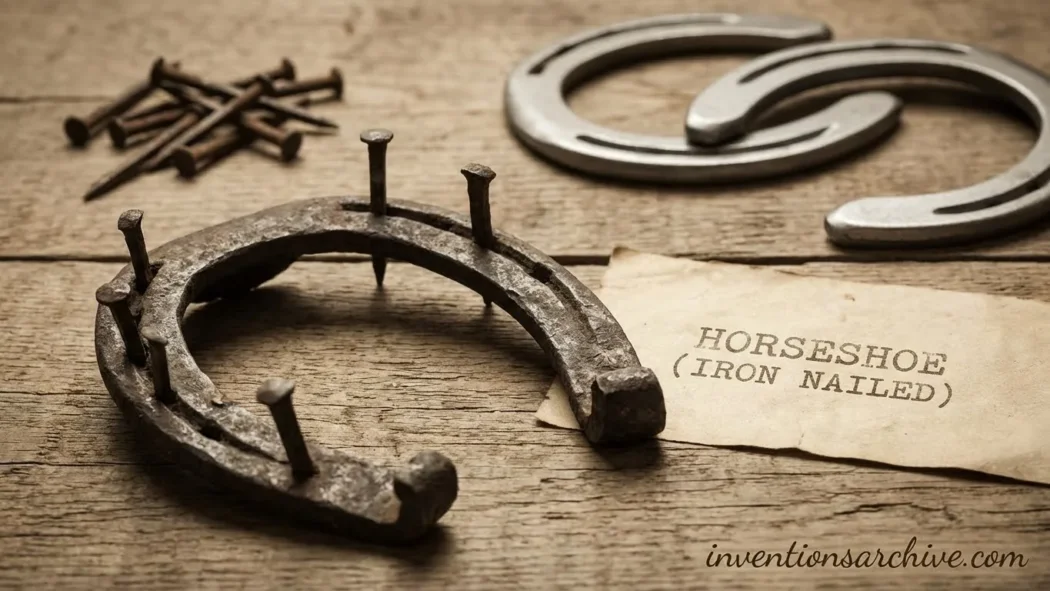
| Invention Name | Iron Nailed Horseshoe |
| Short Definition | U-shaped iron plate nailed to the hoof wall |
| Approximate Date / Period | 9th–10th century CE (Attested) |
| Geography | Europe (early evidence: England) |
| Inventor / Source Culture | Anonymous / collective |
| Category | Materials • Mobility • Animal care |
| Importance |
|
| Need It Addressed | Fast hoof wear on long routes |
| How It Works | Metal rim takes abrasion; nails anchor to hoof wall |
| Material / Tech Basis | Forged iron; nail holes; shaped nails |
| First Known Use | Work and travel horses |
| Spread Route | Western & Northern Europe → wider regions over time |
| Derived Developments | Standard sizes; machine-made shoes; specialty forms |
| Areas of Impact | Trade • Farming • Craft • Mobility |
| Debates / Different Views | Exact “first” origin (Debated) |
| Predecessors + Successors | Strapped hoof guards → nailed shoes → modern steel & alloy shoes |
| Key Cultures | Roman-era hoof protection; early medieval Europe |
| Influenced Variations | Fullered shoes; toe-clip shoes; bar shoes; therapeutic designs |
Table of Contents
The iron nailed horseshoe looks simple, yet it solved a stubborn problem: a hoof that wears faster than it can recover on long, hard routes. By placing a shaped iron rim under the foot and fastening it with carefully positioned nails, the shoe became a durable interface between animal and ground. Over centuries, that idea supported steadier mobility, stronger craft traditions, and a wide family of specialized shoes that still share the same core logic.
Core Purpose
Protection from rapid wear, especially on firm ground, with a replaceable metal edge.
Key Parts
A U-shaped plate, nail holes, and nails that hold in the hoof wall.
Why Iron
Forged iron offers toughness and predictable wear, while staying workable in the hands of a skilled smith.
What It Is
An iron nailed horseshoe is a shaped metal plate fitted to the underside of a horse’s hoof and fixed with nails placed through the outer hoof wall. The shoe acts as a wear surface. The hoof remains the living structure that carries weight and grows, while the shoe takes much of the abrasion from hard ground and heavy use.
This form matters because it is stable. A nailed shoe stays aligned with the hoof during movement, so it can protect the edge of the hoof consistently. Earlier approaches often relied on ties or straps, which could shift under the foot. The nailed iron shoe became the durable standard that later designs still build on.
Why It Appeared
Hooves grow continuously, yet growth has limits. When horses began spending more time on firm routes and longer distances, natural wear could outpace regrowth. The result was not a dramatic mystery; it was plain friction. The nailed iron horseshoe offered a repeatable way to protect the hoof edge and keep the animal working comfortably over time.
- Hard surfaces increase abrasion on the hoof edge.
- Long travel multiplies that abrasion over hours and days.
- Load and traction demands can benefit from a stable, fitted rim.
Early Evidence and Timeline
The story begins before nails. Roman-era sites show hipposandals, heavy iron hoof guards that were tied on rather than nailed, a very different approach to staying power on the foot.Details
For the nailed iron horseshoe, the earliest evidence is clearer in early medieval contexts. In England, one of the earliest attested nailed horseshoes is reported from a late 9th-century context at Winchester, with wider use attested in the 9th and 10th centuries.Details
Simple Timeline
- Roman period: strapped iron hoof guards appear in some sites.
- 9th–10th century CE: nailed horseshoes are attested in early medieval contexts.
- Later medieval period: blacksmithing and farriery expand as regular crafts.
- Modern era: standardized, machine-made shoes and specialized designs become common.
How It Works
The nailed horseshoe relies on a useful biological fact: the hoof wall is dense and largely insensitive, which makes secure nailing feasible when done correctly.Details That allows the shoe to sit beneath the hoof, while the living inner structures remain protected.
Mechanically, the shoe does three quiet jobs. It forms a protective rim under the hoof edge. It spreads contact with the ground across a durable surface. It stabilizes that surface with nails placed through the outer wall so the shoe and hoof move together as a single unit.
Farriers also use controlled heat in some fitting methods. A veterinary source notes that hot fitting does not hurt the horse because the hoof is an effective insulator when handled properly.Details The goal is not spectacle. It is precision and consistency.
Materials and Design Features
Early nailed shoes were typically forged from iron, shaped to match the hoof’s outline. Modern shoes may use steel or lighter alloys, yet the iron nailed concept remains the same: a tough rim, a stable fit, and nails that lock it in place.
- U-shape: leaves the frog area open, supporting natural hoof function.
- Nail holes: placed to guide nail position in the hoof wall.
- Fullering (a groove): helps seat nail heads and can reduce snagging.
- Clips (small tabs): help resist twisting in some designs.
- Heel features: variations may adjust support or grip depending on use.
Design Logic in One Line
Put the wear on the metal, keep the hoof structure healthy, and let the shoe be replaced when it reaches the end of its working life.
Types and Variations
The nailed iron horseshoe evolved into a family of forms. Some variations focus on durability. Others target support or specific movement patterns. The names vary by region, yet most designs still look like a careful riff on the same U-shaped base.
| Type | Defining Feature | Typical Use Context |
|---|---|---|
| Plain Stamped | Simple profile, minimal shaping | General protection on moderate ground |
| Fullered | Groove for nail seating | Common everyday shoe styles |
| Toe-Clip | Small front clip for stability | Extra resistance to forward shift |
| Quarter-Clip | Side clips for twist control | Work needing steadier alignment |
| Bar Shoe | Closed heel section for added support | Support-focused applications |
| Heart-Bar | Support element toward the frog area | Specialized therapeutic contexts |
| Rim Shoe | Distinct rim profile for grip | Situations needing added traction |
What Stayed the Same
- Nails remain the classic anchor method for many shoes.
- The shoe remains replaceable while the hoof continues to grow.
- The U-shape remains a functional compromise between coverage and natural hoof mechanics.
Impact and Legacy
Once the nailed shoe became a dependable standard, it quietly amplified how far and how often horses could work on demanding surfaces. That meant steadier movement of goods, more predictable travel schedules, and a stronger place for metalworking in everyday life.
Britannica notes that the craft of forging and affixing horseshoes became a major staple craft across medieval and modern times, contributing to the development of metallurgy.Details This is not just about the object. It is about the repeatable production of tough, consistent metal forms made to strict fit.
Economic Reach
- Work continuity for horses in regular use
- Route reliability for travel and trade
- Demand for skilled farriery and smithing
Technical Legacy
- Standard shapes and repeatable dimensions
- Specialized designs for different demands
- Improved nail and steel quality over time
FAQ
Is the nailed iron horseshoe the first form of hoof protection?
Not necessarily. Some earlier systems used strapped guards rather than nails. Roman-era hipposandals, for example, were tied on instead of nailed, which changes how stable they are under the hoof.
When do nailed horseshoes appear in the evidence?
Archaeological reporting points to early medieval contexts, with 9th–10th century CE attestation in parts of Europe. The precise “first” location remains debated, but the period is clearer than many popular claims.
How can nails hold without harming the horse?
The hoof wall is dense and largely insensitive, which makes secure nailing feasible when the nails are placed in the correct outer structures. That is a core reason the nailed shoe became so practical.
Why iron, and why a U-shape?
Iron provides a tough wear surface that can be forged and reworked. The U-shape protects the hoof edge while leaving key structures open, supporting the hoof’s natural function.
Are there many kinds of nailed horseshoes today?
Yes. The same nail-fastened idea supports many forms, from common fullered shoes to support-focused bar shoes. The details change, but the core logic remains stable.