
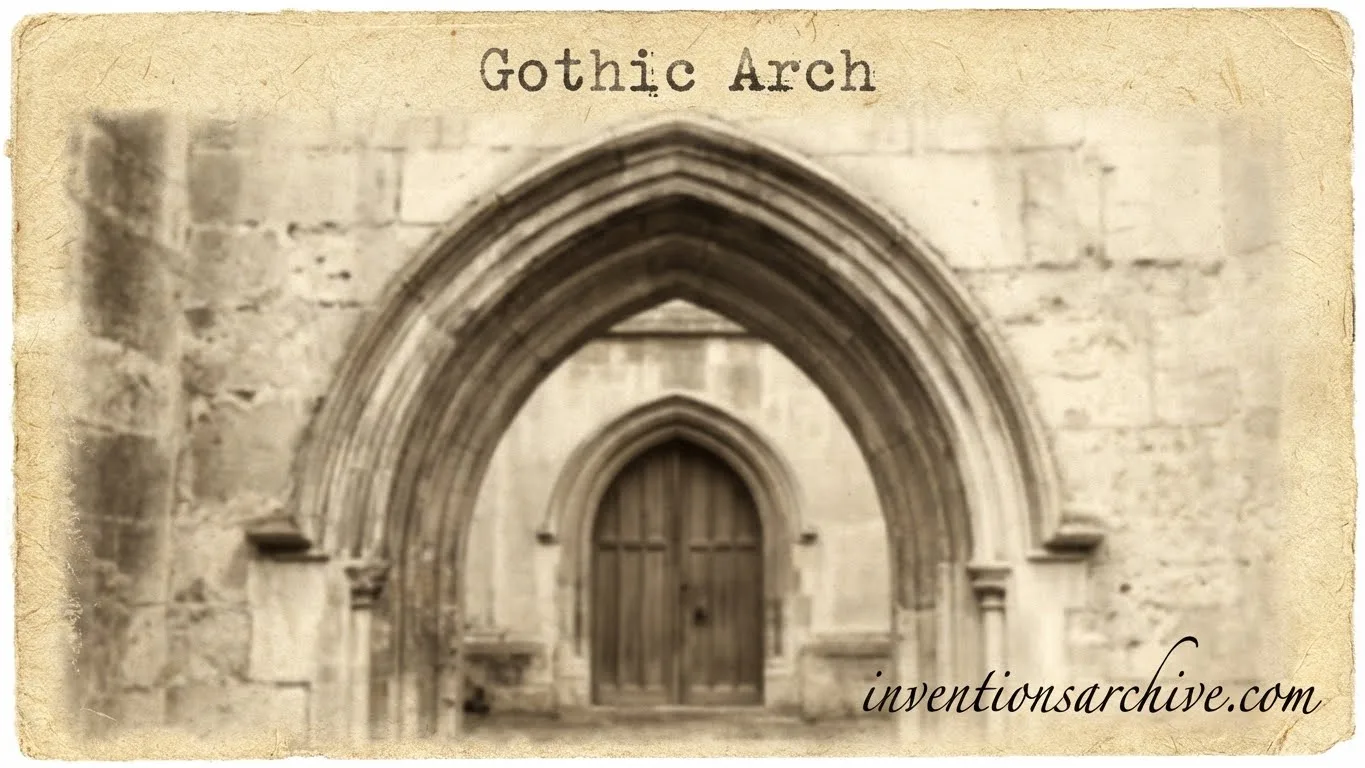
| Invention Name | Gothic Arch (Pointed Arch) |
|---|---|
| Short Definition | Pointed arch; two curved sides meet at an apex |
| Approximate Date / Period | Early–Mid 12th Century (Northern France) Approximate |
| Geography | Île-de-France; Western Europe |
| Inventor / Source Culture | Anonymous / Collective; Medieval Master Masons |
| Category | Architecture; Structural Engineering |
| Importance | Greater height More daylight openings |
| Need / Reason | Wider spans Reduced side thrust Taller interiors |
| How It Works | Redirects loads downward Adjustable geometry for varied spans |
| Material / Tech Basis | Cut stone voussoirs Mortar joints Load-bearing masonry |
| First Main Use | Churches; Abbeys; Cathedrals |
| Spread Route | France → England → Low Countries → Germany → Iberia → Italy |
| Derived Developments | Rib vault systems Large tracery windows Flying buttress networks |
| Impact Areas | Engineering Urban skylines Art glass Stonecraft |
| Debates / Views | Regional origins Earlier pointed-arch traditions elsewhere |
| Predecessors + Successors | Romanesque round arch → Gothic pointed forms → Late Gothic + Revival arches |
| Key People / Centers | Abbot Suger Saint-Denis Île-de-France workshops |
| Influenced Variations | Lancet Equilateral Ogee Four-Centered (Tudor) |
The Gothic arch, often called the pointed arch, looks simple at first glance. Two curves rise, meet, and form a crisp peak. Yet that peak changed the feel of Gothic architecture—and it changed how stone buildings could stand. The shape offered flexible proportions, helped manage side thrust, and opened space for taller walls and larger windows without relying on massive thickness everywhere.
What The Gothic Arch Is
A Gothic arch is a pointed arch formed by two arcs that meet at a peak. In many settings it is also called an ogival arch. The key idea is not decoration. It is geometry: the same basic pointed shape can be taller or wider without forcing the arch’s crown to stay at one fixed height.
Common Names And Close Terms
- Gothic arch: popular name in art and architecture writing
- Pointed arch: the descriptive term for the same form
- Two-centered arch: built from two arc centers rather than one
- Ogive: often used for pointed forms in arches and vault ribs
Origins and Early Use
The pointed arch became a defining tool of the Gothic build style that took shape in northern France during the early 12th century, then spread widely across Europe.Details It fit a time when builders wanted more height, clearer interior organization, and more surface area for windows.
Art historians often point to the region around Paris as a major early center. The pointed arch was part of an engineering package—alongside ribs and exterior support—that let walls become more open and less like solid barriers. One influential summary notes that the style is based on the pointed arch and emerged around Paris in the middle of the 12th century.Details
A Date That Often Appears
For many readers, the story becomes concrete at Saint-Denis. A well-known milestone is the 11 June 1144 consecration of the rebuilt eastern end, closely linked with the early Gothic moment.Details The Gothic arch belongs to this same push toward light-filled stone space.
A Calm Note On “Firsts”
Pointed arches existed in earlier traditions in different regions, and that history is part of a shared architectural heritage. What made the Gothic arch distinctive in Europe was its systematic use in tall stone buildings, tied to vaulting and exterior supports. The result was a recognizable, repeatable language of form.
How The Gothic Arch Works
A masonry arch stands by channeling weight into compression. The Gothic arch changes the direction of that load. Its pointed profile tends to send more force downward, and—depending on proportions—can reduce the sideways thrust compared with a round arch. A research note from MIT summarizes the well-accepted point: pointed arches are widespread in Gothic cathedrals because of decreased thrust compared to circular arches.Details
The Structural Team Around It
In major Gothic buildings, the pointed arch rarely works alone. It partners with ribbed vaults and the flying buttress to handle roof and vault forces at scale. A concise technical description groups these as defining Gothic features: ribbed vault, pointed arch, and flying buttress.Details
- Pointed arches shape openings and guide loads into piers
- Ribs concentrate vault weight into specific lines
- Buttresses receive outward forces and return them to the ground
Why The Same Shape Fits Many Spans
A round arch “wants” a single radius. A Gothic arch can be adjusted: narrow and steep, or wide and gentle. That flexibility mattered in real buildings, where aisles, naves, chapels, and window bays demanded different widths but often needed aligned heights. The pointed profile made that alignment feel natural, with vertical emphasis as a side benefit.
Types and Variations
“Pointed” is a family, not a single outline. Medieval designers used multiple Gothic arch profiles, each with a slightly different feel. Some look sharp and spare. Others look fluid and ornate. The choice shaped the rhythm of arcades, the character of tracery, and even the emotional tone of an interior.
| Profile | Visual Clue | Common Context | Typical Impression |
|---|---|---|---|
| Lancet | Very narrow, tall point | Early window openings | Clean, upward |
| Equilateral | Balanced, “triangle-like” | Arcades, portals | Measured, calm |
| Ogee | S-curve into the apex | Late Gothic detail | Elegant, flowing |
| Four-Centered (Tudor) | Low, wide, soft point | Late medieval openings | Broad, expansive |
| Depressed Pointed | Flattened crown | Wide spans, later work | Grounded, stable |
Where The Differences Matter
- Doorways use profile to set mood at entry
- Windows use profile to frame glass and tracery
- Arcades use profile to control rhythm
- Vault ribs echo the arch shape above
What Stays The Same
Across all profiles, the Gothic arch keeps its core identity: a pointed crown and a strong sense of vertical lift. Even the low four-centered form still reads as pointed, not round. That is why the term “Gothic arch” stays useful across centuries of variation.
Related articles: Manuscript Illumination [Medieval Inventions Series], Flying Buttress [Medieval Inventions Series]
Where It Appears In Buildings
You can spot a Gothic arch in both structure and ornament. In large stone churches it frames the main openings, and it often repeats in smaller layers—windows inside windows, arches above arches—creating a stacked sense of height.
Most Common Locations
- Portals: entry arches that set the vertical theme
- Nave arcades: repeated arches between main space and aisles
- Clerestory windows: tall openings high in the wall
- Tracery patterns: pointed shapes nested inside stone window frameworks
- Rib vault ribs: arches overhead, forming the vault skeleton
A Quick Visual Test
If the crown meets in a point, and the opening feels taller than it is wide, you are likely looking at a Gothic profile. If the crown is a smooth half-circle, it reads as Romanesque or classical. Real buildings mix these, especially across renovations, so the most telling clue is the repeated use of the pointed form across many openings.
Materials and Craft Logic
The Gothic arch is a masonry form. Its strength comes from compression carried through wedge-shaped stones called voussoirs. The joints and the overall curve matter because a stone arch behaves like a chain turned upside down: it “wants” to keep the force flowing smoothly to its supports.
Typical Materials
- Stone: limestone, sandstone, marble (region-dependent)
- Mortar: bedding and jointing, not the main strength
- Iron ties: sometimes used in later phases or specific contexts
Why It Feels “Light”
“Lightness” is an effect, not a lack of mass. By combining pointed arches with ribs and external supports, builders could open more wall area for glass. The structure still carried heavy loads; it simply carried them along clearer lines.
Spread and Long-Term Influence
Once established, the Gothic arch traveled with builders, patrons, and workshop knowledge. The form moved across regions while adapting to local stone, local taste, and local building traditions. In one place it reads as spare and disciplined. In another it becomes intricate, with layered moldings and dense tracery.
The pointed arch also outlived the medieval period. Later designers reused it to signal heritage, craft, and a sense of vertical aspiration. In engineering terms, the shape remains a clear lesson: geometry can change force paths, and small changes in outline can unlock big changes in space. That is the enduring invention behind the Gothic arch.
Faq
Is A Gothic Arch The Same As A Pointed Arch?
In most architectural writing, yes. Gothic arch is the popular name, while pointed arch is the descriptive term for the same form.
Why Did Pointed Arches Help Gothic Buildings Rise Higher?
A pointed profile can channel more force downward and can be tuned to different spans. Paired with ribs and exterior supports, it helped free wall area for larger openings.
Are Gothic Arches Only Found In Cathedrals?
No. The Gothic arch appears in churches, civic halls, colleges, bridges, and later revival buildings. It can be structural, decorative, or both.
What Is The Difference Between Lancet And Ogee Arches?
A lancet arch is narrow and sharply pointed. An ogee arch uses an S-curve that creates a more flowing, late Gothic look.
What Makes A Tudor Arch Part Of The Pointed Family?
A Tudor (four-centered) arch still ends in a point, yet it is lower and wider. It keeps the pointed identity while creating a broader opening and a different visual balance.