
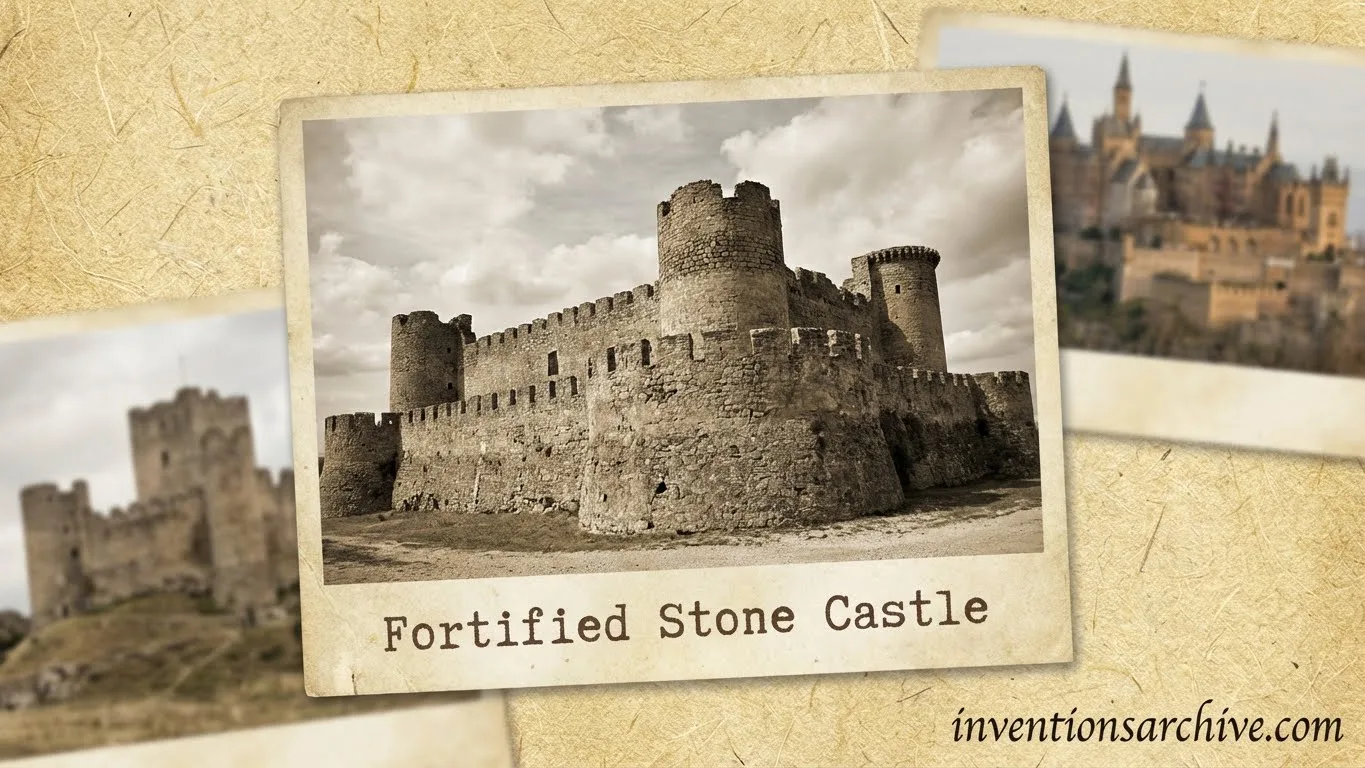
| Item | Value |
|---|---|
| Invention Name | Fortified Stone Castle |
| Short Definition | Stone-built defended residence with controlled access and layered enclosures |
| Approximate Date / Era | First major adoption: 11th century CE Approximate Details |
| Geography | Medieval Europe (wide regional spread); later global adaptations |
| Inventor / Source Culture | Anonymous / collective (many builders, patrons, and local traditions) |
| Category | Architecture; security; governance; domestic life |
| Need / Reason for Emergence | Durable protection; stable administration; long-term residence |
| How It Works (Simple) | Thick masonry; limited openings; strong entry points; layered courtyards |
| Material / Technology Base | Local stone; lime-based mortar; rubble core with dressed facing; timber scaffolding |
| First Common Use Context | Lordly residences and regional centers (courts, storage, household) |
| Spread Route | Craft networks; noble and civic building programs; regional imitation |
| Derived Developments | Gatehouse complexes; ringworks; tower houses; concentric planning |
| Impact Areas | Engineering; settlement patterns; craftsmanship; heritage conservation |
| Debates / Different Views | “First” varies by region; definitions differ (castle vs fort vs palace) |
| Precursors + Successors | Precursors: timber-and-earth strongholds; stone walls and forts | Successors: fortified manor houses; civic walls; later fort systems |
| Influenced Forms | Great towers; walled towns; monumental gateways; “castle-like” civic buildings |
A fortified stone castle is more than a heavy wall around a building. It is a complete system of space, structure, and access control—designed to last, to organize, and to protect. Stone gave these complexes a long life, and their layouts shaped how people moved, worked, stored goods, and gathered under one roof.
Table of Contents
What a Fortified Stone Castle Is
At its core, a fortified stone castle is a masonry residence built with deliberate limits on entry and movement. The word “castle” often gets used for any old strong building, yet a true castle combines living space with structured protection in one integrated plan. In many regions it also served as a local hub for decisions, storage, and ceremony. Details
A useful way to recognize the concept is to look for three features working together: stone mass, controlled access, and layered spaces. A simple fortified house might have one strong doorway. A castle usually adds multiple thresholds—outer edge, inner court, and a more protected core—so the site stays functional even when the outside feels uncertain.
- Defended residence: rooms for daily life, storage, and governance
- Perimeter system: walls and towers that shape movement
- Entry control: a gate complex designed for checking passage
- Symbolic presence: stone scale that signals permanence and authority
Origins and Timeline
Stone castles did not appear from nowhere. Many areas already had stone walls, forts, and monumental gates. What changed in the medieval period was the combination of those building skills with a residential complex meant to stand for generations. When a community invested in stone, it invested in maintenance over centuries, not seasons.
In England, widely cited research summaries note that the first stone castles appear in the 11th century and then continue to evolve through later centuries. Design change is visible in surviving fabric: earlier heavy cores, later more distributed layouts, and more refined living areas within the same defended footprint. Details
| Period | Common Focus | Typical Stone Signals |
|---|---|---|
| 11th–12th centuries | Strong core | Great tower/keep; thick walls; compact plans |
| 12th–13th centuries | Expanded perimeter | Curtain walls; mural towers; improved gatehouses |
| 13th–15th centuries | Layered enclosure | Multiple wards; tighter circulation; more specialized rooms |
| Later adaptations | Comfort and status | More windows; refined halls; mixed “castle-palace” traits |
Core Parts and Layout
A fortified stone castle is easiest to understand as a set of zones. The outer edge manages approach and access. The inner yard supports work and storage. A more protected core holds the most important rooms. Even when styles differ across regions, the goal stays consistent: orderly movement and clear control points.
The Keep and Great Tower
The keep is often the most solid element: a great tower or strong enclosure used for key rooms, storage, and authority. In many traditions it becomes the site’s structural anchor. Details
- Thick walls and limited openings
- Vertical organization: storage below, rooms above
- Clear hierarchy in who uses which spaces
Curtain Walls, Towers, and the Gate
The perimeter usually includes a curtain wall with towers that support watch, storage, stairs, and circulation. The gatehouse matters most because it concentrates movement into one place. A well-planned entry uses narrow passages, multiple doors, and protected angles.
- Towers: views, stairs, small chambers
- Wall-walks: safe circulation along the top edge
- Gate sequence: outer gate, passage, inner gate
Inside the walls, practical spaces matter as much as monumental ones. The great hall supports meetings and ceremony. Kitchens, stores, wells or cisterns, workshops, chapels, and lodging blocks turn stone fortification into a working household. This is why many castles feel like compact towns—carefully arranged around a central court.
How Stone Fortification Works
Stone fortification is not only about height. It relies on mass, geometry, and construction logic. Thick walls resist weather and time, while careful bonding helps the whole structure act as one body. Builders often used an outer face of more regular stone and a core filled with smaller pieces and mortar, creating a wall that is strong and repairable.
Design Principles Behind the Durability
- Few weak points: limited large openings in key walls
- Redundant access: more than one internal route for work and movement
- Drainage and shedding: roofs, channels, and slopes that move water away
- Controlled thresholds: doors, stairs, and corners that slow congestion
- Repair-friendly fabric: stone and mortar that can be patched in stages
Openings tell a story. Narrow slits, small windows, and angled passages often reflect a need for privacy and protection, while later phases may introduce larger windows and brighter rooms as priorities shift. A single castle can hold multiple eras in one footprint—older stone below, newer details above—each layer shaped by changing taste, wealth, and daily needs.
Types and Variations
“Stone castle” is not one design. It is a family of solutions. Some place their strength in a single tall core. Others distribute it across a broad perimeter. Many blend both. The result is a spectrum: from compact strongholds to wide complexes that read like walled neighborhoods with specialized buildings.
| Type | What Defines It | Why It Matters |
|---|---|---|
| Stone Keep Castle | Dominant great tower; compact plan; strong core | Clear hierarchy; efficient use of stone; iconic silhouette |
| Curtain-Wall Castle | Strong perimeter wall with towers; larger inner yard | More space for households and storage; flexible internal growth |
| Concentric Planning | Multiple rings of walls; layered courtyards | Extra depth of protection; managed circulation and zoning |
| Tower House | Vertical residence; compact fortified dwelling | Local adaptation for smaller lords; strong presence with fewer resources |
| Palace Castle | Defended outer shell with refined interiors | Blends status, comfort, and protection in one estate |
Regional variation can be subtle yet meaningful. Stone choice changes wall texture and color. Climate influences roof pitch and drainage. Local craft traditions shape arches, vaults, stair forms, and decorative stonework. A fortified stone castle is often best read as local geology translated into social architecture.
Materials and Building Knowledge
The material story begins at the quarry. Builders worked with what was available: limestone, sandstone, granite, volcanic stone, and many local mixes. The visible face might be dressed ashlar for clean lines, while less visible areas used rougher blocks. Mortar mattered as much as stone: lime-based mixes helped walls breathe, settle, and be repaired without turning brittle.
Large stone structures demanded planning that feels modern: staged construction, supply chains, skilled labor, and careful measurement. Vaults and arches shift weight into piers and walls, allowing larger halls and safer storage. Spiral staircases, often tight and steep, conserve space and guide movement in a way that is both practical and controlled.
- Rubble core: small stone packed with mortar inside thick walls
- Dressed facing: smoother stones that resist weathering
- Timber centering: temporary wooden frames for arches and vaults
- Water management: gutters, drains, and cistern logic
Roles Beyond Defense
Castles are often imagined as purely protective structures. Many were also administrative homes where records, rents, and legal matters were handled. They stored grain, tools, and valuable goods. They hosted gatherings, welcomed guests, and displayed craft and wealth through stone carving, paint, textiles, and metalwork. The fortified envelope helped keep a complex household running with predictability and clear boundaries.
Daily Systems Inside Stone
- Food: kitchens, ovens, pantries, cellars
- Water: wells, cisterns, channels
- Work: workshops, stables, stores
- Worship and ceremony: chapels, halls, formal routes
Why Castles Still Matter
- Engineering record: long-span halls, vaults, thick-wall logic
- Craft record: stone dressing, carving, mortar practice
- Landscape record: how sites relate to routes, water, and settlements
- Heritage value: conservation methods and public history
Legacy and Modern Influence
Stone castles shaped later architecture in quiet ways. Monumental gateways echo in civic buildings. Walled courtyards reappear in colleges, palaces, and institutional complexes. Even modern “secure campus” planning borrows the old logic of zones and thresholds. Today, conservation work also depends on castle fabric: lime mortar practice, stone replacement ethics, and long-term maintenance planning built around weather and structural movement.
Many surviving castles now function as learning sites. They hold evidence in tool marks, mortar joints, blocked doorways, and rebuilt corners. That evidence helps explain how stone buildings age, how repairs should match historic materials, and how a place can stay stable while welcoming new uses that remain respectful to the old fabric.
FAQ
Is a stone castle the same as a fortress?
A fortress is usually described by its protective role. A stone castle is often a residence as well, with halls, kitchens, stores, and formal rooms built into the defended plan.
Why did builders switch from timber to stone?
Stone offers durability and better long-term maintenance. Timber-and-earth structures can be effective, yet stone supports taller walls, fire resistance, and multi-generation rebuilding within the same footprint.
What makes a gatehouse important?
The gate concentrates movement. A well-planned gatehouse adds checks—turns, doors, and controlled space—so entry remains managed rather than open.
Did every castle have a keep?
No. Many have a great tower, others rely on strong perimeter walls and internal buildings. Some sites use a distributed plan where several parts share the role a single keep might otherwise hold.
How can the same castle show different “types” at once?
Castles were often expanded over time. A site may start with a compact core and later add curtain walls, towers, and new lodging blocks, creating a layered complex with multiple phases visible in stone.