
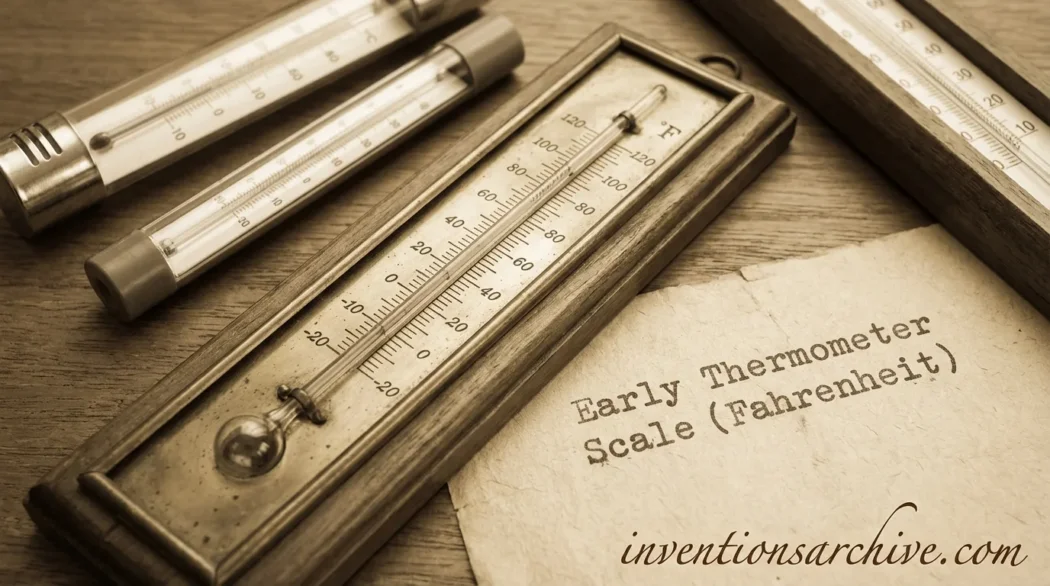
| Invention Name | Early Fahrenheit Thermometer Scale |
|---|---|
| Short Definition | Standardized temperature scale for liquid-in-glass thermometers using repeatable reference points |
| Approximate Date / Period | Early 18th Century; widespread form set by 1724 (Certain) |
| Geography | Dutch Republic (instrument-making centers); later international use |
| Inventor / Source Culture | Daniel Gabriel Fahrenheit |
| Category | Measurement; Scientific Instruments; Thermometry |
| Importance | Repeatable readings; Comparable instruments; Practical day-to-day scale |
| Need / Problem It Solved | Different thermometers disagreed; no shared baseline for temperature |
| How It Works | Thermal expansion of a liquid column; marked scale tied to fixed points |
| Material / Technology Basis | Glass tube; calibrated markings; mercury thermometry in early standard instruments |
| First Use Context | Laboratory, trade workshops, weather observation, medical observation |
| Core Reference Points | 32°F ice-water; 212°F boiling water (standard pressure); early brine-based zero |
| Spread Route | Netherlands → Britain → North America; later broad public use |
| Derived Developments | Instrument standardization; meteorology records; industrial temperature control |
| Impact Areas | Science; Education; Weather reporting; Manufacturing; Daily life |
| Precursors + Successors | Thermoscopes and early fixed-point scales → Celsius, Kelvin, Rankine |
| Key People / Institutions | Fahrenheit; early instrument-makers; scientific societies; metrology bodies |
| Debates / Different Views | Original 0°F story has variants (Debated) |
| Types Influenced | Rankine scale; dual-scale thermometers; modern weather and HVAC conventions |
Table Of Contents
Temperature sounds simple until two thermometers disagree. The early Fahrenheit thermometer scale pushed thermometry toward shared readings: the same instrument could be made again, compared again, and trusted again. It did that with fixed reference points and a scale that suited everyday ranges, from winter air to warm water, with a surprisingly durable logic.
What The Scale Is
The Fahrenheit system is a temperature scale where the degree size is consistent, and familiar events land on stable numbers. Modern reference tables commonly show 32°F for freezing water and 212°F for boiling water at standard atmospheric pressure (Details-1). Between those points sits a clean span of 180 equal steps, which makes halves, quarters, and eighths easy to mark on glass instruments.
Early on, the scale was tightly connected to calibration choices available in a workshop: reproducible mixtures, stable phase changes, and a practical upper reference tied to the human body. The goal was not a perfect theory of heat. It was agreement between instruments, the kind of agreement that lets records pile up without turning into noise.
Why It Mattered Early
Before modern standards, many early thermometers worked like indicators: they showed change, yet not always the same change in the same numbers. Museums and collections describe how seventeenth and eighteenth century researchers kept searching for a standard temperature scale tied to stable points like freezing and boiling water (Details-3). That search matters because science depends on comparability: not just one good reading, but many readings that line up.
- Shared language for temperature across workshops, observers, and later industries
- Repeatable manufacturing where two thermometers could match closely
- Long-term records that stay meaningful when tools evolve
A Practical Idea With Lasting Reach
One quiet strength of the early Fahrenheit approach is that it was built around workshop repeatability. The scale is inseparable from the instrument. That pairing made thermometry feel less like opinion and more like measurement.
Fixed Points and Calibration
Early Fahrenheit calibration is often described through three anchors: a cold point created by a salt-and-ice mixture, the ice-water point, and a human-body reference. A university teaching document lays out a common historical account: 0°F from a brine mixture (ice, water, and ammonium chloride), 32°F at ice and water, and 96°F around body temperature (Details-2).
Over time, boiling water became the preferred high reference point because it is a clear physical event and easier to share across observers. That shift preserved the degree size while improving consistency between instruments, especially when thermometers began to circulate widely.
Reference Points In One View
| Reference Event | Fahrenheit | Celsius | Kelvin |
|---|---|---|---|
| Freezing Point Of Water | 32°F | 0°C | 273.15 K |
| Boiling Point Of Water (Standard Pressure) | 212°F | 100°C | 373.15 K |
| Common Body Temperature (Typical Reference) | 98.6°F | 37°C | 310.15 K |
These values are widely used in modern reference lists and conversion tables (Details-1). They also show why the Fahrenheit degree feels “fine-grained” in daily life: each step is smaller than a Celsius step, which can make weather and room-temperature differences look more detailed.
How The Scale Works
A liquid-in-glass thermometer rises because the liquid expands as temperature increases. The early breakthrough was not the glass tube alone; it was the matching of that movement to stable points so that two instruments could agree. In many early descriptions, Fahrenheit calibrated against a cold brine point and a body reference, aiming for repeatable marks rather than a one-off reading (Details-4).
In modern terms, Fahrenheit conversions follow a straightforward linear relationship. One Celsius degree corresponds to 1.8 Fahrenheit degrees, and conversion tables often show the same fixed points across scales (Details-1). That simple structure is part of why the scale remains easy to work with in everyday settings.
Why 180 Steps Matters
The 180-degree span from freezing to boiling water gives many clean fractional splits. That matters in the real world of early glass marking: repeated halving can place tick marks with confidence. It is a small engineering convenience that helped a scale survive as instruments moved from private workshops to broader use.
Thermometer Design and Materials
Scales do not float in the air. They live on instruments. Collections discussing early thermometers note the role of sealed liquid-in-glass designs and the push toward uniform readings as makers improved materials and technique (Details-3). A well-made tube, a clean liquid column, and careful marking can matter as much as the numbers themselves.
- Sealed glass construction to prevent evaporation and contamination
- Choice of thermometric liquid for predictable expansion
- Calibration practice that links markings to shared reference events
Mercury Thermometry In Early Standard Instruments
Teaching histories often highlight that Fahrenheit became known for mercury thermometers, prized for clarity of reading and consistency between instruments (Details-4). That reputation reinforced trust in the scale itself.
Scale Variations and Related Scales
The “early Fahrenheit scale” is best understood as a family of choices that settled into a durable standard. Historical accounts describe revisions in the upper reference point: early body-temperature anchors near 96°F, later common reference values around 98.6°F, and a stronger focus on the boiling point to strengthen comparability (Details-2).
Common Related Scales
- Celsius: water-based fixed points with 0 and 100
- Kelvin: absolute thermodynamic scale used in science
- Rankine: absolute scale with Fahrenheit-sized degrees
Where Modern Standards Fit
International metrology maintains temperature scale documents such as ITS-90 for precise realization and reference points in calibration work (Details-5). These standards support high-precision measurement while everyday reporting continues to use familiar scales.
Everyday Fahrenheit remains readable because its degree size feels granular across typical weather and indoor ranges.
Original Zero Point Clarity
Many narratives repeat the same core idea: the 0°F point was designed to be reproducible, not mystical. A salt-and-ice mixture provides a stable low temperature, and that stability matters when the aim is consistent calibration rather than a dramatic number (Details-2). Some details vary by account, so the safest takeaway is the engineering purpose: repeatability.
Where Fahrenheit Is Used Today
Fahrenheit remains prominent in daily weather and household temperature contexts in some regions, and it also appears in legacy technical materials and dual-scale instruments. Its persistence is reinforced by familiar reference points: freezing at 32°F, comfortable rooms near the upper 60s, and hot days crossing 90°F (Details-1).
In education and industry, Fahrenheit also shows up in conversion tables and older documents. Modern metrology frameworks keep conversions clean, while the scale itself stays human-readable for everyday temperature ranges.
Common Myths and Clarifications
- Myth: 32°F was chosen randomly. Clarification: historical calibration choices aimed at reproducible points and convenient divisions.
- Myth: Fahrenheit is “unscientific.” Clarification: it is linear and convertible; science relies on absolute scales like Kelvin, yet practical scales remain useful.
- Myth: 0°F was meant to be absolute zero. Clarification: the early low point is described as a brine-based reference, chosen for stability in calibration.
FAQ
Why Is Water Freezing 32°F Instead Of 0°F?
The value comes from the way early Fahrenheit calibration anchored the scale, then later aligned key physical points while keeping the same degree size. The freezing point landed at 32 when the interval structure was set.
What Was The Early 0°F Point Meant To Represent?
Many historical explanations describe a reproducible cold point made from a salt-and-ice brine mixture, used as a stable low reference for calibration.
Why Are There 180 Degrees Between Freezing and Boiling?
The 180-step interval supports easy fractional divisions, which helped with practical marking on instruments and later conversions between scales.
Is Fahrenheit Still Defined By Water Freezing and Boiling Points?
In practice those points remain everyday references, while modern metrology uses precise definitions and reference points for calibration and international consistency.
How Does A Fahrenheit Degree Compare To A Celsius Degree?
A Fahrenheit degree is smaller. One Celsius degree corresponds to 1.8 Fahrenheit degrees, which is why Fahrenheit often feels more granular in weather ranges.