
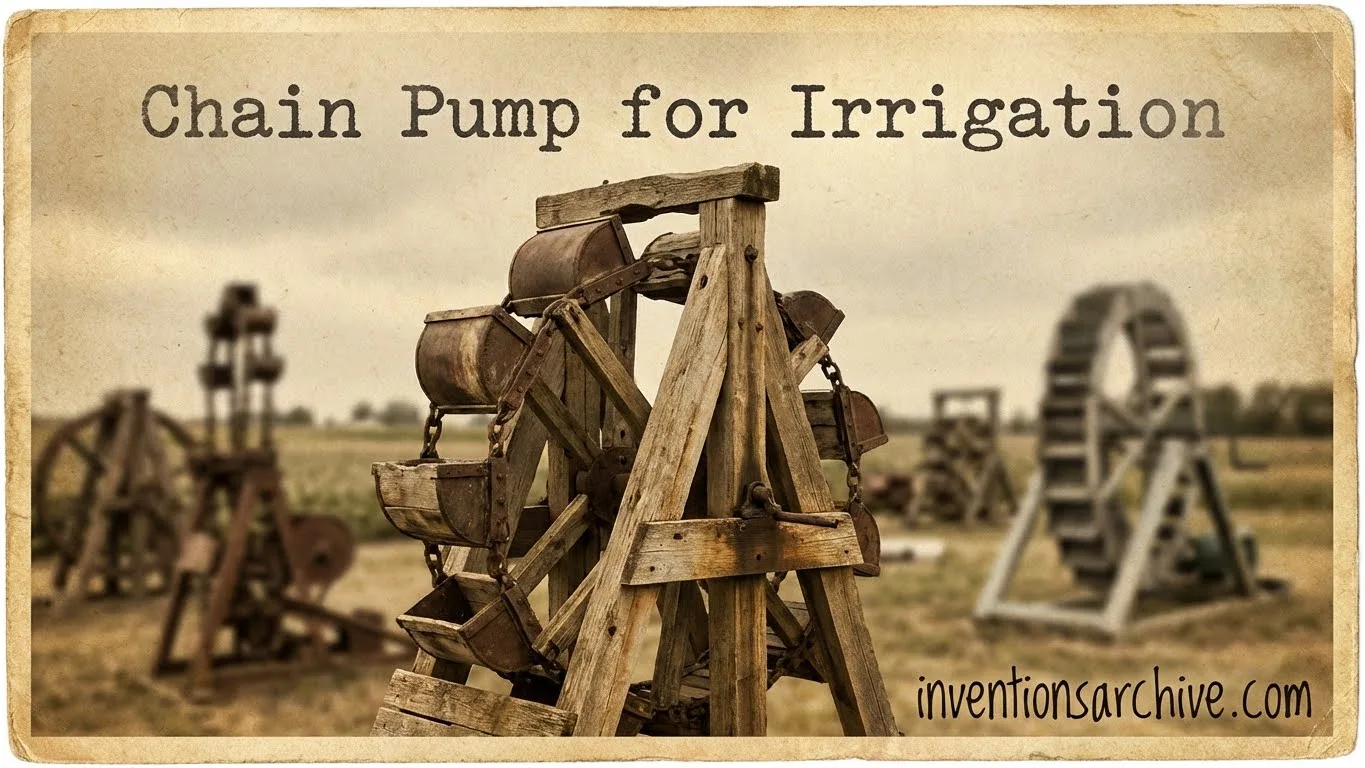
| Invention Name | Chain Pump for Irrigation |
|---|---|
| Short Definition | A continuous water-lifting pump using an endless chain with paddles, buckets, or washers. |
| Approximate Date / Period | Before 1279 (Song-era agricultural engineering context); Certainty: ApproximateDetails |
| Geography | China; Southeast Asia; Europe (regional variants) |
| Inventor / Source Culture | Anonymous / collective (multi-region traditions) |
| Category | Irrigation; water lifting; agricultural engineering |
| Importance |
|
| Need / Why It Emerged | Fast movement of large volumes from streams/canals to fields |
| How It Works | Endless chain moves in a trough/pipe; traps water and carries it upward |
| Material / Technology Basis | Wood or bamboo; chain/belt; paddles/buckets/washers; simple gearing |
| First Common Use | Small farms; paddies; canal-side irrigation |
| Spread Pattern | Local adaptation across regions; shared principles in farming and waterworks |
| Derived Developments | Bucket elevators; chain-and-washer pumps; powered continuous lifters |
| Impact Areas | Agriculture; water management; mechanical design |
| Debates / Different Views | “First” attribution varies by subtype and region; Disputed |
| Precursors + Successors | Precursors: buckets, scoops, shadoof; Successors: piston and centrifugal pumps |
| Influenced Variations | Water ladder (dragon spine); square-paddle chain pump; chain-and-washer; bucket chain |
Chain pump irrigation is a practical way to move water where steady flow matters more than extreme height. The idea is simple: an endless loop keeps lifting water in a continuous rhythm, feeding channels, paddies, or field edges with a dependable stream.
What It Is
A chain pump is a continuous-lift device: one moving loop brings water upward without stop-start cycles. In irrigation settings, that continuity supports smooth distribution into ditches, small canals, or directly onto flood-irrigated plots.
The “chain pump” label covers a family of designs that share one core feature: a moving chain (or belt) carrying elements that capture water. Those elements may be flat paddles, small buckets, or closely fitting washers that climb inside a pipe.
Why It Matters in Irrigation
- Continuous flow helps spread water evenly along small channels and field edges.
- Low-lift performance suits canals, streams, and shallow intakes.
- Simple mechanics made it adaptable to many local materials and power sources.
How It Works
The working principle is repeatable motion: a drive wheel turns, the chain circulates, and water is carried upward by the moving elements. The discharge happens at the top, where water spills into a trough or channel with minimal interruption.
Open-Trough Style
This style uses a slanted trough and a chain of paddles. Each paddle pushes a small “slice” of water upward. The design is often called a water ladder or dragon spine pump in historical contexts.
Closed-Pipe Style
This style runs inside a pipe using washers or discs on the chain. The washers fit closely, so water is pushed upward inside the pipe. In historic descriptions, this family is often linked with the paternoster tradition.
In both styles, output depends on speed, the size of paddles/buckets/washers, and how well the moving parts match the trough or pipe. Tight clearances support stronger lift, while looser clearances often favor durability in rough field conditions.
Early Evidence and Timeline
Chain-based water lifting appears across more than one tradition, so “first” depends on the exact subtype. Written and illustrated records become especially clear in early modern Europe, while Chinese agricultural writing highlights the field-irrigation role of chain pumps.
- 1556: Agricola’s classification of mine-drainage machines includes a chain of dippers and a rag and chain pump, noting that several related devices were known in antiquity.Details
- 1588: An engraved plate in Ramelli’s machine book describes a paternoster pump, also recorded under “rag and chain” naming in the same record context.Details
- Before 1279 (contextual): Chinese irrigation practice includes the square-paddle chain pump as a common method associated with long-running field techniques.
Types and Variations
For irrigation, the practical differences sit in how water is captured and where the pump lives—open trough, closed pipe, or bucket elevator. Each subtype fits a slightly different mix of flow, lift, and available power.
Square-Paddle Chain Pump
This is the classic farm-facing form: a wooden frame with a moving chain of square paddles that lift water steadily. The mechanism pairs naturally with treadles or cranks, making human power a practical match for daily irrigation rhythms.
Related articles: Hydraulic Pump (Renaissance Engineering) [Renaissance Inventions Series], Water-Raising Wheel [Medieval Inventions Series]
Water Ladder and Dragon-Spine Pump
The water ladder uses paddles moving along an inclined open trough. FAO describes it as widely used on small farms in Southeast Asia for flood irrigation and notes typical lengths of 3–8 m, with lifts seldom exceeding about 1.0–1.2 m. A rough test cited there reported an average capacity of 23 m³/h through a 0.9 m lift under a team-based operating pattern.Details
Chain-and-Washer and Paternoster Forms
In the closed-pipe family, the chain carries washers (or similar seals) that move inside a pipe. When the fit is close, the washers create a pushing column effect, lifting water continuously. Historic naming often clusters here: paternoster, rag and chain, and related labels appear in early modern machine literature.
Bucket-Chain and Continuous Bucket Elevators
Some chain pumps lift water in small buckets fixed to the loop. This is especially useful where intake conditions are irregular and a bucket can capture water more reliably than a flat paddle. In irrigation-adjacent settings, the same idea supports water transfer between levels or into holding channels.
| Variation | Water Capture | Best Fit | Typical Lift Profile |
|---|---|---|---|
| Water Ladder | Paddles in open trough | High-flow field flooding, paddies | Low lift |
| Square-Paddle Chain Pump | Paddles or boards on chain | Canal-to-ditch irrigation | Low to moderate |
| Chain-and-Washer | Washers in a pipe | Wells, cisterns, controlled discharge | Moderate |
| Bucket Chain | Small buckets | Variable intake, transfer to channels | Varies by build |
Materials and Design
Across regions, many chain pumps share a repairable material logic: frames and troughs in wood, moving elements in wood or metal, and flexible seals in leather or rubber when a tight fit is needed. That mix supports long service life because individual pieces can be replaced without changing the whole mechanism.
Parts That Define Performance
- Drive wheel and sprocket geometry
- Chain tension stability
- Clearance between paddles/washers and trough/pipe
- Discharge lip shape and catch channel
Common Power Options
- Foot treadles (single or team operation)
- Hand crank and geared handles
- Animal sweep in some traditional setups
- Mechanical drive where available
Irrigation Uses and Fit
Chain pumps excel when water needs to be lifted a small height and moved in a continuous stream. That matches common agricultural moments: shifting water from a canal into field ditches, flooding a paddy, or transferring water between terraces with modest elevation change.
- Field flooding for paddies and small plots
- Canal-to-ditch transfer for distributed watering
- Drainage support in low-lying fields with controlled outlets
- Water routing into holding basins, ponds, or evaporation pans
Why Continuous Flow Changes the Field
Compared with intermittent lifting, a continuous stream reduces waiting between fills. Water reaches distribution channels in a steady pattern, which is especially helpful where timing and uniformity shape flood irrigation outcomes.
FAQ
Is a Water Ladder the Same as a Chain Pump?
A water ladder is a chain-pump subtype that uses paddles moving through an open trough. Many other chain pumps run inside a pipe with washers or use small buckets.
Why Are Chain Pumps Often Used for Low-Lift Irrigation?
Many designs prioritize high flow over extreme height. Low lifts keep the mechanism efficient and steady, which fits canal-side irrigation and field flooding.
What Does “Dragon Spine Pump” Mean?
The term commonly points to the water ladder tradition, where paddles on a moving chain travel up an inclined trough. The visual rhythm of boards along the trough is often linked with the dragon spine name in historical references.
What Is a Paternoster Pump in Water Lifting?
In water lifting, “paternoster” commonly refers to a continuous chain device, often in a pipe, associated with names like rag and chain. The key idea is the same: continuous motion carrying water upward.
How Does a Chain Pump Compare with a Noria or Persian Wheel?
A chain pump typically lifts water using a moving chain with paddles, buckets, or washers, often suited to controlled discharge. A noria or Persian wheel is a rotating wheel with many containers, lifting water as the wheel turns.