
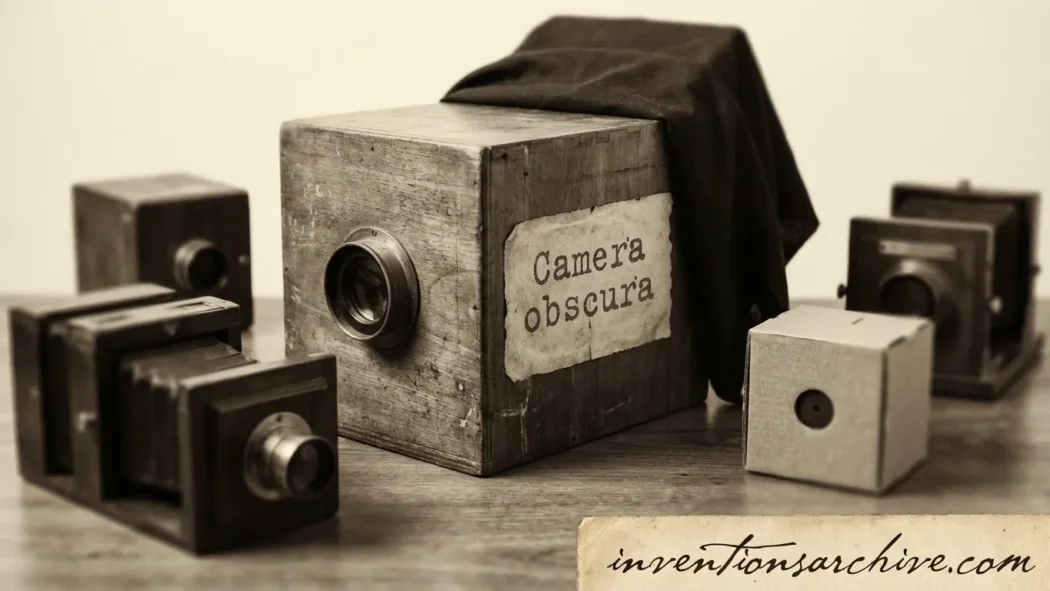
| Invention Name | Camera Obscura |
|---|---|
| Short Definition | Dark chamber; aperture projection; inverted image Details |
| Approximate Date / Period | Antiquity; major refinements 16th–19th c. Approximate |
| Geography | Multi-region; later global use |
| Inventor / Source Culture | Anonymous / collective; many traditions |
| Category | Optics; image projection; visual tools |
| Significance | Precursor to cameras; proof of image formation |
| Need / Origin Driver | Optics study; safe bright-light viewing; accurate perspective |
| How It Works | Small opening; rays cross; image forms on opposite surface |
| Materials / Technology Base | Dark enclosure; aperture; lens (optional); mirror (optional); screen |
| First Use Contexts | Astronomy observation; natural philosophy; drawing aid |
| Spread Route | Teaching; manuscripts; instrument makers; travel culture |
| Derived Developments | Pinhole cameras; lens cameras; photography with light-sensitive plates |
| Impact Areas | Science; art; education; architecture; leisure |
| Debates / Different Views | “First” attribution varies; parallel early descriptions common |
| Precursors + Successors | Precursors: pinhole projection; Successors: photographic camera |
| Key People / Civilizations | Optics scholars; Renaissance artists; 19th-c. photographers |
| Influenced Variants | Room-size; box type; tent type; lens-assisted; mirror-based |
Camera obscura means “dark chamber”. It is a simple optical setup where light from an outdoor scene passes through a small opening and forms a real image inside a dark space. The idea is old, yet it still feels fresh because it explains what every camera does—just with fewer parts.
Table Of Contents
What The Camera Obscura Is
At its core, a camera obscura is a light-proof space with one controlled opening. Light enters, spreads as straight rays, and creates a projected scene on a surface inside. The projection is a real optical image, not a drawing and not a reflection.
Core Idea In Simple Terms
- Aperture: the opening that admits light
- Projection surface: where the image lands
- Inversion: the image appears upside down
- Optional optics: lenses and mirrors can brighten, sharpen, or redirect the view
The name is Latin, yet the concept is universal. Any dark space with a tiny opening can show the same pinhole image. That is why the camera obscura sits at the crossroads of science and visual culture.
Early Evidence and Timeline
Written and practical knowledge of the camera obscura grew in layers. Early observations belong to antiquity. Later centuries added better lenses, smarter layouts, and portable forms. By the time photography arrived, the camera obscura was already a mature image-making tool.
| Period | What Changed |
|---|---|
| Antiquity | Dark-room projection recognized as a natural optical effect |
| 1500s | Lens improvements described; the drawing aid role becomes clearer Details |
| 1600s | Higher-quality lenses enable brighter, more flexible portable designs Details |
| 1700s–1800s | Popular use for travel sketching; optics + craft blend into refined instruments |
| 1800s | Projection paired with light-sensitive materials, turning the principle into photography |
A key historical point is that the camera obscura did not “arrive” as one final blueprint. It evolved through craft, teaching, and steady refinement in materials and optics. That long runway explains why its principles stayed useful for centuries.
How The Camera Obscura Works
Why The Image Turns Upside Down
Light travels in straight lines. Rays from the top of an outdoor scene pass through the opening and land lower on the inside surface. Rays from the bottom land higher. The crossing of rays creates an inverted image with a clear geometric logic.
What Controls Brightness and Sharpness
A smaller opening usually makes edges crisper, yet it also dims the projection. A larger opening brightens the scene, yet blur grows. A lens can gather more light and sharpen focus, while keeping the image bright.
Lens and Mirror Versions
Many classic instruments place a lens at the front and a mirror at roughly 45 degrees inside. The mirror redirects the image onto a horizontal surface, which supports comfortable viewing and careful tracing without changing the underlying projection principle.
- Lens: increases light and focus control
- Mirror: redirects the image path inside the box
- Screen: paper, ground glass, or a pale surface for the projection
Key Designs and Variations
The term camera obscura covers a family of designs. Some are room-sized. Some fold into travel boxes. The differences sit in three choices: aperture style, optics inside, and how the projection is presented.
Room-Size Camera Obscura
- Darkened room with a controlled opening
- Large projection for groups
- Often panoramic in public installations
Portable Box Camera Obscura
- Enclosed box with lens or pinhole
- Mirror may place the image on a top surface
- Travel-friendly for field sketching
Tent and Booth Forms
- Fabric enclosure around a frame
- Light control is central
- Large viewing area without heavy woodwork
| Variation | Typical Strength | Typical Trade-Off |
|---|---|---|
| Pinhole | Simple, stable geometry | Dimmer image |
| Lens-Assisted | Brighter, sharper projection | More parts; alignment matters |
| Mirror-Redirected | Comfortable viewing surface; compact layout | Image may reverse left-right depending on layout |
| Room-Size | Immersive scale; shared viewing experience | Fixed location |
Uses Across Centuries
The camera obscura earned its reputation because it served real needs. It could demonstrate optics with clarity. It could support accurate drawing. It also offered a memorable way to watch the world in motion, framed by pure light.
Optics and Observation
- Image formation made visible
- Aperture and focus effects explained by sight
- Safe viewing setups for bright phenomena in historical contexts
Art and Perspective
- Architecture and landscapes mapped with confidence
- Perspective checked against a projected scene
- Detail captured as light, not guesswork
Public Demonstrations
- Shared viewing in dedicated buildings
- Live panorama effects in some installations
- Curiosity sparked through direct experience
One well-known modern example is a public camera obscura site within the U.S. National Park Service’s Golden Gate National Recreation Area, described as producing 360-degree live images of the surrounding waters Details. It reflects the same old principle, presented at a generous scale.
FAQ
Is A Camera Obscura The Same As A Pinhole Camera?
A pinhole camera is a camera obscura in its most minimal form: a dark space and a tiny opening. Many camera obscuras later gained lenses or mirrors, yet the core projection idea stays the same.
Why Is The Image Inverted?
The rays cross at the opening. Light from the top of a scene lands lower inside, and light from the bottom lands higher. That crossing produces the upside-down view.
Do All Camera Obscuras Use A Lens?
No. Some rely on a small opening alone. A lens is an add-on that can increase brightness and improve focus control, especially in portable instruments.
How Did It Connect To Photography?
The camera obscura provides a projected image. Photography arrived when that projected image could be fixed on light-sensitive materials, turning a fleeting projection into a lasting record.
Can A Camera Obscura Be Large Enough To Walk Into?
Yes. A room can act as the dark chamber, creating an immersive projection on an interior surface. Large installations often emphasize a wide field of view and a shared experience.
Does A Camera Obscura Need Electricity?
No. The system is purely optical. Light, a controlled opening, and a dark space are enough for a working projection.