
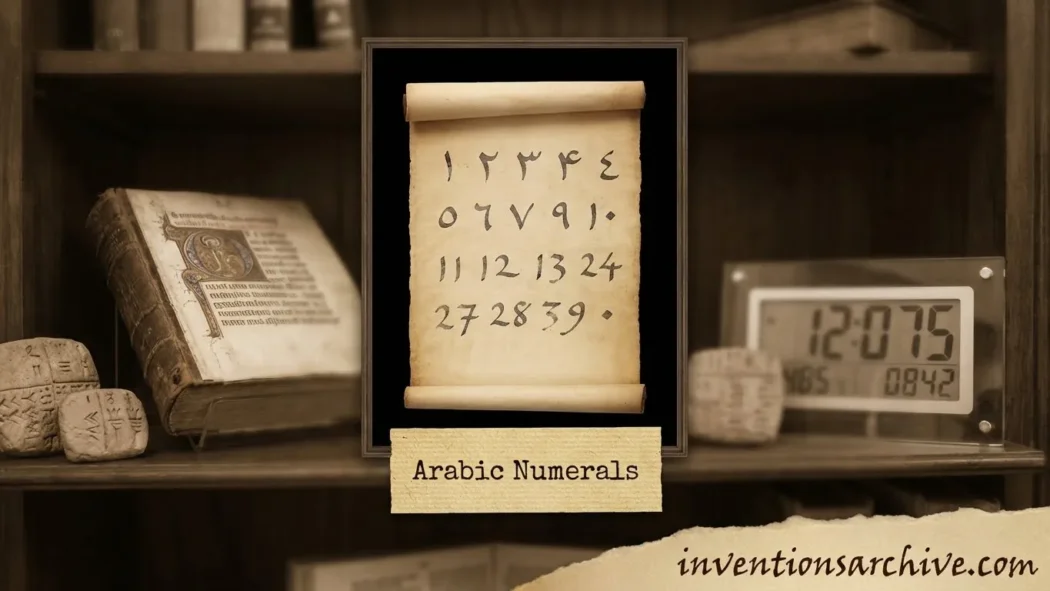
| Invention Name | Arabic numerals, more precisely the Hindu-Arabic numeral system |
|---|---|
| Short Definition | Ten digits—0, 1, 2, 3, 4, 5, 6, 7, 8, 9—used in a decimal place-value system |
| Approximate Date or Period | Developed over centuries in India; mature written evidence by the early medieval period Approximate |
| Date Certainty | Based on surviving evidence No single invention date is known |
| Geography | Indian subcontinent; later adapted across West Asia, North Africa, al-Andalus, and Europe |
| Inventor or Source Culture | Anonymous and collective; Indian mathematicians and scribes, followed by scholars writing in Arabic |
| Category | Mathematics, measurement, record-keeping, education, commerce, and computation |
| Main Problem Solved | Writing large numbers compactly and carrying out repeatable written calculations |
| How It Works | Each digit has a value set by its position; places represent powers of ten, and zero holds an empty place |
| Technical Principle | Base ten + place value + a zero digit |
| Earlier Methods | Tallies, finger reckoning, counting boards, abaci, additive numerals, and alphabetic numeral systems |
| Early Uses | Astronomy, mathematical tables, teaching, accounting, exchange calculations, surveying, and administration |
| Material Basis | Inscriptions, coins, birch bark, dust boards, parchment, paper, ink, and movable type |
| Transmission Route | India → Arabic-speaking scholarly regions → North Africa and al-Andalus → Latin Europe |
| Evidence Status | Confirmed transmission Approximate origin date Attribution varies |
| Surviving Evidence | Brahmi inscriptions and coins; the Bakhshali manuscript; Sanskrit, Arabic, and Latin mathematical texts; medieval manuscript numerals |
| Development Path | Brahmi numeral forms → Indian decimal place value → Arabic adaptations → Western Arabic forms → modern printed and digital digits |
| Main Variations | Western digits 0123456789; Arabic-Indic ٠١٢٣٤٥٦٧٨٩; Eastern Arabic-Indic ۰۱۲۳۴۵۶۷۸۹; script-specific Indic sets |
| Major Interpreters and Transmitters | Brahmagupta, al-Khwarizmi, al-Kindi, al-Uqlidisi, scholars of al-Andalus and North Africa, and Leonardo of Pisa |
| Why It Mattered |
|
| Related Inventions | Zero, abacus, counting board, decimal fractions, algorithms, printing press, mechanical calculator |
| Modern Descendants | Decimal notation, standardized accounting, scientific measurement, calculators, spreadsheets, databases, and digital displays |
| Main Historical Caution | The earliest surviving object proves an early known use, not necessarily the first use |
What Arabic Numerals Are
Arabic numerals are the familiar written digits 0 through 9. In ordinary speech, the term often refers both to the shapes of those digits and to the decimal place-value system in which they operate. Those are related ideas, but they are not identical.
A digit is a written sign. A numeral is a written representation of a number. The system is the rule that gives each sign its value. The digit 5 can mean five, fifty, or five hundred depending on its place in 5, 50, or 500.
Why The Name Can Mislead
Europe received these numerals through Arabic-speaking regions, which explains the European name. The deeper origin of the decimal place-value tradition lies in India. For that reason, historians and mathematics educators often use Hindu-Arabic numerals or Indo-Arabic numerals when speaking about the system rather than only the Western digit shapes.
The label also varies by region. In many Arabic-speaking settings, forms such as ٠١٢٣٤٥٦٧٨٩ are called Indian numerals, while 0123456789 may be called Western or European numerals. Modern technical standards therefore treat “Arabic digits” as an ambiguous expression.
How The System Works
The system combines three simple rules: it uses ten digits, groups places by powers of ten, and uses zero to mark an empty place. In the numeral 4,072, the 4 means four thousands, the 7 means seven tens, and the 0 shows that there are no hundreds.
Position carries value. This makes the notation compact. The same small set of signs can represent numbers of any length without needing a separate symbol for every ten, hundred, thousand, or larger unit.
Zero As Placeholder and Number
Zero performs two connected jobs. As a placeholder, it keeps positions distinct: 205 is not 25. As a number, it can take part in arithmetic and express a quantity of none. These roles developed through a long mathematical history rather than one isolated act.
The written circle used today is one stage in that history. Earlier Indian evidence includes a dot placeholder. Later manuscript and inscription forms became rounder, while mathematical authors worked out rules for calculation involving zero.
Written Algorithms
Place value makes column-based methods practical. Digits can be aligned as units, tens, hundreds, and further places. Carrying, borrowing, multiplication, division, and extraction of roots can then follow repeatable written procedures.
The English word algorithm is tied to the Latinized name of al-Khwarizmi, whose work became associated in Europe with calculation using Indian numerals. The word algorism later referred more narrowly to arithmetic performed with these written digits.
How The Origin Is Traced
Historians follow two linked trails: the ancestry of the digit shapes and the appearance of a full decimal place-value method. The shapes have early relatives in Indian numeral traditions, while the full operating system took form over a longer span.
Brahmi Numerals and Earlier Indian Forms
Brahmi numerals were in use by about the middle of the third century BCE. Surviving examples appear on inscriptions and coins in several parts of India. These numerals were not yet the complete modern system: they included separate signs for tens, hundreds, and other values rather than relying fully on place value.
Even so, their changing shapes form part of the visual ancestry of later Indian, Arabic, and European digits. The exact source of some Brahmi forms remains unsettled, and several theories have been proposed.[b]
Place Value Took Shape Gradually
Indian mathematicians developed ways to express numbers through position, first in verbal or coded notation and later through written digit sets. The mature system joined nine nonzero digits with a placeholder that became zero.
This distinction matters. The existence of a symbol resembling a modern digit does not prove that its users employed the same arithmetic rules. Shape, value, and method must be traced separately.
Why No Single Inventor Is Named
The record does not preserve one person who designed all ten digits and their rules. The system grew through scribal practice, astronomical calculation, mathematical teaching, and changes in writing materials. Different contributors clarified different parts.
- Indian scribes and mathematicians developed the numeral ancestry, decimal place value, and zero tradition.
- Brahmagupta recorded arithmetic rules involving zero in 628 CE.
- Scholars writing in Arabic translated, taught, tested, and adapted Indian calculation.
- Latin translators and practical teachers carried the methods into European schools and commercial work.
The Problem It Answered
People could count, trade, survey, and calculate long before Arabic numerals. They used fingers, tally marks, tokens, counting boards, abaci, written words, Roman numerals, Greek letter numerals, and other local systems.
The main difficulty was not the absence of numbers. It was the gap between recording a value and calculating efficiently on the written page. An additive notation such as Roman numerals can label quantities clearly, but it does not naturally expose columns of units, tens, and hundreds.
Why The Need Grew
Astronomy required repeated calculations with large values. Administrators handled taxes, land, calendars, and accounts. Merchants compared currencies, weights, prices, shares, and interest. These tasks rewarded a notation that was compact, portable, and teachable.
Paper-based methods also mattered. A notation became more useful when operations could be checked and preserved instead of existing only as movements of counters on a board.
From Earlier Tools to Later Forms
| Stage | Form | What Changed |
|---|---|---|
| Earlier Tools | Finger reckoning, tallies, counters, abaci, and counting boards | Quantities could be represented and manipulated, but the working process was often separate from the written record |
| Earlier Written Numerals | Alphabetic, additive, and non-positional systems | Numbers could be recorded, though long values and written operations required many signs or special conventions |
| Indian Development | Decimal place value with nine digits and a zero placeholder | A small sign set could express very large numbers through position |
| Arabic Adaptation | Indian calculation taught on dust boards and later adapted to pen and paper | Methods spread through astronomy, mathematical teaching, administration, and practical arithmetic |
| Western Arabic Forms | Ghubar numeral traditions in North Africa and al-Andalus | Digit shapes moved toward forms later recognized in Latin Europe |
| European Practical Arithmetic | Manuscripts, abacus schools, merchant manuals, and printed arithmetic books | Written calculation became part of commercial and technical education |
| Modern Descendants | Standardized type, decimal fractions, calculators, spreadsheets, databases, and digital interfaces | The digits became machine-readable signs used across many languages and fields |
Transmission Through The Arabic-Speaking World
Knowledge of Indian calculation reached regions west of India before the best-known Arabic mathematical books were written. A seventh-century Syriac source praised Indian computation with nine signs. In the eighth century, Indian astronomical knowledge was translated under Abbasid patronage.
Al-Khwarizmi is closely tied to this transmission, yet the Arabic original of his work on Indian calculation is lost. A later Latin version describes a decimal place-value system using the digits 1 through 9 and 0. That makes the attribution important but also textually incomplete.
Dust Boards and Paper Arithmetic
Early users in Arabic-speaking regions often calculated on a dust board. Digits were written, moved, erased, and rewritten as an operation progressed. Western forms became known as ghubar numerals, a name linked to dust.
During the tenth century, al-Uqlidisi described ways to perform Indian arithmetic with ink and paper. This removed a practical weakness of dust-board work: intermediate steps could now be preserved, copied, inspected, and taught more easily.
More Than One System Coexisted
Indian numerals did not immediately displace every other method. Finger reckoning, alphabetic number notation, sexagesimal astronomy, and written words remained in use. Business communities could prefer familiar techniques even when mathematicians valued the newer notation.
Surviving manuscripts show that digit shapes differed between eastern and western Arabic regions and changed over time. The forms that entered Europe came mainly through North Africa and al-Andalus rather than directly from the forms now widely printed with Arabic script.[c]
Arrival and Adoption in Europe
Arabic numerals were known in parts of medieval Europe before Fibonacci. A Spanish manuscript, the Codex Vigilanus of 976, contains an early surviving European example of Indian-derived numerals. Knowledge, however, did not equal routine use.
Fibonacci’s Role
Leonardo of Pisa, later called Fibonacci, learned mathematical methods connected with North African commerce. His Liber Abaci, first written in 1202, presented Hindu-Arabic place-value arithmetic to Latin readers.
The book addressed practical matters such as prices, profits, currency conversion, and trade calculations. Fibonacci was therefore a promoter and teacher, not the inventor of the numerals.[d]
Why Adoption Was Slow
Roman numerals, counting boards, established bookkeeping customs, and local teaching traditions did not vanish when a better written method appeared. New notation also required trained readers, suitable manuals, and confidence that records could be checked.
Italian merchant schools helped spread practical arithmetic from the late medieval period. More than a thousand surviving manuals show a gradual movement from southern to northern Europe. Printing later widened access to standardized examples, while adoption continued at different rates in different regions.[e]
Early and Everyday Uses
The numeral system gained ground where repeated calculation mattered. Its early strength came from work rather than decoration.
Astronomy and Calendars
Astronomers handled tables, planetary positions, calendar cycles, and trigonometric values. Place-value notation reduced the written space needed for long values and supported step-by-step operations.
Trade and Accounting
Merchants compared currencies, weights, measures, prices, profit shares, loans, and exchange rates. A positional system made these tasks easier to write and teach, especially when paired with paper algorithms.
Related articles: Algebra (Al-Khwarizmi) [Medieval Inventions Series], Abacus [Ancient Inventions Series]
Surveying, Architecture, and Engineering
Measurement work required multiplication, division, proportions, areas, and volumes. Practical arithmetic manuals carried numeral methods into surveying, building, ship construction, and technical crafts.
Education and Administration
Schools could teach reusable procedures instead of separate notation for many orders of magnitude. Administrators could preserve figures in ledgers, tax records, inventories, and dated documents. The change was uneven, but the written record became more calculation-friendly.
Before and After Adoption
| Before The Invention Became Common | What Changed After Wider Adoption |
|---|---|
| Written numerals often used additive signs, letters, or repeated marks | Any whole number could be written with ten reusable digits |
| Calculation frequently depended on counters, boards, or mental conventions | Operations could be written as aligned steps on paper |
| There was no standard zero in Roman notation | Zero preserved empty places and later functioned as a number |
| Large values could require long or specialized notation | Place value kept long numbers compact |
| Commercial methods varied by region and training tradition | Arithmetic manuals offered procedures that could be copied and taught |
| Intermediate work on a counting device might leave little written trace | Paper calculation preserved working steps for checking and instruction |
| Scientific tables were harder to produce in non-positional notation | Decimal notation supported denser tables, later decimal fractions, and standardized measurement |
Main Types and Variations
The numeral system is shared across many writing traditions, but the glyphs are not identical. The rule of place value can remain the same while the visible signs change.
| Digit Family | Example | Current Context |
|---|---|---|
| Western or ASCII Digits | 0123456789 | Common with Latin, Greek, Cyrillic, and many other scripts |
| Arabic-Indic Digits | ٠١٢٣٤٥٦٧٨٩ | Used with Arabic in many, though not all, Arabic-speaking regions |
| Eastern Arabic-Indic Digits | ۰۱۲۳۴۵۶۷۸۹ | Used with Persian, Urdu, Sindhi, and related Arabic-script contexts |
| Devanagari Digits | ०१२३४५६७८९ | Used with Hindi and other languages written in Devanagari |
| Typographic Western Variants | Lining figures and old-style figures | Different printed shapes within the same Western digit encoding |
Unicode separates Western digits, Arabic-Indic digits, Eastern Arabic-Indic digits, and script-specific Indic digits into distinct character ranges. Its terminology notes that the phrase “Arabic digits” can refer either to Western 0123456789 or to digits used with Arabic script, depending on context.[f]
How The Shapes Changed
Digit forms changed whenever they passed through a new script, writing direction, tool, and typographic system. Handwritten signs on dust boards did not need to look exactly like ink signs in manuscripts. Scribes simplified strokes. Regional schools developed preferences. Printers later selected forms that worked in movable type.
This is why visual resemblance alone cannot settle the whole history. A modern 2 or 3 is the endpoint of many copied and rotated forms, not a preserved design drawing from one inventor.
Writing Direction and Number Order
Arabic script runs from right to left, while multidigit decimal numbers are normally arranged with the highest place on the left. Mixed-direction text therefore requires layout rules that treat letters and digits differently.
Modern digital standards preserve these distinctions so that a numeral remains readable inside Arabic, Persian, Urdu, English, and other text environments.
What Changed Because of The System
The main change was not that people suddenly learned to count. It was that written numbers became operational. The page could hold both the value and a repeatable path to the result.
Calculation Became Easier to Teach
A learner could align places and follow set procedures. This supported schools of practical arithmetic, copied manuals, examination of mistakes, and transfer between professions.
Records Became Easier to Compare
Ledgers, prices, measurements, dates, and tables could be written with a shared compact notation. The effect depended on literacy, local custom, and institutional adoption, so it unfolded over centuries.
Later Mathematics Gained A Flexible Notation
Decimal fractions, logarithmic tables, algebraic calculation, scientific measurement, and mechanical calculators all benefited from positional notation. Modern computers often calculate internally in binary, yet users still enter and read most ordinary values through decimal digits.
The Digits Became Cross-Script Tools
Western 0–9 are now used in many languages whose alphabets are unrelated. Other languages retain their own digit forms while using the same decimal place-value principle. The invention’s later life is therefore both mathematical and typographic.
Common Misunderstandings
“The Arabs Invented The Entire System”
The name records the route by which Western Europe received the numerals. The decimal place-value system developed in India, while scholars working in Arabic translated, adapted, taught, and transmitted it.
“Fibonacci Invented Arabic Numerals”
Fibonacci explained and promoted methods already known through Indian and Arabic mathematical traditions. His role belongs to European transmission and practical teaching.
“The Earliest Surviving Example Is The First Use”
An artifact gives a minimum date: the practice existed by then. Earlier examples may have been lost, remain undiscovered, or survive on material that cannot be dated securely.
“All Arabic Numerals Look Like 0123456789”
Western, Arabic-Indic, Eastern Arabic-Indic, and Indian script-specific digits use different glyphs. They can still express values through the same decimal place-value rule.
“Roman Numerals Disappeared As Soon As The New Digits Arrived”
The two notations coexisted for centuries. Roman numerals still appear in clocks, outlines, monarch names, book sections, and ceremonial inscriptions.
“Each Digit Was Designed From Its Number of Angles”
The popular angle-count story is a modern visual explanation, not a supported account of how the historical glyphs developed. Manuscripts show many regional forms that do not fit that pattern.
Related Inventions
- Zero — the placeholder and number that completes decimal place-value notation
- Abacus and Counting Board — earlier and parallel tools for representing and manipulating quantities
- Decimal Fractions — an extension of place value to quantities smaller than one
- Written Algorithms — repeatable arithmetic procedures made practical by positional digits
- Printing Press — a means of standardizing and distributing arithmetic manuals and digit forms
- Logarithms — calculation aids built for positional numerical tables
- Mechanical Calculator — a machine descendant of written place-value arithmetic
- Digital Character Encoding — modern standards that distinguish digit families across scripts
Frequently Asked Questions
Who Invented Arabic Numerals?
No single inventor is known. The system developed collectively in India and was later translated, adapted, and transmitted by scholars working in Arabic before spreading through Europe.
Why Are They Called Arabic Numerals?
Western Europe learned the digits and their calculation methods mainly through Arabic-speaking regions, especially North Africa and al-Andalus. The name reflects that route of transmission.
Are Arabic and Hindu-Arabic Numerals The Same?
They often refer to the same decimal place-value tradition. “Hindu-Arabic” states both the Indian origin and the Arabic route of transmission, while “Arabic numerals” commonly names the Western digit forms 0–9.
Did Fibonacci Bring Arabic Numerals to Europe?
He helped promote them in Latin Europe through Liber Abaci in 1202, especially for commercial arithmetic. Earlier European examples and contacts already existed, so he was not the first European to encounter the digits.
Why Is Zero Needed in The System?
Zero marks an empty place, so 205 can be distinguished from 25. It also functions as a number in arithmetic, though the placeholder role and the full numerical concept developed through different stages.
Why Did Arabic Numerals Replace Roman Numerals?
Place value and zero allowed compact notation and efficient written arithmetic. Adoption remained slow because established accounting, teaching, and record-keeping practices continued alongside the newer system.
Sources and Verification
- [a] Carbon dating finds Bakhshali manuscript contains oldest recorded origins of the symbol “zero” — Used to verify the manuscript’s composite dating, its placeholder dots, and Brahmagupta’s 628 CE treatment of zero. (Reliable because it is an official University of Oxford museum and library source.)
- [b] Indian numerals — MacTutor History of Mathematics — Used to verify the Brahmi numeral evidence, approximate dating, and uncertainty surrounding some early glyph origins. (Reliable because it is maintained by the University of St Andrews.)
- [c] Arabic numerals — MacTutor History of Mathematics — Used to verify transmission through Arabic-speaking regions, al-Khwarizmi’s textual record, dust-board practice, al-Uqlidisi’s paper methods, and the Codex Vigilanus. (Reliable because it is maintained by the University of St Andrews.)
- [d] Fibonacci — MacTutor History of Mathematics — Used to verify the 1202 Liber Abaci, its merchant problems, and Fibonacci’s role in European teaching and transmission. (Reliable because it is maintained by the University of St Andrews.)
- [e] The spread of Hindu-Arabic numerals in European practical mathematics — Used to verify slow European adoption, merchant arithmetic, the spread of manuals, and later use in technical fields. (Reliable because it is published by the Economic History Society and reports academic research.)
- [f] Unicode Digit Terminology — Used to verify modern names, character families, and regional use of Western, Arabic-Indic, Eastern Arabic-Indic, and Indic digits. (Reliable because Unicode is the international character-encoding authority.)

