
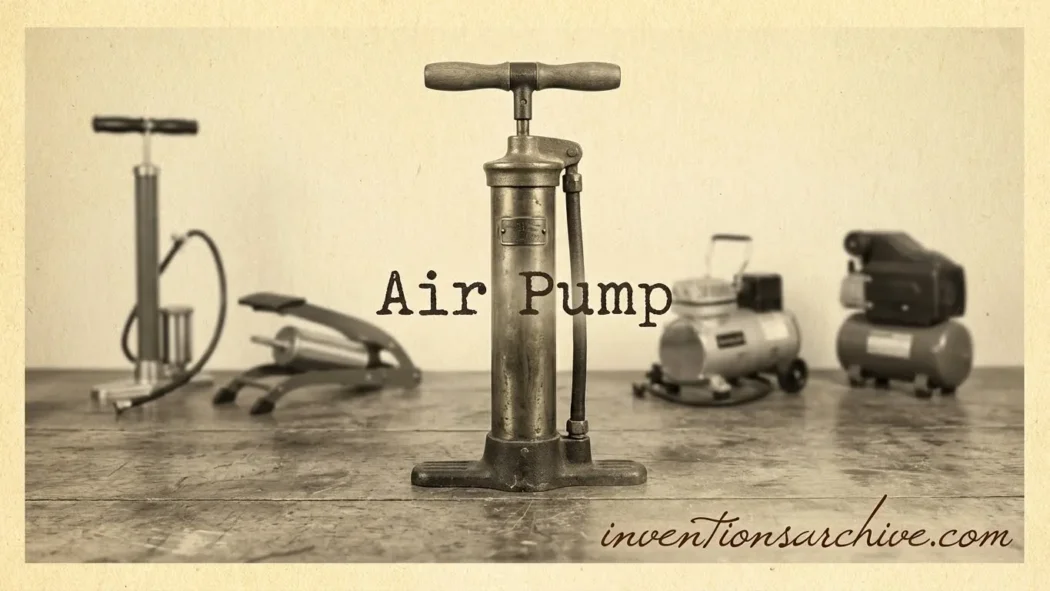
| Invention Name | Air Pump |
|---|---|
| Short Description | Moves air to change pressure in a space |
| Approximate Date / Period | c. 1650 (Approximate) |
| Geography | Magdeburg; later major work in England |
| Inventor / Source Culture | Otto von Guericke; later refinements by instrument makers |
| Category | Pneumatics, Vacuum Technology, Measurement Tools |
| Importance | Controlled vacuum • Reliable pressure control |
| Need / Origin | Study air pressure • Create repeatable “low-air” conditions |
| How It Works | One-way valves + moving chamber change volume |
| Material / Tech Basis | Seals • Valves • Pistons/diaphragms • Tight joints |
| Early Use | Laboratory vacuum experiments • Scientific demonstrations |
| Spread Route | European workshops → labs → industry → everyday tools |
| Derived Developments | Vacuum tubes • Electric lighting • Semiconductor processing |
| Impact Areas | Science • Manufacturing • Healthcare • Education |
| Debates / Different Views | “First” date varies: c. 1650–1654 (Discussed) |
| Predecessors + Successors | Water pumps, syringes → rotary, dry, diffusion, turbo systems |
| Influenced Variants | Vacuum pumps • Inflation pumps • Aspirators |
An air pump is a practical way to move air so pressure changes where it matters. That one capability supports vacuum science, precision manufacturing, and everyday tasks that rely on controlled airflow.
One name, two common uses: In historical science, “air pump” often meant a vacuum pump (removing air from a chamber). In daily life, it often means an inflation pump (pushing air into a tire, ball, or device). Both rely on the same core idea: air flows from higher pressure to lower pressure.
Contents
What the Air Pump Is
An air pump is a device that deliberately moves air so a system reaches a target pressure. Sometimes the goal is compression (inflation). Sometimes it is exhaustion (a partial vacuum). Either way, the pump is a pressure-control tool, not just a way to “move air around.”
- Inflation role: adds air to raise pressure inside a sealed space (tires, sports balls, air bladders).
- Vacuum role: removes air to lower pressure in a chamber (laboratory receivers, industrial vessels).
- Transfer role: moves air from one place to another with steady flow (aeration, ventilation, small devices).
Why this matters: Once pressure becomes controllable, air stops being “invisible background” and becomes an experimental variable or a manufacturing input. That shift is where the air pump’s influence starts.
Early Evidence and Timeline
The air pump became famous through vacuum work, because early researchers needed a repeatable way to remove air from a vessel. A museum overview of vacuum technology describes a first rudimentary air pump—“a sort of syringe”—developed c. 1650 by Otto von Guericke.Details
- c. 1650 (Approximate): Guericke’s early pump makes controlled evacuation feasible at a practical scale.
- 1658–1659 (Specific): A major English air-pump build is described as being constructed for Robert Boyle, with strong mechanical input from Robert Hooke.Details
- 1700s: New workshop designs appear with improved cylinders, linkages, and receivers, making pumps more reliable for demonstrations and lab use.
- After 1850: Mercury-based air pumps expand the reachable vacuum level and support new electrical and lighting research.
- 1900s onward: Rotary and diffusion concepts push vacuum technology into modern research and industry.
One subtle point often missed: early progress was not only about “stronger vacuum.” It was also about repeatability. Better seals, tighter valves, and smarter receivers made results comparable across different labs, which helped air-pump experiments become shared knowledge.
How the Air Pump Works
Most air pumps are positive-displacement machines. They create a small chamber that repeatedly expands and contracts. With one-way valves guiding the flow, air is pulled in from one side and pushed out the other. Over many cycles, the connected space reaches a new pressure balance.
| Cycle Moment | What Changes | Pressure Effect | Why Valves Matter |
|---|---|---|---|
| Intake | Chamber volume increases | Local pressure drops | Inlet opens, outlet stays closed |
| Transfer | Air enters chamber | Pressure equalizes | Backflow is blocked |
| Compression/Exhaust | Chamber volume decreases | Local pressure rises | Outlet opens, inlet stays closed |
In vacuum work, the goal is not “no air.” The goal is a lower density of gas molecules in a chamber. That is why vacuum discussions often focus on measurement and standards. A NIST publication notes that NIST has responsibility to maintain and disseminate the SI unit of pressure, the pascal (Pa).Details
What limits performance: A pump can only be as effective as its sealing, its valves, and the leak paths around the whole setup. Even small gaps can matter when pressure differences grow.
Air Pump Types and Variations
“Air pump” covers a family of designs. The differences are not cosmetic. Each type sets a different balance between flow, pressure range, cleanliness, noise, and maintenance needs.
Related articles: Hot air engine (Amontons) [Renaissance Inventions Series], Steam turbine prototype (Giovanni Branca) [Renaissance Inventions Series]
Inflation and Compression Pumps
- Hand and foot pumps: compact, direct control, common for tires.
- Lever-action pumps: higher pressure with ergonomic stroke.
- Electric inflators: steady flow with automatic shutoff features in many models.
- Bellows-style pumps: simple airflow where high pressure is not needed.
These designs focus on raising pressure quickly and safely inside a sealed object.
Vacuum and Evacuation Pumps
- Piston pumps: classic reciprocating design; strong displacement per stroke.
- Diaphragm pumps: flexible membrane; cleaner operation for many lab tasks.
- Rotary vane pumps: smooth flow; widely used for “rough vacuum” work.
- Scroll and dry pumps: oil-free options where clean chambers matter.
These designs focus on lowering pressure and handling leaks and outgassing in real systems.
Higher-Vacuum Extensions
When work demands much lower pressures, systems often combine stages: a mechanical pump brings a chamber down to a lower baseline, then a second technology takes over. Classic examples include diffusion pumps and later turbomolecular approaches. The aim is a stable environment with fewer gas collisions, enabling sensitive instruments and processes.
| Family | Typical Strength | Common Context | Design Emphasis |
|---|---|---|---|
| Reciprocating (piston) | Strong displacement | Demonstrations, specialized setups | Valves, seals, stroke geometry |
| Rotary (vane/scroll) | Steady flow | Labs, service tools, production lines | Low vibration, reliability |
| Dry/clean | Low contamination | Clean processes | Materials, low backstreaming |
| High-vacuum stage | Very low pressures | Advanced research, precision manufacturing | Flow control at molecular scales |
Key Components and Design Choices
The most important parts of an air pump are not always the largest. Small engineering choices shape whether the pump feels smooth, stays tight, and keeps performance stable over time.
- Check valves: simple idea, critical role. They keep flow one-directional and protect against backflow.
- Seals and gaskets: determine leakage. Better sealing often matters more than a larger motor.
- Receiver or target volume: a chamber’s shape, fittings, and surface condition affect stability.
- Lubrication strategy: improves sealing and wear in many designs; “dry” designs prioritize cleanliness.
- Materials: metals handle stress and heat well; polymers can reduce friction; glass receivers enable visibility in experiments.
Design Points That Matter
- Leak paths can be tiny: fittings, threads, and worn seals often dominate performance.
- Heat changes behavior: air expands, materials move, and seals can soften or tighten.
- Cleanliness is functional: residues can change valve seating and chamber stability.
- Noise and vibration matter in labs: smoother motion helps sensitive measurements.
Where Air Pumps Are Used
Air pumps show up wherever pressure needs to be set, held, or changed with confidence. The same core principle supports very different outcomes, from stable vacuum chambers to reliable inflation.
Science and Measurement
- Experimental physics: controlled low-pressure environments for repeatable tests.
- Metrology: vacuum and pressure measurement chains tied to standards.
- Analytical instruments: stable chambers for sensitive detectors and beams.
Industry and Manufacturing
- Vacuum packaging: reduced air to slow oxidation and improve storage stability.
- Semiconductor processing: clean, controlled environments for thin films and etching.
- Material handling: vacuum grippers for fast, gentle movement of parts.
Everyday Tools
- Tires and sports equipment: predictable inflation for performance and comfort.
- Household vacuum storage: volume reduction by removing trapped air.
- Aquarium and small devices: steady airflow for aeration and circulation.
FAQ
Who is credited with the early air pump?
Early vacuum air-pump development is widely associated with Otto von Guericke, with major later refinements by Robert Boyle and Robert Hooke. The exact “first” date is often treated as approximate because different accounts emphasize different milestones.
Is an air pump the same as a vacuum pump?
Not always. “Air pump” can mean inflation (pushing air in) or evacuation (pulling air out). A vacuum pump is a type of air pump focused on lowering pressure in a chamber.
What determines how low a pressure a pump can reach?
Limits come from leaks, seal quality, valve behavior, and gas released from surfaces inside the system. In many real setups, improving tightness and cleanliness matters more than increasing power.
Why are valves such a big deal in air pumps?
Valves create one-way flow. Without that, each stroke would partially undo the last one. Good valves also help protect the system from pressure bouncing and backflow.
Where do air pumps have the biggest modern impact?
They are central to vacuum-enabled manufacturing and precision tools, while also remaining essential for everyday inflation. The same pressure-control principle supports both worlds.