
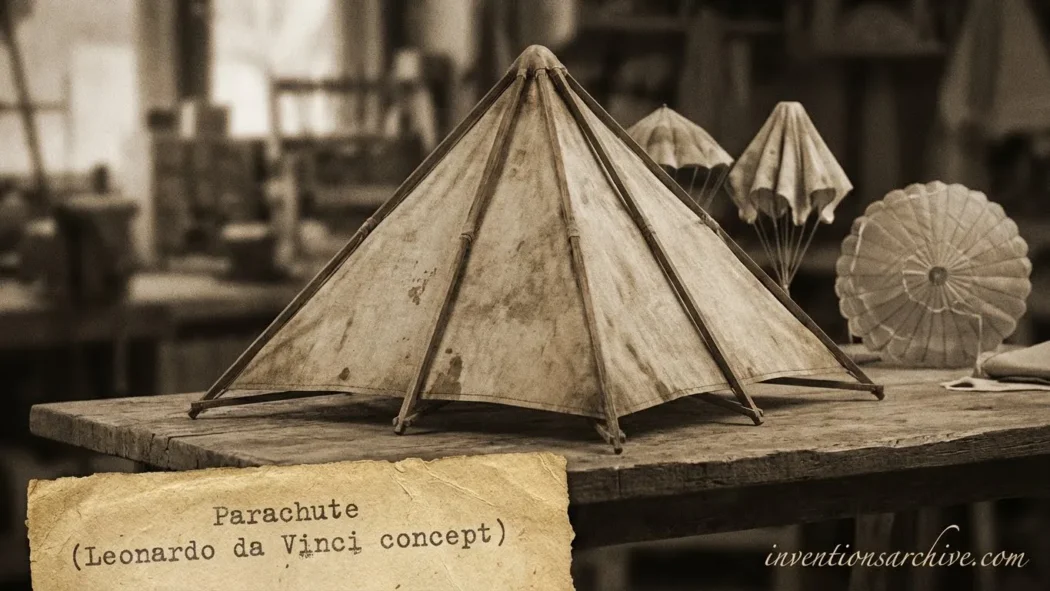
| Invention Name | Parachute (Leonardo da Vinci Concept) |
|---|---|
| Short Definition | Pyramid-canopy descent device sketched in a Renaissance notebook |
| Approximate Date / Period | c. 1485 Approximate |
| Geography | Renaissance Italy |
| Inventor / Source Culture | Leonardo da Vinci |
| Category | Aviation; safety; materials engineering |
| Need / Reason It Emerged | Controlled descent; safer fall from height |
| How It Works | Canopy fills, drag rises, descent slows |
| Material / Technology Basis | Coated cloth; rigid frame (concept) |
| First Intended Use | Notebook concept; flight-safety idea |
| Spread Route | Manuscripts preserved; later studied; modern replicas tested |
| Derived Developments | Canopy parachutes; descent-control engineering; decelerators |
| Impact Areas | Flight science; exploration; public demonstration; education |
| Debates / Different Views | Notebook dating; exact dimensions reading Debated |
| Precursors + Successors | Early flight studies → round canopies → ram-air parafoils |
| Influenced Varieties | Pyramid canopy; rigid-frame concepts; stability-focused designs |
| Why It Matters |
|
Table of Contents
Leonardo da Vinci’s parachute is a rare kind of invention: a clear geometric idea that still reads like engineering. The sketch uses a pyramid canopy held open by structure, aiming for a calm, controlled descent instead of a fast fall.
What It Is
In simple terms, this concept is a canopy shaped like a four-sided pyramid. The canopy is meant to stay open, hold a stable form, and create enough air resistance to slow a person’s descent. The design stands out because it treats shape as the main tool, not cords alone.
Core Elements
- Pyramid canopy for a broad projected area
- Rigid frame to help keep the cloth spread
- Coated cloth (as described in the notebook) to hold shape
- Descent control through drag, not propulsion
Where The Idea Appears
The concept is tied to Leonardo’s notebook material preserved in the Codex Atlanticus. A well-known passage describes a parachute-like “structure” made of coated cloth, and it is linked to a pyramid drawing. The wording is direct, almost like a testable claim, which is unusual for a sketch.
The Famous Line, In Brief
“Se un uomo ha un padiglione… potrà gittarsi d’ogni grande altezza senza danno di sé.” The standard English sense is that a person with the described canopy could descend from a great height without harm.Details
The same account is often summarized with dimensions given as 12 braccia per side and 12 in height—commonly explained as roughly about 7 meters for the side length, depending on how “braccia” is interpreted.Details
How The Concept Works
A parachute works by turning speed into drag. As the canopy fills, it increases the surface pushing against the air. That extra resistance reduces downward speed and helps the body settle into a steadier descent path.
NASA technical literature describes parachutes as textile aerodynamic decelerators used after the most intense phases of high-speed motion have passed. In that framing, the job is simple: decelerate and stabilize.Details
Why A Pyramid?
A pyramid canopy can act like a kept-open surface. The edges define the form, which may reduce sudden collapses that soft cloth can experience. The wide base also creates a strong projected area—the part that “catches” air.
What The Frame Changes
A rigid frame shifts the design closer to a shaped decelerator. It aims to keep cloth tension more even, holding a predictable geometry. That focus on shape control is a key signature of Leonardo’s concept.
Early Evidence and Timeline
Leonardo’s sketch sits in a long story: ideas on controlled descent appeared on paper long before regular real-world use became practical. Later balloon-era experimentation made public demonstrations more common, and parachutes began to look like recognizable systems rather than isolated concepts.
| Period | What Happened | Why It Matters |
|---|---|---|
| Late 15th century | Leonardo’s pyramid-canopy concept in notebook form | Early geometry-driven descent idea |
| 1797 | André-Jacques Garnerin tested a parachute; a major jump reported from over 3,000 feet above Paris | Public proof that a canopy can slow an aeronaut’s descentDetails |
| 2000 | A modern replica of Leonardo’s design was tested in flight conditions | Shows the concept can be practical when built with care |
What Modern Testing Suggests
Reports of a 2000 test describe a full-size pyramid parachute matching the notebook dimensions, released from a balloon at altitude, with a controlled descent before switching to a conventional parachute for the final part of the landing sequence.Details
Types and Variations
Leonardo’s concept is best seen as a shaped-canopy family member. Over time, parachute design branched into different geometries, each balancing stability, packability, and ease of deployment. The pyramid form is unusual today, yet it highlights a real design question: how much shape comes from structure, and how much comes from inflation?
| Design Family | Typical Shape | Key Trait | Connection To Leonardo’s Idea |
|---|---|---|---|
| Rigid-Frame Canopies | Pyramid / framed surfaces | Shape held by structure | Closest match to the original concept |
| Round Canopies | Dome-like | Stable drag device | Shares the same goal: slow descent |
| Conical Variants | Cone-like | Pressure-managed shape | Another route to controlled airflow |
| Ram-Air Parafoils | Wing-like cells | Lift plus forward motion | Different behavior, same respect for geometry |
A Note On Materials, Without The Myths
Leonardo’s text mentions a cloth treated to hold form. That detail matters because the concept leans on a defined shape, not just fabric drifting into place. In modern terms, the design sits between a soft canopy and a fully rigid device, using structure to guide how air loads the surface.
- Cloth stiffness supports a consistent canopy profile
- Frame geometry helps maintain area during descent
- Airflow and pressure do the main work; no moving parts are required
Legacy and Modern Use
This concept lives on as a powerful example of first-principles thinking. It frames parachutes as deliberate shapes in airflow, not just fabric falling through the sky. That mindset echoes in modern decelerators used for stability, speed reduction, and safe recovery across many fields, from education displays to aerospace engineering.
Why It Stays Evergreen
- It is a clean demonstration of drag and surface area
- It shows how geometry can guide real-world behavior
- It connects Renaissance drawing culture with modern design logic
FAQ
Did Leonardo da Vinci build this parachute?
No clear record shows it being built in his lifetime. It is best understood as a documented concept preserved in his notebook tradition.
What makes the pyramid shape different from most modern parachutes?
The pyramid emphasizes kept-open geometry. Many modern canopies rely more on flexible inflation and line geometry, while the da Vinci concept leans on a structured form.
What does “braccia” mean in the dimensions?
“Braccia” is a historical unit used in parts of Italy. Its exact length varied by place and period, so metric conversions are usually given as approximate.
Has the design been shown to work in modern times?
A widely cited modern test describes a full-scale replica producing a controlled descent, showing the geometry can function as a real decelerator under flight conditions.
Why is the Codex Atlanticus important for this invention?
It preserves the original context: drawing plus text. That pairing turns an image into a claim about how air and shape interact, which is exactly what makes this concept so enduring.