
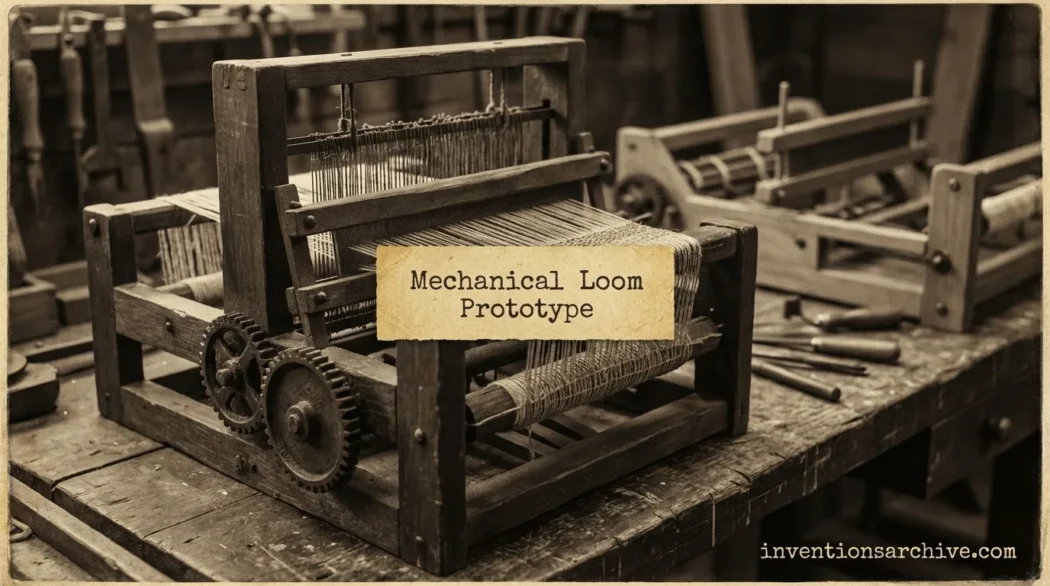
| Invention Name | Mechanical Loom Prototype |
| Short Definition | Early mechanized weaving systems built to test automated pattern control and repeatable loom motion |
| Approximate Date / Period | 1725–1805 (Mixed: Key Dates Certain) |
| Geography | France (Lyon, Paris); Britain (textile regions) |
| Inventor / Source Culture | Multiple inventors (Bouchon, Falcon, Vaucanson, Jacquard, Cartwright) |
| Category | Textile manufacturing; automation; mechanical engineering |
| Importance |
|
| Need / Reason It Emerged | Faster, repeatable patterned cloth without constant manual lifting of warp threads |
| How It Works | Pattern data selects warp threads; mechanical linkages repeat shed–pick–beat cycles |
| Material / Technology Base | Punched paper or cards; hooks; needles; cams; drums; wood-and-metal frames |
| Early Use Cases | Figured silk weaving; workshop-scale experiments; attachment-style upgrades |
| Spread Route | French silk centers → British mills → wider European manufacturing |
| Derived Developments | Jacquard mechanism; self-acting power looms; machine-readable pattern storage |
| Impact Areas | Manufacturing; design; education; early information technology concepts |
| Priority Notes | “First” varies by definition: pattern control vs. powered drive vs. full automation |
| Precursors + Successors | Drawloom + drawboy → punch-card control → industrial power looms → electronic jacquard heads |
| Key Places And Communities | Lyon silk weaving; museum workshops; early factory-era textile engineering |
| Variants Influenced | Falcon-style card chains; Jacquard heads; dobby-style shedding; high-speed factory looms |
Mechanical loom prototypes sit at a turning point where weaving automation became more than an idea. Their goal was practical: make complex cloth patterns repeat reliably, then scale that reliability. What began as pattern control experiments grew into machines that could “remember” instructions, cycle after cycle, with consistent mechanical timing and a clear logic of holes versus no holes.
Table Of Contents
What It Is
A “mechanical loom prototype” is not a single famous machine. It is a lineage of experiments that tried to move weaving from manual coordination to repeatable mechanism—especially for patterned cloth. Some prototypes focused on pattern selection. Others focused on applying power so the loom’s motions could run steadily.
Weaving itself is simple in concept: warp threads run lengthwise; the weft thread crosses them. The hard part is control. Patterned cloth requires selecting which warp threads lift for each pass, then repeating that selection thousands of times with tight timing. Mechanical prototypes tried to make that selection reliable, fast, and transferable between patterns.
What Prototype Means In This Context
- Proof of principle for automated selection of warp threads
- Working testbed for cams, hooks, needles, and synchronized motion
- A bridge between hand weaving and industrial-scale weaving
Early Prototypes And Timeline
The story is easiest to see as two parallel threads: pattern-control prototypes and power-driven prototypes. They overlap, influence each other, and eventually converge into factory-ready systems.
| Period | Prototype Step | What Changed |
|---|---|---|
| 1725 | Punched Paper Tape Control | Pattern instructions stored as holes in a paper tape (Details-1) |
| 1728 | Interchangeable Punch Cards | Cards become swappable units of instructions; a clearer “machine memory” idea (Details-2) |
| c. 1745 | Fully Mechanical Patterned Loom Experiment | Mechanism attempts to reproduce key weaving motions with cams and moving parts (Details-3) |
| 1785 | First Power Loom Patent (Prototype Phase) | Power is applied to loom motion; later refinements increase productivity and reliability (Details-5) |
| 1804–1805 | Jacquard System Consolidation | Punched cards become a standardized control method for intricate patterns (Details-4) |
That sequence shows why “prototype” fits: each step tightens control, then extends what can be repeated. The real leap was not a faster shuttle alone. It was making instructions separable from the loom’s hardware.
Pattern Control
Pattern control prototypes treated the loom like a machine that could “read” a sequence. A hole meant permission for a specific action; no hole meant no action. That simple contrast is why later writers compare it to a binary idea, yet its purpose was concrete: raise the right warp threads at the right moment.
Paper Tape
Punched paper tape is an early way to store a repeating pattern. It sits between a hand-drawn design and a mechanical decision. Its value is repeatability, not speed.
Punch Cards
Punch cards make patterns modular. Swapping cards swaps instructions, which turns complex weaving into a controlled sequence that can be stored, reused, and shared.
The Mechanical Decision Point
- A needle or pin meets the card or tape
- If a hole is present, motion passes through and a hook can engage
- If there is no hole, the path is blocked and the hook stays inactive
- The result is selective lifting of warp threads, producing a patterned shed
Jacquard Mechanism
The Jacquard mechanism is often described as a loom, yet its deeper identity is an attachment-style control system. It turns pattern selection into a repeatable reading process: cards advance, pins test holes, hooks lift selected warp threads, and weaving proceeds with stable rhythm. The early 1800s consolidation of this idea is a landmark because it made intricate designs practical at scale without rebuilding the loom for each pattern.
Why It Feels Like A Prototype Breakthrough
- Separation of pattern instructions from the machine’s structure
- Scalability through card chains that can be as long as needed
- Consistency in repeated complex designs
Another key feature is lineage: the Jacquard system refined earlier approaches and is described as improving on the punched-card design of a mid-18th century Vaucanson loom experiment (Details-4). That is the prototype story in one sentence: ideas tested early, then re-engineered into a repeatable standard.
Power Loom Path
Pattern control explains “what to lift.” Power explains “how to keep it moving.” Power-loom prototypes aimed to apply external energy to the loom’s repeating motions so weaving could run steadily, with less dependence on continuous hand force. The early patent era matters because it anchors the transition from experimental models to industrial engineering cycles measured in output and reliability.
A Useful Snapshot Of Improvement
One museum object history notes that the Lancashire loom (patented 1848) followed decades of refinement after the first power loom patent (1785). It also provides a clear productivity comparison: a Cartwright loom cited at about 120–130 picks per minute, while the Lancashire loom is cited at 220–260 picks per minute with one weaver working multiple looms (Details-5).
Those numbers highlight a prototype reality: early designs proved the concept, later designs refined feeding, take-up, and coordination until higher speed and steadier operation became normal.
Types And Variations
Mechanical loom prototypes branch into families. Each family answers a different question: how to select, how to drive, and how to keep the whole cycle stable at scale.
Pattern-Driven Variations
- Paper-tape control (early stored patterns)
- Punch-card chains (modular pattern storage and swapping)
- Jacquard heads as an attachment concept, enabling intricate control on many loom frames
Motion-Driven Variations
- Cam-driven timing for repeated, synchronized movements
- Rigid frames (often later cast-iron designs) that stay aligned at higher speeds
- Improved take-up and let-off so cloth tension remains steady through long runs
A Prototype Example Worth Knowing
A mid-18th century experiment attributed to Jacques Vaucanson is described as a breakthrough attempt to fully automate key weaving motions by reproducing the work of the cord-puller and the weaver with moving parts. It highlights cams, coordinated mechanics, and a continuous winding approach in an experimental loom dated circa 1745 (Details-3).
Mechanical Anatomy
Across different prototypes, the same core functions appear. The names vary by loom style, yet the logic stays stable: create a shed, pass the weft, beat it into place, and advance cloth. The prototype achievement is making those steps repeatable with tight synchronization and predictable thread handling.
Motion Side
- Primary drive: the energy source and transmission
- Picking: how the weft is carried across
- Beating: packing the weft to form uniform cloth
- Take-up and let-off: steady cloth and warp tension
Pattern Side
- Instruction medium: tape, cards, drum, or equivalent
- Reading mechanism: pins/needles testing holes
- Selection system: hooks and cords lifting chosen warp threads
- Repeat cycle: one pass per row (or unit) of the design
Faq
Is a Jacquard loom a separate machine or an add-on?
In many contexts, “Jacquard” refers to a mechanism attached to a loom. Its purpose is pattern control through stored instructions, rather than replacing every other loom function.
Why do holes matter so much in these prototypes?
Holes provide a simple, physical yes/no decision. That decision selects which warp threads lift. This makes complex patterns repeatable with consistent timing and reduces reliance on constant manual selection.
What makes a “prototype” different from a fully adopted loom?
A prototype proves a mechanism can work. Broad adoption usually requires durability, stable alignment at speed, and systems that keep cloth tension steady. The shift is from demonstration to repeatable industrial performance.
Did pattern control and power development happen in the same order everywhere?
No. Some regions advanced pattern storage first, others pushed powered motion first. Over time, these streams blended as manufacturers aimed for both intricate design and dependable throughput.
Why is this invention often linked to later information technology ideas?
Because the mechanism turns stored instructions into repeatable machine actions. A card sequence acts like a reusable “recipe” for motion. That concept—separable instructions guiding a machine—became a lasting design pattern well beyond textiles.