
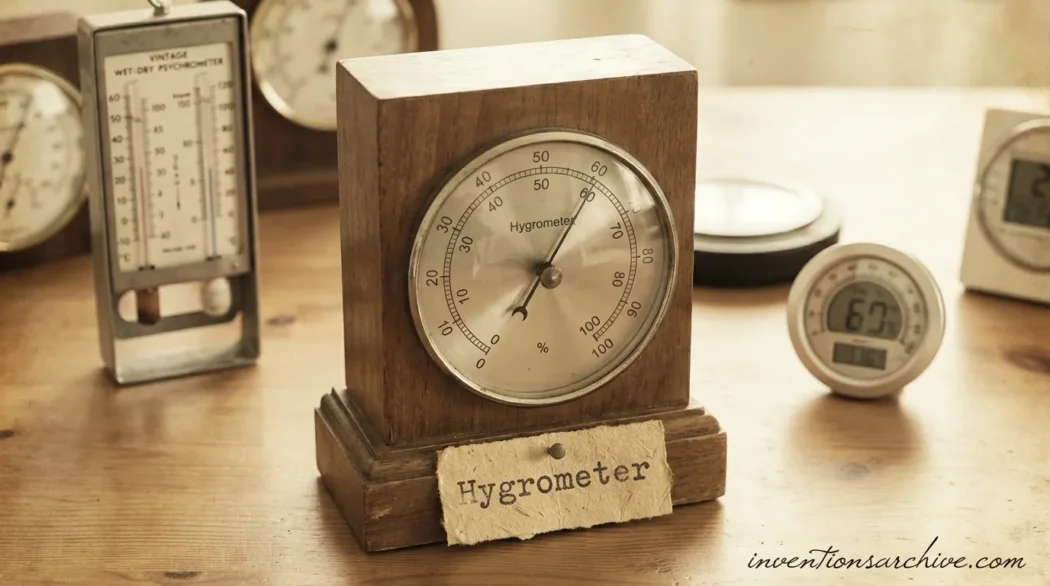
| Invention Name | Hygrometer |
| Short Definition | Instrument that measures air humidity (often RH or dew point) |
| Approximate Date / Period | 1783 (quantitative hair hygrometer) — Certain |
| Geography | Europe (early scientific instrumentation); now global |
| Inventor / Source Culture | Horace-Bénédict de Saussure (Details-1) |
| Category | Meteorology; Measurement; Environmental Monitoring |
| Importance |
|
| Need / Driver | Weather observation; material preservation; process consistency |
| How It Works | Sensing element responds to moisture; mechanism/electronics converts to a value |
| Material / Technology Basis | Hygroscopic materials; thermodynamics; capacitive/resistive sensing |
| Early Use Context | Atmospheric studies; instrument-making; laboratory observation |
| Spread Route | Scientific networks → observatories → industry and homes |
| Derived Developments | Psychrometers; dew-point hygrometers; digital humidity sensors |
| Impact Areas | Meteorology; HVAC; museums; manufacturing; agriculture; research |
| Debates / Different Views | “First” depends on definition: qualitative hygroscopes vs calibrated hygrometers |
| Precursors + Successors | Hygroscope → hair hygrometer → electronic sensors → chilled-mirror reference methods |
| Key People / Institutions | Instrument makers; observatories; modern national metrology labs |
| Varieties Influenced | Hair; psychrometric; condensation (dew point); capacitive; resistive; hybrid |
A hygrometer brings an invisible property of air into focus. Humidity shifts how materials behave, how comfortable a room feels, and how reliably sensitive work can be done. A well-chosen hygrometer turns that shifting moisture into clear numbers, whether the display shows relative humidity or a more technical value like dew point.
Table of Contents
What A Hygrometer Is
A hygrometer is a humidity-measuring instrument. Some models report relative humidity (RH) as a percent. Others focus on dew point, a temperature that reveals how close air is to forming condensation.
What Hygrometers Actually Measure
- Relative Humidity (RH): moisture level compared to saturation at the same temperature
- Dew Point: the temperature where water vapor begins to condense
- Water Amount Fraction and related humidity quantities used in high-precision work
The invention matters because humidity is rarely steady. Air that looks unchanged can carry more or less water vapor within minutes. Hygrometers provide a stable reference point for decisions that depend on repeatable conditions and reliable measurements, especially when data must match across locations and time.
Early Evidence and Timeline
The word “hygrometer” is tied to a long interest in moisture, yet the turning point was the move from observation to calibrated readings. The best-known early quantitative design is the hair hygrometer, where a hygroscopic strand changes length as humidity changes.
Museum collections preserve a clear snapshot of this shift. One documented instrument matches a hygrometer described by Horace-Bénédict de Saussure around c. 1780, using hair tension, a pulley, and a pointer to show humidity changes (Details-2).
A Compact Timeline of Milestones
- Late 18th Century: portable hair hygrometers become practical scientific tools
- 19th Century: broader instrument families expand, supporting observatories and laboratories
- 20th Century: electronic sensing grows, enabling compact digital devices
- Modern Era: reference-grade instruments link measurements to national standards
How It Works and Why It Matters
Every hygrometer relies on a simple idea: air moisture influences something measurable. In classic designs, that “something” is a material property such as length. In modern sensors, it is often an electrical property. Either way, the instrument converts a physical change into a stable signal that can be interpreted as humidity or dew point.
Material-Response Path
Hair hygrometers are the classic example. Hair absorbs and releases moisture, changing length. A linkage magnifies the motion so a dial can show a value. The elegance is in the mechanical amplification of a tiny change.
Thermodynamic Path
Dew-point instruments focus on phase change. When a surface cools enough for condensation to appear, the air has reached a key threshold. That threshold links directly to water vapor content and is prized for reference measurements.
Why Humidity Data Can Surprise People
- Warm air can hold more water vapor than cool air, so RH can change even when moisture stays similar
- Local microclimates form easily near windows, vents, plants, or cold surfaces
- Sensor placement changes what is “true” for a room versus what is true for a surface
- Condensation risk is often better captured by dew point than by RH alone
Types and Variations
“Hygrometer” is a family name. The core difference is the sensing principle and the humidity quantity the device reports. A practical overview starts with the major types most often encountered: hair, psychrometric, condensation (dew point), and electronic.
Hair Hygrometers
Hair hygrometers use a hygroscopic strand (traditionally hair) under tension. As humidity changes, the strand length shifts, and a mechanical linkage moves a needle over a scale. They are valued for their intuitive behavior and visible mechanism, though they can be sensitive to aging and contamination of the sensing element.
Psychrometers
Psychrometers infer humidity from two temperatures: a “dry bulb” and a “wet bulb.” Evaporation cools the wet bulb, and the temperature difference reflects how much moisture the air can still accept. The concept is rooted in evaporative cooling, and it connects directly to wet-bulb temperature and dew point.
Condensation and Dew-Point Hygrometers
Condensation hygrometers look for the point where condensation begins on a cooled surface. In high-precision instruments, this is often implemented as a chilled-mirror approach. Because it targets a physical threshold, it is frequently treated as a reference method for dew point and traceable calibration.
Electronic Hygrometers
Most digital hygrometers use a humidity-sensitive material that changes an electrical property. A common approach is capacitive sensing, where a polymer absorbs moisture and changes capacitance. Resistive sensing is also used, where the electrical resistance varies with humidity. These devices are popular for their compact size, fast response, and easy integration into electronics.
| Type | Typical Output | Strength | Common Limit |
|---|---|---|---|
| Hair | RH scale | Simple, readable mechanism | Sensing element can age or contaminate |
| Psychrometer | RH / dew point (calculated) | Strong physical basis | Depends on airflow and wetting quality |
| Condensation (Dew Point) | Dew point | Reference-style measurement | More complex and sensitive to surface condition |
| Electronic (Capacitive/Resistive) | RH (often with temperature) | Small, low power, fast | Drift and hysteresis vary by sensor design |
Measurements and Terms
Humidity language can be confusing because different numbers describe different aspects of the same air. A good hygrometer is not only a sensor, it is a translator. It converts a physical signal into a specific humidity quantity, tied to clear definitions and consistent units.
Dry-bulb, wet-bulb, and dew-point temperatures are widely used in humidity work and help define the state of humid air (Details-5).
Core Quantities
- Relative Humidity (RH): a percentage that compares actual water vapor to saturation at the same temperature
- Dew Point: a temperature that directly reflects moisture content and condensation risk
- Absolute Humidity: mass of water vapor per volume of air (context-sensitive, less common in everyday devices)
- Water Amount Fraction: used in high-precision metrology and calibration chains
Relative Humidity (RH %) ≈ (e / es) × 100
e  = actual water vapor pressure
es = saturation vapor pressure at the same temperature
RH is powerful for quick comparisons, yet it can be misleading if temperature swings. Dew point stays closer to the underlying moisture content, which is why condensation-aware work often prefers dew point over RH alone.
Accuracy, Drift, and Calibration
Two hygrometers can disagree without either being “broken.” Humidity sensing is sensitive to temperature, airflow, contaminants, and time. The key is understanding how a device is specified and how its readings connect to recognized standards through calibration and traceability.
International guidance exists for meteorological instruments and methods, including dedicated coverage of humidity measurement in the WMO guide series (Details-3).
Common Sources of Error
- Temperature coupling: sensor and air temperature may differ, shifting RH calculations
- Hysteresis: readings differ depending on whether humidity is rising or falling
- Drift: gradual changes from aging, contamination, or material stress
- Slow response in still air, especially near walls or cold surfaces
Calibration practice depends on the measurement level required. National metrology services provide calibration frameworks that define ranges and uncertainties. For example, NIST describes calibration services that include chilled-mirror hygrometers across dew/frost points from −90 °C to +85 °C, and relative humidity ranges that can span low to high values under controlled temperatures (Details-4).
In many settings, the most important outcome is consistency. A stable sensor with known bias can be more useful than a perfectly accurate sensor that drifts unpredictably. That is why documented performance and repeatable conditions sit at the center of trustworthy humidity data.
Where Hygrometers Are Used
Humidity measurement shows up wherever materials, comfort, or precision depend on moisture in air. The applications look different, yet the shared need is the same: measurable stability, predictable conditions, and comparable readings.
- Meteorology: surface stations, upper-air systems, and observation networks
- HVAC and building management: comfort, ventilation balance, and moisture control
- Museums and archives: preservation conditions for paper, textiles, wood, and mixed materials
- Manufacturing: processes where moisture shifts yield, adhesion, or electrostatic behavior
- Pharma and laboratories: controlled environments and quality systems
- Food storage: stability of dry goods and packaged products
Matching A Hygrometer to A Use Case
Choosing among hygrometers is less about “best” and more about fit. The correct fit depends on what must be known: a quick room RH snapshot, a reliable trend over months, or a number that must align with calibration records. The language of fit is uncertainty, response time, and long-term stability.
Typical Pairings
- General monitoring: electronic RH sensors for continuous, readable data
- Field education and demonstrations: psychrometric approaches for a strong physical story
- Preservation environments: stable sensors with documented drift behavior and periodic calibration
- Reference comparison: dew-point focused instruments where the measurement chain is critical
Trade-Offs That Matter Most
- Accuracy vs stability: some sensors drift slowly but stay smooth; others are sharp yet sensitive
- Response vs robustness: faster response can mean higher sensitivity to placement and airflow
- RH vs dew point: RH is intuitive; dew point can be more diagnostic for condensation risk
FAQ
Is A Hygrometer The Same As A Humidity Sensor?
A humidity sensor is the sensing element. A hygrometer is the full instrument that interprets the sensor signal and reports a humidity value, often with temperature compensation and display or logging.
Why Can Relative Humidity Change Without Adding Water To The Air?
Because RH is relative to saturation at the current temperature. When air warms, the saturation point rises, so RH can drop even if the moisture amount stays similar. Dew point is often more stable because it is tied to moisture content, not just temperature context.
What Makes Dew Point So Important?
Dew point indicates the temperature where condensation begins. It connects directly to moisture content, so it is widely used when condensation risk matters. That can be more informative than RH alone in spaces with cold surfaces or changing temperatures risk.
Do Hygrometers Need Calibration?
Calibration is how readings are related to recognized references and documented uncertainty. For general monitoring, periodic checks can support confidence. For regulated or precision work, traceable calibration and documented uncertainty are central.
Are Mechanical Hygrometers Still Useful Today?
Yes, in the right context. Mechanical designs can be excellent for visibility and education because the sensing principle is tangible. Digital devices often win on convenience, yet a mechanical hygrometer can still deliver meaningful trends when it is well maintained and understood as a system in context.