
| Invention Name | Hourglass (Sandglass, Sand Timer) |
| Short Definition | Fixed-interval timekeeper using gravity-driven granular flow |
| Approximate Date / Period | Early 14th century (documented) (Approximate) |
| Date Certainty | Documented (early references); earlier origin uncertain |
| Geography | Europe (early records); maritime use across European seafaring |
| Inventor / Source Culture | Anonymous / collective |
| Category | Timekeeping; navigation; household tools; education |
| Importance |
Portable timing; repeatable intervals Useful without sunlight; simple, durable design |
| Need / Reason It Emerged | Reliable short intervals; ship watches; work pacing; routine timing |
| How It Works | Measured grains pass a narrow throat; flip to restart |
| Materials / Technical Basis | Glass bulbs; narrow neck; dry grains; sealed chambers; frame/stand |
| Early Use Context | Shipboard timing; civic/visual references; routine interval keeping |
| Spread Route | Port cities → ship inventories → wider household and workshop use |
| Developments Enabled | Structured watches; timed tasks; clearer scheduling habits |
| Impact Areas | Navigation; work organization; education; craft; daily routines |
| Debates / Different Views | Exact origin and earliest makers unclear |
| Precursors + Successors | Precursors: sundials, water clocks • Successors: mechanical clocks, precision chronometers |
| Key People / Cultures | Medieval Europe; maritime communities; early clockmaking centers |
| Influenced Variants | Marine sandglasses; watch glasses; log glasses; modern game timers |
Hourglasses turn time into something you can see. A steady stream of grains makes an interval feel real, not abstract. That simple motion helped people keep short, repeatable periods for work, travel, and daily routines—long before screens and alarms were everywhere.
Contents
What It Is
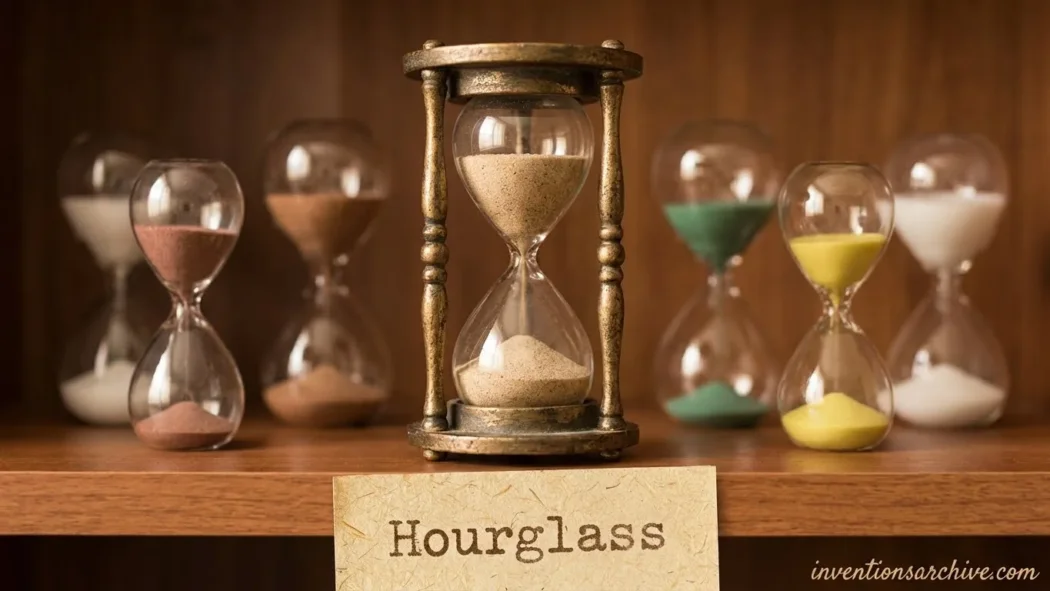
An hourglass is a fixed-interval timer. Two bulbs are connected by a narrow neck. Dry grains flow from the upper bulb to the lower bulb under gravity. When the top empties, the interval is complete. Flip it, and the same span begins again.
Core Parts and Simple Terms
- Upper bulb: the starting reservoir
- Lower bulb: the receiving reservoir
- Neck: the narrow passage that controls flow
- Granular material: often sand, sometimes other fine powders
- Frame: keeps alignment and protects the glass
It helps to separate a timer from a clock. A clock aims to track ongoing time. An hourglass measures one repeatable slice—three minutes, thirty minutes, an hour, or another set interval—then stops until it is turned.
Early Evidence and Timeline
Documented references place the sandglass in the early 1300s. A work written about 1310 describes shipboard use, and an early image appears in a fresco in Siena from 1338–1339, where the virtue Temperance holds a sandglass.Details
- c. 1310 — Early written mention tied to shipboard timing
- 1338–1339 — Early known image in a civic fresco, showing a familiar time symbol
- 1500s — Widespread maritime use for watches and routine navigation intervals
- 1600s+ — Continued use alongside improving mechanical clocks, especially for short spans
Why the origin can be hard to pin down: an hourglass leaves fewer durable traces than large public clocks. Early evidence often comes from written descriptions and images, not from surviving everyday pieces.
How It Works
The heart of an hourglass is steady discharge. For many dry grains, the flow through an opening is often fairly constant during most of the run. In granular physics, this kind of discharge can remain broadly independent of how much material sits above the opening—unlike water flowing from a tank—because stresses in a granular pile behave differently from fluid pressure.Details
In plain terms, the neck sets the pace. So do the grain size and how smoothly grains can slip past each other. When those are well matched, the hourglass keeps a clean rhythm: grain after grain, a controlled stream, and a predictable finish.
What Mainly Sets the Measured Interval
- Amount of grains inside the bulbs
- Neck width and neck shape
- Grain size and uniformity
- Dryness and resistance to clumping
- Bulb geometry near the neck
Materials and Build
Most classic hourglasses pair glass bulbs with a protective frame made from wood or metal. The grains are chosen for consistent flow. The seal matters too. When moisture sneaks in, grains can clump and timing drifts.
Common Fill Materials
- Fine dry sand
- Powdered marble
- Powdered eggshell
- Other fine, dry granular materials
Frame and Form
- Two-bulb classic layout
- Protective frame for stability
- Neck designed to reduce sticking
- Stands made for quick flipping
Types and Variations
“Hourglass” is a broad family. The same idea—measured grains through a narrow passage—shows up in many sizes. Some are meant for minutes. Others mark watch periods at sea. A few are built for very short precision intervals used with other ship tools.
Marine Timing Variants
One famous maritime variant is the log glass, used alongside a log and line to help estimate a ship’s speed. Royal Museums Greenwich notes common timing periods of 14 or 28 seconds for sand-filled log glasses.Details
- Watch glass: often half-hour intervals within longer watches
- Short glass: seconds-scale timing for measured procedures at sea
- Log glass: short standardized intervals for speed estimation methods
Outside navigation, many hourglasses are designed for everyday timing: cooking, games, classroom demonstrations, and simple work intervals. Modern pieces may use bright grains or multiple timers in one frame, yet the underlying principle stays unchanged.
Accuracy and Limits
An hourglass can be surprisingly consistent, yet it is not a precision laboratory clock by default. The Library of Congress highlights that accurate timing depends on careful calibration and on factors such as grain quality, neck width, moisture control, bulb shape, and even having a flat, level surface.Details
| Influence | What It Can Change | Why It Matters |
|---|---|---|
| Moisture | Clumping, sticking | Flow slows or becomes uneven |
| Wear at the neck | Wider opening over time | Interval can shorten |
| Grain size mix | Irregular discharge | Small grains jam; large grains stumble |
| Angle and stability | Side friction and uneven stream | Repeatability drops |
Compared with many historic clocks, the hourglass offers a clear strength: it measures one interval in a way that is easy to repeat. Its limit is just as clear: it does not automatically track the full day. It also cannot be “read” mid-flow with the same clarity as a dial—unless it has markings or is used with a routine that counts flips.
Where It Was Used
At sea, the hourglass became a practical tool for watchkeeping and dead reckoning. The U.S. National Park Service describes the sandglass as the timepiece most often used on ships, commonly in four-hour and half-hour sizes, with routine turning and audible signals to mark the passage of time.Details
Typical Maritime Roles
- Watch rhythm: repeating half-hour marks inside longer watches
- Bells and calls: signaling time to the crew
- Speed routines: short-interval glasses paired with a measured line
- Night-friendly: works without sunlight or flame
On land, hourglasses appeared in settings where a repeatable short span mattered: workshops, homes, classrooms, and games. Their value is not in “perfect time,” but in shared timing—a visible interval that different people can agree on at a glance.
Care and Preservation
Historic hourglasses are delicate objects: glass, fine grains, and a narrow passage that can be affected by moisture. In collections, the goal is stable conditions so the grains stay dry and the seal remains sound. Even a small change—humidity, vibration, tiny chips near the neck—can alter flow.
What Museums Watch For
- Humidity and condensation risk
- Seal integrity at joints
- Neck condition (wear or blockage)
- Frame stability and safe handling supports
Why Small Changes Matter
- Moist grains clump
- Worn neck widens the stream
- Mixed grains flow less evenly
- Minor cracks can let in air and moisture
FAQ
Is an hourglass always exactly one hour?
No. Hourglass is a general name. Many are designed for minutes, half-hours, or other set intervals. The measured span comes from the amount of grains and the neck design.
Why does sand flow differently from water in this kind of timer?
Dry grains behave like a granular material, not a simple fluid. In many situations, the discharge rate through an opening can stay fairly steady for much of the run, with the opening size and grain properties playing a leading role.
What can make an hourglass drift or stop flowing?
Common causes include moisture, grains that clump, a neck that is too narrow for the grain mix, or grains that are not consistently sized. Wear at the neck can also change the interval over time.
What is a log glass in maritime history?
A log glass is a short-interval sandglass used with a log and line method to help estimate a ship’s speed. Some were designed around standardized short periods such as 14 or 28 seconds.
Why did ships rely on sandglasses for watches?
They provided repeatable intervals without relying on sunlight, and they supported routine watch systems. Half-hour and four-hour sizes fit naturally into shipboard watch schedules.