
| Invention Name | Eyeglasses (Spectacles) |
|---|---|
| Short Definition | Wearable framed lenses that change focus for clearer vision. |
| Approximate Date / Period | Late 13th century (c. 1290) Approximate |
| Geography | Northern Italy; likely Pisa / Tuscany Approximate |
| Inventor / Source Culture | Anonymous / collective artisans; early written reference: Giordano da Pisa |
| Category | Optics; vision correction; assistive device |
| Importance |
|
| Need / Motivation | Presbyopia; manuscript reading; fine crafts |
| How It Works | Lens refraction; shifts focal point onto the retina |
| Material / Tech Basis | Ground glass lenses; early simple frames (wood/leather/metal) |
| Earliest Use | Reading; scholarship; record-keeping; close inspection |
| Spread Route | Italian workshops → European cities → global adoption |
| Derived Developments | Temple arms; refined prescriptions; coatings; lightweight materials |
| Impact Areas | Education; science; crafts; daily mobility; design |
| Debates / Different Views | Single “first inventor” unclear; multiple attributions in later records |
| Precursors + Successors | Reading stones → rivet spectacles → temple glasses → modern frames |
| Influenced Variants | Rivet spectacles; pince-nez; monocles; rimless; wrap styles |
Eyeglasses sit at the intersection of optics and everyday life. A pair can look simple, yet each lens is a carefully shaped surface that bends light with purpose. That quiet control of light made reading easier, skilled work steadier, and learning more accessible for generations.
Table of Contents
What Eyeglasses Are
Eyeglasses are lenses set in a frame and worn in front of the eyes. Their job is precise: change how light enters the eye so the image forms where it should. When people say “glasses,” they often mean the whole system—lenses, frame geometry, and the way both sit relative to the face.
Common Vision Errors
- Myopia (nearsightedness)
- Hyperopia (farsightedness)
- Astigmatism (uneven focus)
- Presbyopia (age-related near focus change)
How Glasses Fit In
Prescription lenses are calculated for a specific person. Readers are a simple near-focus option for some cases of presbyopia. Specialty designs can also include prism or task-specific focus zones.
Early Evidence and Timeline
The strongest early trail points to Northern Italy in the late 13th century. One Oxford record notes eyeglasses were likely made around 1290 and also preserves a 1306 sermon describing the craft as a new art, still within living memory Details. That tells a simple story: skilled glasswork met a real need for clear near vision.
Visual evidence arrives soon after. A well-known painted portrait from 1352 shows eyeglasses in use, making it an early artistic depiction of spectacles in daily scholarly life Details. The object had become recognizable enough to symbolize reading and focused work.
| Period | Design Shift | What Changed |
|---|---|---|
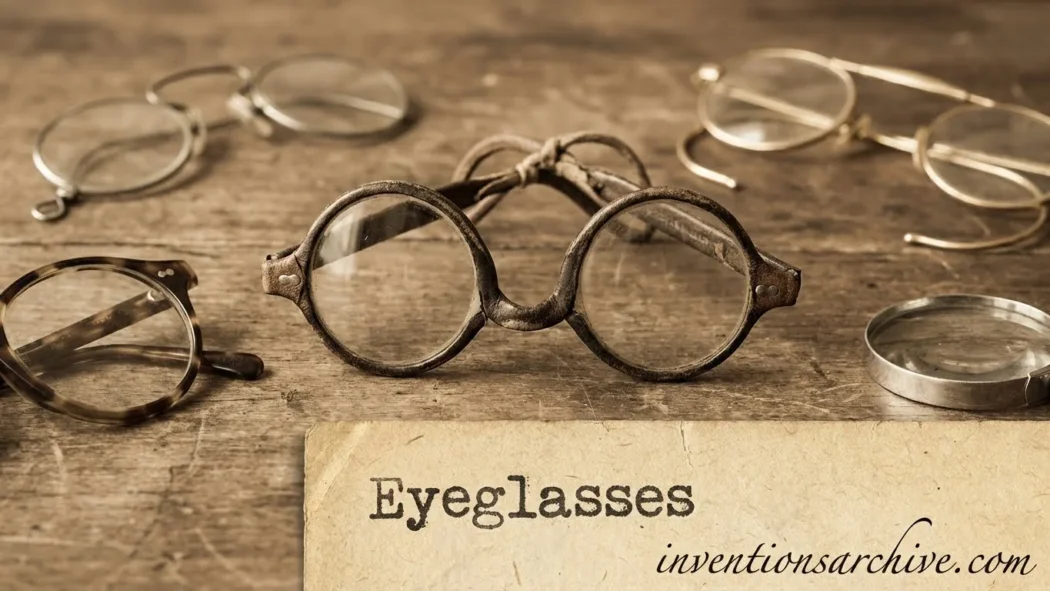
| 13th century | Rivet spectacles | Two lenses joined; hand support often needed |
| 16th century | Nose spectacles | More stable bridge styles; broader correction use |
| 18th century | Temple glasses | Arms develop to help frames stay in place |
| 19th century | Pince-nez | Spring grip on the nose; compact styling options |
| 20th century | Modern mass designs | Broader materials, lighter lenses, wider availability |
For a clear, museum-backed view of how frames evolved from rivet designs to temple arms, the British Optical Association Museum outlines key milestones and credits early “temples” to London optician Edward Scarlett Details. The story is less about one genius and more about steady refinement.
How Eyeglasses Work
Eyeglasses work through refraction: a lens bends incoming light so it focuses properly on the retina. When focus lands in front of the retina, distance can look soft; when it lands behind, near details can blur. A lens reshapes that path without changing the eye itself.
Basic Lens Shapes
- Convex (plus power): supports near focus and many cases of hyperopia
- Concave (minus power): supports distance focus in many cases of myopia
- Cylinder + Axis: addresses astigmatism by correcting uneven focus
What “Prism” Means
A prism does not “sharpen” in the usual way. It shifts the image position, which can help align what each eye perceives. It is a controlled, measurable part of lens design.
Main Parts and Terms
Every pair of eyeglasses is a system of geometry and fit. The same prescription can feel different when the frame position changes, because lenses are designed to be used at specific angles and distances.
Frame Components
- Bridge: rests across the nose
- Rims: hold the lenses
- Nose pads: fine contact points on many metal frames
- Hinges: connect front to temples
- Temples: arms that stabilize fit
Common Prescription Terms
| SPH | Overall lens power for myopia or hyperopia |
| CYL | Astigmatism correction amount |
| AXIS | Astigmatism direction (0–180) |
| ADD | Extra near power for presbyopia |
| PD | Pupillary distance used to center optics |
Lens Types and Variations
The word lens covers many designs. Some are a single, uniform power. Others blend zones so the eye can switch between distance and near tasks without swapping glasses.
Related articles: Spectacles Grinding Technique [Medieval Inventions Series]
| Lens Type | Core Idea | Typical Use |
|---|---|---|
| Single Vision | One power across the whole lens | Clear distance or clear near |
| Reading Lenses | Near-focused power | Text, labels, close detail |
| Bifocal | Two distinct powers in one lens | Distance + near without changing glasses |
| Trifocal | Three distinct powers | Distance + intermediate + near |
| Progressive | Power changes gradually (no sharp line) | Multi-distance viewing with smoother transitions |
| Occupational | Zones optimized for near/intermediate | Desk work and close focus ranges |
| Prism | Shifts image position for alignment | Specific binocular vision needs |
Bifocals became a famous milestone in multi-zone design. The Library of Congress notes Benjamin Franklin is credited with sketching bifocals for a friend in a letter dated May 23, 1785 Details. Whether the idea appeared in other forms nearby, the concept is clear: two viewing distances, one frame.
Frame Designs and Materials
Frames hold optics in the right position, yet they also shape comfort. A stable bridge, balanced temples, and reliable hinge tension keep the optical center where it belongs.
Common Frame Styles
- Full-rim: lenses fully surrounded by the frame
- Semi-rimless: partial rim with a support line
- Rimless: lenses drilled and mounted with minimal structure
- Wrap: curved front for broader coverage
Typical Materials
- Acetate (cellulose-based)
- Stainless steel and other durable metals
- Titanium (lightweight)
- Nylon and engineered polymers for flexible designs
Lens Materials and Coatings
Lens performance comes from shape and material together. Modern plastic lenses can be lighter than glass, while high-index options can reduce thickness for stronger prescriptions. Coatings add another layer of function without changing the prescription itself.
| Material | Why It’s Used | Common Notes |
|---|---|---|
| Glass | Optical clarity; scratch resistance | Heavier; breaks differently than plastics |
| CR-39 | Lightweight; good optics | Widespread standard plastic |
| Polycarbonate | Impact-resistant; light | Often used for active lifestyles |
| Trivex | Light; strong; good optics | Balance between clarity and durability |
| High-Index Plastics | Thinner profiles for higher powers | Often paired with anti-reflective coatings |
Common Coatings
- Anti-reflective (AR): reduces glare
- Scratch-resistant: protective hard layer
- UV protection: reduces ultraviolet transmission
- Hydrophobic: water and smudge resistance
Design Variations Inside One Lens
Aspheric designs can slim the lens profile and reduce edge distortion for some prescriptions. Toric surfaces are shaped to correct astigmatism. These are not separate gadgets; they are ways of sculpting optical surfaces with intent.
Why Eyeglasses Matter
The most lasting impact of eyeglasses is quiet and cumulative. They support reading, detailed craftsmanship, and sustained study. They also turned optics into a practical craft that pushed better lenses, better measurements, and better tools for working with light.
- Knowledge work: clearer text and diagrams for long periods
- Precision tasks: stable near vision for crafts and technical work
- Optical thinking: everyday familiarity with lenses and refraction
- Design culture: frames as both functional objects and personal style
FAQ
Are “eyeglasses” and “spectacles” the same thing?
In most modern usage, yes. Eyeglasses and spectacles both refer to framed lenses worn in front of the eyes. “Spectacles” often sounds more traditional, but the object is the same.
What’s the difference between single vision and progressive lenses?
Single vision lenses keep one power across the lens. Progressive lenses blend powers gradually, supporting more than one viewing distance without a sharp dividing line. Both rely on refraction and careful surface shaping.
Why do prescriptions include CYL and AXIS?
CYL and AXIS describe correction for astigmatism. CYL is the amount of correction, while AXIS indicates the orientation used to balance uneven focusing across different meridians of the eye.
What does “ADD” mean on a prescription?
ADD is additional near power, commonly used for presbyopia. It describes how much extra focusing support is built into a near zone, whether in bifocal, trifocal, or progressive designs.
Why is PD important in eyeglasses?
PD (pupillary distance) helps place the optical center of each lens in line with each pupil. It supports natural viewing through the intended part of the lens design.