
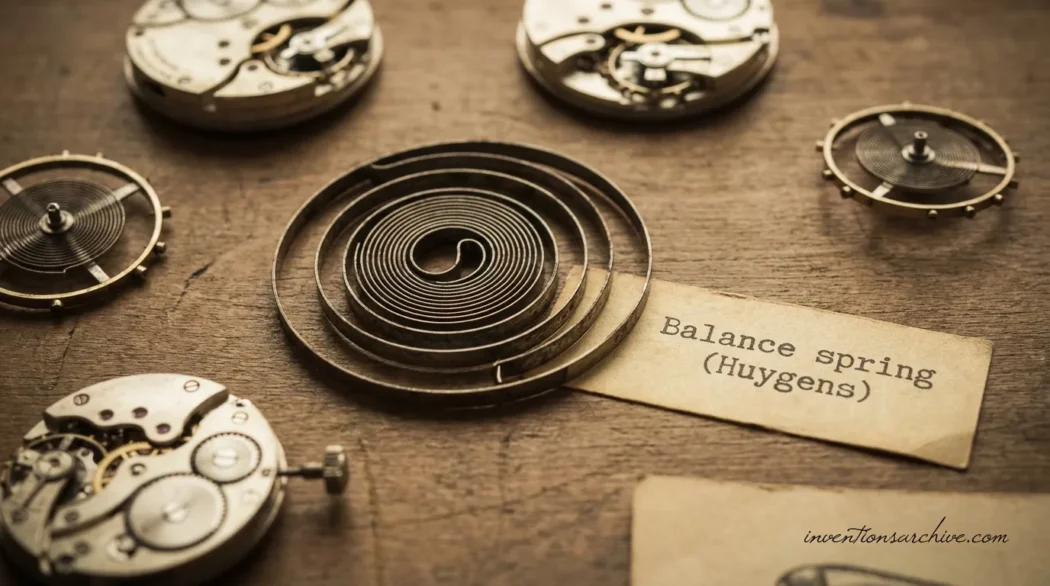
| Item | Value |
|---|---|
| Invention Name | Balance Spring (spiral hairspring) |
| Short Definition | A thin spiral spring that gives restoring torque to the balance wheel, setting a steady beat. |
| Approximate Date / Era | 1674–1675 Certain (Details-1) |
| Geography | Dutch Republic (design), early build-work in Paris and adoption across Europe |
| Inventor / Source Culture | Christiaan Huygens; early model-making linked to Isaac II Thuret (Details-3) |
| Category | Timekeeping • mechanical regulation • precision engineering |
| Importance | Portable accuracy • steady oscillations • practical minute-level timing |
| Need / Reason It Appeared | Daily drift from variable drive force • pre-spring watches could lose about an hour/day (Details-2) |
| How It Works | Balance wheel turns → spring twists → spring returns energy → repeatable oscillation |
| Material / Technical Basis | Elastic metal ribbon (later refined alloys and modern fabrication methods) |
| First Use Context | Pocket watch regulation • workshop prototypes • early high-skill watchmaking |
| Spread Route | Paris ↔ London ↔ The Hague → wider European production |
| Derived Developments | Regulators • overcoil geometry • better isochronism (Details-5) |
| Impact Areas | Navigation • trade • science • industry • daily scheduling |
| Debates / Different Views | Priority discussion: Hooke’s early spring idea vs Huygens’s spiral watch design (Details-4) |
| Precursors + Successors | Balance without spring + fusee → sprung balance → improved terminals and temperature control |
| Related Types Influenced | Flat spiral • overcoil • cylindrical/helical variants • modern etched springs |
From the outside, a mechanical watch looks calm. Inside, a ribbon-thin spiral decides whether the hands stay steady or wander. That spiral is the balance spring, also called the hairspring—small enough to hide under a bridge, powerful enough to shape everyday time.
On This Page
What A Balance Spring Is
A balance spring is not a power spring. It does not “drive” the watch. It regulates it. Attached to the balance wheel, it pulls the wheel back toward center after each swing, creating a repeating cycle. In watchmaking language, that cycle is the beat.
- Balance wheel: the rotating “mass” that swings back and forth
- Hairspring: the elastic element that provides the return force
- Escapement: the gate that feeds small packets of energy to keep the motion alive
On paper the idea is simple. The hard part is making the spring behave the same way in heat, cold, different positions, and after years of motion. That’s where the Huygens spiral form starts to matter.
Why It Changed Watches
Portability Without Guesswork
A pendulum likes one thing: staying vertical. A sprung balance works in any orientation, so timing can travel in a pocket, then later on a wrist.
A More Even Rhythm
The spiral spring pushes back with a force that is closer to proportional to displacement. That helps the balance wheel act more like a harmonic oscillator—a fancy term for “it prefers one steady period.” Short swings, larger swings… it aims to keep the time base similar.
Perfect behavior never happens in metal, but the direction is clear: steadier oscillation, better time.
A Concrete Before-And-After
- Before a true regulating spring, daily error could be on the order of an hour in some portable watches.
- With the spiral balance spring in place, daily error moved into minutes for well-made examples.
That shift sounds modest until it’s lived. Minutes are the difference between “about now” and “on time.”
Origins And Early Evidence
The “Huygens” tag matters because the spiral form becomes the usable form. Christiaan Huygens worked out a spring-regulated balance design in 1674–1675, and the idea quickly moved from drawings to working pieces.
Workshops, Not Just Paper
Here’s the practical detail people forget: the invention shows up where it counts, inside movements. A watch associated with Johannes van Ceulen (made in the mid-1670s) is documented as incorporating the new balance spring, and the museum record even notes how subtle it can look under the bridge. Small part, big effect.
A Calm Priority Discussion
Several skilled minds circle this moment. Robert Hooke explored spring behavior and early timekeeper ideas; Huygens’s spiral watch design becomes the widely adopted pattern; and makers such as Isaac II Thuret appear in records around model construction. Credit, in real technical history, often has more than one name attached. (It happens.)
How It Works
The Three-Part Loop
- Energy comes from a mainspring (or weight in some clocks).
- The escapement releases that energy in controlled steps—tick, then tock.
- The balance wheel and hairspring store and return that energy as oscillation, defining the rate.
If the oscillation period stays stable, the gear train turns at a stable rate, and the hands track time with less drift. Simple statement; hard engineering.
Why Isochronism Shows Up Everywhere
Watchmakers use the word isochronism for one central idea: the period should change as little as possible when the swing amplitude changes. As the watch winds down, drive force shifts—so does amplitude. A spring-balance system that shrugs off those changes keeps better time.
And yes, this is where geometry and finishing start to feel like science disguised as craft. Weirdly satisfying.
Types And Variations
A “balance spring” sounds like one thing, but watchmaking splits it into families based on shape, terminal geometry, and how the spring breathes as it expands and contracts. The goal stays the same: keep the center behavior tidy while the outer coils move.
Spiral Forms Used In Most Watches
- Flat spiral: the common layout, compact and easy to house.
- Terminal tweaks: subtle shaping at the outer end to reduce timing error.
- Free-sprung setups: regulation without curb pins (used in some higher-grade systems).
Shapes That Aim For Better Breathing
- Overcoil-style terminals: the spring’s end lifts and curves to help the spring expand more concentrically.
- Cylindrical/helical variants: taller geometry that can improve symmetry, with tradeoffs in space.
- Modern etched springs: precise forms made with advanced manufacturing, often paired with anti-magnetic strategies.
What Changes When The Material Changes
The base idea stays elastic. The problems, though, are very “real world”: temperature, magnetism, shocks, internal friction, lubricant aging. Modern alloys and fabrication methods aim to keep the spring’s elasticity stable so the beat rate stays put.
Limits And What Watchmakers Fight
A spring can look perfect and still time a little differently depending on conditions. That is not failure; it’s physics. The balance assembly behaves like an oscillator whose frequency can shift with amplitude, and watchmakers measure that drift carefully.
Common Error Sources In Plain Language
- Amplitude shift: as power changes, the swing size changes, nudging the rate.
- Position effects: gravity loads pivots differently when a watch rests in a new orientation.
- Temperature: metal stiffness shifts, changing the spring’s effective strength.
- Internal friction: tiny energy losses inside the spring material alter behavior over time.
Design details like terminal geometry (including overcoil approaches) target these effects by keeping the spring’s “breathing” more centered, which helps keep the oscillator closer to its preferred period.
Legacy In Modern Timekeeping
The Huygens balance spring does one job: it makes a stable portable oscillator practical. Once that exists, everything built on precise portable time—navigation, lab measurement, transport timetables, manufacturing schedules—gets easier to coordinate. Quiet invention, loud ripple.
A neat way to say it: the balance spring turned “portable time” from an expensive novelty into a repeatable machine behavior. Not magic—repeatability.
FAQ About The Balance Spring
Is a balance spring the same thing as a hairspring?
Yes. Watchmakers use both terms. “Hairspring” is common in horology; “balance spring” makes the function obvious: it works with the balance wheel.
Why does the spiral shape matter so much?
A spiral can expand and contract in a controlled way around a center, helping the balance return with a more even restoring action. That supports steadier oscillation.
Did Huygens invent it alone?
Huygens is strongly linked to the spiral balance spring design used in watches. The period also involves other contributors and a long-running priority discussion, including Robert Hooke and early makers associated with prototypes.
What limits accuracy in a spring-balance system?
Amplitude changes, temperature effects, friction, position differences, and small geometry imperfections can all shift the rate. Watchmaking focuses on reducing those shifts, not pretending they do not exist.
Do modern watches still rely on the same idea?
Yes. Materials and manufacturing can change, but the core arrangement—balance wheel plus hairspring as the time base—remains the standard approach for mechanical watches.