
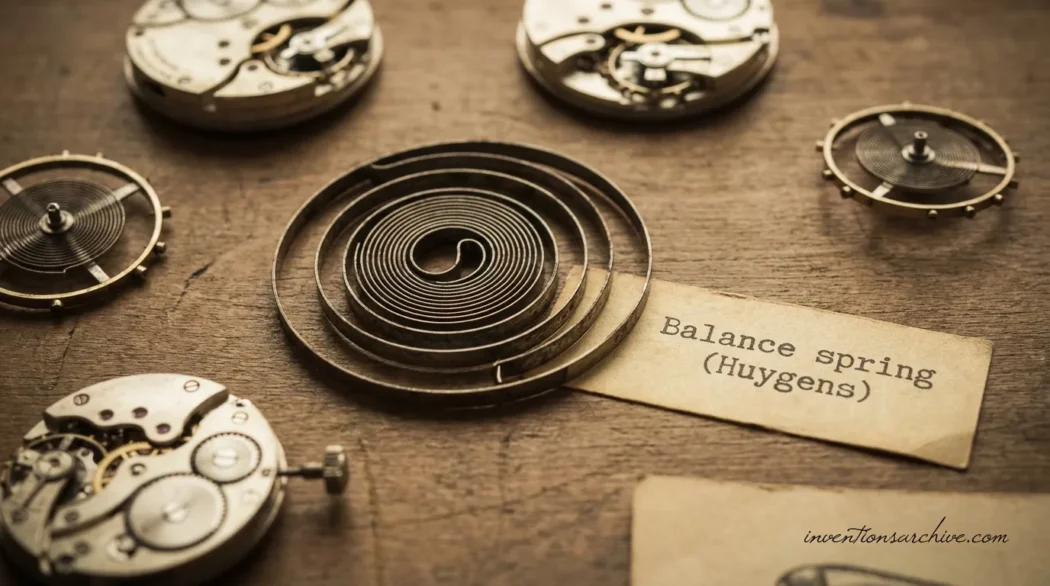
| Invention Name | Spiral Balance Spring, also called the hairspring |
|---|---|
| Short Definition | A fine spiral spring coupled to a watch balance wheel to create a repeating mechanical oscillator that regulates timekeeping. |
| Approximate Date or Period | 1675; Huygens’s description was published on February 25, 1675 |
| Geography | Developed by Huygens while working in Paris, France; rapidly taken up by watchmakers in France, the Dutch Republic, and England |
| Inventor or Source Culture | Christiaan Huygens is firmly associated with the published spiral design; Robert Hooke claimed earlier work on spring-regulated balances |
| Category | Mechanical horology; oscillators and timekeeping regulators |
| Importance | Made portable watches substantially better regulators of time and established the balance-and-spring oscillator that remained fundamental to mechanical watchmaking |
| Evidence Status | 1675 publication confirmed Earlier priority debated |
| Main Problem Solved | Provided the balance wheel with a controlled restoring force, allowing its oscillations to regulate a portable timepiece more consistently |
| How It Works | The balance wheel rotates back and forth while the spiral spring alternately coils and uncoils, producing a restoring torque toward its neutral position |
| Material or Technical Basis | A thin elastic spring attached between the balance assembly and a fixed part of the movement; early examples used metal springs |
| Early Use Context | Pocket watches and experiments in portable precision timekeeping, including efforts connected with determining longitude |
| Development Path | Unsprung balance → spring-regulated balance → improved spiral geometry, escapements, compensation systems, spring materials, and precision mechanical watch oscillators |
| Key People | Christiaan Huygens, Isaac II Thuret, Robert Hooke, Thomas Tompion, Johannes van Ceulen |
A Portable Oscillator Instead of a Pendulum
By the middle of the seventeenth century, the mechanical watch already existed, but its regulating system was poorly suited to precise timekeeping. A conventional portable watch used a balance that swung back and forth under the influence of the escapement. Without a dedicated restoring spring governing that motion, changes in the force delivered by the mainspring and other disturbances could alter the balance’s behavior.
The pendulum offered a much better solution for stationary clocks. Christiaan Huygens had already transformed clockmaking through his practical application of the pendulum in the 1650s. A pendulum, however, depends on gravity and on maintaining a suitable orientation. A clock whose case moves with a person, carriage, or ship cannot rely on a freely swinging pendulum in the same way as a stationary clock.
The balance spring provided a different kind of oscillator. Instead of gravity returning a pendulum toward its central position, the elasticity of a spring returned a rotating balance toward its neutral position. The mechanism could be made small enough for a watch and could continue operating while its case changed orientation.
This distinction explains why the balance spring belongs among the defining inventions of portable mechanical timekeeping. It did not merely make an existing spring-driven watch smaller. It supplied the watch with a much better physical basis for regulating the rate at which its gear train advanced.
What Huygens Published in February 1675
Huygens’s documentary claim is unusually clear because a contemporary technical description survives. In a communication addressed to Jean Gallois and published in the Journal des Sçavans on February 25, 1675, Huygens described a spring wound into a spiral and connected to a balanced wheel.[a]
His description identified the essential arrangement recognizably associated with a balance spring today. The inner end of the spiral was attached to the axis of the balance, while the outer end was fixed to a part connected with the watch plate. As the balance moved, the spring repeatedly tightened and relaxed. The gear train supplied small impulses to maintain the motion that would otherwise diminish through friction and other losses.
Huygens was interested in more than simply making the balance oscillate. He wanted the successive oscillations to take approximately equal amounts of time even when their extent varied. The goal was closely related to his earlier investigation of isochronous motion in pendulum clocks.
The practical realization of the idea involved the Paris clockmaker Isaac II Thuret. Huygens depended on skilled craftsmen because converting a mathematical and mechanical principle into a watch movement demanded extremely fine metalworking. Thuret constructed early models, and the relationship later became contentious when questions arose over who deserved credit for the device.
The surviving evidence therefore separates two roles that are sometimes compressed into the single word “inventor.” Huygens supplied and publicly described the spiral regulating arrangement, while professional watchmakers had to turn the concept into workable mechanisms that could actually be installed in portable timepieces.
The Balance and Spiral Form a Single Oscillator
The balance spring should not be confused with the mainspring. Both are springs, but they perform different jobs.
The mainspring is an energy reservoir. When the watch is wound, energy is stored in that spring and released gradually through the gear train. The balance spring is part of the regulator. Its purpose is to help determine the rhythm at which the movement is permitted to run.
In a balance-spring oscillator, the balance wheel has rotational inertia. If it is turned away from its resting position, the spring develops a restoring torque that acts in the opposite direction. The balance accelerates back toward the center, passes through it because of its inertia, and winds the spring in the opposite direction. The process repeats.
For an idealized oscillator in which the spring’s restoring torque is approximately proportional to angular displacement, the period can be represented as:
T ≈ 2π√(I/κ)
Here, T is the period of oscillation, I represents the balance wheel’s moment of inertia, and κ represents the effective torsional stiffness of the spring. Increasing the balance’s rotational inertia tends to lengthen the period, while increasing the spring’s stiffness tends to shorten it.
A real watch is more complicated. Pivot friction, air resistance, imperfect spring geometry, temperature, lubrication, the escapement, manufacturing tolerances, and the position of the watch can all disturb ideal behavior. Even so, coupling an elastic spring to the balance gave watchmakers a much more controllable oscillator than the older unsprung balance.
Why the Escapement Is Still Necessary
The balance and spring do not receive unlimited energy. Each oscillation loses a small amount through friction and other resistance. Without additional energy, the balance would eventually stop.
The escapement connects the oscillator to the watch’s powered gear train. It performs two related jobs: it allows the train to advance in controlled increments, and it delivers periodic impulses that replace energy lost by the balance.
This relationship also explains why Huygens’s spring did not immediately create a mechanically perfect watch. Seventeenth-century watches commonly used forms of the verge escapement. Its interaction with the balance could disturb the oscillator that the spring was intended to regulate. Later watchmakers improved escapements, balance construction, spring geometry, lubrication, and manufacturing accuracy, gradually allowing the balance spring to perform much closer to its theoretical potential.
Why the Spiral Shape Mattered
Spring regulation of a balance was broader than Huygens’s particular configuration. What distinguished his published 1675 arrangement was the use of a spring wound into a compact spiral around the balance axis.
The geometry allowed a relatively long and flexible spring to occupy a small area. During operation, its coils expanded and contracted as the balance rotated in alternating directions. This made the mechanism suitable for the confined interior of a watch.
Huygens’s own description emphasized that the coils should remain free rather than rubbing against surrounding parts. That requirement was mechanically important. Contact between neighboring coils or between the spring and another component introduces irregular forces that can disturb the period of oscillation.
Later generations of watchmakers devoted extensive attention to this behavior, often described as the spring “breathing” as its coils expand and contract. The geometry of the inner and outer attachment points, the concentricity of the spring, its thickness, and its terminal shape all influence the balance’s motion.
The Hooke–Huygens Priority Dispute
Calling the balance spring simply “Huygens’s invention” without qualification hides one of the best-known priority disputes in seventeenth-century horology.
After Huygens’s mechanism became known in 1675, the English experimental scientist Robert Hooke protested that he had worked on applying springs to watch balances much earlier. In his own published defense, Hooke claimed that his investigations reached back roughly seventeen years and described discussions and negotiations concerning spring regulation around 1660. He also stated that he had explained ways of applying springs to balances in lectures at Gresham College in 1664.[b]
These claims are historically important, but they do not make every part of the priority question straightforward. “Inventing the balance spring” can mean several different things: proposing that an elastic spring regulate a balance, constructing an experimental spring-controlled mechanism, devising a practical spiral arrangement, publicly disclosing it, or producing watches that other makers could reproduce.
Huygens’s position is strongest where the documentary evidence is most precise: a compact spiral spring attached to the balance was described and illustrated under his name in 1675. Hooke’s surviving claims support earlier investigation of spring-regulated balances in England. For that reason, modern historical treatment often distinguishes Huygens’s documented spiral balance spring from the broader question of who first conceived spring regulation for a watch balance.
The dispute was not restricted to two scientists. Thuret also became involved in disagreements over authorship and rights. In England, Hooke worked with the outstanding clockmaker Thomas Tompion on spring-balance watches. The controversy therefore shows how seventeenth-century invention could emerge from an unstable mixture of mathematical theory, experimental demonstrations, craft knowledge, private correspondence, publication, and attempts to secure commercial control.
From a Paris Model to Working Watches
The balance spring spread rapidly because watchmakers could recognize its practical value. A surviving watch associated with the Dutch maker Johannes van Ceulen and dated to about 1676–80 preserves the technology from the years immediately following Huygens’s announcement. The Metropolitan Museum of Art describes the balance spring as a major seventeenth-century advance and records Van Ceulen among the early Dutch watchmakers permitted to make watches using Huygens’s system.[c]
English makers moved quickly as well. The Science Museum Group preserves a Thomas Tompion pocket watch dated approximately 1675–79 that is among the earliest surviving English balance-spring watches. Its unusual dial includes indications for minutes, hours, and seconds. The museum connects the improved usefulness of minute indication directly with the better timekeeping made possible by the balance spring.[d]
This change in the dial is an important clue to the invention’s practical effect. A minute hand has limited value on a portable watch whose rate can wander badly. Once the mechanism could keep time much more consistently, displaying minutes became genuinely useful rather than primarily decorative.
The surviving early watches also show that adoption did not mean instant standardization. Makers experimented with different escapement layouts, balances, spring arrangements, regulators, gear trains, and methods of dealing with the changing force of the mainspring. The balance spring created a much better oscillator, but watch architecture still had to evolve around it.
The Longitude Ambition
Huygens explicitly connected portable accurate timekeeping with the problem of determining longitude. In principle, a navigator who carries a clock maintaining the time of a known reference location can compare that time with locally determined time. The difference corresponds to a difference in longitude.
The method places severe demands on a clock. A sea-going timekeeper has to maintain its rate while being subjected to motion, changes in orientation, temperature differences, vibration, humidity, and long periods without external correction.
Huygens had already explored pendulum clocks for maritime use, but ship motion exposed their limitations. His balance-spring work offered a regulator far better suited to a portable instrument. Smithsonian’s Time and Navigation project places Huygens’s balance spring within this search for reliable sea timekeeping and identifies both his pendulum clock and balance regulator as technologies that altered the development of time measurement.[e]
The 1675 balance spring did not by itself solve marine longitude. The oscillator still suffered from limitations in escapements, spring behavior, temperature response, friction, and positional effects. Eighteenth-century marine chronometers would require another long sequence of mechanical improvements. Huygens’s work nevertheless established an oscillator principle that became part of that later precision-horology tradition.
What the First Spiral Could Not Correct
A perfectly elastic spring with ideal geometry would return the balance with predictable force, but real springs depart from that ideal. Temperature changes can alter both the dimensions of the balance and the elastic properties of the spring. Changes in the position of a watch can expose small imbalances and distortions. Friction at the balance pivots varies, and the escapement can interfere with otherwise regular oscillation.
The spring itself can introduce error if its center of mass shifts as it expands and contracts or if the coils do not move symmetrically. Early springs also had relatively few turns compared with many later designs. Making such a fine elastic component repeatably was a demanding manufacturing problem in its own right.
Watchmakers therefore spent the following centuries refining the system rather than replacing its underlying principle. They developed improved balance designs, more suitable spring materials, terminal curves, temperature-compensation methods, better regulators, finer pivots and jewel bearings, and escapements that disturbed the balance less severely.
One later approach was to shape the outer portion of the spring so that its expansion and contraction became more symmetrical. Overcoils and carefully formed terminal curves appeared in precision watches and chronometers. Other developments addressed temperature by combining changes in the balance with materials whose elastic behavior was more stable.
These improvements altered the performance and construction of the oscillator, but the recognizable pairing remained the same: a rotating balance provides inertia, while an elastic spring supplies the restoring force.
Why the 1675 Design Endured
The mechanical value of Huygens’s spiral arrangement comes from the way it separates portable timekeeping from the pendulum’s need for a fixed gravitational reference. A watch can be turned, carried, or worn while the balance continues oscillating around its own axis.
Gravity does not disappear from the problem. It can still influence an imperfectly poised balance or a balance spring whose geometry changes with position. The important difference is that gravity is not the restoring mechanism that makes the oscillator run. Elasticity performs that role.
This made the balance spring unusually adaptable. Watchmakers could change the dimensions and inertia of the balance, modify spring stiffness and geometry, alter oscillation frequency, and pair the oscillator with successive generations of escapements without abandoning the basic concept.
Mechanical wristwatches centuries later therefore retain a direct conceptual connection to the seventeenth-century breakthrough. Materials, manufacturing precision, escapements, shock protection, regulation, and spring geometry have changed radically, yet a conventional mechanical watch still measures time through repeated oscillations of a balance controlled by an elastic spring.
Sources and Verification
- [a] Christiaan Huygens to J. Gallois, February 1675 — The preserved text of Huygens’s communication describes the spiral spring, its attachment to the balance, its oscillating action, and its intended use in portable watches. DBNL presents the historical text through an edition of Huygens’s collected works produced in cooperation with the Huygens Institute.
- [b] Robert Hooke’s 1675 balance-spring priority statement — Preserves Hooke’s own account of his earlier spring-regulation experiments, his claims dating from around 1658–60, and his description of the 1664 Gresham College lectures. It is a primary historical source for understanding the priority dispute.
- [c] The Metropolitan Museum of Art — Watch with scenes from the story of Rebekah at the well — Documents an early balance-spring watch by Johannes van Ceulen and provides museum research on Huygens, the 1675 publication, Isaac Thuret, the priority controversy, and early Dutch adoption of the mechanism.
- [d] Science Museum Group Collection — Early balance spring watch by Thomas Tompion — Records one of the earliest surviving English balance-spring watches, dated 1675–79, and explains the improvement in practical watch timekeeping associated with the new regulator.
- [e] Smithsonian Time and Navigation — Christiaan Huygens — Places Huygens’s balance-spring regulator within the history of portable timekeeping and the search for accurate clocks suitable for navigation.