
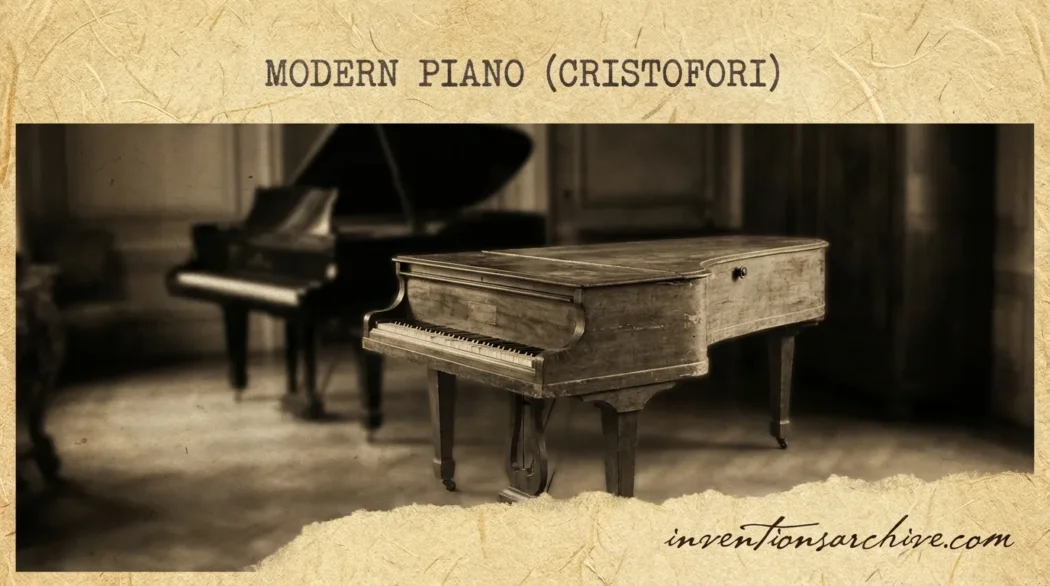
| Aspect | Data |
|---|---|
| Invention Name | Modern Piano (Pianoforte) |
| Short Description | Hammer-struck string keyboard with soft-to-loud control |
| Approximate Date / Period | 1700 — Certain |
| Geography | Florence, Italy (Tuscan court environment) |
| Inventor / Source Culture | Bartolomeo Cristofori — Italian instrument-making |
| Category | Music technology; mechanical design; materials engineering |
| Need / Reason It Emerged | Keyboard that can play quiet and loud without changing instruments |
| How It Works | Key lever drives a hammer; hammer escapes; damper controls decay |
| Materials / Technology Base | Wood case + soundboard; leather/cloth hammer coverings; later iron + steel |
| Earliest Evidence | Medici inventory note; early description; court annotation |
| First Known Uses | Court music and skilled private performance; controlled expression |
| Spread Route | Italian workshops → Central Europe → broader European makers |
| Derived Developments | Improved action geometry; repetition systems; stronger frames; wider range |
| Influence Areas | Composition; performance; education; instrument manufacturing |
| Debates / Different Views | Details of early prototypes vary; Cristofori credit stays stable |
| Precursors + Successors | Harpsichord & clavichord → fortepiano → modern concert grand & upright |
| Early Surviving Examples | 1720 (New York), 1722 (Rome), 1726 (Leipzig) |
| Related Types | Grand; upright; historical fortepiano; digital; hybrid; player piano |
A court inventory written in 1700 already describes a keyboard instrument with hammers and dampers—words that still sit at the heart of the modern piano. That tiny paper trail matters, because it pins a date on an invention that later reshaped how people learn music, write music, and even hear harmony in their heads.
Sections in This Article
What Modern Piano Means
The modern piano is a dynamic keyboard: the same key can whisper or ring out, because the mechanism translates finger speed into hammer energy.
- Harpsichord: a pluck; volume stays comparatively steady.
- Clavichord: a tangent touches the string; expressive, but limited in loudness.
- Piano: a hammer strike plus a damper system—more range in attack and decay.
That single idea—graded loudness—is why the piano became the default “all-rounder” in homes, schools, studios, and concert halls. Sometimes it backs a singer. Sometimes it carries everything alone. That flexibility is not magic. It’s mechanics.
Cristofori and the First Pianoforte
Bartolomeo Cristofori worked in Florence within the Medici musical world, surrounded by instruments that already represented the best craft of the day. Then he pushed past them. In records tied to 1700, a newly invented “arpicimbalo” is described with hammers and dampers, even noting a range of four octaves (C–c‴) and early naming that leads to “pianoforte.” (Details-1)
What Cristofori Added
- Hammer action that can repeat without staying stuck to the string.
- Damper control that shapes how long notes last.
- A design language that later makers could copy, simplify, then rebuild.
Why The Date Matters
Instrument histories often drift into “early 1700s” fog. Here, a court context pins the invention to a year. Rare. Useful. A little shocking, honestly.
How the Action Controls Volume
Think of the piano action as a chain of small decisions. A key goes down; a hammer accelerates; then—at the last moment—the action lets the hammer break free so it can strike and fall away. Into the string, the hammer flies. Off it goes again.
Key and Levers
The key is a lever system. It multiplies motion so a fingertip can drive a hammer with real speed.
Hammer and Escape
The escape idea prevents a “pressed hammer” sound. The strike stays crisp, and repetition stays possible.
Damper and Decay
Dampers mute strings when keys release, shaping clarity. Lift them and resonance blooms. That contrast is the piano’s daily bread.
Small but telling detail: early Cristofori instruments used materials and proportions that look closer to a harpsichord on the outside, while hiding a new inner logic. Outer familiarity, inner change.
From Wood to Iron and Steel
Early pianos lived mostly in wood. Modern pianos cannot—at least not if they want modern volume and stability. Why? String tension. A typical grand carries about 240 strings with a combined pull around 20 tons, while builders keep individual tensions roughly in the 150–160 pounds range. (Details-4)
That load pushes instrument design toward metal reinforcement: bracing, plates, and the overall structure that keeps the instrument from slowly “giving in” over years of tension. Not glamorous, but essential.
Now contrast that with a surviving Cristofori pianoforte dated 1722 in Rome: it remains a mostly wood-built instrument with a reported length around 192 cm and a range of four octaves; the same museum notes that pedals arrive later in piano history, rather than being a built-in feature from the start. (Details-2)
- Wood era: lighter frames, smaller ranges, quieter rooms.
- Iron-and-steel era: stronger structure, wider range, more sustain, more power.
- Soundboard stays: even with metal inside, a wooden soundboard still shapes the voice.
Touch and Repetition
Fast repetition looks like a performer’s problem. It is also a hardware problem. In 1821, the piano-maker Sébastien Érard patented a “double escapement” action, adding an intermediate lever that makes rapid note repeats more reliable without fully releasing the key each time. (Details-3)
That upgrade matters because it changes what hands can do at speed—trills, repeated chords, sharp rhythmic patterns—while keeping control over tone. It also nudges composers and performers into new textures. (Yes, the mechanism quietly shapes the music.)
Piano Families and Variants
“Piano” is a family name, not one fixed object. The shared DNA is still Cristofori’s core idea: a hammer-struck string keyboard with real dynamic range.
Acoustic Forms
- Grand piano: horizontal strings; long soundboard; concert projection.
- Upright piano: vertical strings; compact footprint; common in homes and schools.
- Fortepiano: historical style (lighter build, earlier action feel).
Electro-Mechanical and Digital
- Digital piano: sampled or modeled sound; often weighted keys.
- Hybrid: acoustic action paired with digital control and silent practice modes.
- Player systems: automated performance using encoded input.
Even pop culture keeps proving the point: film scores, game music, short-form video covers—piano stays recognizable because its sound carries both rhythm and harmony without needing a full band behind it. Familiar, but never flat.
Common Standards and Measurements
Modern acoustic pianos often share a few baseline conventions: an 88-key keyboard, a standard concert pitch reference, and structural choices built for long-term stability under tension. These conventions arrived over time; they were not “born complete” in 1700.
One anchor point for modern tuning is the international standard that sets the treble-staff A to 440 Hz (with a stated accuracy window). (Details-5)
| Convention | Typical Modern Form | Early Context |
|---|---|---|
| Keyboard Range | 88 keys (common full size) | 4 octaves appears in early documentation |
| Core Mechanism | Hammer strike + escape + dampers | Same concept, earlier materials and geometry |
| Structure | Wood soundboard + metal reinforcement | Mostly wood-built surviving examples |
| Repetition | Double-escapement style actions common in grands | Earlier actions show the idea, later refined |
| Tuning Reference | A = 440 Hz (standard reference) | Pitch varied by place and era |
FAQ
Why is Cristofori credited as the inventor of the modern piano?
Because early documentation points to a hammer-and-damper keyboard instrument made under his direction around 1700, and surviving instruments show a coherent mechanism that later makers could adapt. Credit here is tied to both records and engineering continuity.
What does “pianoforte” mean?
It refers to “soft” and “loud.” The term highlights the feature that separates the piano from plucked keyboards: the ability to shape volume through touch.
What makes a piano different from a harpsichord in simple terms?
A harpsichord typically plucks strings; the piano strikes strings with hammers and then releases them, which allows broader control over loudness and note decay.
How did the piano reach the modern 88-key range?
The range grew as composers asked for more notes and builders improved frames, strings, and actions. Expansion happens in steps: stronger structures allow longer strings and higher tensions, which support more keys without losing stability.
What is “double escapement” in plain language?
It’s a repetition-friendly action design that lets a note be played again quickly without fully resetting the key to its top position, helping fast passages stay clean and controlled.