
| Invention Name | Battery — Voltaic pile |
|---|---|
| Short Definition | A wet battery built from repeated pairs of unlike metals and moist separators to supply continuous electric current. |
| Approximate Date / Period | 1800 |
| Date Certainty | Exact for public disclosure |
| Geography | Italy; later circulated through Paris and London |
| Inventor / Source Culture | Alessandro Volta; late Enlightenment Italian science |
| Category | Electrochemistry; electrical power; laboratory apparatus |
| Why It Mattered |
|
| Need or Problem | Researchers needed a source of electricity that lasted longer than static discharge. |
| Basic Working Principle | Unlike metals plus a moist electrolyte create a potential difference; stacked pairs raise total output. |
| Material / Technical Basis | Zinc; copper, silver, or pewter; paper, cloth, or cardboard; brine or alkaline moisture |
| Early Use | Electrical experiments; chemical decomposition; lecture demonstration |
| Spread Route | Italy → London scientific circles → Paris → European laboratories → North America |
| Developments It Opened | Electrolysis; electrochemistry; improved wet cells; early electromagnets; telegraph power |
| Areas Affected | Science; chemistry; education; communication; industry |
| Historical Debate | Animal electricity vs. metal-contact explanation; later chemistry clarified the cell process |
| Earlier Devices | Leyden jar; electrostatic machines; Galvani’s frog-leg experiments |
| Later Designs | Trough battery; Daniell cell; Grove cell; dry cell |
| Main People and Institutions | Volta; Luigi Galvani; Humphry Davy; Michael Faraday; Royal Society; Royal Institution |
| Related Forms Within This Invention Family | Voltaic column; crown of cups; trough battery; dry pile |
Before generators, before sockets on the wall, there was a stack of metal discs that changed laboratory practice. The voltaic pile gave researchers a way to produce steady current instead of a brief static burst, and that single change opened the door to new chemistry, cleaner electrical measurement, and the long line of cells that led to modern batteries. It looked simple. Its effect was anything but small. (Details-1)
Contents
What the Voltaic Pile Is
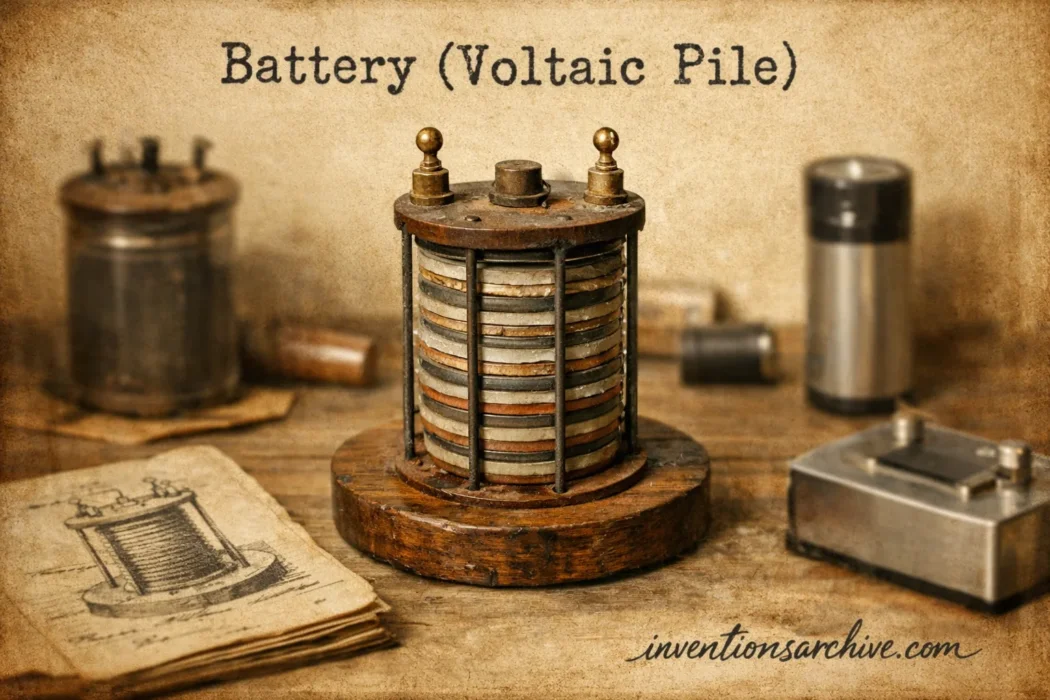
The voltaic pile was the first device widely credited with providing a continuous electric current. In physical terms, it was a vertical stack of repeated metal pairs separated by a moist layer. Each pair contributed a small electrical push. Add enough pairs, and the output became useful for experiment.
That is the part many short write-ups skip: the pile was not merely an early battery in name. It changed the behavior of available electricity. A Leyden jar could store charge and release it suddenly. A voltaic pile could keep current moving for a longer stretch, which made observation, comparison, and repetition much easier. Electricity became workable, not just spectacular.
What Made It New
- Repeated cells in one stack
- Moist separators that let the chemistry proceed
- A source that could be used for longer experiments, not only for a spark display
- A design that could be scaled by adding more pairs
Where the Idea Came From
Galvani and the Debate on Animal Electricity
The story begins with Luigi Galvani’s frog-leg experiments. Galvani read those motions as evidence of animal electricity. Volta took a different path. He argued that the effect came from contact between unlike metals and a moist conductor rather than from some special fluid unique to living tissue. That disagreement did not stay abstract; it pushed Volta toward a new device that removed the frog from the experiment and left the metals in place. (Details-2)
By 1800, Volta had made public not only his stacked column but also a related arrangement often called the crown of cups, where paired metals sat in a series of liquid-filled cups. Same principle, different layout. That second form matters because it shows Volta was thinking beyond one shape; he was testing a whole electrochemical idea.
Volta’s 1800 Disclosure
Volta described the new battery in a paper sent to the Royal Society in 1800. This is one of those dates worth fixing firmly in place because battery history turns on it. From there, the design moved quickly through European scientific circles. The invention traveled fast because the result was easy to reproduce in principle and impossible to ignore in practice. (Details-3)
How the Stack Produces Current
Why Two Metals Matter
Volta’s pile used unlike metals—commonly zinc with copper or silver—separated by paper or cloth soaked in a conducting liquid. Zinc tends to react more readily. In modern language, that side gives up electrons more easily. The moist layer allows ions to move, and the external connection lets electrons flow through the circuit. That is the working heart of the pile: metal difference plus electrolyte plus a complete path. (Details-4)
Why the Moist Separator Matters
The separator did two jobs at once. It kept the metal discs from touching directly, and it carried the liquid that allowed the cell chemistry to continue. No moisture, no useful current. In that sense, the paper or cloth was not filler. It was part of the operating system.
Simple to describe, yes. Easy to get right, not always. Wet layers could dry, shift, leak, or become uneven, and that affected performance.
Why More Pairs Raise Output
Each metal pair produced only a small potential difference. Stack many pairs in series, and the total voltage rose. That is why the pile was built upward, layer after layer. The design was modular before anyone used that word for batteries.
| Feature | Voltaic Pile | Leyden Jar |
|---|---|---|
| Electrical Behavior | Steady current while the chemistry lasts | Short stored discharge |
| Basis | Electrochemical reaction | Electrostatic charge storage |
| Best Use | Extended experiment and measurement | Demonstration and spark effect |
| Historical Value | Made repeatable research easier | Shaped early static electricity studies |
Materials, Forms, and Close Variants
Common Materials
The early pile did not depend on one fixed recipe. Volta described combinations such as zinc and silver, and related versions also used copper or pewter. The separator could be paper, cardboard, felt, or cloth. The wetting medium was often brine, though alkaline solutions also appear in historical descriptions.
- Reactive metal: usually zinc
- Second metal: silver, copper, or pewter
- Separator: paper, cloth, felt, or cardboard
- Electrolyte source: salt water or alkaline moisture
Column Pile and Crown of Cups
The best-known version is the column pile, the stacked tower. The crown of cups used the same principle in a row of linked cups. In both cases, the design joined multiple cells in series. One looks like a pillar. The other spreads sideways. Function first; shape followed.
Later Variants Near the Original Idea
Very soon, experimenters reworked the layout for easier handling and stronger output. The trough battery arranged plates in a more practical frame. Later wet cells, especially the Daniell cell, aimed at a steadier current with fewer performance problems. The principle remained familiar: two unlike electrodes, an ion-carrying medium, and a circuit that lets charge move.
Why It Changed Experimental Science
It Turned Electricity into a Laboratory Tool
Once a pile could sit on a bench and keep current flowing, electricity stopped being only a striking effect. It became an instrument. Researchers could run the same setup again, vary one condition, observe a difference, and repeat the test. That regularity mattered deeply for physics and chemistry.
One early payoff was electrolysis. Another was the widening of electrochemistry as a field. The battery did not just power later work; it changed the questions scientists felt able to ask.
From Davy to Faraday
At the Royal Institution, batteries derived from Volta’s design fed the research of Humphry Davy, who used them in early electrochemical work and in the isolation of elements such as sodium and potassium. The same line of work then passed, intellectually and materially, toward Michael Faraday. The pile did not merely power experiments; it helped reorganize nineteenth-century science around electrical action. (Details-5)
Fields Opened by the Pile
- Chemistry: decomposition by current, electrode reactions, element isolation
- Physics: better study of current, resistance, and magnetic effects
- Technology: early electromagnets, telegraph circuits, electrical instruments
- Education: repeatable demonstrations in lecture rooms and laboratories
Limits and the Designs That Followed
The original pile had real drawbacks. Hydrogen bubbles could build up on one electrode and weaken performance. Wet separators dried out. Liquids shifted. Stacks were awkward to keep uniform. Output could drift, sometimes quickly. So, yes, it was a breakthrough, but it was also a device that pushed people to improve it almost immediately.
That is why battery history after Volta moves fast. The trough battery simplified arrangement. The Daniell cell gave a steadier current and became much more useful for practical work. Later designs chased longer life, cleaner handling, and better portability. Modern cells look very different, yet the family resemblance remains easy to spot: separated electrodes, a medium for ion movement, and stored chemical potential turned into electrical work.
The pile also left a language legacy. The volt carries Volta’s name, and the logic of cells connected in series still sits close to the center of battery design. The old stack is gone; the idea stayed.
FAQ
Was the voltaic pile the first true battery?
It is widely treated as the first battery that could supply continuous current. Earlier electrical devices existed, but they did not provide the same sustained electrochemical source.
Why was the stack built from many repeated pairs?
Each pair produced only a small electrical push. By placing many pairs in series, Volta increased the total voltage and made the device more useful for experiment.
Was the voltaic pile the same as a modern household battery?
No. The basic principle is related, but the voltaic pile was a wet, early-form cell with exposed layers and unstable performance compared with sealed modern batteries.
What is the difference between the column pile and the crown of cups?
The column pile stacked cells vertically. The crown of cups arranged related cells across multiple cups. Same electrochemical idea, different geometry.
Why does the invention still matter in battery history?
Because it changed electricity from a brief event into a workable source of current. That shift supported electrochemistry, later cell design, and a large share of nineteenth-century electrical research.