
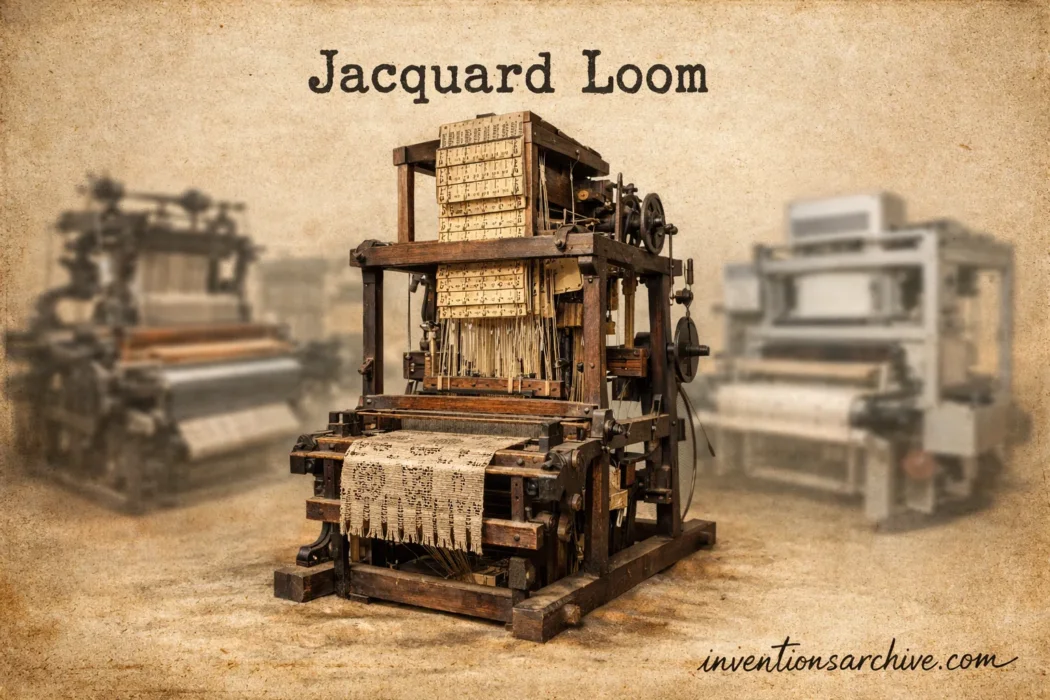
| Invention Name | Jacquard loom, more precisely the Jacquard mechanism fitted to a loom |
|---|---|
| Short Definition | A pattern-control mechanism that selects warp threads according to instructions encoded in punched cards. |
| Approximate Date or Period | 1801–1805 Development occurred in stages |
| Geography | Lyon and Paris, France |
| Inventor or Source Culture | Joseph-Marie Jacquard, building on earlier French weaving mechanisms by Basile Bouchon, Jean-Baptiste Falcon and Jacques de Vaucanson |
| Category | Textile machinery; programmable pattern control |
| Importance | Made intricate figured weaving more repeatable while establishing a practical system of interchangeable machine-readable instructions. |
| Evidence Status | Based on surviving machines and institutional records |
| Main Problem Solved | Automated the selection of warp threads that had previously required a drawboy or other manual pattern-control work. |
| Development Path | Drawloom → Bouchon perforated paper → Falcon linked cards → Vaucanson automated loom → Jacquard compact card-controlled mechanism |
| Encoding Principle | Hole and no-hole positions determine which parts of the warp-selection mechanism respond during successive weaving operations. |
| Early Use Context | Figured silk and other patterned textiles, especially in the Lyon weaving industry |
| Modern Descendants | Mechanical and electronic Jacquard shedding systems controlled from digital textile designs |
Why the Name “Jacquard Loom” Can Be Misleading
The familiar term Jacquard loom suggests that Joseph-Marie Jacquard invented an entirely new loom. The historical machine is better understood as a control mechanism mounted above a loom. The underlying loom still performed weaving: warp threads ran lengthwise, the shed opened, and a weft thread passed across them. Jacquard’s device changed how selected warp threads were chosen when a patterned fabric was being made.
This distinction matters because patterned weaving already had a long technical history. Jacquard’s achievement was not the invention of weaving, the drawloom or even the first use of perforated material to control a pattern. His mechanism brought earlier experiments into a smaller and more practical arrangement that could repeatedly read a sequence of punched cards and translate that sequence into warp selection.
Surviving museum examples reinforce this distinction. A nineteenth-century Spitalfields hand loom in the Science Museum Group collection has a Jacquard machine fitted to it as a separate mechanism. The museum dates the Jacquard component to about 1825 while the loom itself is later, showing how the control system could be treated as equipment attached to a weaving machine rather than as an inseparable new type of loom.[a]
The Pattern-Control Problem Above the Weaver
Producing plain cloth requires the loom to divide warp threads into groups so that the weft can pass between them. Figured weaving becomes much harder because the selection must change repeatedly across the width of the fabric. Floral ornament, lettering, portraits and other detailed motifs can require many different combinations of raised and lowered warp threads.
Before Jacquard mechanisms became established, elaborate figured textiles could be produced on a drawloom. A system of cords allowed selected warp threads to be lifted according to the intended pattern. This often involved a second worker commonly called a drawboy, who operated the pattern cords while the principal weaver managed the weaving itself.
The arrangement was capable of elaborate work, but it placed part of the pattern information in a labor-intensive system of cords, selections and human actions. Changing or repeating intricate designs demanded preparation and coordination. The technical challenge was therefore not simply to make a loom move faster. It was to separate the pattern-selection information from the worker who had previously interpreted and executed it.
Bouchon and Falcon Put the Pattern Outside the Worker’s Memory
The path toward Jacquard’s machine began decades before his own work. Records preserved by the Conservatoire national des arts et métiers document an important experiment by Lyon worker Basile Bouchon in 1725. Bouchon’s arrangement used perforated paper pressed against a set of needles connected with the loom’s pattern-control apparatus. The position of the holes determined which needles could respond.
In 1728, Jean-Baptiste Falcon changed the format. Instead of relying on a perforated sheet or strip in the same manner, Falcon used a sequence of individual perforated cards linked into a chain. The cards could be advanced successively, allowing a sequence of pattern instructions to be presented to the mechanism. The Conservatoire’s textile machinery catalogue records models of both the Bouchon loom of 1725 and the Falcon loom of 1728 and describes Falcon’s substitution of an endless chain of cards for Bouchon’s perforated paper.[b]
This was an important conceptual change. A textile design could be represented by a physical sequence stored outside the loom operator. Each section of that sequence could be read mechanically. Pattern information had become removable, reproducible and capable of being presented to the machine in a predetermined order.
Falcon’s cards were therefore not an incidental detail added by Jacquard decades later. They belonged to an existing line of experimentation. Jacquard’s contribution has to be understood within that lineage rather than by treating every feature of the later machine as his independent invention.
Vaucanson Tried to Automate More Than Pattern Selection
Jacques de Vaucanson, known for his mechanical automata as well as his work with textile machinery, became inspector of French silk manufactures in the eighteenth century. He studied ways of mechanizing weaving and developed a loom intended to replace older drawloom arrangements.
The Musée des Arts et Métiers describes Vaucanson’s project as an attempt to improve the punched-control systems associated with Bouchon and Falcon while mechanizing more of the weaving process. Cams operated parts of the machinery, while other mechanisms handled functions that had depended on the actions of workers. Despite its technical ambition, Vaucanson’s loom did not become an industrial success.[c]
That lack of adoption did not make the machine irrelevant. Conservatoire records show that Vaucanson’s weaving work became part of the technical inheritance available to Jacquard. Later museum catalogues explicitly describe Jacquard as combining and simplifying ideas associated with Falcon and Vaucanson.
The sequence is therefore better described as cumulative engineering: Bouchon demonstrated perforated control, Falcon made the instructions into linked cards, Vaucanson pursued broader mechanical automation, and Jacquard reorganized useful elements into a mechanism that proved far more practical for patterned weaving.
Why Both 1801 and 1804–1805 Appear in Jacquard Histories
The date of the Jacquard loom is often given as a single year, but museum records describe several stages of development. National Museums Scotland states that Jacquard first demonstrated his mechanism in 1801. A Musée des Arts et Métiers record also identifies a patent registered on 23 December 1801 for a machine intended to remove the need for the worker who operated the draw cords.[d]
Other institutional collections date the developed Jacquard machine to 1804 or 1804–1805. The Science Museum Group, for example, describes the Jacquard loom as developed in 1804, while another collection record places development in 1804–1805.[e]
These dates do not necessarily describe contradictory inventions. They reflect the difference between an early patented or demonstrated form and the practical mechanism that emerged after further refinement. Treating 1801–1805 as the development period preserves that distinction more accurately than assigning every part of the mature Jacquard system to one isolated moment.
How the Punched-Card Mechanism Selected Warp Threads
A Jacquard mechanism stores a pattern as a sequence of punched cards. Cards are joined so they can be presented one after another to the reading mechanism. As the sequence advances, each card provides the selection required for a stage of the woven pattern.
The mechanical logic depends on the relationship between holes, needles and hooks. A card is pressed against an array corresponding to positions in the selection mechanism. Where the card contains a hole, a needle can respond differently from one that encounters solid card. That distinction determines which hooks participate in the lifting action. Through harness cords connected below the Jacquard head, those decisions ultimately determine which warp threads rise to form the shed.
A Science Museum Group hand loom demonstrates the process clearly. Its cards form a continuous loop and move as weaving proceeds. The cards are presented to pins; holes allow some pins to pass while solid areas stop others. The resulting mechanical selection controls which warp threads are raised.[f]
The card does not contain an image in the way a printed sheet displays the finished textile. Its pattern of perforations represents mechanical decisions. The full woven motif appears only after a sequence of those decisions has been executed through many successive operations of the loom.
Hole and No-Hole as Two-State Information
The card-reading process is often compared with binary information because each reading position presents two physical possibilities: a hole is present or it is absent. That comparison is useful, provided it is not stretched too far.
Related articles: Analytical engine (Babbage) [Industrial Age Inventions Series], Power loom [Industrial Age Inventions Series]
The Jacquard mechanism was not a general-purpose computer. Its cards primarily controlled selections in a textile machine, and its mechanical actions were tied directly to weaving. Yet it demonstrated something that later engineers could apply elsewhere: a machine’s behavior could be altered by supplying an external sequence of encoded instructions rather than rebuilding the machine for every new pattern.
Changing the card chain changed what the mechanism selected. The machine remained substantially the same while the instruction set could be exchanged. That separation between mechanism and stored control information is one reason the Jacquard system occupies an unusual place in both textile history and computing history.
Repeatability Changed the Economics of Figured Cloth
The drawloom could produce remarkable textiles, so Jacquard’s advantage was not that elaborate patterning had previously been impossible. The change lay in how the pattern was controlled and repeated.
Once a design had been translated into a correctly prepared card sequence, the loom could read those selections repeatedly. The separate drawboy role was no longer required in the same form. This reduced the dependence of every pick on a second worker interpreting pattern cords and made complicated designs easier to reproduce through mechanical control.
The Metropolitan Museum of Art notes that the Jacquard mechanism eventually replaced drawloom pattern control for much European figured weaving. It accelerated the preparation and production of complex woven structures and permitted levels of pictorial detail that became a showcase for nineteenth-century silk manufacture.
The labor consequence also explains part of the resistance surrounding the new mechanism. A device that removed an established task could be viewed very differently by manufacturers seeking lower production costs and by workers whose employment depended on that task. Jacquard mechanization belonged to the broader industrial process in which machinery changed not just output but the distribution of skill and labor inside textile workshops.
A Woven Portrait Demonstrated What the System Could Resolve
One of the best surviving demonstrations of Jacquard weaving is an 1839 silk portrait of Joseph-Marie Jacquard in the collection of The Metropolitan Museum of Art. Manufactured by Didier, Petit et Cie in Lyon and woven by Michel-Marie Carquillat, the textile was based on a portrait by painter Claude Bonnefond.
The piece is striking because details that might initially appear engraved or printed are formed through weaving. The Met notes the convincing rendering of elements such as a translucent curtain and window panes, illustrating how carefully controlled warp selection could produce extremely fine pictorial effects in silk.[g]
Such textiles were demonstrations of both design preparation and machine control. The loom did not invent the portrait or decide how it should look. Designers and technicians still had to convert visual information into a structure that the cards and weaving system could execute. Jacquard automation transferred repeated selection to the mechanism; it did not remove human design work from textile production.
The Card Chain Became a Model for Programmable Machinery
The Jacquard system’s influence extended beyond textiles because its cards provided a visible example of stored instructions controlling a machine. A sequence could be prepared in advance, read automatically and replaced when a different result was wanted.
Charles Babbage adopted this principle while designing his nineteenth-century Analytical Engine. The Computer History Museum states that Babbage planned to use punched cards for programs and data and explicitly traces the idea to the Jacquard loom. His Analytical Engine was never completed in the form he envisioned, but its design separated functions such as storage and arithmetic processing and incorporated punched-card input.[h]
Ada Lovelace recognized the analogy between the two machines. In her writing on the Analytical Engine, she compared the machine’s manipulation of mathematical relationships with the way the Jacquard loom generated woven patterns. The comparison was apt because both systems involved a physical machine whose sequence of operations could be directed by externally encoded instructions.
The connection should not be reduced to the claim that the Jacquard loom was simply “the first computer.” It was a textile-control system, not a general calculating machine. Its historical importance for computing lies in a narrower and more defensible idea: punched media could store an ordered set of machine instructions and could be exchanged to alter what the same mechanism produced.
From Jacquard Cards to Later Punched-Card Systems
Punched media appeared in several later technologies. The Computer History Museum traces applications from Babbage’s proposed Analytical Engine to nineteenth-century information systems and Herman Hollerith’s punched-card tabulating equipment. These later systems did not all perform the same task as a Jacquard loom, and the meaning assigned to their holes could be very different.
The continuity lies in machine-readable physical encoding. A pattern, command or piece of information could be represented by the presence and absence of perforations and then read through mechanical or electromechanical equipment. Once that principle moved beyond weaving, punched cards became associated with calculation, tabulation and eventually generations of computing equipment.
The Jacquard card chain therefore belongs to two histories at once. In textile history it is part of the mechanization of figured weaving. In information-technology history it is an early, highly visible example of separating stored instructions from the machinery that executes them.
The Jacquard Principle After Cardboard
The disappearance of traditional punched-card chains from many modern weaving environments did not eliminate Jacquard weaving. It changed the method by which selections reach the loom.
Electronic Jacquard heads now allow digital textile designs to control large numbers of hooks without requiring a physical chain of perforated cards. Loughborough University’s weaving facilities, for example, include an industrial electronic Jacquard system used with textile-design software to produce complex woven designs.[i]
The control medium has moved from cardboard to electronic signals, yet the central textile problem remains recognizably related to the one addressed by Jacquard and his predecessors: determine which warp elements must be selected at each stage so that repeated crossings of warp and weft accumulate into a designed structure.
That survival of the principle explains why the word Jacquard remains part of textile vocabulary more than two centuries after Joseph-Marie Jacquard’s experiments. The enduring idea is not the wooden frame of an early nineteenth-century loom or even the cardboard card itself. It is the controlled, repeatable selection of warp threads from externally prepared pattern information.
Sources and Verification
- [a] Hand loom for silk weaving with Jacquard machine — Science Museum Group collection record documenting a surviving loom fitted with a separately dated Jacquard mechanism and describing its role in patterned weaving.
- [b] Catalogue du musée. Section T, Industries textiles, teintures et apprêts — Conservatoire national des arts et métiers catalogue documenting the Bouchon loom of 1725, Falcon loom of 1728 and the technical progression toward Jacquard.
- [c] Métier à tisser les étoffes façonnées de Vaucanson destiné à remplacer l’ancien métier à la tire — Musée des Arts et Métiers object documentation explaining Vaucanson’s effort to mechanize figured weaving and his relationship to earlier punched-control systems.
- [d] The Jacquard loom: Innovation in textiles and computing — National Museums Scotland account identifying Jacquard’s 1801 demonstration and explaining the operation of the punched-card attachment.
- [e] Jacquard Hand Loom — Science Museum Group collection entry dating development of the Jacquard machine to 1804–1805 and describing how the cards, pins and warp selection interact.
- [f] Jacquard cards — Science Museum Group object record explaining how punched cards carry instructions governing which warp threads are raised during patterned weaving.
- [g] Joseph Marie Jacquard — Metropolitan Museum of Art collection record for the 1839 woven silk portrait by Didier, Petit et Cie, with details on Michel-Marie Carquillat and the pictorial capabilities of Jacquard weaving.
- [h] The Engines — Computer History Museum documentation of Charles Babbage’s Analytical Engine and its planned punched-card programming system derived from the Jacquard principle.
- [i] Hub 2 – Print, dye, weave, stitch and digital embroidery — Loughborough University facility documentation showing the continued use of computer-controlled electronic Jacquard equipment in modern textile design and weaving.