
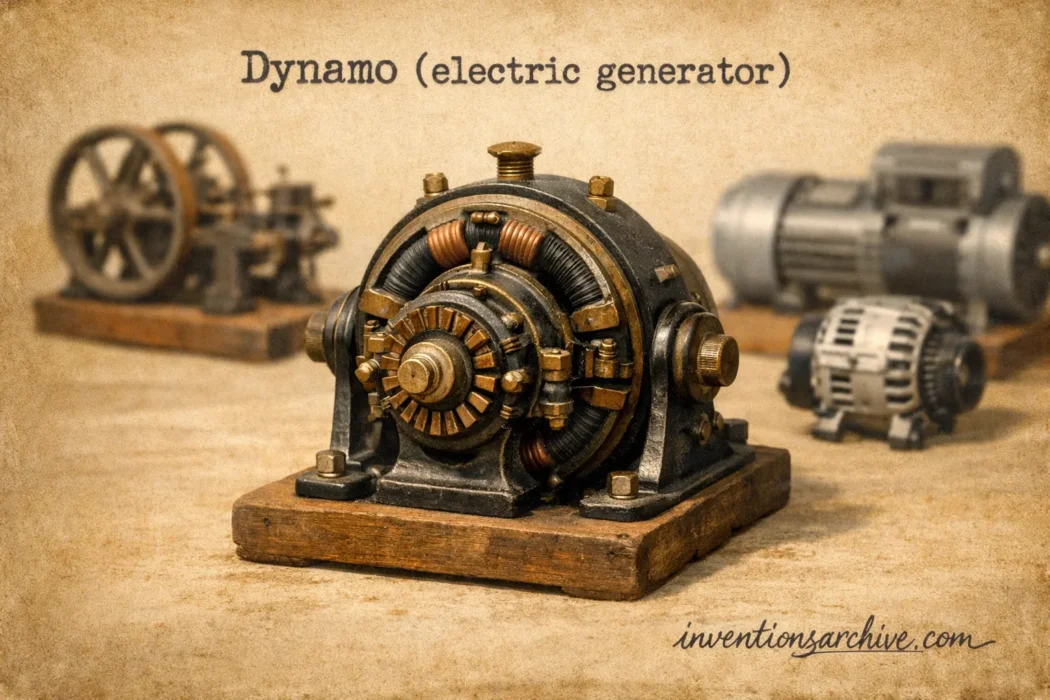
| Item | Information |
|---|---|
| Invention Name | Dynamo (electric generator) |
| Short Definition | A machine that turns mechanical motion into electrical energy; in strict historical use, a DC generator with a commutator. |
| Date / Period | 1831–1871 for the core development path; later adoption spread through the late 19th century. |
| Date Certainty | Mixed: exact milestone dates exist for several steps; broad industrial uptake was gradual. |
| Geography | United Kingdom, France, Italy, Germany; later worldwide. |
| Inventor / Source Culture | Michael Faraday, Hippolyte Pixii, Antonio Pacinotti, Werner von Siemens, Zénobe-Théophile Gramme; collective 19th-century electrical engineering. |
| Category | Electrical engineering, power generation, industrial machinery. |
| Why It Mattered |
|
| Need That Led to It | Batteries were limited for long, high-current work and costly at scale. |
| How It Works | Motion moves conductors through a magnetic field; a commutator turns the output into direct current. |
| Material / Technology Base | Copper wire, iron cores, permanent magnets or electromagnets, brushes, commutator, rotating shaft. |
| Early Uses | Laboratory work, electroplating, arc lighting, battery charging, early workshop power. |
| Spread Route | Britain and continental Europe to North America, then to public lighting systems and industry worldwide. |
| Developments It Opened | Central stations, electric motors, tramways, electrochemical production, later large-scale generators. |
| Impact Areas | Science, industry, transport, communications, urban lighting. |
| Debates / Different Views | The “first” depends on the meaning: first generator, first commutated dynamo, first self-excited machine, or first widely practical industrial design. |
| Precursors and Successors | Electrostatic machines, batteries, Faraday induction apparatus; later alternators, turbo-generators, automotive charging systems. |
| Main People and Traditions | Faraday, Pixii, Pacinotti, Siemens, Gramme, Brush, early electrical workshops, museum and university laboratory culture. |
| Varieties Shaped by Its Legacy | Homopolar generators, magnetos, ring-armature dynamos, series/shunt/compound DC dynamos, bicycle “dynamos,” modern alternators. |
Contents on This Page
Electricity had been observed, stored, and studied long before the dynamo matured, yet the real shift came when motion could feed a steady electrical output. That was the break. The dynamo turned spinning shafts, waterwheels, steam engines, and later turbines into usable current, and once that happened, electric light, electroplating, workshop motors, and urban power systems stopped looking like isolated experiments and started looking like infrastructure.
What the Dynamo Is
A dynamo is an electrical generator driven by motion. In strict historical use, the term points to a machine that produces direct current with a commutator. In casual use, people sometimes stretch the word to mean almost any small generator. That broad use is common, but it blurs an important difference.
Not every generator is a dynamo. A modern public-power machine is usually an alternator, which makes alternating current. A classic dynamo, by contrast, uses a commutator and brushes so the output leaves the machine as one-way current. That detail matters because it shaped the machine’s design, its maintenance needs, and its place in the history of power engineering.
Faraday’s 1831 apparatus and generator experiments opened the route from motion to current, and that route still defines electrical generation today (Details-1).
Before the Practical Dynamo
The dynamo did not appear all at once. It arrived in layers. First came the discovery that a changing magnetic condition could produce electricity. Then came machines that proved the idea. Only later did engineers smooth the output, strengthen the field, cut losses, and make the device useful for everyday work.
Michael Faraday’s work in 1831 showed the central rule: electromagnetic induction. Move a magnet relative to a conductor, or move a conductor through a magnetic field, and an electrical force appears. In 1832, Hippolyte Pixii applied that law in an early dynamo, and rising demand from telegraphs and arc lamps pushed generator design forward in the decades that followed (Details-2).
Those early machines proved the point, but they were still awkward. Output came in pulses. Magnets were limited. The machines could make electricity, yes, though not yet with the steadiness and scale industry wanted.
Why the Early Machines Were Limited
- Permanent magnets restricted field strength.
- Large air gaps wasted magnetic effect.
- Simple armatures produced rough, uneven current.
- Scaling output upward brought heat, friction, and contact problems.
How the Dynamo Became Practical
The history gets clearer when it is read as a chain of improvements instead of a single “who invented it” moment. That is where many short articles fall short. The machine that mattered in factories and city streets was the product of several linked advances.
Major Steps in the Dynamo’s Development
- 1831 — Faraday demonstrates generator principles and early apparatus.
- 1832 — Pixii builds an early commutated machine.
- 1860–1863 — Antonio Pacinotti develops the ring armature, a major move toward smoother direct current.
- 1866 — Werner von Siemens describes the dynamo-electric principle, allowing the machine to reinforce its own magnetic field.
- 1869 / 1871 — Gramme conceives and presents a machine that gives a steadier, more useful continuous-current output.
- 1870s — Dynamos spread into lighting systems, workshops, electrochemical processes, and transport experiments.
In 1866, Werner von Siemens described the dynamo-electric principle, which let the machine build its magnetic field through electromagnets rather than depend only on permanent magnets; Siemens also named electric lighting and drive technology as the first fields of application (Details-3).
Antonio Pacinotti’s ring armature deserves a firm place in that story. It was not a minor side note. It changed how the armature handled the magnetic field, fed the commutator more evenly, and moved the machine away from harsh pulses toward a smoother output. The Smithsonian’s historical notes connect Pacinotti’s ring armature directly to Gramme’s motors and generators, and also note that Charles F. Brush built his first dynamo in 1875 (Details-5).
Then came Gramme. His design, conceived in 1869 and shown in 1871, gave the dynamo a far steadier continuous-current output than earlier machines, and by 1873 its reversibility as a motor had been publicly demonstrated (Details-4).
That last point is easy to miss, but it is huge: the same machine family could sit on both sides of the energy exchange. Spin it, and it makes electricity. Feed it electricity, and it turns. Suddenly the generator and the motor were not strangers. They were close relatives.
How the Dynamo Works
Plainly put, a dynamo works because a conductor moving through a magnetic field experiences an induced electrical force. The machine arranges that motion in a controlled loop. A shaft turns. An armature rotates. Magnetic flux changes across windings. Current appears.
Yet there is a twist. The voltage induced in a rotating coil naturally changes direction every half turn. Left alone, that behavior gives alternating current. The commutator fixes the direction seen at the output terminals by reversing the connection at the right moment. So the outside circuit receives unidirectional current, even though the internal coil voltage keeps alternating. Clever bit of engineering, really.
As machines improved, engineers used many coils and many commutator segments. That made the output smoother. The more segments and the better the magnetic layout, the less the current looked like a rough pulse train and the more it behaved like a useful supply.
Main Parts of a Classic Dynamo
- Field system — permanent magnets or electromagnets that create the magnetic field.
- Armature — the rotating part with windings where voltage is induced.
- Commutator — segmented rotary switch that directs the output as direct current.
- Brushes — stationary contacts, often carbon, that collect current from the commutator.
- Shaft and prime mover — the mechanical input, supplied by hand, water, steam, belts, engines, or turbines.
Why the Commutator Changed Everything
Without a commutator, the machine is simply generating alternating voltage in its windings. With a commutator, the output becomes direct current. That one mechanical device placed the dynamo at the center of 19th-century DC systems, from electroplating shops to arc lighting plants. It also became the part that wore out fastest. Useful, yes. Gentle on maintenance teams, not always.
Main Dynamo Types and Related Machines
The dynamo family is not one single machine pattern. Once the principle was established, several forms appeared. Some remained historical curiosities. Others became standard industrial equipment.
Historical and Technical Variations
- Homopolar generator — associated with Faraday’s disc; simple in concept, low voltage, very high current in some forms.
- Permanent-magnet dynamo — earlier design; limited by magnet strength.
- Self-excited dynamo — uses its own output to energize the field; a major step toward stronger machines.
- Ring-armature dynamo — smoother output, tied to the Pacinotti–Gramme line.
- Series-wound dynamo — field winding in series with the load; output changes strongly with load.
- Shunt-wound dynamo — field winding in parallel with the load; better voltage behavior for many uses.
- Compound-wound dynamo — mixes series and shunt field effects to improve regulation.
- Bicycle “dynamo” — the name survived even when many small units produced AC internally and were not classic dynamos in the narrow sense.
That variety tells its own story. Engineers were not merely trying to make electricity. They were trying to make the right kind of electricity for lamps, plating baths, charging systems, rail vehicles, or workshop machines. Same family. Different jobs.
Where Dynamos Were First Used
Many short articles jump from “invented” straight to “modern generators.” That skips the part that shows why the dynamo mattered so much. Its early use cases were practical, sometimes narrow, and very revealing.
- Electroplating — steady current made metal finishing far more workable than battery-only supply.
- Arc lighting — bright illumination demanded stronger, steadier electrical sources.
- Battery charging — dynamos became charging machines in many systems.
- Laboratory and workshop power — dynamos moved electricity from benches into productive spaces.
- Early electric traction — once motors and generators matured together, rail and tram applications moved forward.
Telegraph systems had already shown the value of electricity, yet batteries were enough for many signal circuits. Large-scale lighting and electrochemical work were different. They needed more current, for longer periods, at lower operating cost. The dynamo met that need and, step by step, changed electricity from a specialty tool into a public utility.
Why the Dynamo Changed Industry
The dynamo mattered not because it was the first electrical machine of any kind, but because it made sustained electrical output economically workable. That changed the rhythm of work. A battery runs down. A dynamo keeps going as long as mechanical input remains available.
Factories gained a controllable power source for lighting and certain process loads. Cities could begin to think in terms of central stations. Electrochemistry moved into a more dependable age. Motor development sped up because generator and motor principles mirrored one another. And the social effect was plain to see: nighttime lighting improved, workshop layouts changed, and electrical engineering began to separate itself into a real industrial field rather than a scattered collection of clever demonstrations.
The dynamo also forced designers to wrestle with very concrete questions: efficiency, brush wear, commutator sparking, heat, magnetic saturation, field regulation, insulation, and transmission limits. Those are not side notes. They are the engineering problems that turned an interesting machine into a serious one.
Why Large Dynamos Gave Way to Alternators
For large public-power systems, the classic dynamo eventually lost ground to the alternator. The reason was not fashion. It was engineering sense.
- No commutator on the main output — less wear and less sparking in large machines.
- AC worked neatly with transformers — voltage could be raised for transmission and lowered for local use.
- Maintenance fell — fewer heavy brush-and-commutator problems at utility scale.
- Long-distance systems improved — AC transmission fit growing power networks better.
That shift did not erase the dynamo’s place. It simply marked a new branch in generator design. The older DC machine remained useful in charging systems, electrochemical plants, some traction roles, and reversible motor-generator arrangements. Even today, the old logic is easy to see: the alternator took over the large-grid job, while the dynamo remains the historical engine room where many ideas were first worked out in hard metal and moving contact.
Legacy in Modern Power Engineering
Modern generators still live by the same rule Faraday uncovered: changing magnetic flux induces voltage. That part has not changed. What changed are the materials, scale, cooling methods, magnetic design, insulation systems, and the decision to favor alternators for most large networks.
Look closely and the dynamo’s fingerprints are all over modern electrical practice. The link between generator and motor. The use of field excitation. The concern with armature reaction. The trade-off between output smoothness and machine complexity. The marriage of mechanical drive systems to electrical output. None of that appeared out of thin air. The dynamo era worked it through.
Even the language stayed behind. People still call many small chargers or bicycle units “dynamos.” Museums still display them as turning points in electrical history. And for good reason — this machine sits right in the middle of the move from experimental electricity to organized electrical power.
Common Questions about the Dynamo
Is a dynamo the same as an electric generator?
No. Dynamo is often used broadly, yet in the stricter historical sense it refers to a direct-current generator with a commutator. A generator can also be an alternator or another type of machine.
Who invented the dynamo?
There is no single neat answer. Faraday established the generating principle, Pixii built an early machine, Pacinotti improved the armature form, Siemens described self-excitation, and Gramme produced a highly usable industrial design. The dynamo emerged through linked advances.
Why was the Gramme machine so important?
It delivered a steadier continuous-current output than earlier machines and helped make electrical power more useful in real industrial settings. Its public demonstration as a reversible motor also strengthened the bond between generators and motors.
Why did alternators replace large dynamos in public power systems?
Alternators were better suited to transformer-based AC transmission and avoided the heavy commutator issues that limited large DC dynamos. That made large-scale power networks easier to build and maintain.
Are bicycle dynamos true dynamos?
The name survived, but many bicycle “dynamos” are not classic dynamos in the narrow technical sense. Many small units actually generate AC internally and may use rectification or lamp-compatible output arrangements.