
| Aspect | Details |
|---|---|
| Invention Name | Electric Light Bulb |
| Short Definition | An electric lamp that produces visible light, most famously through a heated filament sealed inside a glass bulb. |
| Approximate Date / Period | Early electric light experiments: early 1800s; practical household incandescent lamp: late 1870s to 1880 Mixed certainty |
| Date Certainty | Broad invention history: Approximate; Edison patent date: Exact; first-inventor claim: Disputed |
| Geography | Britain, United States, wider Europe |
| Inventor / Source Culture | Anonymous and collective early work; Humphry Davy; Joseph Swan; Thomas Edison and team; later material scientists and lamp engineers |
| Category | Lighting, electrical engineering, materials technology, domestic infrastructure |
| Why It Matters |
|
| Need Behind It | Safer, steadier, controllable indoor light without relying on open flame |
| How It Works | Electric current meets resistance; the light-producing element heats up and glows |
| Material / Technology Base | Glass bulb, filament, vacuum or inert gas, metal contacts, socket, electric supply |
| Early Use Areas | Laboratory demonstrations, streets, factories, public buildings, later homes and shops |
| Spread Route | Britain and the United States outward to Europe and then worldwide through power networks |
| Developments It Opened | Power stations, meters, switches, standardized sockets, better lamp manufacturing, later fluorescent and LED adoption |
| Areas of Impact | Homes, education, manufacturing, urban design, retail, medicine, transport, culture |
| Debates and Different Views | Who counts as the “inventor”; first electric light vs first practical incandescent lamp; patent priority vs public adoption |
| Precursors and Successors | Oil lamps, candles, gas light, arc light → carbon-filament bulb → tungsten bulb → halogen, fluorescent, CFL, LED |
| Notable Figures and Groups | Humphry Davy, Joseph Swan, Thomas Edison, Charles Batchelor, William Coolidge, Irving Langmuir, lamp makers and glassworkers |
| Forms Shaped by This Invention | Carbon-filament lamps, tungsten incandescent bulbs, halogen bulbs, decorative Edison-style lamps, miniature and appliance lamps |
Inside This Article
Electric light did not appear as one finished object. It grew step by step. Early experimenters proved that electricity could make a material glow; later inventors improved the filament, the glass envelope, the vacuum, the metal base, and the supply system behind the wall. By the time the household bulb became normal, it was already more than a lamp. It was part of a whole electrical environment.
What the Electric Light Bulb Is
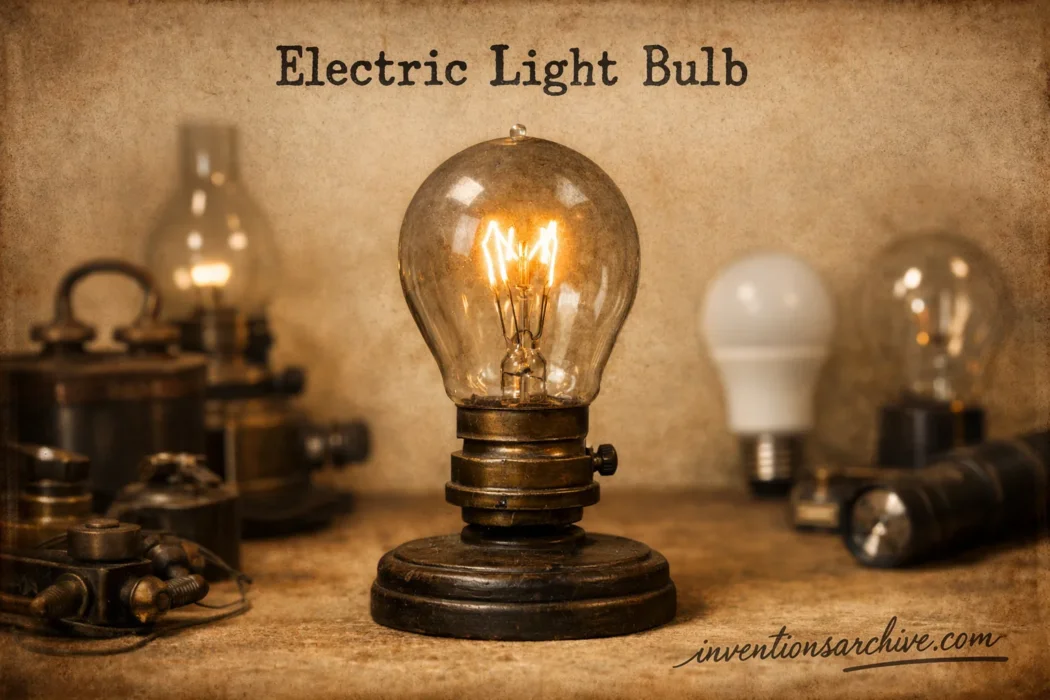
The phrase electric light bulb usually points to the classic incandescent lamp: a sealed glass bulb with a thin light-producing element inside. When electric current passes through that element, resistance turns part of the energy into heat, and the heated element glows.
That sounds simple. In practice, it took hard material choices, careful glasswork, better vacuum methods, and reliable connections. A bulb that glows for a moment is one thing; a bulb that lasts, fits a socket, and can be used day after day is something else entirely.
Why It Was Not One Person’s Invention
No single name can honestly cover the whole story. The U.S. Department of Energy notes that the light bulb came from a series of improvements, not one isolated breakthrough (Details-1).
Joseph Swan matters because he produced a successful incandescent filament lamp in Britain and, in 1881, opened what North East Museums describes as the world’s first lightbulb factory. Swan’s work also helped move electric light from experiment to manufacturing (Details-2).
Thomas Edison is tied so closely to the bulb because he and his team turned the incandescent lamp into a commercially viable product and refined the high-resistance design that worked well with centralized power distribution. Smithsonian’s National Museum of American History points to that practical leap, not merely to the idea of electric light itself (Details-3).
The patent story is often flattened too much. The U.S. National Archives states it plainly: Edison’s 1880 patent was for an improvement in electric lamps, not for the first electric lamp ever conceived (Details-4).
So who “invented” the electric light bulb? The most accurate answer is a little untidy — and that is exactly why it is the right answer. Electric light was a cumulative invention.
Early Experiments and the Road to a Practical Lamp
Before the familiar household bulb, electric light first appeared in forms too bright, too costly, or too fragile for ordinary rooms. Arc lighting showed that electricity could create visible light. It did not solve the domestic problem.
- Early 1800s: experimenters showed that electric current could produce bright light, though the results were not yet fit for normal household use.
- Mid-1800s: inventors tested platinum, carbon, different glass forms, and different ways to reduce oxygen inside the bulb.
- Late 1870s to 1880: work by Swan, Edison, and their circles pushed incandescent lamps toward longer life and wider use.
- Early 1900s: tungsten filaments and better bulb atmospheres made lamps brighter, more durable, and more economical.
- Later decades: halogen lamps refined the incandescent family, while fluorescent lamps and LEDs followed the same goal — useful electric light with better efficiency.
A detail many short histories miss: even famous dates are not always as clean as they look in popular retellings. The National Park Service notes that some widely repeated claims about Edison’s October 1879 test date do not hold up under newer research, which is a useful reminder that invention history rarely fits a neat one-line slogan (Details-5).
How an Incandescent Bulb Produces Light
An incandescent bulb works by heating a filament until it glows. Current enters through the metal contacts, passes into the filament, and meets enough resistance to create intense heat. That heat makes the filament shine.
The rest of the bulb exists to protect that tiny glowing part. The glass shell isolates it. A vacuum or inert gas slows chemical damage. The support wires hold the filament in place. The base lets the bulb connect to a socket again and again, without much fuss.
- Filament: the light-producing element
- Glass Envelope: the sealed outer shell
- Vacuum or Gas Fill: helps the filament last longer
- Lead Wires and Base: carry current into the lamp
- Socket Connection: makes the bulb replaceable, not fixed in place
That, really, is the point. The bulb is tiny; the engineering challenge around it was not.
The System That Made Electric Light Useful
People often talk as if the bulb alone changed indoor lighting. Not quite. A lasting change came when the bulb was joined to a usable electrical system — generators, wiring, switches, sockets, meters, and methods for making large numbers of lamps that behaved in a predictable way.
- Power Generation brought current to the lamp.
- Wiring Networks carried that current safely through buildings.
- Switches made light controllable in daily use.
- Meters made electric service measurable and billable.
- Standard Bases and Sockets made replacement practical.
- Glassblowing and Filament Production made scale possible.
This system view explains why Edison remains central in popular memory. He worked on the lamp, yes, but also on the surrounding infrastructure of use. That broader view is closer to how electric light actually entered homes and businesses.
Main Types and Variations
Carbon-Filament Bulbs
These belong to the earlier practical phase of incandescent lighting. The filament was made from carbonized material. They were a huge step forward for their time, though later designs would outlast them and produce better light per unit of electricity.
Related articles: Electric light arc lamp [Industrial Age Inventions Series], Thermometer [Renaissance Inventions Series]
Tungsten-Filament Bulbs
Tungsten changed the game because it tolerated very high temperatures better than earlier filament materials. That meant stronger light output and longer service life. Once tungsten became workable in lamp manufacture, the incandescent bulb entered a more mature phase.
Gas-Filled and Coiled-Filament Bulbs
Later incandescent lamps improved the interior atmosphere and filament geometry. Filling the bulb with an inert gas and refining the filament shape helped slow wear and boost efficiency. Small changes, yes — but useful ones.
Halogen Bulbs
Halogen lamps belong to the incandescent family. They run hotter, keep a compact design, and became common where a bright, focused beam mattered. They are not a separate origin story; they are an evolved branch of the same basic light-making method.
Decorative Edison-Style Bulbs
These are mostly a modern design revival. Their visible filaments and warm glow reference early lamp forms, even when the internal technology is newer. The look is historical; the manufacturing often is not.
Later Electric Light Families
Fluorescent lamps, compact fluorescents, and LEDs sit further down the same long lighting story. They do not use a glowing filament in the same way, yet they inherit the same ambition: controllable, practical, indoor electric light with better efficiency and longer life.
Materials and Design Changes That Shaped the Bulb
For all the fame of the bulb, its history is also a materials story. The lamp improved when engineers solved one stubborn problem after another: what should the filament be made of, how should the air be removed or replaced, how can the glass stay sound, how should the base connect, how can the bulb be made in large numbers without wild variation?
- Carbon made early practical incandescent lamps possible.
- Tungsten allowed hotter operation and better durability.
- Inert Gas Fills helped protect the filament.
- Improved Vacuum Methods reduced unwanted reactions inside the bulb.
- Standardized Bases turned lamps into replaceable consumer goods.
- Mass Production lowered cost and widened adoption.
Seen this way, the electric light bulb belongs as much to materials science and industrial production as it does to pure invention. That broader angle often goes missing from short articles. It should not.
How Electric Light Changed Homes, Work, and Cities
The bulb changed more than visibility. It changed routines. Shops stayed usable after sunset. Factories and offices gained steadier indoor illumination. Schools, libraries, stations, theaters, and homes could shape space around electric light instead of around flame.
- Homes: cleaner and more controllable evening light
- Workplaces: longer usable indoor hours and more even illumination
- Cities: new patterns in streets, commerce, and public interiors
- Architecture: rooms no longer depended on daylight alone
- Consumer Culture: lighting became a replaceable household product
- Technology Chains: electric lighting helped normalize wider electrification
And there is another effect, quieter but lasting. The bulb helped train the public to trust the home electric network itself. Once lighting entered daily life, other electric devices had a smoother path into the same rooms.
Questions Readers Often Ask
Who invented the electric light bulb?
No single person covers the entire invention story. Early electric light grew through multiple stages, while Joseph Swan, Thomas Edison, and others helped turn incandescent lighting into practical use.
Why is Thomas Edison so strongly linked to the light bulb?
Edison is linked to the bulb because he and his team helped create a practical, market-ready incandescent lamp and built the wider system needed to use it at scale.
What made tungsten so important?
Tungsten could operate at high temperatures more effectively than earlier filament materials, which helped lamps last longer and shine more strongly.
Is an LED bulb the same thing as an incandescent bulb?
No. Both are electric lamps, but they produce light through different methods. Incandescent bulbs use a heated filament, while LEDs use semiconductor-based light emission.
Was the electric light bulb useful on its own?
Not fully. A useful lighting era required generators, switches, sockets, wiring, meters, manufacturing skill, and a stable power supply alongside the bulb itself.