
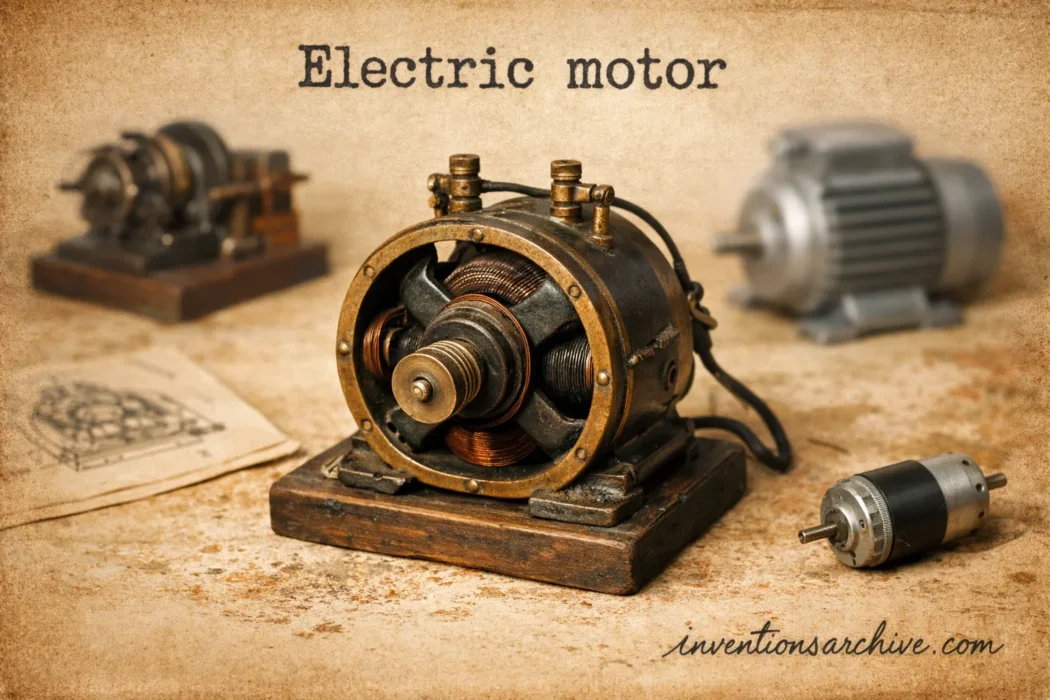
| Invention Name | Electric Motor |
|---|---|
| Short Definition | A machine that converts electrical energy into mechanical motion through electromagnetic forces. |
| Approximate Date or Period | Experimental electromagnetic rotation: 1821; practical rotary motors: 1830s; modern AC induction development: 1880s |
| Geography | Britain, continental Europe, Russia, and the United States |
| Inventor or Source Culture | No single inventor; associated with Michael Faraday, Moritz Jacobi, Thomas Davenport, Galileo Ferraris, Nikola Tesla, and other electrical experimenters |
| Category | Electrical engineering; electromechanical machinery |
| Importance | Made electricity a practical source of rotary mechanical power for machinery, transportation, appliances, automation, and industry |
| Evidence Status | Well documented, with attribution divided by developmental stage |
| Main Problem Solved | Conversion of electrical energy into controlled mechanical rotation |
| Development Path | Electromagnetism → electromagnetic rotation → commutated rotary motors → practical DC motors → rotating magnetic fields → AC induction and synchronous motors → electronically controlled motors |
| Core Technical Basis | Interaction between magnetic fields and electric currents produces torque on a moving rotor |
| Main Structural Elements | Stator, rotor, shaft, magnetic field system, windings or permanent magnets, and bearings; some designs also use brushes and a commutator |
| Modern Descendants | Induction motors, synchronous motors, brushed DC motors, brushless DC motors, permanent-magnet motors, servo motors, and traction motors |
Why the Electric Motor Has No Single Invention Date
The history of the electric motor does not begin with a finished machine appearing in one inventor’s workshop. Several different technical problems had to be solved first. Scientists needed to establish the relationship between electricity and magnetism, find a way to turn electromagnetic force into continuous movement, construct machines capable of useful mechanical work, and finally develop electrical supply systems that could operate motors economically.
For this reason, claims that one person simply “invented the electric motor” can hide much of its actual development. Michael Faraday’s electromagnetic rotation experiment of 1821 is widely treated as the first continuous conversion of electrical energy into mechanical motion. More practical rotating machines appeared during the 1830s. Later in the century, work by Galileo Ferraris, Nikola Tesla, Westinghouse engineers, and others established the alternating-current motor systems that became central to industrial power.
Electromagnetism Made Electrical Motion Possible
The immediate scientific background came from Hans Christian Ørsted’s discovery in 1820 that an electric current could influence a magnetic needle. The observation showed that electricity and magnetism were directly connected rather than completely separate phenomena. André-Marie Ampère and other researchers rapidly investigated the geometry and forces associated with electric currents and magnetic fields.
Michael Faraday explored the implications at the Royal Institution in London. On 3 September 1821, he obtained continuous electromagnetic rotation: a current-carrying conductor moved around a magnet. The Royal Institution describes the experiment as the first production of continuous mechanical movement from electricity.[a]
Faraday’s apparatus was far removed from a modern industrial motor. Its purpose was experimental rather than commercial, and it used a liquid electrical contact involving mercury. Yet its underlying importance was unmistakable. Electricity was no longer merely producing a brief attraction, deflection, or reciprocating movement. It could maintain continuous rotary motion.
An original apparatus made by Faraday in 1822 survives in the Royal Institution collection. The institution identifies it as the first surviving electric motor. It consists of materials including glass, wood, copper, iron, wax, and mercury and preserves the physical form of Faraday’s early rotation experiments.[b]
From Laboratory Rotation to Useful Rotary Machinery
Faraday had demonstrated a principle, but an economically useful motor required much more. Early nineteenth-century developers experimented with electromagnets arranged around rotating wheels, reciprocating magnetic mechanisms, switching contacts, and different methods of reversing current. These machines were often limited by weak electromagnets, inefficient batteries, poor electrical contacts, and the absence of a large electricity-distribution network.
Moritz Hermann Jacobi produced one of the important advances. Working in Königsberg, then part of Prussia, he completed a rotary electromagnetic motor in May 1834. Karlsruhe Institute of Technology describes Jacobi’s machine as the first genuinely useful rotating electric motor and records a mechanical output of about 15 watts for the 1834 version.[c]
A later Smithsonian reconstruction of Jacobi’s 1834 design shows how much the machine had progressed beyond Faraday’s experimental apparatus. It used fixed and rotating electromagnets. A commutator mounted on the shaft reversed electrical polarity as the rotor passed the stationary magnets, allowing attraction and repulsion to continue producing rotation.[d]
Jacobi continued improving his machines. In 1838 he demonstrated a much stronger motor capable of propelling a boat carrying passengers. Experiments of this kind proved that electromagnetic motors could perform recognizable mechanical work, although battery power remained too expensive for broad industrial adoption.
Thomas Davenport and the First U.S. Electric-Motor Patent
At roughly the same period, American blacksmith Thomas Davenport was developing electromagnetic rotary machines in Vermont. His work eventually produced an important patent milestone.
On 25 February 1837, Davenport received U.S. Patent No. 132 for an electric motor. The Smithsonian National Museum of American History identifies it as the first United States patent issued for an electric motor. The surviving museum object is a replacement patent model made because Davenport’s original model was destroyed in the U.S. Patent Office fire of 1836.[e]
Davenport’s model used rotating electromagnets within a ring of permanent steel magnets. It showed that electromagnetic rotation could be treated as a machinery technology rather than solely as a laboratory effect.
The patent should not be interpreted as the date on which the electric motor itself suddenly appeared. Faraday’s continuous rotation preceded it by sixteen years, and several experimenters were producing electromagnetic machinery during the 1830s. Davenport’s importance lies partly in the transition toward patented machinery intended to apply electromagnetic power to mechanical work.
The Commutator Solved a Fundamental DC Motor Problem
A simple magnetic rotor tends to turn only until its magnetic orientation reaches an equilibrium position. Continuous rotation requires the direction or location of the magnetic force to change as the rotor turns.
In many traditional direct-current motors, this task is performed mechanically by a commutator. Conductive segments mounted on the rotor shaft make contact with stationary brushes. As the shaft rotates, the electrical connections switch so that current through the armature windings changes at the appropriate point. The resulting magnetic polarity continues to produce torque in the same rotational direction.
This arrangement became one of the defining features of conventional brushed DC motors. The stationary portion of a motor is called the stator, while the moving component is the rotor. The rotor is connected to the output shaft, allowing electromagnetic torque to perform external mechanical work. Oregon State University’s motor engineering materials describe motor torque as resulting from interaction between magnetic fields associated with the stator and rotor.[f]
Commutators made practical DC rotation possible, but they introduced sliding electrical contacts. Brushes and commutator surfaces wear during service, produce friction, and can require maintenance. The later development of AC induction motors offered a way to build major classes of motors without a mechanical commutator on the rotor.
Why Early Motors Did Not Immediately Replace Steam Power
The existence of a working motor did not mean that electricity was ready to become an industrial power source. During the 1830s, electrical machines generally depended on chemical batteries. Producing large amounts of continuous electrical energy this way was costly.
Factories already had established mechanical power systems based on water wheels and steam engines. A practical electrical alternative needed generators, conductors, switching equipment, reliable insulation, economical distribution, and motors that could operate for long periods under load.
The motor therefore developed together with the broader electrical system. Improvements in generators during the nineteenth century made mechanical generation of electricity practical. Once central generating stations and distribution networks appeared, motors could draw power from an electrical supply rather than relying on individual chemical cells.
This changed their economic role. An electric motor could be installed close to the machine that actually needed mechanical power. Eventually, factories no longer had to distribute all mechanical energy through long line shafts, pulleys, and belts driven from a central engine.
Rotating Magnetic Fields Changed AC Motor Design
The emergence of alternating-current power created another problem. Engineers needed motors that could make effective use of AC electricity while remaining mechanically simple.
Italian physicist and engineer Galileo Ferraris developed the principle of the rotating magnetic field during the 1880s. Historical records associated with Turin document an experimental rotating-field motor in 1885. Ferraris used alternating currents displaced in phase to produce a magnetic field whose direction rotated through space rather than merely increasing and decreasing along one fixed axis.[g]
This principle is central to the induction motor. A suitably arranged set of AC stator windings creates a rotating magnetic field. That changing field induces electrical currents in the rotor. The magnetic field produced by those rotor currents interacts with the stator field and develops torque.
Because rotor current is induced electromagnetically, the common induction motor can operate without delivering current to the rotor through a commutator and brushes. This gave AC motors a path toward mechanically durable designs well suited to continuous industrial service.
Tesla’s Polyphase Motor System
Nikola Tesla independently developed polyphase alternating-current motor and power-transmission systems in the United States. His patent filings turned the rotating-field principle into a broader system for electrical power conversion and transmission.
U.S. Patent No. 381,968, filed on 12 October 1887 and issued on 1 May 1888, describes an electromagnetic motor using multiple alternating-current circuits arranged so that magnetic poles progressively shift around the motor. Tesla explicitly connected the motor problem with efficient electrical transmission and the need for simpler, more reliable machinery.[h]
Related articles: Nikola Tesla Inventions: What Did Tesla Actually Invent?, Chainsaw Invention: Who Invented the Chainsaw and Why? [Industrial Age Inventions Series]
The histories of Ferraris and Tesla are therefore best understood by distinguishing experimental demonstration, publication, patent filing, engineering design, and commercialization rather than forcing all of them into one “first inventor” claim. Ferraris demonstrated rotating-field experiments in Italy during the 1880s, while Tesla developed and patented a polyphase AC motor system in the United States.
Westinghouse Turned the AC Motor into Commercial Machinery
Patentable principles still had to become manufacturable equipment. Engineers working for George Westinghouse refined Tesla’s designs and built early commercial alternating-current induction motors.
The Smithsonian preserves a Westinghouse two-phase induction motor made in 1888. Its collection record describes a motor based on Tesla’s rotating magnetic field concept, operating without a commutator or contact brushes. Two sets of field windings received alternating currents displaced in phase, creating the changing magnetic conditions needed for rotation.[i]
This development connected the motor directly with the expanding AC power system. Generators could produce alternating current, transformers could change voltage for transmission and distribution, and AC motors could convert delivered electrical energy back into mechanical power.
| Period | Development | What Changed |
|---|---|---|
| 1820 | Ørsted demonstrates the magnetic effect of electric current | Establishes an experimental link between electricity and magnetism |
| 1821 | Faraday produces continuous electromagnetic rotation | Electrical energy produces sustained mechanical motion |
| 1834 | Jacobi completes a useful rotary electromagnetic motor | Motor output becomes capable of practical mechanical work |
| 1837 | Davenport receives U.S. Patent No. 132 | Electric-motor technology enters the U.S. patent record |
| 1885 | Ferraris demonstrates rotating magnetic-field experiments | Establishes the physical basis for major forms of AC induction motor |
| 1887–1888 | Tesla files and receives patents covering polyphase electromagnetic motors | Rotating magnetic fields become part of an integrated AC power system |
| 1888 onward | Westinghouse engineers refine and commercialize AC motors | Induction motors become practical components of electrical power networks |
How a Modern Electric Motor Produces Torque
Although electric motors now exist in many forms, most depend on controlled interaction between magnetic fields. Electrical current passing through windings can create an electromagnet. Permanent magnets can supply another magnetic field, or additional windings can produce it electrically. By arranging these fields so their relative orientation continually changes, the machine develops a turning force on the rotor.
The stator is the stationary part of the motor. Depending on the design, it can contain copper windings, magnetic steel, permanent magnets, or combinations of these components. The rotor turns inside or around the stator and is mechanically connected to the shaft.
The narrow space separating rotor and stator is the air gap. Motor designers try to control magnetic flux across this gap while limiting electrical resistance, magnetic losses, mechanical friction, vibration, and heat.
The U.S. Department of Energy describes electric-drive motors in the same basic structural terms: a moving rotor and stationary stator convert stored electrical energy into mechanical energy. Permanent-magnet traction motors place magnets on or within the rotor while current-carrying stator windings create the controllable electromagnetic field.[j]
DC, Induction, Synchronous, and Brushless Motors
The term electric motor covers a family of machines rather than one fixed mechanism.
Brushed DC Motors
A conventional brushed DC motor uses a mechanical commutator and brushes to switch current as the rotor turns. These motors offer straightforward speed and torque control, but their sliding contacts introduce wear.
Induction Motors
An induction motor generally creates a rotating magnetic field in the stator and induces currents in the rotor. The rotor must normally turn slightly slower than the stator’s rotating field for induction to continue producing torque. The speed difference is known as slip.
This mechanically simple principle became especially important in industrial equipment. Three-phase squirrel-cage induction motors can operate without brushes, commutators, or electrical connections to the moving rotor.
Synchronous Motors
In a synchronous motor, the rotor follows the rotating stator field at a speed directly associated with the electrical supply frequency and number of magnetic poles. Modern permanent-magnet synchronous motors are widely used where high efficiency, controllable torque, and compact dimensions are desirable.
Brushless Electronically Commutated Motors
Brushless DC and related permanent-magnet motors replace the mechanical commutator with electronic switching. Power electronics energize stator windings in a controlled sequence, creating a moving magnetic field that pulls the permanent-magnet rotor around with it.
This arrangement transfers the switching function from wearing mechanical contacts to electronic circuitry. It has become common in computer cooling fans, appliances, pumps, industrial automation, drones, machine tools, and electric vehicles.
Power Electronics Changed What Motors Could Do
For much of motor history, available speed was closely tied to the electrical supply and the physical construction of the machine. Modern semiconductor power electronics changed that relationship.
A variable-frequency drive can supply an AC motor with electricity whose frequency and voltage are adjusted electronically. Motor speed can therefore be controlled without relying entirely on mechanical throttles, belts, gear changes, or fixed-frequency operation.
Electronic drives also made high-performance brushless motors practical. Controllers can coordinate current with rotor position, regulate torque, reverse direction, manage acceleration, and recover mechanical energy in systems designed for regenerative operation.
The motor consequently became part of a larger electronic drive system containing sensors, switching semiconductors, control software, and power-conversion hardware. The nineteenth-century electromagnetic principle remains, but the timing and magnitude of the magnetic fields can now be controlled with far greater precision.
Why Electric Motors Spread Into Nearly Every Machine Category
Electric motors can be manufactured across an enormous scale range. Very small motors move optical mechanisms, medical instruments, cooling fans, and precision actuators. Larger machines drive compressors, pumps, conveyors, elevators, machine tools, ventilation systems, railway equipment, and industrial processing lines.
Their usefulness comes partly from the direct relationship between electricity and controllable rotary motion. Electric power can be routed through wires to an individual machine, while the motor can start, stop, reverse, and change output without transmitting mechanical energy across an entire building through shafts and belts.
Electrification therefore altered factory architecture as well as machinery. Instead of organizing every workstation around a central mechanical drive shaft, manufacturers could eventually place separate motors close to individual machines. Production layouts became less dependent on the geometry of a central engine and its mechanical transmission system.
The same principle moved into domestic equipment. Refrigerators, washing machines, vacuum cleaners, fans, air conditioners, power tools, kitchen appliances, disk drives, and countless automated mechanisms depend on electric motors. In transportation, traction motors now convert electrical energy directly into wheel-driving torque in electric trains and road vehicles.
What Survives From the Earliest Motor Experiments
The documentary and museum record makes it possible to distinguish original objects from later reconstructions. The Royal Institution preserves Faraday’s 1822 electromagnetic rotation apparatus, an original instrument made shortly after his 1821 discovery.[b]
Jacobi’s original 1834 motor no longer survives. Museum and university collections instead preserve reconstructions based on historical descriptions and drawings. The Smithsonian’s Jacobi model, for example, was manufactured in 1903 from nineteenth-century documentation and should not be mistaken for Jacobi’s original machine.[d]
Davenport’s surviving patent model also requires qualification. The Smithsonian records it as a replacement for the original model lost in the Patent Office fire and notes that Davenport may have incorporated later improvements into the replacement.[e]
By contrast, surviving Westinghouse induction motors from 1888 preserve physical evidence from the period when polyphase AC motors were moving from experimental and patent work into commercial engineering. Together, these objects show that the electric motor was not one unchanged invention. It was repeatedly redesigned as electrical science, power generation, magnetic materials, insulation, manufacturing, and control technology improved.
Sources and Verification
- [a] The birth of electric motion — Royal Institution account of Faraday’s 1821 electromagnetic rotation experiment and its connection with Ørsted’s discovery.
- [b] Michael Faraday’s electric magnetic rotation apparatus (motor) — Royal Institution collection record for Faraday’s surviving 1822 apparatus, including its date, materials, and operating context.
- [c] The invention of the electric motor 1800-1854 — Karlsruhe Institute of Technology history documenting Jacobi’s 1834 rotating motor and the broader early development of electromagnetic motors.
- [d] Model of Jacobi direct current motor of 1834 — National Museum of American History collection record describing the reconstructed Jacobi motor, its stator, rotor, electromagnets, and commutator.
- [e] Davenport electric motor, US patent #132 — Smithsonian collection record verifying Davenport’s 25 February 1837 patent, its status as the first U.S. electric-motor patent, and the replacement patent model.
- [f] Motor Fundamentals — Oregon State University engineering resource describing stator, rotor, magnetic-field interaction, torque, and electromechanical energy conversion.
- [g] Galileo Ferraris (Livorno Ferraris, Vercelli, 1847 – Torino, 1897) — MuseoTorino record documenting Ferraris’s rotating magnetic-field work and his 1885 experimental motor.
- [h] US381968A – Electro-magnetic motor — Historical patent record for Nikola Tesla’s polyphase electromagnetic motor, filed in 1887 and issued on 1 May 1888.
- [i] Electric Motor for Alternating Current — National Museum of American History collection record describing an 1888 Westinghouse two-phase induction motor based on Tesla’s rotating-field system.
- [j] Electric Motors Research and Development — U.S. Department of Energy overview of rotor-and-stator motor construction and permanent-magnet electric-drive systems.