
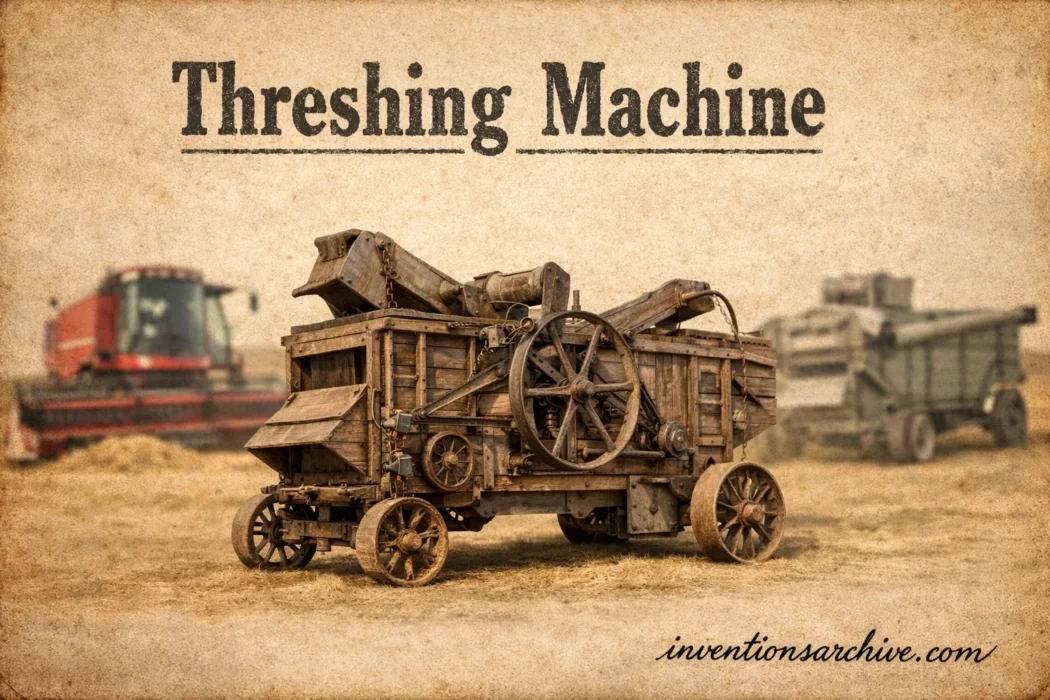
| Topic | Details |
|---|---|
| Invention Name | Threshing machine |
| Short Definition | A farm machine that separates grain from harvested stalks and seed heads. |
| Approximate Date / Period | 1699–1700 for an early documented experimental design; 1786 for the first successful machine most commonly credited to Andrew Meikle — first-ever claim remains debated. |
| Geography | German states for early experiments; Scotland for the best-known practical breakthrough; later spread through Britain, Europe, North America, and beyond. |
| Inventor / Source Culture | Andrew Meikle is most often credited; earlier work is linked to Jobst Heinrich Voigt and Gottfried Wilhelm Leibniz; later improvements came from many builders and farm engineers. |
| Category | Agricultural machinery; post-harvest grain processing. |
| Why It Mattered | Cut post-harvest labor Raised grain-handling speed Opened the path to the combine harvester |
| Need It Answered | Manual flail threshing was slow, tiring, and seasonal. |
| How It Works | Crop enters a rotating drum or cylinder; grain loosens from heads; concaves, sieves, walkers, and air flow separate grain from straw and lighter material. |
| Material / Technology Base | Wood and iron at first; later steel, belts, gears, horse gears, boilers, engines, and PTO systems. |
| Early Main Use | Wheat and other cereal grains after cutting and drying. |
| Spread Route | Scotland → Britain → Europe and North America → global grain mechanization. |
| Later Developments | Horse-powered threshers Portable steam outfits Stationary multi-crop threshers Combine harvesters |
| Impact Areas | Agriculture, grain trade, labor organization, machine design, rural industry |
| Debates / Different Views | Who was first is not perfectly settled; the stronger claim is usually first successful practical machine, not first idea ever recorded. |
| Predecessors and Successors | Flail, animal treading, simple rotary attempts → drum threshers, thresher-winnowers, steam threshers, combines. |
| Associated People and Cultures | Andrew Meikle, Jobst Heinrich Voigt, Gottfried Wilhelm Leibniz, Hiram A. Pitts, John A. Pitts, and many British and North American machine builders. |
| Varieties Influenced by This Invention | Drum threshers, spike-tooth and peg-tooth threshers, stationary multi-crop threshers, rice threshers, combine harvesters. |
Inside This Article
For centuries, the slow part of grain farming came after the crop was cut. The stalks still held the kernels, and that meant long hours with a flail, repeated handling, dust, noise, and plain old fatigue. The threshing machine changed that bottleneck. It did not make agriculture simple — farms never are — but it turned one of the hardest post-harvest jobs into a mechanical process that could be scaled, refined, and eventually folded into the combine harvester.
What a Threshing Machine Does
A threshing machine separates grain from the cut plant. In plain terms, it takes harvested cereal crops and breaks the bond between the kernels and the heads or husks. That sounds narrow. It is not. This single step sits right in the middle of grain handling.
The old hand method relied on repeated blows. A machine replaced those blows with controlled motion: rollers, drums, teeth, bars, screens, and air. Early models focused on the threshing action itself. Later machines handled more than that, adding shaking, fanning, and better cleaning so the grain came out in a more market-ready state. That shift matters, because the threshing machine was not just one object. It became a family of machines.
- Threshing loosens grain from the harvested plant.
- Cleaning removes lighter material and broken plant fragments.
- Separation improves as screens, fans, and return systems become more refined.
Early Experiments and First Practical Design
The history does not begin with one neat moment. It rarely does. An early documented experimental threshing machine was developed and improved by Jobst Heinrich Voigt and Gottfried Wilhelm Leibniz in 1699–1700, which shows that engineers were already trying to convert manual grain work into rotary mechanical action. (Details-1)
The machine most often treated as the first successful practical thresher, though, is Andrew Meikle’s design in Scotland from 1786. Meikle’s machine fed sheaves through fluted rollers into a rotating drum that beat the grain against a curved surface called the concave. That basic logic stayed alive long after the original machine itself changed form. (Details-2)
Once that working arrangement proved itself, builders improved it bit by bit — power transmission, feed systems, portability, cleaning, and output handling. In the United States, the Pitts “Ground Hog,” patented in 1837, marked a notable step because it combined threshing and fanning in one machine. (Details-3)
So the line runs like this: early experiments, then a workable late-18th-century machine, then a long 19th century of refinement. Faster feed. Better separation. More portable power. And, little by little, the stand-alone thresher became part of a larger harvesting system.
How the Machine Works
The basic action is mechanical and direct. The crop enters a threshing space. A rotating element strikes, rubs, or combs the seed heads. The kernels break free. Then gravity, vibration, and air do more sorting. Not every model uses the same arrangement, but the logic stays familiar.
- Feed stage: Cut crop enters by hand feed, belt feed, pickup, or header.
- Threshing stage: A drum or cylinder works against a concave to detach grain.
- Straw handling: Straw moves to walkers, shakers, conveyors, or outflow racks.
- Cleaning stage: Screens and sieves sort material by size and weight.
- Air separation: A fan pushes off lighter chaff while heavier grain drops and collects.
- Return path: Some machines send unthreshed material back for another pass.
That is why the threshing machine sits at an interesting point in mechanical history. It is not just a beater. It is a coordinated separator. The better the coordination between cylinder speed, concave clearance, airflow, and screens, the cleaner the output and the lower the grain loss. Modern combine descriptions still use those same ideas — cylinder, concave, walkers, screens, fan, return. (Details-4)
Simple in principle, yes. In practice, it is a balancing act. Too gentle, and grain stays in the head. Too harsh, and kernels crack while straw shatters into extra trash.
Main Parts and Power Sources
As the machine evolved, its power source changed just as much as its internal parts. Early threshers could be worked by horse power, water, or hand-fed motion systems. Later versions used portable steam engines, then internal-combustion engines, tractor PTO systems, and finally self-propelled combine powertrains.
- Feed table or intake: Brings the crop into the machine.
- Rollers: Guide material toward the threshing unit in some designs.
- Cylinder or drum: The main working element that loosens grain.
- Concave: A curved opposing surface under or around the cylinder.
- Walkers or shakers: Move straw while letting leftover grain fall out.
- Sieves and screens: Sort by size and help clean the sample.
- Fan: Blows away lighter chaff and dust.
- Bagging platform, auger, or grain bin: Collects cleaned grain.
Seen together, these parts explain why the threshing machine mattered so much to later farm engineering. It brought motion control, material handling, and crop separation into one working chain. That chain later got longer and smarter, but its bones were already there.
Types and Variations
There is no single “standard” threshing machine that covers all crops, regions, and periods. Builders changed the machine according to crop type, farm scale, available power, and local field conditions. Formal classifications still sort threshers by feeding method, crop flow inside the machine, and the type of threshing element used. (Details-5)
Drum and Cylinder Threshers
These are the line most people picture first. Crop enters a drum-and-concave system, kernels break free, and straw continues onward. They became the basic pattern for many later machines.
Horse-Powered and Water-Powered Machines
These belong to the early age of practical threshing. The threshing unit itself did the separation, while power came from outside the machine — horses walking a power gear, or water turning a connected system. They made threshing faster, though still tied to setup time and local conditions.
Related articles: Mechanical reaper [Industrial Age Inventions Series]
Portable Steam Threshers
By the 19th century, portable steam power changed the scale of operation. A farm no longer needed only a small fixed machine. A steam outfit could move from place to place, work larger volumes, and serve whole threshing crews. The rhythm of harvest changed with it — louder, faster, more organized.
Stationary Multi-Crop Threshers
These remain useful where farms handle different grains, pulses, or seed crops in smaller batches. The machine stays in one place, and the cut crop is brought to it. That makes sense for many small operations and for settings where field combines are not the best fit.
Rice and Regional Thresher Lines
Rice threshers, treadle threshers, axial-flow machines, and peg-tooth arrangements show how the invention adapted outside the classic wheat-and-barley story. Same family, different habits. Crop structure matters. Moisture matters too. Terrace fields, small plots, and hand-cut bundles often pushed builders toward lighter, narrower, more portable designs.
Combine Harvesters
The combine did not erase the threshing machine’s logic. It absorbed it. Cutting, feeding, threshing, separating, cleaning, and grain collection were joined into one mobile machine. That was the next step, not a total reinvention.
Why It Changed Farming
The threshing machine altered grain farming because it attacked one of the worst bottlenecks in the whole annual cycle. Reaping was hard. Carrying and stacking were hard. Yet post-harvest separation could still drag on for days or weeks. Mechanical threshing shortened that interval.
- Labor shifted: Fewer people were needed for flail work, while more skill moved toward machine feeding, adjustment, repair, and power handling.
- Output rose: Larger cereal acreage became easier to manage within narrow harvest windows.
- Handling improved: Grain moved more quickly toward storage, bagging, and sale.
- Machine chains formed: Reapers, binders, threshers, wagons, and engines began to work as linked systems.
- Design culture grew: Builders kept refining drums, teeth, fans, screens, belts, and drive systems for better crop flow.
It also changed farm time. That is easy to miss. A machine that speeds threshing does more than save effort; it reduces exposure to bad weather, delays in marketing, and pileups in the yard. Grain agriculture became more schedule-sensitive, more mechanical, and more dependent on machine reliability.
From Stand-Alone Thresher to Combine
The stand-alone thresher was a transitional machine in the best sense of the word. It solved one heavy job so well that farmers wanted the neighboring jobs solved too. Once reaping and binding improved, the pressure to merge operations grew. Why cut in one pass, haul in another, then thresh in a third, if a single machine could keep moving?
That is where the combine enters. It kept the threshing cylinder, the concave, the cleaning shoe, and the airflow logic, then added field cutting and on-board grain collection. The result was not just speed. It was continuity of process. Material flowed forward in one direction, and the harvest became a machine-managed stream rather than a broken sequence of separate yard operations.
Even so, the older thresher never vanished everywhere at once. Stationary threshers still make sense in some places, especially where plots are small, crop types vary, labor patterns differ, or field combines are not practical. Old technology, new context — that happens more often than people think.
Frequently Asked Questions
Who is usually credited with inventing the threshing machine?
Andrew Meikle is most often credited with the first successful practical threshing machine, dated to 1786 in Scotland. Earlier experimental designs existed, so the cleaner claim is usually first successful machine, not necessarily the first idea ever proposed.
Was threshing different from winnowing?
Yes. Threshing loosens the grain from the harvested plant. Winnowing or cleaning removes lighter material such as chaff. Many later machines handled both jobs in one working sequence.
Why did the threshing machine matter so much?
It cut one of the slowest parts of grain farming. That meant less manual post-harvest labor, faster grain handling, and a stronger push toward larger and more integrated harvesting systems.
Did the combine harvester replace the threshing machine?
In many large-scale grain systems, yes. The combine absorbed the threshing machine’s function into a larger field machine that cuts, threshes, separates, cleans, and stores grain in one pass.
Are threshing machines still used today?
Yes. Stationary threshers, multi-crop threshers, and smaller regional variants still have value where farm size, terrain, crop mix, or equipment budgets make a full combine less suitable.