
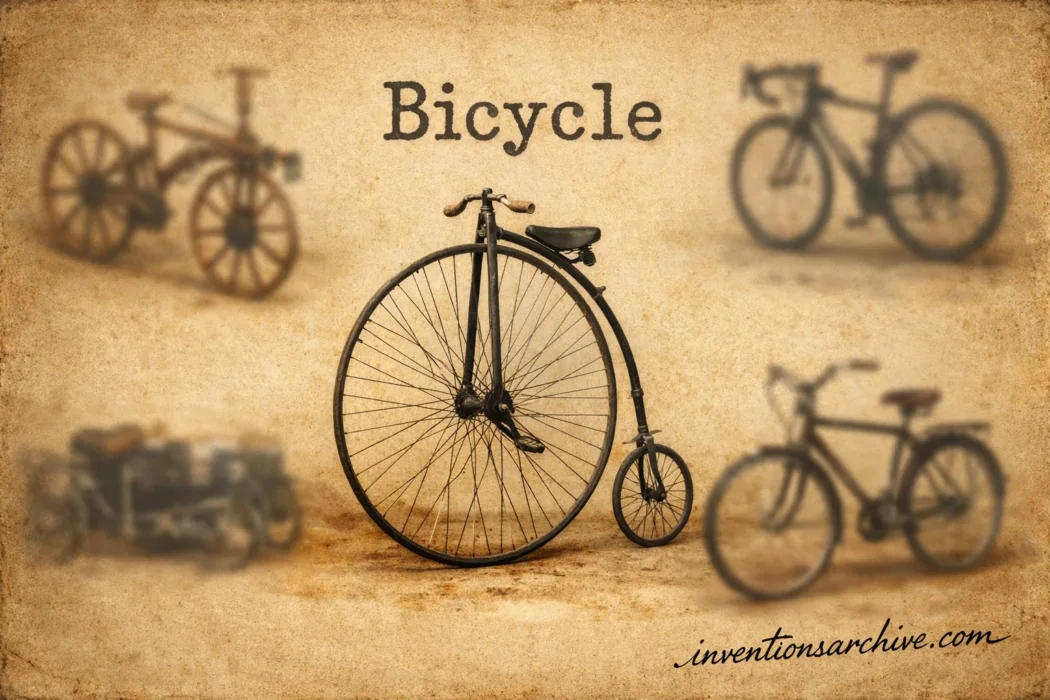
| Invention Name | Bicycle |
|---|---|
| Short Definition | A steerable two-wheeled vehicle propelled primarily by human power, usually through pedals and a mechanical drivetrain. |
| Approximate Date or Period | 1817 for the documented steerable two-wheeler; major pedal and drivetrain developments followed during the 1860s–1880s. |
| Geography | German states, France, Britain, and later other industrial regions worldwide |
| Inventor or Source Culture | Karl Drais is associated with the first documented steerable two-wheeler; later development involved Pierre Lallement, the Michaux workshop, James Starley, John Kemp Starley, John Boyd Dunlop, and many manufacturers. |
| Category | Transportation · Human-powered vehicle · Mechanical engineering |
| Importance | Created an inexpensive form of individual wheeled transport and established a vehicle layout that remains in widespread use. |
| Evidence Status | Developmental attribution No single inventor created every defining feature of the modern bicycle. |
| Main Problem Solved | Faster individual travel using human power without requiring a draft animal. |
| Development Path | Running machine → pedal velocipede → high-wheel bicycle → safety bicycle → pneumatic-tyred modern forms |
| Mechanical Principle | Balance and steering on two aligned wheels combined with human power transmitted through cranks, pedals, and usually a chain to the rear wheel. |
| Modern Descendants | Road, utility, touring, racing, mountain, cargo, folding, BMX, recumbent, and electrically assisted bicycles |
The Bicycle Was Developed in Stages, Not Invented in One Moment
The familiar bicycle combines several ideas that appeared at different times: two wheels arranged in line, steering, rider-controlled balance, mechanical propulsion, gearing, resilient tyres, effective braking, and a frame capable of carrying the rider without excessive weight. For that reason, asking who invented the bicycle has no completely satisfactory one-name answer.
The strongest starting point for its documented history is Karl Friedrich Drais’s Laufmaschine of 1817. Drais’s vehicle had two wheels arranged one behind the other and, most importantly, a steerable front wheel. The rider sat astride the machine and pushed against the ground with the feet. The Conservatoire national des arts et métiers identifies the draisine as the ancestor of the bicycle and notes that the older story of a French nobleman named Comte de Sivrac riding a supposed two-wheeled célérifère around 1790 was a later historical fabrication.[a]
This distinction matters because the Sivrac story appeared for decades in bicycle histories. Later investigation found that the documentary trail led instead to an 1817 privilege connected with a horse-drawn vehicle and that the supposed eighteenth-century bicycle had been introduced into the historical narrative much later. Drais’s running machine therefore provides the firmer documented beginning for the steerable, single-track vehicle that led toward the bicycle.
Drais Introduced the Essential Two-Wheel Steering Arrangement
Drais publicly demonstrated his running machine in Mannheim in 1817. The machine had a wooden structure, two wheels positioned in a single track, a saddle, and a pivoting front assembly that allowed the rider to choose direction while balancing. Unlike a carriage, it did not rely on lateral wheel spacing for stability. The rider had to keep the vehicle upright while moving.
That requirement established one of the bicycle’s defining characteristics. A bicycle is dynamically different from a tricycle or four-wheeled vehicle because the rider and machine can lean around the line connecting the tyre contact points. Steering is therefore connected with balance rather than being merely a way of pointing the vehicle in another direction.
The draisine still lacked pedals. Forward motion came from repeated contact between the rider’s feet and the road, closer in propulsion to a modern balance bike than to a pedal cycle. Examples and reproductions spread beyond the German states into France and Britain, where related machines became known by names including draisienne, hobby horse, and dandy horse.
The early enthusiasm did not immediately produce a permanent transport revolution. Road surfaces were poor, the machines offered limited comfort, and their practical advantages varied with local conditions. The basic idea nevertheless survived: a person could travel on two wheels in line while steering the front wheel and actively maintaining balance.
Pedals Changed the Machine From a Running Device Into a Cycle
The next major transformation occurred during the 1860s, when cranks and pedals were fitted directly to the front wheel of two-wheeled velocipedes. The exact priority is disputed. Accounts commonly connect the development with the Paris workshop of Pierre Michaux and with Pierre Lallement, who later moved to the United States. The surviving evidence does not justify reducing this stage to a simple claim that one person unquestionably invented the pedal bicycle.
Lallement’s U.S. Patent No. 59,915, granted on November 20, 1866, provides clear documentary evidence for a steerable two-wheel velocipede driven by cranks and treadles attached to the front wheel.[b] The patent drawing and description show the basic combination plainly: one wheel behind the other, a saddle, a steerable front assembly, and rider-operated cranks driving the front axle.
These pedal velocipedes solved one problem while creating others. The rider no longer had to push repeatedly against the road, but each full turn of the pedals produced only one rotation of a directly driven wheel. Speed was therefore closely tied to wheel circumference and pedalling rate. Many machines also used rigid wheels and tyres, which transmitted road irregularities directly to the rider. The resulting harsh ride contributed to the later nickname boneshaker.
Why the Front Wheel Became Enormous
Designers seeking greater speed from direct front-wheel drive faced a mechanical limitation. Without a separate gear train, increasing the distance travelled per pedal revolution meant increasing the circumference of the driven wheel. That logic encouraged the development of bicycles with a very large front wheel and a much smaller trailing wheel.
Advances in lightweight metal construction and wire-spoked wheels made such machines more practical. In 1871, James Starley of Coventry introduced the Ariel, an influential high-wheel bicycle using wire spokes. Similar designs became widespread and were later called ordinary bicycles. The American term high-wheeler and the later popular name penny-farthing describe the same general layout.[c]
The high wheel provided speed, but it placed the rider high above the ground and only slightly behind the front axle. That geometry made abrupt deceleration dangerous. If the front wheel struck an obstruction or stopped suddenly, the rider could pitch forward over the handlebars in the accident riders called a header.
The ordinary bicycle was therefore a technological branch with impressive performance but an awkward compromise. Its enormous driven wheel compensated for the absence of a multiplying drivetrain. Once designers could obtain suitable gearing through a chain and sprockets, there was no longer a mechanical need to place the rider above a wheel of such extreme diameter.
The Safety Bicycle Established the Modern Arrangement
During the 1870s and 1880s, manufacturers experimented with ways to lower the rider while retaining useful speed. The decisive direction was the rear-wheel-driven safety bicycle: pedals turned a crank near the middle of the frame, a chain carried motion to a sprocket on the rear wheel, and the front wheel remained responsible primarily for steering.
This separated pedal rotation from driven-wheel rotation. By choosing the relative sizes of the chainring and rear sprocket, designers could make the rear wheel rotate faster than the cranks. Large road wheels were no longer necessary simply to obtain useful gearing.
The Science Museum Group describes John Kemp Starley’s 1885 Rover as the first successful safety bicycle and notes that it possessed the defining features of standard bicycles, including chain drive and wheels of similar size.[d] The Rover was not the first low bicycle ever attempted, nor did the entire modern form appear unchanged in a single model. Its success showed, however, that the chain-driven safety arrangement offered a practical alternative to the ordinary.
Manufacturers continued refining frame geometry, steering, bearings, chains, brakes, saddles, wheel construction, and gearing. By the end of the nineteenth century, bicycles with two similarly sized wheels and rear chain drive had largely established the architecture still visible in conventional bicycles today.
| Development Stage | Typical Form | Mechanical Change |
|---|---|---|
| 1817 | Drais Laufmaschine | Two aligned wheels with front-wheel steering; propulsion by pushing against the ground |
| 1860s | Pedal velocipede | Cranks and pedals directly drove the front wheel |
| 1870s–1880s | Ordinary or high-wheel bicycle | A much larger driven wheel increased distance travelled per pedal revolution |
| 1880s | Safety bicycle | Chain transmission drove the rear wheel and allowed two wheels of similar size |
| Late 1880s onward | Pneumatic-tyred safety bicycle | Air-filled tyres improved rolling comfort and performance on uneven roads |
Pneumatic Tyres Removed One of the Bicycle’s Harshest Limitations
Early bicycles ran on wooden, metal, or solid-rubber wheel surfaces. Even after the safety layout lowered the rider, vibration and impact from rough roads remained serious limitations.
Related articles: Automobile (Benz Patent-Motorwagen) [Industrial Age Inventions Series], Dynamo (electric generator) [Industrial Age Inventions Series]
John Boyd Dunlop, a veterinary surgeon working in Belfast, developed a practical pneumatic tyre for cycles in 1888. National Museums Scotland preserves a prototype tyre donated by Dunlop and records that he developed the idea while trying to improve the ride of his son’s tricycle.[e] Air inside the tyre created a deformable cushion between the wheel and the road, reducing the direct transmission of small surface irregularities.
Dunlop should not be described as the first person ever to conceive a pneumatic tyre. Scottish engineer Robert William Thomson had patented an air-filled tyre decades earlier, including patents in France in 1846 and the United States in 1847. Dunlop apparently developed his cycle tyre without knowing about Thomson’s earlier work. Dunlop’s version arrived when the bicycle industry provided a market capable of making pneumatic tyres commercially useful.
The pairing of the safety bicycle with practical pneumatic tyres was especially effective. Low rider position addressed the danger of the high wheeler, chain gearing provided useful speed without an enormous front wheel, and air-filled tyres improved comfort and road contact. Those technologies helped turn the bicycle from a specialized sporting machine into practical personal transport.
How a Modern Bicycle Converts Pedalling Into Motion
On a conventional chain-driven bicycle, the rider applies force to pedals attached to crank arms. The cranks rotate a front chainring. A chain carries that rotation to a sprocket connected to the rear wheel, causing the bicycle to move forward when the tyre pushes backward against the road.
The ratio between the effective sizes of the front and rear sprockets determines how wheel rotation relates to crank rotation. A larger front chainring combined with a smaller rear sprocket produces more wheel rotation for each crank revolution, while a lower ratio reduces the distance travelled per crank turn but decreases the pedal force needed for a given resistance. Multi-speed drivetrains allow riders to change this mechanical relationship while travelling.
The freewheel or freehub mechanism found on most modern bicycles allows the driven wheel to continue rotating when the rider stops pedalling. Braking systems create controlled friction at the rim or a dedicated disc, depending on the design. The frame carries loads between the steering assembly, crank area, saddle, and rear wheel while keeping those components in the required geometric relationship.
Balancing a Bicycle Is More Complex Than the Gyroscope Explanation
A moving bicycle is often said to remain upright simply because its spinning wheels act as gyroscopes. Wheel rotation can affect bicycle dynamics, but research shows that gyroscopic action alone does not explain bicycle stability.
In a 2011 study published in Science, researchers from Delft University of Technology and Cornell University demonstrated a bicycle that could exhibit self-stable motion even when wheel gyroscopic effects were cancelled and conventional positive caster trail was removed.[f] Their result showed that mass distribution, steering geometry, steering-axis orientation, speed, and other interacting properties can produce self-stability.
A rider also maintains balance through steering. When the combined bicycle-and-rider system begins to lean, steering changes the path of the tyre contact points relative to the center of mass. During ordinary riding these corrections can be extremely small and largely automatic. Turning deliberately requires a coordinated relationship between steering and lean; a bicycle cannot negotiate an ordinary curved path while remaining perfectly vertical at useful speed.
This interaction between balance and steering was already embedded in Drais’s 1817 concept even though the mechanical explanation was developed much later. The defining invention was not merely the presence of two wheels. It was the creation of a steerable single-track vehicle that a rider could dynamically balance.
The Bicycle Changed Who Could Travel Independently
Once safety bicycles became affordable and reliable, cycling expanded rapidly during the 1890s. The machine provided personal mobility without the continuing expense of keeping a horse and without requiring a fixed railway route. It could serve commuting, delivery work, recreation, touring, and sport.
The bicycle also became part of broader debates over women’s independence and clothing. High-wheel machines had been especially restrictive, while low safety bicycles opened cycling to a much wider range of riders. During the 1890s, women rode safety bicycles in large numbers, and cycling became associated with practical dress reforms including divided skirts and cycling trousers.
The bicycle’s effect was visible in public infrastructure as well. In the United States, cyclists were active in the late nineteenth-century Good Roads Movement. The National Museum of American History records that the League of American Wheelmen distributed millions of tracts advocating road improvements.[g] Roads later associated mainly with automobile travel therefore had an earlier constituency among cyclists seeking smoother and more dependable surfaces.
From Bicycle Workshops to New Transport Industries
The late nineteenth-century bicycle industry required manufacturers to produce light structures, wheels, bearings, chains, tyres, brakes, and accurately fitted mechanical parts in large quantities. Bicycle factories became centers of mechanical experimentation, and several people who later worked in motor vehicles or aviation had direct connections with cycle manufacture.
Among the best-known examples were Wilbur and Orville Wright, who operated a bicycle sales and repair business in Dayton, Ohio, before their aviation experiments. Bicycle work did not by itself produce the airplane, but it formed part of the mechanical environment in which the brothers developed practical workshop skills and financed some of their aeronautical work.
The bicycle itself continued evolving without abandoning the safety bicycle’s general layout. Manufacturers introduced better bearings and brakes, freewheels, multi-ratio transmissions, lighter steel tubing, aluminum alloys, composite materials, suspension systems for rough terrain, specialized aerodynamic designs, and electric pedal assistance.
Modern road racers, city bicycles, mountain bikes, cargo bicycles, BMX machines, folding bicycles, and electric-assist cycles can look very different from one another. Most still preserve the nineteenth-century solution that proved durable: two approximately aligned wheels, a steerable front assembly, a rider positioned between them, and a mechanical system that converts human effort into wheel rotation.
Sources and Verification
- [a] 1817 : la draisienne – exposition virtuelle — Conservatoire national des arts et métiers material documenting Karl Drais’s 1817 machine and explaining why the older Comte de Sivrac célérifère story is not accepted as genuine bicycle history.
- [b] US59915A – Improvement in velocipedes — The surviving 1866 patent record for Pierre Lallement’s pedal-driven, steerable velocipede, including its drawings, claims, and mechanical description.
- [c] Rise of the Ordinary — Smithsonian bicycle collection history documenting James Starley’s Ariel, wire-spoked high-wheel bicycles, and the safety problems associated with the ordinary.
- [d] Rover ‘Safety’ Bicycle, 1885 — Science Museum Group collection record for John Kemp Starley’s 1885 Rover and its rear-wheel chain drive, similar-sized wheels, and relationship to the modern bicycle arrangement.
- [e] The Dunlop tyre: Air apparent — National Museums Scotland account of Dunlop’s surviving prototype, his 1888 work, and Robert William Thomson’s earlier pneumatic-tyre patents.
- [f] A bicycle can be self-stable without gyroscopic or caster effects — Bibliographic record and abstract for the 2011 Science study demonstrating that neither wheel gyroscopic action nor positive caster trail is individually necessary for bicycle self-stability.
- [g] Better Roads — National Museum of American History material documenting bicyclists’ role in the American Good Roads Movement and the League of American Wheelmen’s road-improvement campaign.