
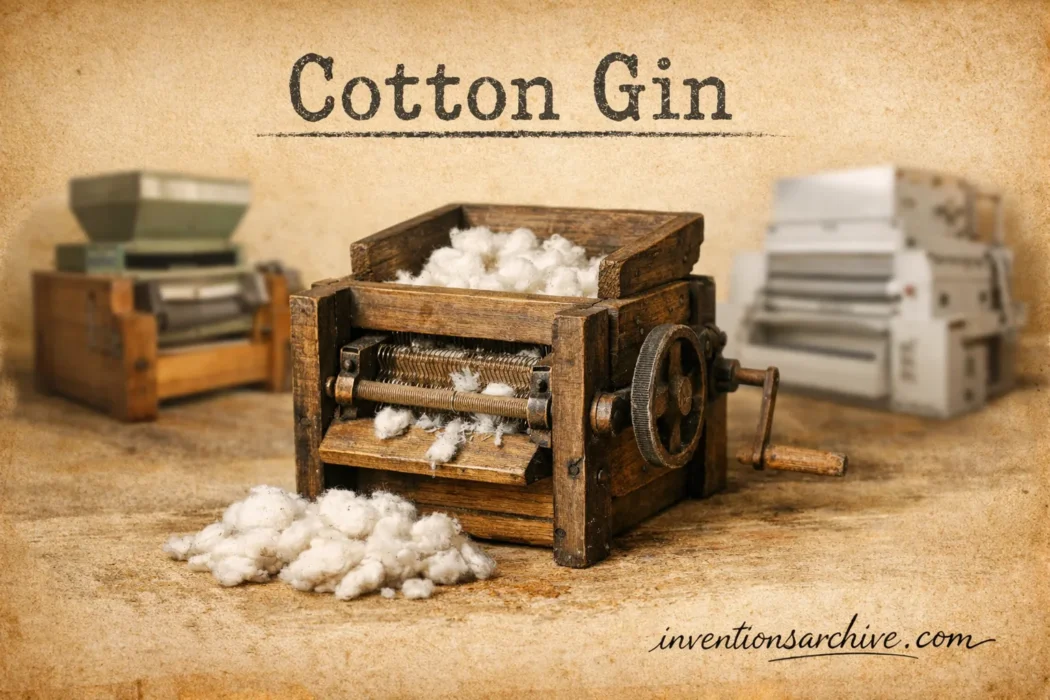
| Invention Name | Cotton Gin |
|---|---|
| Short Definition | A machine that separates usable cotton fiber, or lint, from cotton seeds. |
| Approximate Date or Period | Roller gins existed by at least the 5th century; Eli Whitney’s U.S. gin was patented in 1794; Hodgen Holmes patented a saw-gin improvement in 1796. |
| Geography | Early forms developed across the Old World; roller gins later reached the Americas. The best-known U.S. development occurred in Georgia. |
| Inventor or Source Culture | Multiple technological traditions; Eli Whitney patented a new U.S. spike-tooth form, followed by important improvements from Hodgen Holmes and other mechanics. |
| Category | Agricultural machinery; textile preparation; fiber-processing technology |
| Importance | Mechanized one of the major bottlenecks in preparing raw cotton for textile manufacture and reshaped cotton production on an industrial scale. |
| Evidence Status | Confirmed patent record Long pre-1794 development history |
| Main Problem Solved | Removing seeds from cotton fiber much faster than manual separation. |
| Development Path | Single-roller gin → double-roller or churka gin → Whitney spike-tooth gin → Holmes saw gin → improved saw and roller ginning systems |
| How It Works | Mechanical gripping or pulling elements separate flexible lint from seeds that cannot pass through the same restricted opening. |
| Main Historical Forms | Single-roller gin, double-roller gin, spike-tooth gin, saw gin, reciprocating-knife roller gin, modern high-capacity roller and saw gins |
The Cotton Gin Was Older Than Eli Whitney
The familiar story that the cotton gin suddenly appeared in Georgia in the 1790s compresses a much longer technological history. Machines for separating cotton fiber from seed had existed for centuries before Eli Whitney. Technical histories trace early single-roller gins to at least the fifth century, followed by more productive double-roller machines. The double-roller form often called the churka became an established cotton-processing technology and was in use in North America well before the end of the eighteenth century.[a]
These earlier machines generally worked by drawing cotton between closely spaced rollers. The soft fibers could pass through while the larger seeds were held back. That principle worked particularly well with cotton whose seeds separated relatively readily from the lint. It was less satisfactory for the varieties of upland cotton that became commercially important across the interior of the American South.
This distinction matters because Whitney did not invent the basic idea of mechanically ginning cotton. His achievement belongs to a later stage in the technology’s development: creating and patenting a different mechanism that attacked the difficult seed-removal problem presented by short-staple upland cotton.
Why Upland Cotton Created a Mechanical Bottleneck
Cotton harvested from the plant is not ready to spin. The fibers surround seeds and must be separated before the lint can move into cleaning, carding, spinning, weaving, and other textile processes. Manual seed removal was slow enough to restrict how much usable fiber could be prepared from varieties whose seeds clung tightly to the lint.
Long-staple cotton could be grown successfully in some coastal areas and was comparatively easier to clean with existing methods. Short-staple, or upland, cotton could grow across a much larger interior region, but separating its seeds efficiently was a harder engineering problem.
The commercial opportunity was therefore not simply to make a cotton gin. Cotton gins already existed. The problem was to create a machine that could process the abundant upland crop rapidly enough to change its economics.
Whitney’s 1793 Machine and the 1794 Patent
Eli Whitney encountered the cotton-processing problem after arriving in Georgia in 1792. While staying in the environment of Catharine Greene’s Mulberry Grove plantation, he began developing a machine for cleaning upland cotton. The resulting design was patented on March 14, 1794. The National Archives preserves the restored patent drawing and records Whitney’s machine as a device designed to separate cotton fiber from seed.[b]
The word gin itself is a shortened form of engine. Whitney’s machine departed from the older roller approach. Instead of depending primarily on squeezing cotton between rollers, a rotating cylinder carried rows of wire teeth or hooks. These caught the lint and drew it through narrow openings. The cotton fibers could pass through those openings, while the much larger seeds remained behind.
The Clearing Brush Was Essential to Continuous Separation
Pulling lint away from seed solved only part of the problem. Once the fiber had been captured by the rotating teeth, it also had to be removed from them efficiently. A rotating brush or clearer swept the lint from the teeth so that the cylinder could continue operating instead of rapidly becoming clogged.
The interaction among the toothed cylinder, restrictive openings and clearing mechanism was the important mechanical combination. Rather than treating each seed individually, the machine repeatedly exploited the physical difference between flexible fibers that could be drawn through a narrow space and seeds that could not.
Contemporary descriptions credited a Whitney-type gin with cleaning as much as roughly fifty pounds of cotton in a day under favorable conditions, compared with the extremely small quantity that could be separated manually. Such figures should be read as historical capacity claims rather than universal performance specifications, but they show why mechanized ginning attracted immediate attention.[b]
Holmes and the Rise of the Saw Gin
The machinery associated with the mature American saw gin was not frozen in the form shown in Whitney’s 1794 patent. Mechanics quickly altered it. One of the most important was Hodgen Holmes of Georgia, who received a cotton-gin patent on May 12, 1796. The surviving patent record is cataloged as U.S. X115.[c]
Holmes replaced the earlier style of projecting teeth with toothed circular saws and helped turn ginning into a more continuous process. Cotton-ginning histories distinguish Whitney’s spike-tooth machine from Holmes’s continuous-flow saw gin, and the saw principle eventually became the dominant method for processing upland cotton.[a]
This progression is one reason the phrase “Whitney cotton gin” can be misleading when applied to every later saw gin. Whitney’s patent was a major event in the development of the American machine, but the commercial technology continued changing through the work of Holmes and many other mechanics, manufacturers and operators.
The Patent Was Easier to Copy Than to Monetize
Whitney entered the enterprise with Phineas Miller, who had close ties to the Greene household and helped finance the project. Instead of simply selling machines, Whitney and Miller initially planned to operate gins and receive a portion of the cotton processed through them. Growers resisted the arrangement, while the relative mechanical simplicity of the machine encouraged unauthorized copying.
The result was years of patent disputes. The National Archives records repeated efforts to defend Whitney’s rights and his later petition to Congress for renewal of the patent. His experience became an early American example of the gap between obtaining legal protection for an invention and successfully extracting income from it.[d]
By the time enforcement became more favorable, competing machines and modifications were already widespread. Whitney became famous for the gin, but the invention did not deliver the straightforward fortune he had once expected from it.
Related articles: Hot Air Balloon [Industrial Age Inventions Series], Power loom [Industrial Age Inventions Series]
Who Should Receive Credit for the Cotton Gin?
There is no historically sound reason to assign the entire cotton gin to one inventor. Roller gins existed for centuries before Whitney, and the machines used after the 1790s incorporated further changes made by other mechanics. The narrowest defensible attribution is that Eli Whitney patented a particular American cotton-ginning mechanism in 1794, while the broader technology had a much older and more distributed history.
Catharine Greene also belongs in the documented story. Whitney developed his machine while connected with Greene’s plantation household, and she and Phineas Miller supported the enterprise. Later accounts went further and argued that Greene suggested part of the mechanism. Other traditions have proposed contributions from enslaved people familiar with cotton processing. The National Archives acknowledges such competing claims but does not treat them as conclusively established replacements for Whitney’s documented patent attribution.[d]
The safest historical distinction is therefore between patent authorship, mechanical development, and the much older history of cotton-ginning practice. They are related questions, but they are not the same question.
Faster Ginning Changed the Economics of Enslaved Cotton Production
The cotton gin reduced labor in one narrow stage of production: separating seed from lint. It did not mechanically plant cotton, weed fields, pick ripe bolls or transport the crop. Once much larger quantities of harvested cotton could be cleaned efficiently, plantation owners had a stronger economic incentive to expand the amount of cotton under cultivation.
This had severe human consequences in the United States. The Library of Congress identifies the invention and rapid adoption of the cotton gin as one of the primary forces behind the renewed expansion of slavery around 1800. Short-staple cotton could be grown across large areas of the Deep South, and mechanized seed removal removed a processing constraint that had previously limited its profitability.[e]
The machine therefore illustrates an important feature of labor-saving technology: reducing labor per unit at one stage does not necessarily reduce total labor demand. When mechanization makes a commodity more profitable and greatly expands output, demand for labor elsewhere in the production system can increase.
That is what occurred across much of the cotton economy. More land was placed under cotton cultivation, production moved westward, and enslaved labor was forced into expanding plantation systems. Cotton also fed textile mills in the northern United States and Britain, linking plantation agriculture to a much larger industrial and commercial network.
The economic expansion was also connected with pressure for additional land in the South and Southwest. The rise of the cotton economy cannot be attributed to one machine alone—world textile demand, transportation, credit, land policy and other technologies all mattered—but faster ginning removed one of the crop’s most restrictive processing bottlenecks.
Saw Gins and Roller Gins Did Not Follow the Same Path
The spread of the saw gin did not make the roller gin obsolete for every type of cotton. Different cotton fibers respond differently to mechanical treatment. Saw ginning provided high capacity for upland cotton, while roller systems retained advantages where protecting longer, more delicate fibers mattered.
In 1840, Fones McCarthy developed a reciprocating-knife roller gin that became associated especially with long-staple cotton. Later roller-gin technology continued to evolve, including rotary-knife systems introduced in the twentieth century and high-speed roller designs developed much later. Modern cotton processing therefore preserves two broad mechanical families rather than a single unbroken line descending from Whitney’s machine.[a]
Modern saw gins process large quantities of upland cotton through banks of saws working with ribs, brushes, airflow and additional cleaning equipment. Industrial installations also perform tasks far beyond the seed-separation mechanism of an eighteenth-century gin, including drying, foreign-material removal, lint cleaning, conveying and bale preparation.
The fundamental separation problem, however, remains recognizable: recover valuable lint efficiently while controlling seed separation and fiber damage.
What Survives From the Early Machines
The original patent record has an unusual preservation history. Many early American patent records were lost in the Patent Office fire of 1836. Whitney’s cotton-gin drawing survives through the restored patent record held by the National Archives, allowing the patented configuration to be examined separately from later machines that are sometimes casually described as replicas of the “original” gin.
The National Museum of American History also holds a reproduction of a Whitney cotton-gin model. The Smithsonian describes it as a wood-and-metal reproduction representing the 1794 machine and notes the combination of rotating brushes and teeth used in seed removal.[f]
Later surviving machines document how far the technology moved beyond the small patent-era apparatus. A Pratt Manufacturing Company cotton gin in the Smithsonian collection, made in Alabama during the late nineteenth century, contains iron, wood and leather and represents the mature industrial manufacture of ginning machinery. Daniel Pratt’s company had become a major gin producer, selling machines across the United States and abroad by the nineteenth century.[g]
Placed beside the patent drawing and early models, such machines show why the cotton gin is better understood as a technological lineage than as a single immutable invention. Roller systems, Whitney’s patented mechanism, Holmes’s saw development and later industrial gins addressed the same basic separation problem with different mechanical solutions shaped by cotton variety, desired fiber quality, production scale and available power.
Sources and Verification
- [a] Development of the Cotton Gin — A technical history in the Journal of Cotton Science documenting early roller gins, the Whitney spike-tooth gin, Holmes’s saw gin, later roller systems and the continuing division between saw and roller ginning.
- [b] Patent for Cotton Gin (1794) — The U.S. National Archives record for Whitney’s March 14, 1794 patent drawing, with historical explanation of the machine’s purpose, operation and production context.
- [c] Cotton gin — Georgia Southern University’s early U.S. patent collection record for Hodgen Holmes’s May 12, 1796 cotton-gin patent, cataloged as X115.
- [d] Eli Whitney’s Patent for the Cotton Gin — National Archives educational material covering Whitney’s Georgia work, Catharine Greene and Phineas Miller, the patent dispute, copying of the machine and later requests for patent renewal.
- [e] Pre-Civil War African-American Slavery — Library of Congress historical material explaining the connection between widespread cotton-gin adoption, short-staple cotton production and the expansion of slavery in the antebellum United States.
- [f] Reproduction of Eli Whitney’s Cotton Gin Model — National Museum of American History collection record documenting a reproduction of Whitney’s machine, its wood-and-metal construction and its seed-separation mechanism.
- [g] Pratt Mfg. Co. Cotton Gin, Alabama; ca. 1876 — Smithsonian collection documentation for a surviving nineteenth-century Pratt gin and the later industrial development and international distribution of American cotton-ginning machinery.